
Pharmacology
Oral Anabolic Steroids - Episode 8: Why 17α-alkylation Changes Pharmacology
September 8, 2026
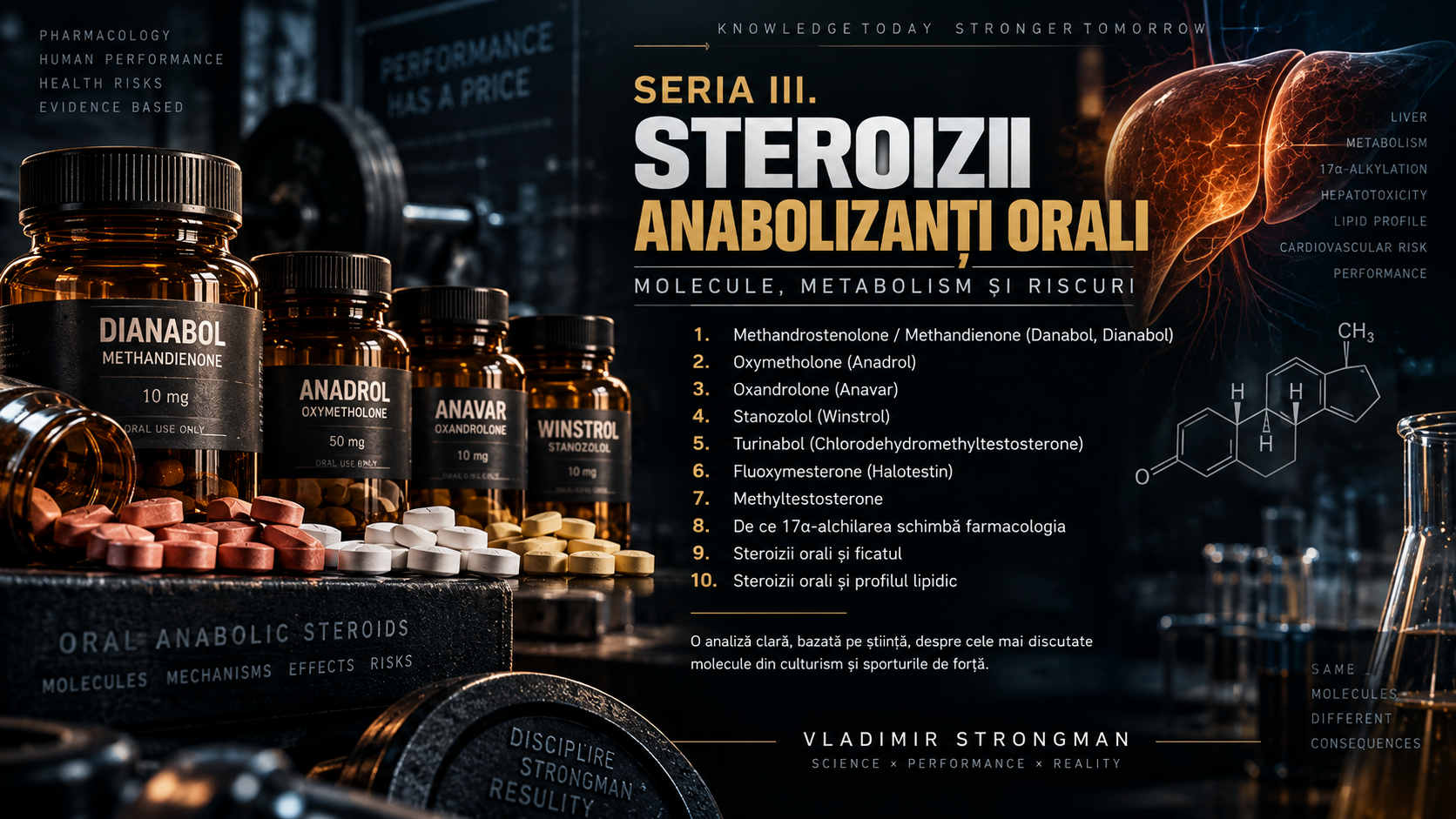
1. What is 17α-alkylation and why does it matter?
17α-alkylation is a chemical modification of the steroid nucleus in which a small group, usually a methyl group, is introduced at the 17-alpha position. In androgen pharmacology, this modification played a major role in developing molecules capable of producing systemic effects after oral administration.
The central idea of this episode is simple: the modification does not change only the molecule's shape. It changes how the body absorbs, metabolizes, and eliminates it. Chemistry therefore changes pharmacokinetics, and pharmacokinetics changes the overall safety profile.
2. Why is oral testosterone a problem?
Testosterone given orally is extensively metabolized, including during first-pass processing in the liver. A substantial fraction is handled before enough of the molecule reaches systemic circulation in an active form.
This is one reason oral derivatives were developed with structural changes that increase resistance to early metabolism. 17α-alkylation is one of those medicinal-chemistry strategies.
3. What does first-pass hepatic metabolism mean?
When a substance is swallowed, it passes from the gastrointestinal tract through the portal circulation to the liver before entering much of the systemic circulation. The liver can metabolize a substantial fraction of the compound, reducing the amount that remains available to the rest of the body.
This is the first-pass effect. It is very large for some drugs and smaller for others. For 17α-alkylated steroids, structural modification is one strategy for reducing degradation during this stage.
4. How does a 17α-methyl group change metabolism?
Adding a 17α-methyl group can increase resistance to certain hepatic metabolic reactions. It does not make the molecule impossible to metabolize; instead, a greater fraction can survive the initial processing.
That resistance is enough to turn a bioavailability problem into meaningful oral activity. But this is also where the pharmacological trade-off appears: helping the molecule survive first-pass metabolism can increase the importance of hepatic effects.
5. Bioavailability: how much of the molecule reaches systemic circulation?
Bioavailability is the fraction of an administered dose that reaches systemic circulation in a form available to produce effects. It depends on absorption, metabolism, and other pharmacokinetic processes.
For oral 17α-alkylated steroids, increased survival through first-pass metabolism contributes to sufficient oral bioavailability for systemic activity. This is the pharmacological advantage, not evidence that the molecule is safer.
6. Pharmacokinetics changes, not just the route of administration
When structure changes, plasma concentration, half-life, distribution, metabolism, and elimination can also change. That means 17α-alkylation may influence the concentration-time profile, not merely whether a drug can be swallowed.
Modern pharmacology looks at these relationships closely. A compound is defined not only by what it does at a receptor, but also by how long it remains present and where it reaches.
7. Pharmacodynamics versus pharmacokinetics
Pharmacodynamics asks what the molecule does to the body, such as activating the androgen receptor and changing gene expression. Pharmacokinetics asks what the body does to the molecule, including absorption, distribution, metabolism, and elimination.
17α-alkylation matters primarily through its influence on pharmacokinetics, but its consequences appear across the pharmacological profile. A molecule that reaches systemic circulation more effectively can produce clearer systemic effects and a different safety profile.
8. Why does the liver become central to the discussion?
The liver is one of the main organs responsible for drug metabolism. For a 17α-alkylated steroid, the fact that the molecule is designed to resist part of initial hepatic metabolism changes the relationship between the compound and the liver.
This does not mean every person will develop liver injury. It means that this chemical family has a structural reason for making hepatic safety an important topic.
9. Cholestasis: one of the distinctive risks
Some 17α-alkylated androgens are associated with cholestatic liver injury, in which bile flow is impaired. Cholestasis may present with jaundice, itching, and elevated bilirubin.
An important point is that clinical severity does not always correspond to dramatic AST and ALT elevations. Hepatic assessment therefore needs to be viewed as a pattern, not as two isolated numbers.
10. Why AST and ALT are not enough
AST and ALT are useful markers of hepatocellular injury, but they do not measure every aspect of liver function. Bilirubin, alkaline phosphatase, and GGT can add information about the pattern of injury.
Strength athletes add another complication: intense exercise can increase AST and sometimes ALT. Abnormal results therefore need to be interpreted alongside training history, CK, symptoms, and medical context.
11. 17α-alkylation and the lipid profile
The story does not stop with the liver. Androgenic steroids, including oral 17α-alkylated compounds, can alter lipoprotein metabolism, with lower HDL and unfavorable changes in LDL.
These effects matter because they usually do not produce immediate symptoms. An athlete can perform well while already having an unfavorable lipid profile.
12. HDL, LDL, and cardiovascular risk
HDL and LDL are only two parts of a broader cardiovascular picture. Still, persistent changes in an unfavorable direction can contribute to increased cardiovascular risk.
A highly athletic physique does not automatically protect against these changes. Muscle mass and conditioning are valuable, but they do not cancel pharmacological effects on lipid metabolism.
13. Blood pressure
Androgens can influence blood pressure through mechanisms involving fluid retention and changes in systems that regulate vascular tone and volume. Responses vary between individuals.
In strength sports this deserves extra attention because maximal effort already produces very large, transient increases in blood pressure.
14. The endocrine axis
An exogenous androgen can reduce activity of the hypothalamic-pituitary-gonadal axis through negative feedback. GnRH can fall, followed by lower LH and FSH, which can reduce endogenous testicular testosterone production and spermatogenesis.
This is independent of whether the molecule is oral or injectable. Route changes pharmacokinetics, but endocrine feedback responds to androgenic signaling and the resulting hormone environment.
15. Aromatization: not all 17α-alkylated steroids behave alike
17α-alkylation by itself does not determine whether a molecule aromatizes. Some compounds can enter the aromatase pathway, while others were structurally modified to reduce or prevent this conversion.
We therefore need to separate two ideas: 17α-alkylation mainly explains part of oral pharmacokinetics, while other structural changes help determine aromatization and receptor behavior.
16. Why hepatic risk is not an absolute rule
The presence of 17α-alkylation increases the importance of liver safety, but it does not allow an exact prediction for a specific person. Genetics, other medicines, alcohol, underlying liver disease, and individual variability all matter.
Pharmacology deals with mechanisms and probabilities, not individual certainties. A real risk can vary between people without being imaginary.
17. 17α-alkylation and molecular shape
Adding a group at carbon 17 changes the steric and electronic properties of the molecule. These changes can influence enzyme access, molecular orientation, and the way the compound is processed.
In medicinal chemistry, the exact position of a substituent can matter as much as the substituent itself. “Methyl” does not mean the same thing in every position.
18. Why can a small modification have a large effect?
Biological molecules interact with enzymes and receptors in three dimensions. A seemingly small structural change can alter shape, solubility, stability, and recognition by metabolic enzymes.
This is why testosterone derivatives are not merely “testosterone with another name.” Each structural change creates its own pharmacological profile.
19. 17α-alkylation does not create a steroid that is stronger in every sense
Better oral bioavailability does not automatically mean greater absolute androgenic activity in every tissue. Receptor potency, concentration, distribution, and local metabolism remain important.
This is important for athletes: a pharmacokinetic modification should not be translated into slogans such as “better at everything.”
20. Why can oral administration be more convenient and more problematic at the same time?
A tablet removes some practical issues associated with injections. But convenience is not a safety marker. For 17α-alkylated steroids, the advantage of oral administration is part of the same structural story that creates hepatic concerns.
Pharmacology contains many such trade-offs: a desired property is achieved through a modification that also changes other systems.
21. Why does 17α-alkylation appear so often in discussions of oral steroids?
Several orally administered androgenic steroids have used this structural strategy. Therefore, when you encounter an oral 17α-alkylated steroid, the first question should be about the relationship between bioavailability and hepatic metabolism.
That does not mean every molecule has an identical risk profile. The full structure matters, including substitutions elsewhere on the steroid nucleus and the ability to aromatize.
22. 17α-alkylation and effects on skin and hair
Skin and hair effects are driven mainly by androgenic activity and local tissue biology. 17α-alkylation is not the direct cause of acne or hair loss; it is part of the molecular architecture that allows systemic androgen exposure after oral administration.
Individual susceptibility matters. The same hormonal environment can produce very different skin responses in two people.
23. Why is the Strongman context relevant?
Strongman demands maximal strength, carries, stability, grip, repeated effort, and fatigue tolerance. That is why steroid discussions in the sport have long included claims about muscle mass, recovery, and intensity.
But 17α-alkylation is first and foremost a pharmacokinetic story. Performance cannot be inferred simply from the fact that a molecule is oral.
24. Deadlift, yoke, and log lift
A maximal deadlift depends on muscle mass, technique, motor-unit recruitment, and force production. The yoke demands stability and control while moving, while the log lift combines overhead strength with mobility and coordination.
None of these events can be explained by one chemical modification. Pharmacology can change the physiological environment, but sporting performance remains a system-level outcome.
25. How is 17α-alkylation connected to the reputation of “orals”?
Many athletes use “oral” as if it described a single functional class. In reality, it only describes the route of administration. Each compound's profile comes from its structure.
17α-alkylation is an important chemical clue, not a complete summary of a molecule. Each compound therefore needs to be understood on its own.
26. Why metabolic resistance is not the same as absence of metabolism
17α-alkylation increases resistance to certain metabolic processes, but the body still transforms and eliminates the molecule. The liver, peripheral enzymes, and kidneys continue to participate in its pharmacokinetic fate.
Understanding this difference prevents a common myth: “if the molecule is protected from the liver, it is no longer metabolized.” That is not the mechanism.
27. Why first-pass metabolism is not the only determinant
Oral bioavailability is only one part of the story. Intestinal absorption, transport, protein binding, tissue distribution, later metabolism, and elimination also matter.
This is why two 17α-alkylated molecules can still have very different pharmacokinetic and clinical profiles.
28. Hepatic monitoring: what questions matter?
In a medical context, assessment may include AST, ALT, GGT, alkaline phosphatase, and bilirubin, depending on the situation. Symptoms such as jaundice, itching, or dark urine immediately change the clinical relevance.
For athletes, training load and other substances also need to be considered. A result should not be interpreted in isolation or used to justify continued exposure.
29. Cardiovascular monitoring
Blood pressure, lipid profile, and cardiovascular history can be relevant. Depending on risk, a clinician may decide that additional evaluation is appropriate.
The same lesson appears again: silent effects can matter more than the ones you feel immediately.
30. Why normal tests do not mean zero risk
A laboratory panel is a snapshot, not a guarantee about the future. Risk depends on exposure, susceptibility, and how markers change over time.
A good result today does not prove that a structural modification is free of long-term consequences.
31. Anti-doping status
17α-alkylated anabolic steroids belong to the broader universe of prohibited anabolic agents in anti-doping regulations. For competition, the current official list for the relevant year should be checked directly with the competent anti-doping authority.
Forum posts and old lists can be outdated. In elite sport, anti-doping status should be treated as official information, not gym memory.
32. Why there is no “safe oral steroid” simply because the amount is small
Safety cannot be reduced to one variable and cannot be guaranteed by an arbitrary amount. Structure, duration of exposure, interactions, and individual susceptibility all contribute to risk.
For that reason, this series explains mechanisms and risks rather than providing administration or optimization schemes.
33. 17α-alkylation and the idea of pharmacological trade-offs
In pharmacology, almost every optimization is a trade-off. A molecule can gain metabolic resistance and oral activity while becoming more concerning from a hepatic or metabolic perspective.
That is why “more modern” or “more oral” does not automatically mean “better.” The right question is always: better for which property, and at what cost?
34. The medicinal-chemistry lesson
17α-alkylation is an elegant example of structure-activity relationships. Substitution at a precise carbon can change resistance to metabolism, bioavailability, and risk.
Once you understand that relationship, it becomes easier to see why methandrostenolone, oxymetholone, oxandrolone, stanozolol, and methyltestosterone are not interchangeable simply because all can be administered orally.
35. The pharmacology lesson
Pharmacology does not artificially separate benefit from risk. Receptor action, plasma concentration, exposure time, metabolism, and toxicity form a single clinical profile.
17α-alkylation demonstrates exactly this: a pharmacokinetic change can cascade into systemic effects and into the way the body handles the molecule.
36. What does this mean for an athlete?
For an athlete, the key lesson is not to confuse convenience of administration with safety and not to confuse oral activity with guaranteed performance.
17α-alkylation is a chemical tool that solves a bioavailability problem. It is not a certificate of sporting efficacy and not a shield against adverse effects.
37. What should be remembered?
17α-alkylation can increase resistance of a steroid to hepatic first-pass metabolism and allow oral activity. At the same time, this modification is associated with a hepatic and metabolic profile that deserves attention.
The most important concept is the trade-off: the same molecular architecture that helps pharmacokinetics can contribute to safety problems. There is no chemical magic, only biological consequences.
38. Conclusion
17α-alkylation changed the history of androgen pharmacology because it made relevant systemic activity possible for several molecules after oral administration. But to truly understand the modification, you must follow the whole chain: first-pass metabolism, bioavailability, metabolism, distribution, and adverse effects.
In a series about oral anabolic steroids, this may be the most important thread of all: chemistry and physiology are not separate stories. A single group placed at a precise position can change the way the body sees the entire molecule.
Selected sources
PubChem compound summaries for 17α-alkylated androgens; LiverTox, androgenic steroids and drug-induced liver injury; Endotext, Androgen Physiology, Pharmacology, Use and Misuse; pharmacology sources on oral bioavailability, first-pass metabolism, and hepatic drug metabolism; World Anti-Doping Agency, Prohibited List.
More From The Journal

Training
The Science of Strongman Training - Episode X: Competition Programming
How to build a complete Strongman competition preparation block: calendar, events, volume, intensity, specificity, simulations, autoregulation, tapering and fatigue management.

Training
The Science of Strongman Training - Episode IX: Peaking
Peaking in Strongman: how to turn months of training into maximal competition performance by reducing fatigue, preserving adaptations and managing specificity.