
Pharmacology
Oral Anabolic Steroids - Episode 5: Turinabol / Chlorodehydromethyltestosterone
September 8, 2026
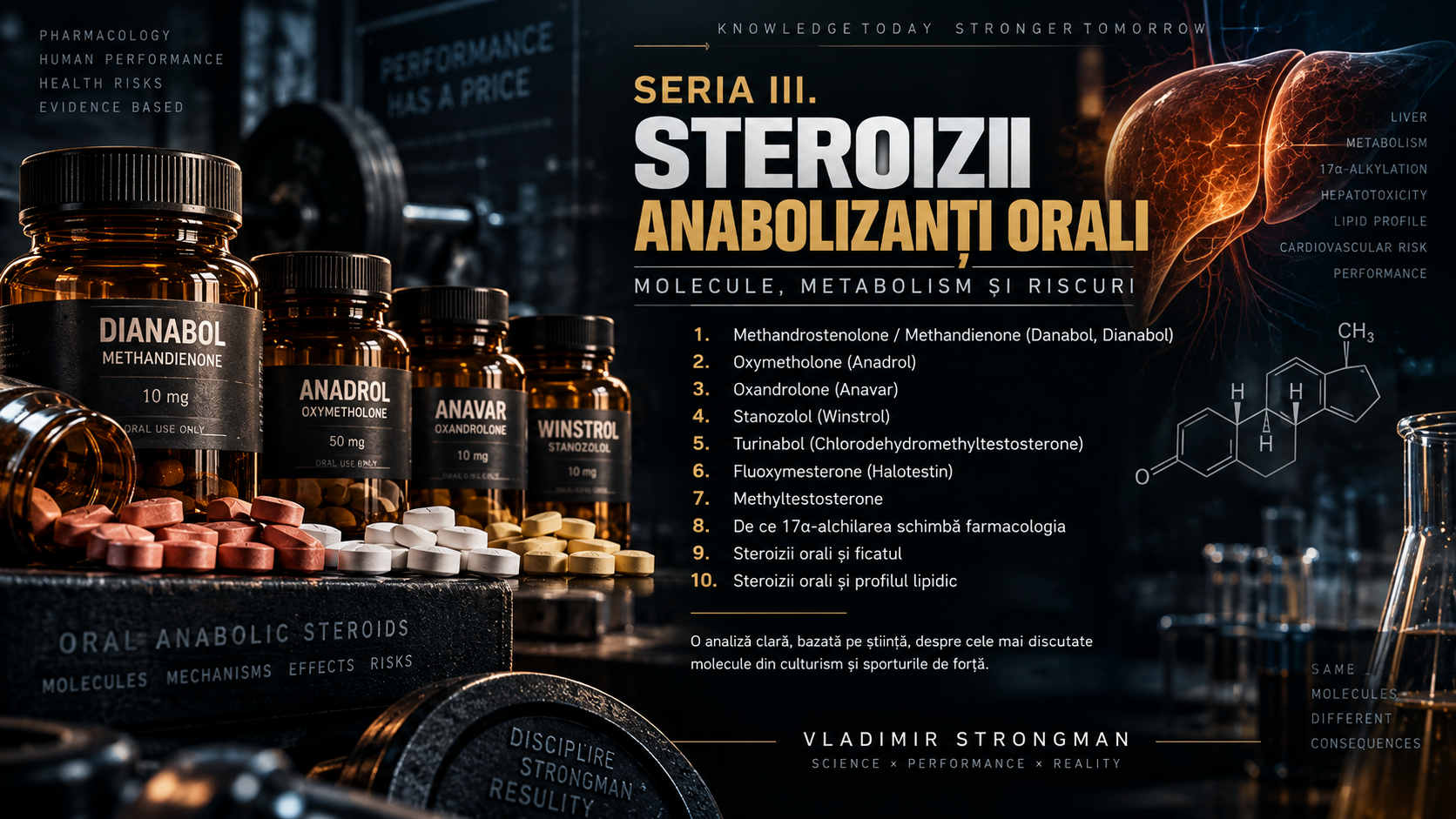
1. Why is Turinabol important in a series about oral steroids?
Turinabol, known as Oral-Turinabol and by the chemical name chlorodehydromethyltestosterone, is one of the interesting molecules in steroid pharmacology.
It is a useful example of the central idea of this series: a few structural changes to testosterone can alter oral activity, metabolism, receptor interactions, and risk.
2. What actually is Turinabol?
Turinabol is a synthetic anabolic-androgenic steroid. PubChem identifies it as 4-chloromethandienone and gives the molecular formula C20H27ClO2 and a molecular weight of about 334.9 g/mol.
The long name may sound intimidating, but the idea is simple: the steroid nucleus is modified at several key positions, and those changes create its own pharmacological profile.
3. Are Turinabol and Oral-Turinabol the same substance?
Yes, in the context of this discussion. Oral-Turinabol is the name used for the oral form of chlorodehydromethyltestosterone, while Turinabol is the shorter name used in sport and literature.
A trade or historical name does not change the chemical identity of the active molecule.
5. The 4-chloro modification, explained simply
Turinabol has a chlorine atom at carbon 4 of the steroid nucleus. This distinguishes it from methandrostenolone, which has a related structure but lacks that chlorine.
One atom can change the local shape of a molecule and the way enzymes recognize it. In pharmacology, small details can produce large differences.
6. The 1,4-diene: the link to methandrostenolone
Turinabol retains a 1,4-diene configuration also found in methandrostenolone. This is one reason the two molecules are structurally related.
But adding chlorine changes the profile and again shows that closely related structures are not automatically equivalent.
7. 17-alpha methylation and oral activity
Turinabol is 17-alpha methylated. This modification helps the molecule resist hepatic first-pass metabolism and remain active after oral administration.
Here we meet the same lesson as with other oral steroids: oral activity is created through a structural trade-off, not magic.
8. Oral does not automatically mean safe
The fact that Turinabol can be taken orally does not mean it is risk-free. Route of administration and toxicity are separate questions.
For 17-alkylated steroids, the liver must remain central to the discussion.
9. The androgen receptor: where the signal goes
Turinabol acts as an androgen and can activate the androgen receptor, an intracellular receptor that influences gene expression.
Receptor activation can alter processes related to protein synthesis and tissue function, helping explain anabolic effects.
10. Why the receptor is not a muscle button
The androgen receptor is present in multiple tissues. The same signal can therefore affect muscle, skin, reproductive tissues, and metabolism.
That is why a serious discussion of Turinabol has to look at the whole organism, not only performance.
11. Does Turinabol aromatize?
Turinabol is not considered an androgen that aromatizes through the classic aromatase pathway to estrogen. Its structure differs from testosterone in a way that prevents classic aromatization.
Therefore, it does not have the same direct estrogenic profile as an aromatizable androgen such as testosterone.
12. Why does lack of aromatization matter?
The lack of aromatization changes the molecule's relationship with estrogen biology, but it does not make Turinabol an endocrine-free steroid.
An exogenous androgen can suppress the hormonal axis even when it does not convert to estrogen.
13. Why is it sometimes called a 'dry steroid'?
In sports culture, 'dry' usually refers to less obvious water retention and a more defined appearance.
It is a gym term, not a medical diagnosis or a measure of health.
14. Scale weight versus muscle mass
If a steroid causes less water retention, scale weight may change less dramatically. That does not mean every change in body composition is new muscle.
Glycogen, water, muscle tissue, and fat all contribute to body weight and appearance.
15. Why is Turinabol's reputation different from Anadrol?
Anadrol is known for rapid changes in body weight and fluid retention. Turinabol has a reputation much less centered on dramatic water-weight gain.
These differences are useful for comparison, but they should not become a simplistic ranking of steroids.
16. Turinabol and oxandrolone
Oxandrolone and Turinabol are both oral and 17-alkylated, but their structures are different. Oxandrolone is a 2-oxa steroid, while Turinabol is 4-chloro and retains the 1,4-diene configuration.
Similar reputation does not mean chemical or pharmacological identity.
17. Turinabol and stanozolol
Stanozolol and Turinabol both have reputations as non-aromatizing oral steroids, but their structures are very different. Stanozolol contains a pyrazole system, while Turinabol carries the characteristic 4-chloro modification.
This shows why the terms 'dry' and 'oral' are not enough to describe a drug.
18. The liver: the major class issue
Turinabol is an oral 17-alkylated androgen, and this class is associated with liver injury and cholestasis.
The issue is not just a possible rise in ALT or AST. Biliary injury can have a different pattern and can become severe.
19. What is cholestasis?
Cholestasis occurs when bile formation, secretion, or flow is impaired. When bilirubin accumulates, the skin and eyes can become yellow.
Severe itching, dark urine, or jaundice are signs that require medical assessment.
20. Why are ALT and AST not the whole story?
ALT and AST are important markers, but they do not describe every type of liver injury on their own.
A clinician may therefore also consider bilirubin, alkaline phosphatase, GGT, and the overall clinical picture.
21. Lipids: the invisible risk
Oral anabolic androgens can affect the lipid profile, including HDL and other lipoproteins.
These changes may be completely symptom-free, making them easy for an athlete to ignore.
22. Why do HDL and LDL matter?
HDL and LDL provide information about cholesterol metabolism and cardiovascular risk. A mirror cannot show how the lipid profile has changed.
An athlete can look excellent while still having less favorable cardiovascular markers.
23. Blood pressure
Cardiovascular health is not only about cholesterol. Blood pressure is equally important.
The fact that Turinabol is not famous for massive visible water retention does not make blood pressure or cardiovascular risk irrelevant.
24. The hypothalamic-pituitary-gonadal axis
Turinabol is an exogenous androgen. Through negative feedback, increased androgenic signaling can reduce GnRH, LH, and FSH.
The result can include reduced endogenous testosterone production and impaired spermatogenesis.
25. Why does lack of estrogen not stop suppression?
Endocrine suppression is driven by exogenous androgenic signaling. The molecule does not need to become estrogen for negative feedback to occur.
Aromatization and suppression of the hormonal axis are two different questions.
26. Skin, hair, and other tissues
Androgenic activity can increase sebum production and promote acne. Hair effects depend on genetics and follicular sensitivity.
Again, the word 'dry' tells us little about the whole biology.
27. Why did Turinabol become interesting in sport?
Turinabol's sporting reputation developed around the idea of improved performance and lean tissue without spectacular changes in water weight.
That combination made it interesting in bodybuilding and other strength sports, but reputation is not the same as evidence of safety.
28. The connection with strength sports
In strength sports, an athlete may seek strength without a very large increase in body weight, especially when mobility and speed matter.
That gives Turinabol a different cultural profile from a molecule known for massive fluid retention.
29. But what does this mean for Strongman?
Strongman often rewards absolute strength, body mass, and stability. For that reason, Turinabol does not have the same historical reputation in Strongman as Anadrol or other compounds associated with rapid body-weight gain.
Still, not being the typical 'bulk' steroid does not mean it is absent from the broader world of strength sports.
30. Speed and mobility in Strongman
Some Strongman events require speed as well as strength: loaded sprints, medleys, farmer's walks, or yoke.
More body weight is not always beneficial if it reduces movement efficiency or conditioning.
31. Why can a 'dry' profile seem interesting to an athlete?
An athlete may sometimes prefer to avoid large fluctuations in water and body weight. That is an observation about sporting objectives, not a recommendation to use the drug.
Even in an open-weight sport, body mass has to be converted into functional performance.
This is one of the most dangerous mental shortcuts in gym pharmacology.
33. Anti-doping status
Turinabol is an anabolic agent prohibited by anti-doping rules. For tested athletes, that creates sporting consequences independent of the medical risks.
Anti-doping rules and medicine are two different filters, and both matter.
34. Why this is not a use protocol
The purpose of this series is pharmacological education. We explain structure, mechanism, metabolism, and risk rather than provide dosing schemes or methods for optimizing doping.
For a serious athlete, understanding biological consequences is more valuable than copying an internet plan.
35. What does Turinabol teach us about steroid chemistry?
Turinabol is chemistry in miniature: 17-alpha methylation favors oral activity, while the 4-chloro modification changes its profile compared with methandrostenolone.
A single atom or bond can change how the body recognizes and metabolizes a steroid.
36. What does it teach us about pharmacology?
Pharmacology asks what the body does to the molecule and what the molecule does to the body. Turinabol shows how structure, receptors, metabolism, and tissues connect.
Once you follow that path, complicated steroid names start to make sense.
37. What should an athlete remember about Turinabol?
Turinabol is a 17-alkylated oral androgen with a 4-chloro structure and no classic aromatization. Its reputation is linked to performance and less dramatic visible water changes than Anadrol.
But 'dry' does not mean 'safe'. Liver, lipids, blood pressure, and the hormonal axis remain part of the same story.
38. Conclusion
Turinabol, Oral-Turinabol, or chlorodehydromethyltestosterone is another example in which structural modification creates a molecule with its own identity.
In sport, its reputation as a non-aromatizing oral androgen with less visible water retention made it well known. In Strongman, its profile is less central than compounds associated with rapid mass gain, but it remains part of the wider history of strength sports.
The final lesson is simple: structure explains pharmacology, and pharmacology explains both the desired effect and the biological price.
Selected sources
PubChem. Oral-Turinabol, molecular structure, synonyms, and properties.
LiverTox, NCBI Bookshelf. Androgenic Steroids: liver injury, cholestasis, and metabolic effects.
World Anti-Doping Agency. Prohibited List 2026, S1 Anabolic Agents.
Handelsman DJ. Androgen Physiology, Pharmacology, Use and Misuse. Endotext, NCBI Bookshelf.
More From The Journal

Training
The Science of Strongman Training - Episode X: Competition Programming
How to build a complete Strongman competition preparation block: calendar, events, volume, intensity, specificity, simulations, autoregulation, tapering and fatigue management.

Training
The Science of Strongman Training - Episode IX: Peaking
Peaking in Strongman: how to turn months of training into maximal competition performance by reducing fatigue, preserving adaptations and managing specificity.