
Pharmacology
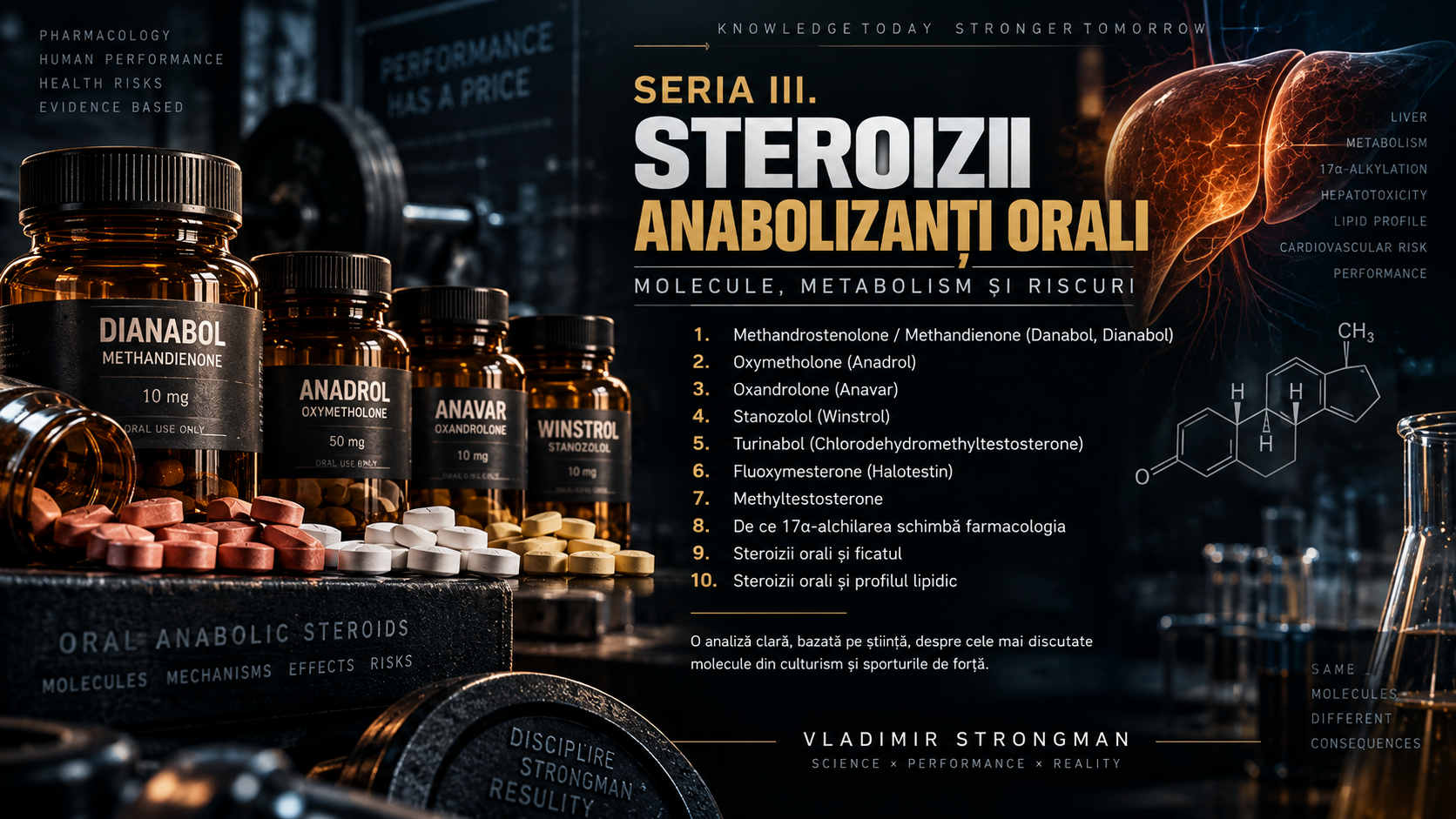
Oral Anabolic Steroids - Episode 2: Oxymetholone / Anadrol
September 8, 2026
1. Why is oxymetholone important in a series about oral steroids?
Oxymetholone, best known under the trade name Anadrol, is one of the molecules that has remained highly visible in the history of androgen pharmacology and in the culture of strength sports.
It is an excellent example of a central idea: a molecule cannot be understood by reputation alone. We have to look at structure, receptors, metabolism, fluid retention, and biological cost.
2. What actually is oxymetholone?
Oxymetholone is a synthetic anabolic androgenic steroid. PubChem describes it as a 3-oxo-5α steroid with the molecular formula C21H32O3 and a molecular weight of about 332.5 g/mol.
Like many compounds in this family, it retains the steroid nucleus and uses structural similarity to natural androgens to activate the androgen receptor.
3. Are Anadrol and oxymetholone the same thing?
In pharmacological terms, Anadrol is the trade name associated with oxymetholone. The trade name is the product label, while oxymetholone is the active molecule.
Online discussions often use the names interchangeably. In a scientific article, however, oxymetholone is the more precise term when discussing the molecule itself.
4. What makes it different from methandrostenolone?
Both are oral anabolic androgens and both belong to the C17-alkylated family, but their structures are not identical. Oxymetholone contains additional functional features that change the shape of the molecule and how it is metabolized.
That means we cannot turn the statement 'it is another oral steroid' into the conclusion 'it has the same effects.' In pharmacology, structural details matter.
5. 17-alpha alkylation: the key to oral activity
Oxymetholone is 17-alpha-alkylated. This modification helps the molecule resist hepatic first-pass metabolism and therefore remain active after oral administration.
But the same structural feature that solves a bioavailability problem also contributes to why the liver becomes an important site of risk.
6. Oral does not mean gentle
A common misconception is that a tablet is automatically easier on the body than an injectable steroid. Route of administration is not a direct measure of toxicity.
With oxymetholone, oral activity is linked to a structural change that alters its relationship with the liver. That is why oral availability must be discussed together with hepatotoxicity.
7. Where does oxymetholone act?
Oxymetholone acts primarily through the androgen receptor, an intracellular receptor that can alter gene expression after an androgen binds to it.
Androgenic signaling can influence protein synthesis and the function of several tissues. That is why the effects do not stop at skeletal muscle.
8. The androgen receptor is not a strength button
Activation of the androgen receptor starts a chain of cellular events. The final result depends on tissue, exposure, metabolism, and the other hormonal signals present.
That is why the same drug class can affect muscle, skin, reproductive tissues, and metabolism at the same time.
9. Why did oxymetholone become famous for size and strength?
Oxymetholone has a strong reputation in strength sports for rapidly changing body weight and supporting the ability to perform very intense work. That reputation eventually became much larger than the medical purpose for which the drug was developed.
But sporting reputation must be separated from clinical evidence. A molecule can be associated with performance and still carry important adverse effects.
10. What does strength actually mean here?
Strength is the result of the nervous system, muscle mass, technique, biomechanics, available energy, and hydration status. A steroid does not produce strength through one isolated mechanism.
With oxymetholone, changes in body mass and the anabolic environment may contribute to performance, but that does not mean that every kilogram gained is new contractile muscle tissue.
11. Fluid retention: why the scale can move quickly
Oxymetholone is associated with sodium and fluid retention. Drug labeling for this androgenic class lists edema and electrolyte retention as possible adverse reactions.
For a strength athlete, this can produce a rapid change in body weight. What appears on the scale is a mixture of tissue, glycogen, water, and other components.
12. Why can water affect performance?
Body mass affects leverage, positioning, and stability in many strongman events. A change in body mass can alter those mechanical relationships even when it does not come entirely from muscle.
That does not make fluid retention equivalent to muscle. It simply means that body weight is part of the biomechanical equation of the sport.
13. This is where the Strongman story begins
Strongman is a sport in which body mass, absolute strength, and the ability to repeatedly produce force are especially important. Because of that, any compound associated in sports culture with rapid increases in body weight and strength has developed a strong reputation.
Anadrol became part of that story and has long been associated in strength-sport culture with strongman preparation. That is a historical and cultural point, not a recommendation for use.
14. Why was it attractive to Strongman athletes?
In a sport built around very heavy objects, carries, lifts, and events where absolute body mass can matter, a compound associated with rapid gains in body weight and force production could appear attractive.
Anadrol entered that narrative because of its reputation for fast changes in weight and performance. That explains the popularity; it does not make the drug medically safe.
15. Strongman and the difference between body weight and functional mass
In Strongman, body weight can help with stability, leverage, and absolute force production, but not every kilogram has the same functional value.
An athlete still has to carry that mass, move with it, and control it. That is why body composition and the quality of muscular mass remain relevant even in an open class without a bodyweight limit.
16. Atlas Stones, yoke, and farmer's walk: where does weight matter?
Events such as Atlas Stones, yoke walks, and farmer's carries require not only strength but also control of the center of mass and the ability to stabilize the trunk.
Greater body mass can change those mechanical relationships, but it does not automatically make an athlete a better competitor. Technique, conditioning, and the ratio between strength and body mass remain critical.
17. Log lift and overhead events: body weight has two sides
In overhead events, body mass can contribute to stability and positioning, but excess fluid can also add strain to the cardiovascular system.
This shows the contradiction clearly: the same change that may look useful from a sporting perspective can carry a physiological cost.
18. Why the liver is the central issue
Oxymetholone is one of the compounds for which the literature on anabolic androgens explicitly discusses liver injury and cholestasis. LiverTox includes oxymetholone among androgens associated with hepatic abnormalities and describes characteristic risks of the C17-alkylated class.
That is why 'it is only a tablet' is a misleading statement. Oral administration does not remove the liver problem.
19. What is cholestasis?
Cholestasis means that bile formation, secretion, or flow is impaired. Bile is important for the handling of several substances and for fat digestion.
When bile flow is disturbed, bilirubin can rise and the skin and whites of the eyes can become yellow. Severe itching and other symptoms may occur as well.
20. Why can liver enzymes sometimes look less dramatic than expected?
In cholestatic injury, transaminases may be less dramatic than someone expects if they are thinking only about acute hepatitis.
LiverTox describes cases in which jaundice can be severe and prolonged while some enzyme elevations are only moderate. That is why symptoms and laboratory markers must be interpreted together.
21. Edema and electrolyte retention
Drug labeling for anabolic androgenic agents includes sodium and water retention and edema among possible adverse effects. For an athlete, this can mean a visible change in weight and appearance.
For the body, however, extra fluid is not free. In vulnerable people, fluid retention can worsen cardiovascular or renal problems.
22. The heart does not see only muscle
When an athlete gains a large amount of body mass, the cardiovascular system has to supply that larger body. If fluid retention and changes in blood pressure or lipids are added, the cardiovascular story becomes more important.
This is one reason steroid assessment has to leave the gym floor and include the health of the whole organism.
23. Lipids: a risk you cannot see in the mirror
Anabolic androgens can alter the lipid profile. For this class, reductions in HDL and other changes may contribute to higher atherosclerotic risk.
The problem is that these changes can happen without pain or an obvious warning signal. An athlete may perform extremely well while simultaneously having a less favorable cardiovascular profile.
24. Why does HDL matter?
HDL participates in reverse cholesterol transport. It should not be reduced to a simplistic good-or-bad label, but it remains part of the lipid profile used to assess cardiovascular risk.
When the lipid profile worsens, the biological problem is real even if performance has not changed that week.
25. The hormonal axis is still part of the equation
An exogenous androgen sends a signal that the endocrine system interprets. Through negative feedback, GnRH, LH, and FSH can be suppressed.
This can reduce endogenous testosterone production and impair spermatogenesis. In other words, an effect on muscle comes with an effect on the hormonal system.
26. Why can natural testosterone fall?
The hypothalamus and pituitary do not ask whether the androgen came from a gland or from outside the body. They respond to the hormonal signal that is present.
When that signal becomes sufficiently high, the command for internal production can be reduced. This is the basic principle of endocrine negative feedback.
27. Skin, hair, and androgen-sensitive tissues
Androgens can increase sebaceous gland activity and favor acne. Hair effects depend on genetic predisposition and follicular sensitivity.
These are not merely cosmetic details. They show that androgen receptors are active in many tissues, not only muscle.
28. Is oxymetholone the same as DHT?
No. Oxymetholone is a distinct molecule with its own structure and metabolic profile. Being an androgen does not make it dihydrotestosterone.
Structural differences are why we cannot predict the profile of one steroid simply by looking at another steroid relative.
29. What about aromatization?
Oxymetholone has a different structure from testosterone and should not be treated as though it automatically follows the same aromatization pathway. Its biological profile has to be discussed in relation to its specific structure and metabolites.
The important point is that oral activity, aromatization, and hepatotoxicity are three separate questions, even though they all start with the same molecule.
30. Why is oxymetholone often called a 'wet' steroid?
In sports jargon, 'wet' usually refers to an appearance and weight gain associated with water retention. It is a cultural sports term, not a medical term.
For a scientific article, it is more accurate to discuss sodium and water retention, changes in body weight, and changes in body composition.
31. Why did Strongman amplify its reputation for strength?
Strongman emphasizes absolute strength, very heavy loads, and events where body mass and the ability to produce force are highly relevant. In that environment, the reputation of a compound for rapidly increasing weight and performance can easily become amplified.
Historical reputation, however, is not the same as evidence that a drug is safe or appropriate for sport.
32. Use in Strongman: what can we responsibly say?
Oxymetholone has long been associated in Strongman culture with strength preparation and gaining body mass. It is a familiar part of the historical conversation around strength sports, but details about what any individual athlete used, when, and in what amount are often anecdotal rather than controlled medical data.
A serious article should therefore separate documented pharmacology from stories told around the sport.
33. Why this article does not become a dosing protocol
Explaining pharmacology means explaining mechanism and risk. Turning that information into a step-by-step administration guide would be a different kind of content and is not the purpose of this series.
For a Strongman reader, the real value is understanding why the molecule became popular and what biological problems come with it.
34. What does oxymetholone teach us about 'anabolic'?
Anabolic describes tissue-building and tissue-maintaining effects. It does not mean 'without adverse effects' and it does not mean 'muscle only'.
With oxymetholone, anabolic signaling overlaps with hepatic, lipid, endocrine, and fluid-retention effects.
35. What does it teach us about steroid chemistry?
The molecule shows again that small structural changes can produce very different pharmacological profiles. It is not enough to say that two substances are oral or C17-alkylated.
The full arrangement of atoms matters, as does the way that structure is recognized by enzymes and receptors.
36. What does it teach us about sports medicine?
Sports medicine has to hold performance and health together. A change that helps in the short term can create consequences that appear later.
With oxymetholone, liver health, lipids, blood pressure, fluid retention, and the hormonal axis are all parts of the same story.
37. What should a Strongman athlete remember about Anadrol?
Anadrol is not simply a 'strength pill'. It is an oral anabolic androgen with a structure that permits systemic activity, but it also belongs to a class associated with significant hepatic and metabolic risks.
Its reputation in Strongman has a cultural and physiological explanation: rapid changes in body mass and perceived strength are highly attractive in a sport built around absolute strength. Attraction, however, is not the same as safety.
38. Conclusion
Oxymetholone is almost a perfect example of the philosophy of this series: change the structure, change the path of the molecule through the body, and you create a new biological profile.
Anadrol became famous in strength sports and has long been associated with Strongman, body mass, and strength. Behind that reputation is a C17-alkylated androgen with documented hepatic and metabolic concerns and endocrine effects that cannot be ignored.
The lesson for the reader is simple: do not judge the molecule only by what it can do on the platform. Judge it also by what it can do to the liver, cardiovascular system, lipids, and hormonal axis.
Selected sources
PubChem. Oxymetholone, molecular structure and properties.
LiverTox, NCBI Bookshelf. Androgenic Steroids: hepatotoxicity, cholestasis, and clinical effects.
World Anti-Doping Agency. Prohibited List 2026, S1 Anabolic Agents.
Handelsman DJ. Androgen Physiology, Pharmacology, Use and Misuse. Endotext, NCBI Bookshelf.
More From The Journal

Training
The Science of Strongman Training - Episode X: Competition Programming
How to build a complete Strongman competition preparation block: calendar, events, volume, intensity, specificity, simulations, autoregulation, tapering and fatigue management.

Training
The Science of Strongman Training - Episode IX: Peaking
Peaking in Strongman: how to turn months of training into maximal competition performance by reducing fatigue, preserving adaptations and managing specificity.