
Pharmacology
Oral Anabolic Steroids - Episode 1: Methandrostenolone / Methandienone (Danabol / Dianabol)
September 8, 2026
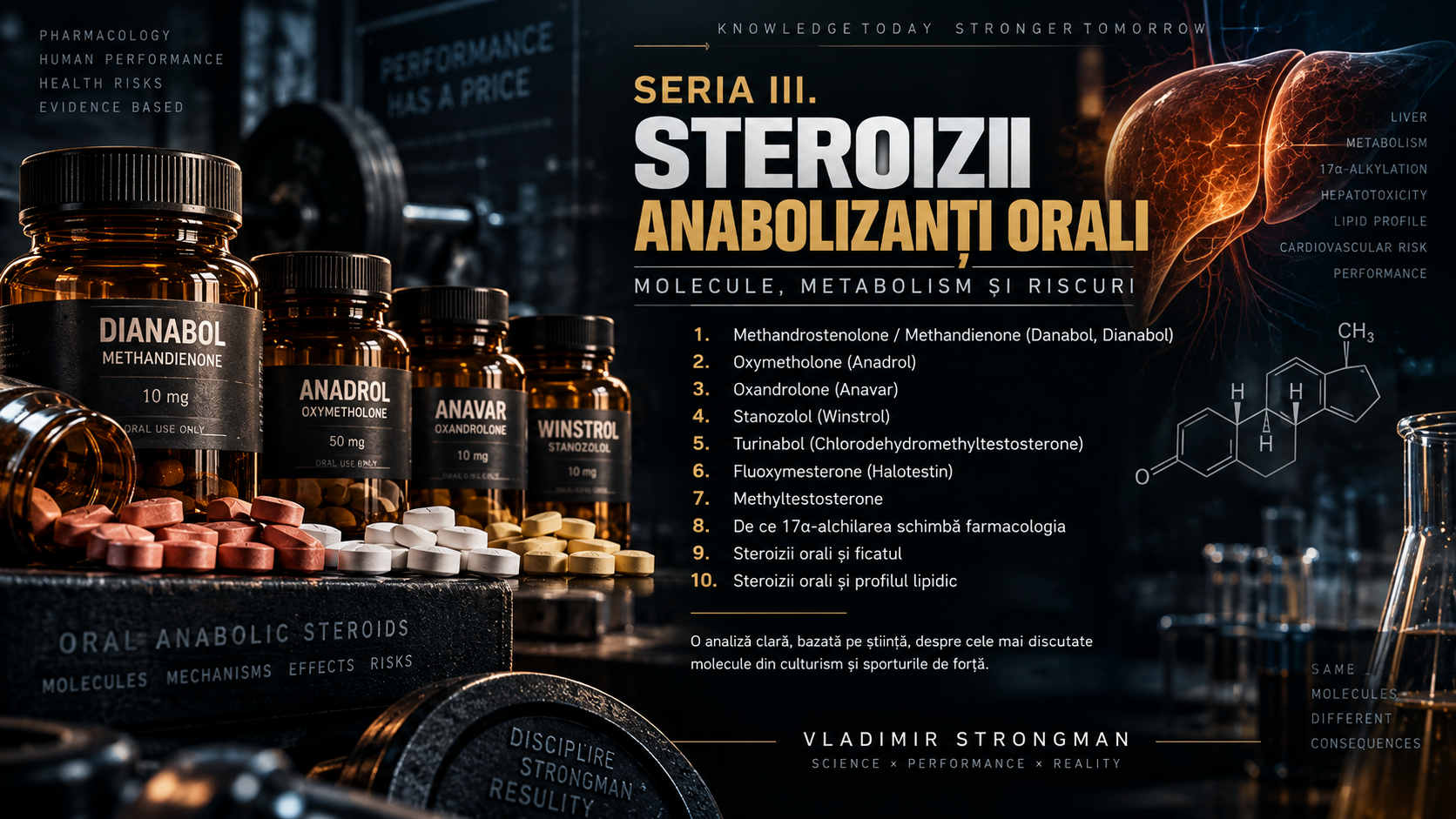
1. Why are we starting with methandrostenolone?
Methandrostenolone, also called methandienone, is one of the classic molecules in the history of oral anabolic steroids. The trade names Dianabol and Danabol are much more familiar to the public than the chemical name, but understanding the molecule starts with structure, not gym reputation.
It is an excellent example of a principle that will appear throughout this series: a few structural changes to testosterone can alter route of administration, metabolism, aromatization, and risk profile. PubChem identifies methandrostenolone and methandienone as synonyms and gives a molecular formula of C20H28O2 with a molecular weight of about 300.4 g/mol.
2. What is methandrostenolone?
Methandrostenolone is a synthetic anabolic androgen built on a steroid framework closely related to testosterone. The chemical name sounds complicated, but the idea is simple: the molecule keeps the basic architecture of testosterone and adds modifications that change how the body handles it.
These changes do not make it unrelated to the testosterone family. Its structural similarity helps explain androgen receptor activity, while the differences explain why it can be orally active and why its metabolic profile is different.
3. Are Danabol and Dianabol the same molecule?
In essence, those trade names refer to methandrostenolone or methandienone when used for this active ingredient. Differences can reflect brand, manufacturer, or presentation rather than a fundamentally different pharmacology.
In this series, the trade name is simply the label on the box. The molecule is the real subject.
4. The first major modification: 17-alpha alkylation
Methandrostenolone is a 17-alpha-alkylated androgen. That means the steroid structure carries a modification at carbon 17 that increases resistance to certain hepatic processes involved in first-pass metabolism.
Put simply, the molecule is designed to avoid being destroyed too quickly by the liver after oral administration. That same structural strategy, however, is associated with important hepatic and metabolic costs.
5. Why does plain testosterone behave differently by mouth?
Orally administered testosterone is subject to substantial hepatic metabolism. A large portion is transformed before enough active hormone reaches the systemic circulation. 17-alpha alkylation is one historical strategy used to increase oral bioavailability of androgens.
This is one of the clearest demonstrations of the relationship between chemistry and pharmacology: change one position of the molecule and you change its path through the body.
6. First-pass metabolism, explained simply
After a medicine is swallowed, it does not simply enter the blood and start working. Much of what is absorbed from the intestine first travels through the liver. This is first-pass hepatic metabolism.
Some molecules are transformed so efficiently that only a small fraction reaches systemic circulation. Methandrostenolone was modified to resist this process better and remain orally active.
7. Hepatic resistance does not mean hepatic protection
This is a very common misunderstanding. A molecule being resistant to hepatic metabolism does not mean that it protects the liver. The two ideas are almost opposites.
For C17-alkylated androgens, the advantage of oral activity comes with a more difficult hepatic profile. Methandienone belongs to the class in which cholestasis and other forms of liver injury are documented clinically.
8. The basic structure and its relationship to testosterone
Methandrostenolone retains the steroid nucleus of the androgen family and the 17-beta-hydroxyl group important for androgenic activity. At the same time, it contains an additional double bond compared with testosterone and a methyl modification at C17.
The differences may look small on paper, but the body recognizes molecules in three dimensions through precise interactions with enzymes and receptors.
9. What does anabolic androgenic actually mean?
Androgenic means that a molecule can produce effects associated with androgen signaling. Anabolic refers to tissue-building and tissue-maintaining processes. In reality, the two categories overlap and cannot be perfectly separated by a chemical switch.
Methandrostenolone can activate the androgen receptor and, through that pathway, influence gene expression and cellular processes. Effects depend on tissue, concentration, and physiological context.
10. The androgen receptor: where the signal goes
The androgen receptor is an intracellular protein that acts as a sensor for androgens. When an androgen binds to it, the receptor can influence gene activity inside the cell.
That is why a steroid does not simply 'build muscle directly.' It changes cellular signaling, and the body responds through processes that can influence proteins, tissues, and metabolism.
11. Why receptor binding is not the final effect
Receptor binding is only one stage. It also matters how much drug reaches a tissue, how long it remains there, which cofactors are available, and what other hormonal pathways are active.
That is why two molecules that activate the same receptor can still have different profiles of effect and risk.
12. What happens with aromatization?
Methandrostenolone should not be grouped with DHT-derived steroids that are structurally unable to aromatize. The molecule can participate in estrogen-related pathways, and pharmacological literature places it among androgens with a relationship to aromatization.
This matters because androgenic effects do not occur in isolation. Part of the biological profile can depend on metabolism and the balance between androgenic and estrogenic signaling.
13. Why does aromatization matter?
Estradiol is not simply a 'female hormone.' In men it has important physiological roles in bone, sexual function, the brain, and other tissues. Changing the balance between testosterone, its metabolites, and estrogens can therefore produce effects in several directions.
With an exogenous androgen, an increase in androgenic signaling alone does not tell the whole story of what happens to the hormonal system.
14. The androgen receptor is not a 'muscle button'
Androgen receptors are found in many tissues. That is why the same molecule can affect muscle, skin, hair follicles, reproductive tissues, and other systems.
This is a key idea for the entire series: when you modify testosterone, you modify a broad biological signaling system, not just athletic performance.
15. Why did methandrostenolone become famous in sport?
The molecule became well known because it combines androgenic activity with oral administration and a pharmacological profile that can substantially alter systemic androgen exposure. In fitness culture, this combination helped build a reputation for increasing size and strength.
But sports reputation should not be mistaken for a complete clinical profile. A drug can produce a desired performance effect while also affecting the liver, lipids, and endocrine axis.
16. Body weight is not the same as muscle mass
Androgens can influence sodium and water retention, glycogen, and other components that affect body weight. A change on the scale cannot automatically be interpreted as an increase in contractile muscle tissue.
In sport, the scale and the mirror tell only part of the story. Body composition, performance, and health markers are different things.
17. Why must the liver be discussed in episode one?
For oral C17-alkylated steroids, the liver is one of the most important topics. The issue is not simply an increase in enzymes. Bile-flow disorders and patterns of liver injury can occur that do not look like the classic picture of severe hepatitis.
LiverTox notes that C17-alkylated androgens can cause cholestasis that is sometimes severe and prolonged.
18. Cholestasis without the jargon
The liver produces bile, and bile has to flow through the biliary system. When bile formation, secretion, or flow is disturbed, cholestasis occurs.
One consequence can be accumulation of bilirubin, which can lead to jaundice, meaning yellowing of the skin and whites of the eyes. Severe itching and other symptoms may also occur. This is a real and well-documented problem, not an internet myth.
19. Why liver enzymes alone do not tell the whole story
Transaminases are useful, but they do not represent the whole hepatic system. In cholestatic injury, the laboratory pattern can differ from classic hepatocellular necrosis.
That is why medical assessment of liver health uses multiple markers and clinical symptoms rather than one isolated number.
20. Lipids: the invisible problem
Anabolic androgens can alter the lipid profile. For an athlete, this is easy to underestimate because it may not create an immediate symptom.
You may become stronger without noticing that HDL has fallen or that other parts of the lipid profile have changed. That is why performance sport and preventive medicine have to be viewed together.
21. Why do HDL and LDL matter?
HDL and LDL are part of the body's cholesterol transport system. In simplified terms, LDL is an important marker in atherosclerotic risk, while HDL participates in reverse cholesterol transport.
When the lipid profile shifts in an unfavorable direction, cardiovascular risk can increase without producing anything visible in the mirror.
22. The hypothalamic-pituitary-gonadal axis
An exogenous androgen also changes the central hormonal system. The hypothalamus and pituitary participate in a feedback loop that regulates the body's own androgen production.
When androgenic signaling rises, GnRH, LH, and FSH can be suppressed. The result can be reduced endogenous testosterone production and impaired spermatogenesis.
23. Why can natural testosterone production fall?
The body does not treat exogenous androgen as a neutral supplement. If the endocrine system receives enough androgenic signal, it reduces the command for internal production.
A simple analogy is a thermostat: when the system already senses enough of a signal, it reduces its own output. In endocrinology, this feedback helps maintain balance but can become a problem when the external signal persists.
24. Prostate, skin, and hair
Androgen-sensitive tissues respond differently to increased signaling. Skin may respond with increased sebum production and acne, while hair follicles may respond to androgen stimulation depending on individual susceptibility.
The prostate is also androgen-sensitive. This does not mean that every exposure automatically causes disease, but it shows why androgen pharmacology cannot be reduced to muscle alone.
25. Fluoxymesterone, oxandrolone, and oxymetholone: why are they on the same map?
Methandrostenolone belongs to the broad family of C17-alkylated androgens that also includes fluoxymesterone, oxandrolone, and oxymetholone. But sharing one structural feature does not make the molecules equivalent.
Additional changes in the A-ring, carbon positions, and functional groups alter metabolism and the biological profile of each molecule.
26. What does the additional double bond change?
Methandrostenolone contains an additional double bond in the steroid framework compared with testosterone. In chemistry, changing saturation changes three-dimensional shape and electronic distribution in that region.
There is no single isolated consequence, however. The modification works together with 17-alpha methylation and the rest of the structure to create the final profile.
27. Why are oral activity and aromatization separate questions?
Whether a compound is oral does not tell you whether it aromatizes. Oral activity is mainly a question of absorption and metabolism, while aromatization is a question of enzymatic transformation of steroid structure.
Methandrostenolone helps separate these concepts. It is orally active because its structure helps it survive first-pass metabolism, while its estrogen-related profile differs from that of a non-aromatizable DHT derivative.
28. Why can oral activity and hepatotoxicity coexist?
This is one of the major paradoxes of steroid pharmacology. To make an androgen orally active, chemists try to protect it from hepatic metabolism. But the structural strategy used for that pharmacokinetic protection is associated with a more problematic hepatic profile.
It is not a contradiction. It is a molecular design trade-off.
29. What is the difference between rapid effect and long duration?
A molecule can produce a noticeable change relatively quickly without having a very long duration of action. Duration depends on absorption, distribution, metabolism, and elimination.
That is why 'you feel it quickly' and 'it stays in the body for a long time' are different pharmacokinetic questions.
30. Why does the athlete see only the spectacular part?
Strength, body weight, and appearance are easy to observe. Lipids, bilirubin, gonadotropin suppression, and other physiological changes are invisible without testing.
That is why a steroid's reputation can become much simpler than its actual biology.
31. What should not be confused with liver protection?
There is no sound pharmacological basis for claiming that a C17-alkylated androgen protects the liver simply because it resists hepatic metabolism. In fact, this class is recognized for specific liver-related problems.
Products or supplements marketed as automatic antidotes should not be treated as if they erase the medication's underlying risk.
32. Status in sport
Methandrostenolone is prohibited under anti-doping rules. For an athlete, this status matters alongside the pharmacology of the molecule.
33. Why can't we reduce it to 'Dianabol = mass'?
That label leaves out the mechanism, liver, lipid profile, hormonal feedback, and systemic risks. An androgenic molecule produces a network of effects rather than one isolated function.
And an increase in body mass can represent more than true contractile muscle hypertrophy.
34. What should you understand about its structure?
If you remember only three elements, remember these: an androgenic steroid nucleus closely related to testosterone, 17-alpha methylation that favors oral activity, and a modified steroid framework that changes metabolism compared with plain testosterone.
Those structural changes drive much of the pharmacological story: oral activity, androgen receptor signaling, metabolic behavior, aromatization, and risk.
35. What does it teach us about steroid chemistry?
Methandrostenolone is an excellent teaching example of the principle that structure determines function. Change one position and the molecule becomes more resistant to first-pass metabolism. Change another feature and metabolism and enzyme interactions can shift.
In biology, what matters is not only which elements a molecule contains, but where each one is located and how the atoms are arranged in three dimensions.
36. What does it teach us about pharmacology?
Pharmacology connects four questions: what the body does to the molecule, what the molecule does to the body, where it goes, and what effects it creates in each tissue.
Methandrostenolone is interesting because the answers are not identical. The structure permits oral activity, androgen receptor signaling explains much of its biological action, metabolism explains differences from plain testosterone, and the C17-alkylated class explains why the liver deserves serious attention.
37. The lesson for the athlete
When you look at a steroid only through strength or size, you see only the final output of a much larger equation. The same biology that produces a desired effect can influence the liver, cholesterol, endocrine system, skin, and other organs.
A serious evaluation does not ask only 'does it work?' It also asks 'what does it change in the body, and at what biological cost?'
38. Conclusion
Methandrostenolone, methandienone, Dianabol, and Danabol point to the same molecular story: a synthetic androgen built on the testosterone scaffold and modified so that it remains active after oral administration.
The most important lesson of this first episode is not that the molecule is 'strong' or 'weak.' It is that each structural modification has a consequence. 17-alpha alkylation solves a bioavailability problem but comes with a hepatic and metabolic price. Androgen receptor activity may support anabolic effects while simultaneously suppressing the endocrine axis.
For a reader who is not a specialist, that is the starting point for the whole series: we do not judge a steroid by the trade name or by its gym reputation. We judge it by structure, metabolism, receptors, tissues, and biological consequences.
Selected sources
PubChem. Methandrostenolone, structure and molecular data.
LiverTox, NCBI Bookshelf. Androgenic Steroids: liver injury, cholestasis, and clinical data.
Handelsman DJ. Androgen Physiology, Pharmacology, Use and Misuse. Endotext, NCBI Bookshelf.
More From The Journal

Training
The Science of Strongman Training - Episode X: Competition Programming
How to build a complete Strongman competition preparation block: calendar, events, volume, intensity, specificity, simulations, autoregulation, tapering and fatigue management.

Training
The Science of Strongman Training - Episode IX: Peaking
Peaking in Strongman: how to turn months of training into maximal competition performance by reducing fatigue, preserving adaptations and managing specificity.