
Pharmacology
Oral Anabolic Steroids - Episode 4: Stanozolol / Winstrol
September 9, 2026
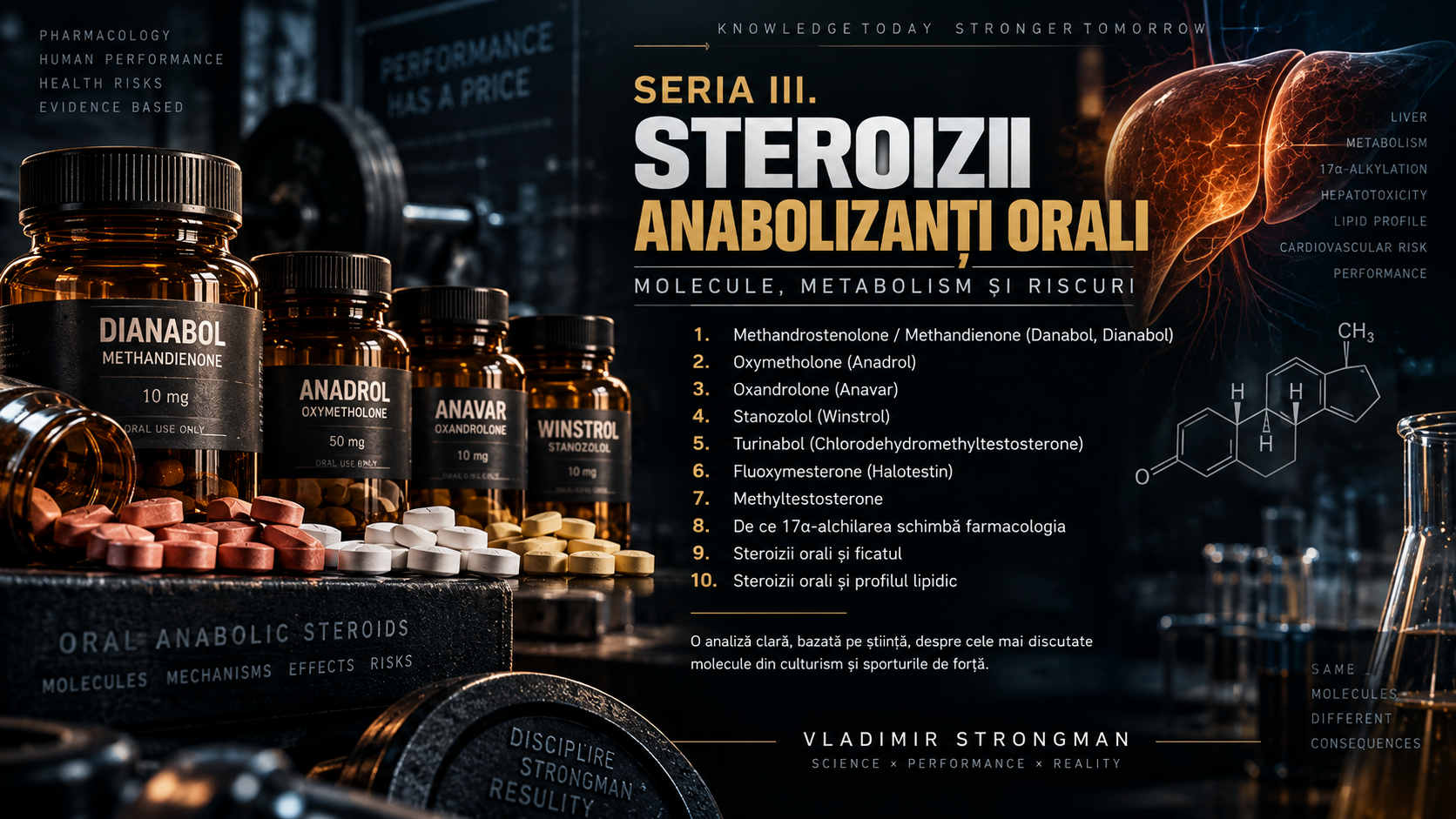
1. Why does stanozolol deserve its own episode?
Stanozolol, best known by the trade name Winstrol, is one of the most recognizable oral anabolic steroids. In sport it became famous for its association with strength and with less dramatic visible water retention.
But sporting reputation tells only part of the story. To understand stanozolol, we need to follow its chemical structure, androgen receptor, metabolism, liver effects, lipids, and hormonal consequences.
2. What actually is stanozolol?
Stanozolol is a synthetic anabolic-androgenic steroid. PubChem lists the molecular formula as C21H32N2O and the molecular weight as about 328.5 g/mol. It is also known by names such as Winstrol and Win-14833.
For a reader without a chemistry background, the key idea is that stanozolol keeps the steroid nucleus but modifies it in a distinctive way, introducing a pyrazole-type ring into the molecular structure.
3. Are Winstrol and stanozolol the same thing?
Yes. Stanozolol is the active substance, while Winstrol is the best-known trade name. In pharmacological discussion, stanozolol is the more precise term.
In sport, however, the name Winstrol became so familiar that it is often used almost as a synonym for the molecule. It is the same substance discussed in this episode.
4. The modification that makes it special: the pyrazole ring
Stanozolol is a steroid derivative in which the classical framework is modified by formation of a pyrazole-type system. It is therefore not simply another version of testosterone, but a molecule with its own geometry and electronic properties.
This modification illustrates one of the main lessons of the series: an apparently small structural change can alter receptor interactions, metabolism, and the pharmacological behavior of a molecule.
5. Why does structure matter?
Receptors and enzymes do not see a molecule as a simple chemical formula. They interact with its three-dimensional shape and charge distribution. That is why two related substances can have different biological profiles.
Stanozolol is a good example: changing the steroid framework modifies how the molecule behaves without eliminating androgenic activity.
6. 17-alpha methylation and oral activity
Stanozolol contains a 17-alpha methyl group that contributes to resistance to hepatic first-pass metabolism. This helps explain its oral activity.
But the same structural strategy reminds us of an important rule: oral activity achieved through chemical modification can have consequences for the liver. Oral does not mean automatically safe.
7. Stanozolol is not simply an oral steroid
Stanozolol has existed in both oral and injectable forms in different medical and veterinary contexts. The route of administration changes pharmacokinetics, but it does not turn the molecule into something without systemic effects.
That is why Winstrol should be discussed as a molecule first and a dosage form second.
8. The androgen receptor: the center of action
Stanozolol acts as an androgen through the androgen receptor. After binding, the receptor complex can influence gene expression and the activity of multiple tissues.
This produces anabolic and androgenic effects. Muscle is important to the athlete, but androgen receptors exist in other tissues as well, which explains why the effects are not limited to performance.
9. 'Anabolic' does not mean muscle only
Anabolic describes processes involved in building and maintaining tissue. It does not mean that the compound acts selectively on muscle fibers.
The same androgenic signaling can influence skin, reproductive tissues, metabolism, and hormonal feedback. Performance effects and adverse effects therefore belong to the same biology.
10. Why does Winstrol have a 'dry' reputation?
In sports culture, stanozolol is often called 'dry' because it is not associated with the same visible water retention as some other anabolic compounds. This is sports jargon, not a medical category.
A less watery appearance can make muscular definition look more pronounced, but appearance says nothing reliable about liver, lipid, or cardiovascular status.
11. 'Dry' does not mean healthier
One of the persistent confusions in sport is equating less visible water retention with safety. Those are separate questions.
An athlete can look leaner while lipid markers worsen or the liver is under stress. The mirror cannot measure cholesterol or liver function.
12. Stanozolol and estrogen
Stanozolol is not considered an androgen that is converted to estrogen by aromatase in the way testosterone can be. This contributes to its reputation for lacking the classic estrogenic effects associated with testosterone.
But the absence of aromatization does not mean the absence of endocrine effects. An exogenous androgen can still suppress endogenous testosterone production through negative feedback.
13. Why does lack of aromatization matter?
With testosterone, part of the molecule can be converted to estradiol. With stanozolol, that is not the principal pathway responsible for its activity. This contributes to a different visible profile.
But the body does not respond through estrogen alone. The androgen receptor and hypothalamic-pituitary feedback remain active, so lack of aromatization does not protect the endocrine axis.
14. Why 'non-aromatizing' should not mean 'no effects'
Non-aromatization tells us about one metabolic pathway. It does not mean that the molecule cannot affect blood pressure, lipids, liver function, fertility, or cardiovascular risk.
In pharmacology, removing one possible adverse effect does not automatically make the overall profile safe.
15. The liver: the sensitive point of 17-alkylated orals
Stanozolol belongs to the C17-alkylated androgen group, a class associated with liver injury and abnormal liver tests. LiverTox describes cholestatic patterns among the possible injuries associated with this family.
That does not mean every person will develop severe liver injury. It means the molecular structure creates a real biological reason to take hepatic effects seriously.
16. Cholestasis explained simply
Cholestasis occurs when bile formation or bile flow is impaired. Bile is produced by the liver and must move properly for bilirubin handling and other digestive processes to work normally.
Significant cholestasis can cause jaundice, dark urine, and severe itching. LiverTox notes that cholestatic injury associated with C17-alkylated androgens can be severe and prolonged.
17. Why ALT and AST do not tell the whole story
ALT and AST are important markers of hepatocellular injury, but cholestatic patterns can look different. In some cases of androgen-associated cholestasis, transaminases may be less dramatic than expected.
That is why liver assessment should consider multiple laboratory values and symptoms rather than a single result. Bilirubin, alkaline phosphatase, and GGT can become relevant in the right clinical context.
18. Lipids: the invisible part
Stanozolol can affect the lipid profile, including the relationship between HDL and LDL. The problem is that these changes may produce no symptoms that an athlete can feel.
You can become stronger and more defined while cardiovascular markers move in an unfavorable direction. Those two realities can coexist.
19. HDL and LDL cannot be seen in the mirror
HDL and LDL are components of lipid transport. In cardiovascular assessment, their values provide information that body weight, strength, and physique cannot replace.
For strength athletes, this matters precisely because physical appearance can create an impression of health even when certain metabolic risks are increasing.
20. The hypothalamic-pituitary-gonadal axis
An exogenous androgen can tell the body that sufficient androgenic signaling is already present. The hypothalamus and pituitary can respond by reducing GnRH, LH, and FSH signaling.
The result can include reduced endogenous testosterone production and impaired spermatogenesis. The fact that a steroid does not aromatize does not prevent this negative feedback.
21. Why Winstrol does not 'trick' the body
Terms such as 'mild' or 'dry' describe sporting reputation, not how the hypothalamus and pituitary perceive the molecule. The endocrine system responds to androgenic signaling, not the label on the bottle.
That is why stanozolol can suppress the hormonal axis even though it does not produce the same estrogenic pathway as testosterone.
22. Stanozolol and muscle mass
Androgen receptor activation can support anabolic processes and maintenance of muscle tissue. In sport, these effects are associated with strength and preservation of lean mass.
Performance, however, is never produced by one molecule alone. Training, technique, nutrition, sleep, and neurological adaptation remain essential.
23. Why does Winstrol have a strength reputation?
In strength-sport culture, stanozolol became associated with performance without the same visible increase in water weight linked to some other anabolic drugs. That is part of its reputation.
But reputation is not a universal physiological rule. Responses differ between people, and perceived performance effects cannot be separated from training and the rest of the hormonal environment.
24. What happens to body weight?
Stanozolol is not known for the same degree of water retention associated with some other steroids. As a result, scale changes may look less dramatic than with compounds known for rapid weight gain.
For an athlete, however, body weight is only one variable. Relative strength, absolute strength, muscle mass, and the ability to perform events matter differently across sports.
25. Why Winstrol is not 'stronger Anavar'
Oxandrolone and stanozolol are both oral and 17-alkylated, but their structures are very different. Oxandrolone is a 2-oxa steroid, while stanozolol has its characteristic pyrazole system.
Therefore, we cannot build a simple ladder such as 'small Anavar, big Winstrol.' The molecules have distinct pharmacological profiles.
26. Why Winstrol should not be confused with testosterone
Testosterone is the reference molecule from which many steroid families were developed. Stanozolol is a heavily modified derivative with a different structure and metabolic behavior.
Therefore, stanozolol's effects cannot simply be inferred from what we know about testosterone. Structure must come before conclusions.
27. Skin, hair, and the androgen receptor
Androgen receptors are present in many tissues, including skin and hair follicles. Androgenic signaling can contribute to acne and can influence hair loss in genetically predisposed people.
These effects are another reminder that 'anabolic' should never be translated as 'muscle only.' The body is a network, not a gym machine with one button.
28. Stanozolol in women
Stanozolol has androgenic effects, and exposure in women can produce virilization. Voice changes, increased hair growth, skin changes, and genital changes may occur.
Some androgenic changes can be irreversible. Sporting reputation should therefore never be used to minimize individual risk.
29. Stanozolol in Strongman: why does it come up?
Strongman is a sport where absolute strength, body mass, acceleration of heavy implements, and the ability to repeat very intense efforts matter. Historically, stanozolol has existed within the broader doping culture of strength sports.
However, it is important not to turn evidence of use into the claim that Winstrol was 'the Strongman steroid.' No single molecule defines the sport or an athlete's career.
30. Why might the Winstrol profile seem interesting to a strength athlete?
In a sport where extra body mass can help some events, avoiding excessive water retention is not necessarily the main objective. Still, an athlete may value functional body weight and a particular body-composition profile.
That helps explain why stanozolol can appear in discussions about strength sports, but it is not a recommendation and says nothing about the safety of using it.
31. Strongman is not only about how much you weigh
Body mass has mechanical value, but performance also depends on how effectively that mass is converted into force and movement. Technique, leverage, speed, and neurological capacity matter enormously.
That is why any discussion of a steroid in Strongman should begin with sport physiology, not the simplistic idea that more mass automatically means more performance.
32. Why athletes can overestimate the effect of one substance
A strong result usually follows months or years of training, technical adaptation, and muscular development. When a substance is introduced at the same time, it is easy to attribute every change to one cause.
This is one of the problems with personal anecdotes. 'I took it and got stronger' does not demonstrate how much came from the drug versus training, recovery, nutrition, or other changes.
33. What does Winstrol teach us about the liver?
It shows how important the difference between oral activity and metabolic cost can be. The 17-alpha methyl group helps the molecule survive first-pass metabolism, while the same structural class is associated with liver injury.
LiverTox describes cholestasis associated with C17-alkylated androgens as potentially severe and prolonged, sometimes with jaundice and marked itching. This is pharmacology, not a footnote.
34. What does Winstrol teach us about the heart and vessels?
Changes in blood lipids can matter for cardiovascular risk. An unfavorable HDL or LDL pattern can develop without obvious symptoms.
For an athlete who feels strong and healthy, this part is easy to ignore. That is precisely why laboratory markers can be more informative than the subjective feeling of being in great shape.
35. Why 'it does not hold water' is not a medical argument
Water retention is visible. Lipids, blood pressure, and liver function are not. The human brain naturally gives more attention to changes it can see, and that creates a trap.
A favorable physique can coexist with an unfavorable biological profile. Those two assessments must be kept separate.
36. Stanozolol and anti-doping status
Stanozolol is a prohibited anabolic agent in regulated anti-doping sport. Its status matters to athletes competing under World Anti-Doping Agency rules.
For a competitive athlete, the issue is not only pharmacology but also the consequences of an anti-doping violation: suspension, loss of results, and damage to a career.
37. What should you remember about Winstrol?
Stanozolol is an anabolic-androgenic steroid with a distinctive structure, oral activity, and androgen receptor action. Its reputation as a 'dry' and 'strength' steroid comes from sports culture, not from a guarantee of safety.
The liver, lipid profile, and hormonal axis remain important parts of its profile. And the fact that a molecule has been used in strength sports does not make it necessary or safe.
38. Conclusion
Stanozolol, known as Winstrol, is a perfect example of the central lesson of this series: changing structure changes pharmacological behavior. Its pyrazole system and 17-alpha methylation give it a distinct profile compared with testosterone, oxandrolone, or methandrostenolone.
In sport, Winstrol became associated with a 'dry' appearance, strength, and performance sports, including the world of strength sports. But the gym-floor image is only half the story. The other half is in the liver, lipids, endocrine system, and cardiovascular risk.
The final lesson is simple: a molecule can look discreet on the outside and still have important biological effects inside. Good pharmacology does not ask only 'what does it do for muscle?' but also 'what does it do to the rest of the body?'.
Selected sources
PubChem. Stanozolol: molecular structure, formula, synonyms, and properties.
LiverTox, NCBI Bookshelf. Androgenic Steroids: liver injury, cholestasis, and metabolic effects.
FDA Substance Registration System. Stanozolol: chemical identity and synonyms.
Handelsman DJ. Androgen Physiology, Pharmacology, Use and Misuse. Endotext, NCBI Bookshelf.
More From The Journal

Training
The Science of Strongman Training - Episode X: Competition Programming
How to build a complete Strongman competition preparation block: calendar, events, volume, intensity, specificity, simulations, autoregulation, tapering and fatigue management.

Training
The Science of Strongman Training - Episode IX: Peaking
Peaking in Strongman: how to turn months of training into maximal competition performance by reducing fatigue, preserving adaptations and managing specificity.