Pharmacology
Series: Injectable Steroids and Their Derivatives - Episode 8: 19-Nor Androgens: What Makes Them Different
September 16, 2026
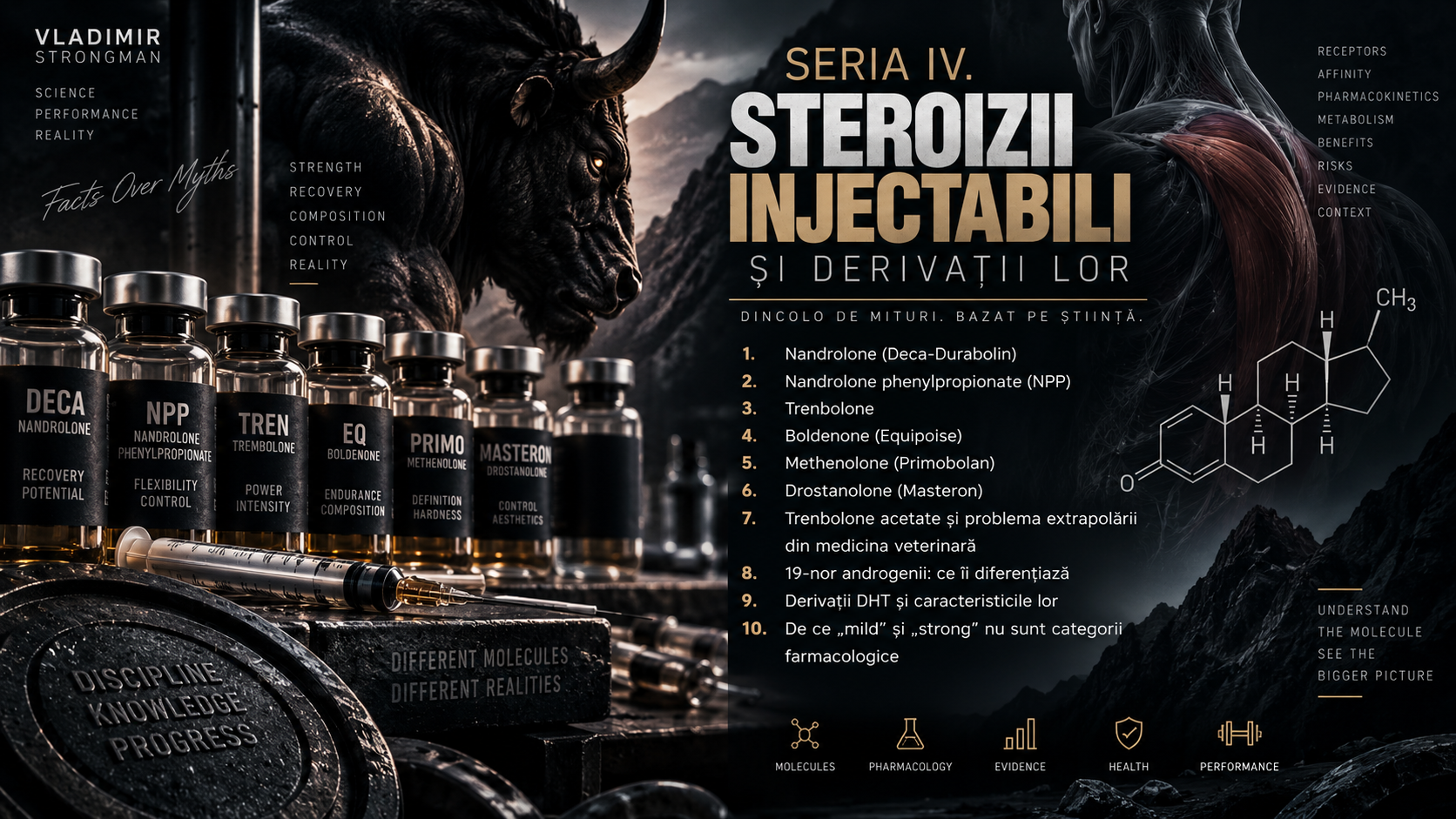
What does “19-nor” mean?
“19-nor” sounds complicated, but the basic idea is simple: the steroid structure lacks the carbon at position 19 that is present in the classic testosterone scaffold. Nandrolone is the best-known example. Trenbolone belongs to the same 19-nor family, but it has additional structural changes that make its pharmacology different.
Why can one structural change matter so much?
In pharmacology, molecules are not just formulas on paper. Their shape influences receptor binding, enzymatic metabolism, and duration of activity. A seemingly small structural change can alter the biological profile of an entire compound.
Nandrolone: the first major example
Nandrolone, or 19-nortestosterone, keeps the basic androgenic steroid nucleus but lacks the carbon-19 substituent present in testosterone. This contributes to a different metabolic profile, particularly when nandrolone and testosterone are compared in androgen-dependent tissues.
5α-reductase: the enzyme that changes the story
Testosterone can be reduced by 5α-reductase to DHT, a more potent androgen in certain tissues. Nandrolone can also undergo 5α-reduction, but the resulting dihydronandrolone has a different and weaker androgenic activity than DHT. This is one explanation for the more favorable anabolic-to-androgenic profile observed in some experimental models.
Why do muscle and prostate not respond identically?
Tissues have different concentrations of metabolic enzymes. Skeletal muscle has relatively little 5α-reductase activity, while some androgen-dependent tissues have more. The same hormone can therefore be processed differently depending on where it acts.
Does that mean 19-nor steroids are automatically “more anabolic than androgenic”?
That phrase is useful for understanding the pharmacology behind their reputation, but it should not become an absolute rule. The anabolic-to-androgenic balance depends on the molecule, tissue, metabolism, exposure, and measurement method. There is no perfect separation between the two effects.
Where does trenbolone fit?
Trenbolone is also a 19-nor androgen, but it is not simply “stronger nandrolone.” It has additional structural changes, including three double bonds in the steroid nucleus, and those changes alter its pharmacology. Two molecules being 19-nor does not make them interchangeable.
19-nor does not automatically mean the same aromatization
Another common myth is that all 19-nor androgens behave the same way with estrogen. They do not. Nandrolone can aromatize to an estrogenic metabolite, but its profile differs from testosterone. Trenbolone is not a classic aromatase substrate. The structure of each molecule matters.
What happens at the androgen receptor?
Both nandrolone and trenbolone can activate the androgen receptor. After binding, the hormone-receptor complex influences gene expression in androgen-responsive tissues. The differences arise from receptor affinity, metabolites, and tissue context, not because “19-nor” is a separate receptor.
Why do metabolites matter so much?
The effect of a steroid is not defined only by the administered molecule. Metabolites can have their own activity and can alter the final response. Research on 19-nor androgens shows that tissue-specific metabolic differences help explain their biological profile.
Why can 19-nor androgens suppress natural testosterone?
The body does not need an exogenous androgen to be chemically identical to testosterone before responding to it. Exogenous androgen exposure can reduce hypothalamic and pituitary signaling, lowering LH and FSH. This can reduce testicular testosterone production and impair spermatogenesis.
That explains the difference between muscular and reproductive effects
A compound can favor anabolic processes in skeletal muscle while simultaneously reducing signaling needed for reproductive function. These effects are not contradictory. They are consequences of the same endocrine feedback system.
19-nor steroids and prolactin: where does the confusion begin?
In bodybuilding communities, many symptoms are reduced to one explanation: “high prolactin.” Human physiology is more complicated. Sexual function can be influenced by testosterone, estradiol, prolactin, sleep, stress, and general health. A symptom does not identify the mechanism by itself.
Why should nandrolone and trenbolone not be treated as the same drug?
They are both 19-nor compounds, but their structures are not identical. Nandrolone is 19-nortestosterone, while trenbolone has a more extensively modified structure. Differences in metabolism, receptor behavior, aromatization, and pharmacokinetics make their effects non-interchangeable.
The cardiovascular profile does not disappear because a compound is 19-nor
AAS can affect blood pressure, lipids, hematocrit, and cardiac structure and function. The 19-nor label does not automatically protect the cardiovascular system. Risk has to be considered for the individual molecule and exposure context, not a single chemical label.
Why does this matter in Strongman?
Strength sports combine body mass, maximal strength, high training volume, and recovery demands. In that setting, 19-nor androgens became part of the sport's pharmacology culture. But a compound perceived as effective is not the same thing as a compound proven safe.
The myth that “19-nor = better”
There is no magical chemical category in which every molecule is automatically better. 19-nor describes a structural modification, not a performance class. That modification can produce particular pharmacologic properties, but the final outcome depends on the whole molecule and the organism.
Anti-doping
Nandrolone and trenbolone are included in category S1 of the 2026 WADA Prohibited List. Anabolic agents in this category are prohibited both in and out of competition.
What should you remember?
19-nor is not an effect and it is not a “special steroid.” It is a structural description. Removing carbon 19 changes how the molecule is metabolized and can alter the balance between anabolic and androgenic activity. Nandrolone shows this principle clearly, while trenbolone demonstrates how much pharmacology can change when additional structural modifications are added to the 19-nor scaffold.
Main sources
PubMed: Different patterns of metabolism determine the relative anabolic activity of 19-norandrogens; PubMed: Myoanabolic steroids and selective androgen receptor modulators; PubMed: Relative binding affinities of testosterone, 19-nortestosterone and their 5α-reduced derivatives; PubMed: Anabolic-Androgenic Steroids Revisited: Structural Biology, Receptor Signaling, and Mechanisms of Anabolic-Androgenic Dissociation; WADA: 2026 Prohibited List.
More From The Journal

Training
The Science of Strongman Training - Episode X: Competition Programming
How to build a complete Strongman competition preparation block: calendar, events, volume, intensity, specificity, simulations, autoregulation, tapering and fatigue management.

Training
The Science of Strongman Training - Episode IX: Peaking
Peaking in Strongman: how to turn months of training into maximal competition performance by reducing fatigue, preserving adaptations and managing specificity.