
Pharmacology
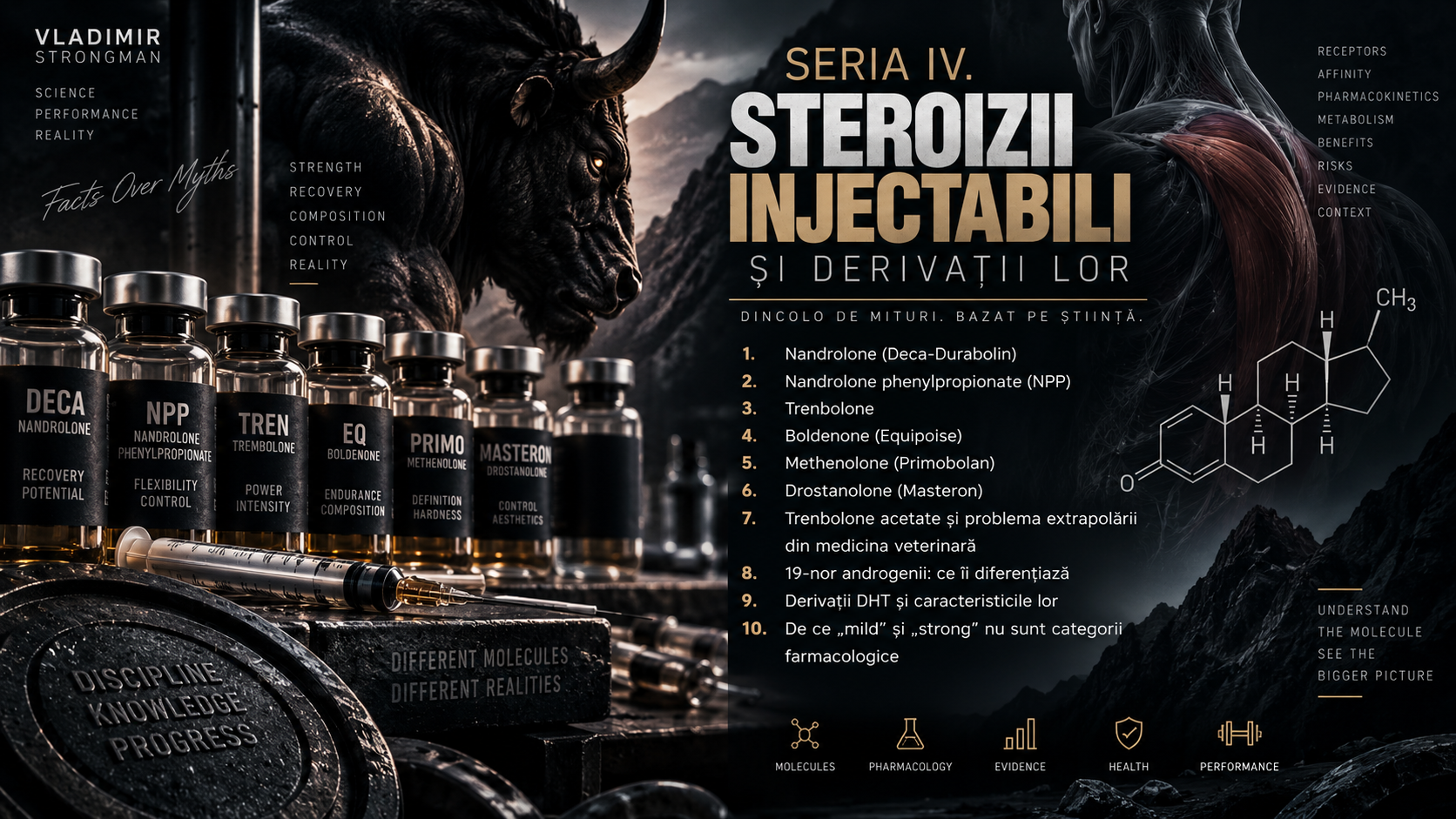
Series: Injectable Steroids and Their Derivatives - Episode 7: Trenbolone Acetate and the Problem of Extrapolating from Veterinary Medicine
September 15, 2026
What is trenbolone acetate?
Trenbolone acetate, or TBA, is the acetate ester of trenbolone. Trenbolone is a synthetic anabolic-androgenic steroid, and the acetate form became especially known through veterinary use in cattle. This is where one of the biggest fitness-culture mistakes begins: the fact that a substance has veterinary data and veterinary uses does not automatically turn those data into a guide for human use.
Why does it appear in veterinary medicine?
FDA describes cattle implants containing trenbolone acetate, sometimes combined with an estrogen, for increasing weight gain and improving feed efficiency. These products are developed for animals and have species-specific indications, formulations, and conditions of use.
First lesson: an animal is not a larger human
A drug can act on the same molecular target in two species and still produce different effects. Differences in metabolism, receptors, distribution, elimination, body composition, and hormonal sensitivity can change exposure and response. Pharmacology research warns that simple weight-based extrapolation can be inaccurate, while pharmacokinetic data are much more useful when comparing species.
Why can't a cattle dose be converted into a human dose?
This is one of the most dangerous shortcuts in reasoning. You cannot take an amount given to an animal, divide it by body weight, and call the result a human dose. Interspecies conversion may use body-surface-area or metabolic scaling and, ideally, pharmacokinetic data. Even those methods have limitations and do not automatically create a safe clinical regimen.
Same molecule, different pharmacology across species?
The molecule remains the same, and its basic androgen-receptor activity can be discussed at the molecular level. But clinically relevant exposure depends on the actual concentrations reached, metabolites formed, duration of exposure, and tissue response. Veterinary literature describes metabolism, excretion, and physiology in the relevant animal species, not a complete clinical profile for humans.
What do cattle studies actually tell us?
Veterinary studies can show how a compound behaves in an animal, what metabolites appear, how tissues respond, and how long residues persist. FDA uses such data in evaluating food safety and residues in edible tissues. That is a different question from: “Is trenbolone acetate safe for a human to use for performance?”
Food safety is not doping safety
When FDA establishes safe concentrations for residues in meat, the question is how much substance may remain in edible tissues so consumer exposure is acceptable. That does not mean intentional administration of the hormone to a human is safe. The two assessments have different objectives.
Why did bodybuilding culture over-extrapolate?
Trenbolone gained an enormous reputation in bodybuilding and strength sports because it is linked to anabolic effects observed in animals and to reports from users. The problem appears when “it works in cattle” becomes equivalent to “we know exactly what it does in humans.” Scientifically, there is a large uncertainty gap between those statements.
What do we know about the androgenic mechanism?
Trenbolone is an androgen-receptor agonist. Receptor activation changes gene expression in androgen-responsive tissues and can support anabolic processes. Some veterinary studies have also described changes in protein metabolism and protein breakdown in cattle. These mechanisms help explain the compound, but they do not remove the limits of extrapolating to humans.
What do we not know well enough about humans?
There is no modern body of clinical trials that rigorously defines the safety and efficacy of trenbolone acetate for improving performance in humans. The absence of such studies does not mean the compound has no effects; it means there is greater uncertainty about the exact relationship between exposure, benefits, and harms.
Hormonal suppression
As an exogenous androgen, trenbolone can suppress the hypothalamic-pituitary-gonadal axis. Falling LH and FSH can reduce endogenous testosterone production and impair spermatogenesis. The fact that much of the evidence comes from nonclinical or clandestine-use contexts does not make the endocrine effect less relevant.
Estrogen and the aromatization myth
Trenbolone does not classically aromatize to estrogen. But that is not the same as saying it has no hormonal effects. The endocrine system involves more than estradiol, and suppression of endogenous testosterone can indirectly alter the overall hormonal balance.
Prolactin: what should we avoid?
The internet often reduces sexual problems associated with trenbolone to “high prolactin.” The physiology is more complicated. Libido and sexual function can be influenced by testosterone, estradiol, prolactin, sleep, stress, and general health. A symptom alone does not identify the mechanism.
Cardiovascular risk: extrapolation becomes even more dangerous here
AAS evidence indicates effects on lipid profiles, blood pressure, and cardiac structure and function. The response of an animal used for food production cannot directly estimate the individual cardiovascular risk of a human repeatedly exposed to an anabolic steroid. Calling trenbolone “safe for the heart” based on veterinary studies would be an unjustified conclusion.
Hematocrit and hemoglobin
Androgens can stimulate erythropoiesis. Increases in hemoglobin and hematocrit are relevant to risk assessment and cannot be predicted reliably from cattle data alone. A complete blood count provides direct information about the human response.
The liver
Trenbolone acetate is not a 17α-alkylated oral steroid, and its hepatic profile differs from that of many oral AAS. Still, the association with veterinary implants does not justify the conclusion that the human liver is “protected.” Clinical assessment should be based on laboratory findings and context.
Why does the implant matter?
In cattle, TBA is used in products designed for controlled release through an implant. Formulation, species, target tissues, and treatment objective are all part of pharmacology. You cannot separate the molecule from the delivery system and then assume the result will be identical in humans.
“But it was approved by FDA?”
That is another common confusion. FDA can approve a trenbolone acetate implant for cattle under specific conditions. Approval for an animal and veterinary indication is not approval for administration to humans. FDA also states that extralabel use of cattle implants for growth promotion is not permitted.
Why is there no “safe human dose” derived from cattle?
Because safety is not a simple mathematical conversion. It requires pharmacokinetics, pharmacodynamics, toxicology, characterization of adverse effects, and clinical human data. A conversion calculation can be useful in preclinical research, but it does not by itself produce a medical recommendation.
Risks of injectable administration
Beyond pharmacologic effects, injectable administration can add infection, abscess, tissue injury, and contamination. A product intended for veterinary use or obtained from illicit sources may have additional problems involving sterility, identity, or concentration.
Anti-doping
Trenbolone is included in category S1 of the 2026 WADA Prohibited List, and anabolic agents in this category are prohibited at all times, both in and out of competition.
What should be medically monitored?
Depending on context, assessment may include blood pressure, complete blood count with hemoglobin and hematocrit, lipid profile, liver and kidney markers, and hormonal assessment. When sexual symptoms or fertility questions exist, endocrine evaluation and semen analysis can provide more information than assumptions based on forums.
Conclusion
Trenbolone acetate is an excellent example of why pharmacology cannot be reduced to “it worked in an animal, so we know what it does in humans.” Veterinary data are valuable for mechanism, metabolism, residues, and biological effects, but they must be interpreted through comparative pharmacology. Without those filters, an observation about cattle can very easily become a false certainty about humans.
Main sources
FDA: Steroid Hormone Implants Used for Growth in Food-Producing Animals; FDA animal-drug approval and safety summaries for trenbolone acetate implants; PubMed: Metabolism of endogenous and exogenous anabolic agents in cattle; PubMed: Quantitative bibliographic review on anabolic hormones in ruminants; PubMed: Extrapolation of animal toxicity to humans; PubMed: Application of allometric principles for prediction of pharmacokinetics; WADA: 2026 Prohibited List.
More From The Journal

Training
The Science of Strongman Training - Episode X: Competition Programming
How to build a complete Strongman competition preparation block: calendar, events, volume, intensity, specificity, simulations, autoregulation, tapering and fatigue management.

Training
The Science of Strongman Training - Episode IX: Peaking
Peaking in Strongman: how to turn months of training into maximal competition performance by reducing fatigue, preserving adaptations and managing specificity.