
Pharmacology
Series: Injectable Steroids and Their Derivatives - Episode 10: Why “Mild” and “Strong” Are No Longer Pharmacological Categories
September 18, 2026
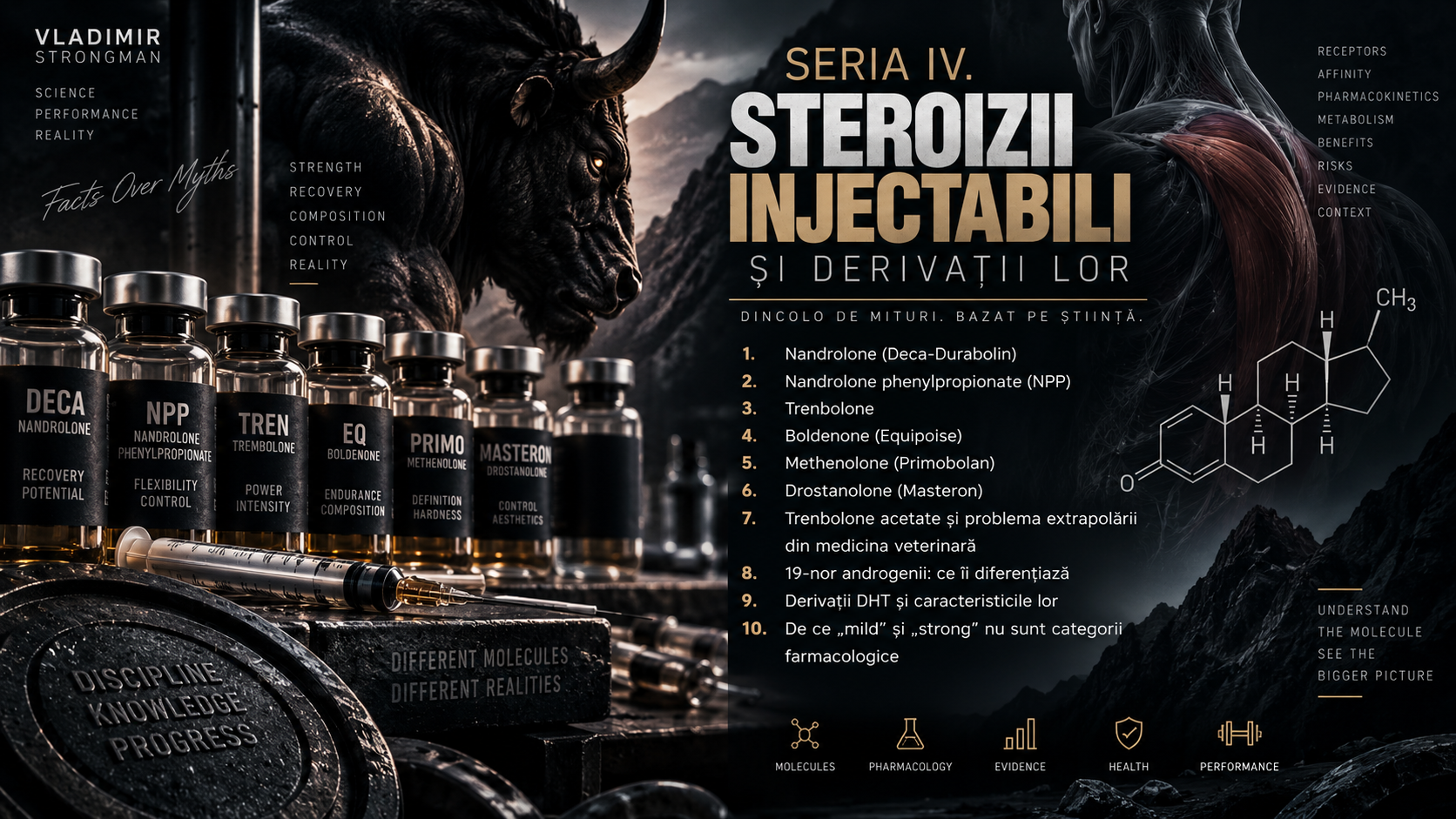
What do “mild” and “strong” actually mean?
In the gym, “mild” and “strong” are used to describe how powerful a steroid feels. In pharmacology, however, these are not precise categories. A compound can be highly active at the androgen receptor and still produce a particular effect in one tissue and a very different effect and risk profile in another.
First problem: “strong” can mean different things
At least four different questions can be hiding behind the word: how strongly the molecule binds the receptor, how large the biological response is, how much muscle or strength changes, and how large the adverse effects are. These are not synonyms and cannot be placed on one simple scale.
Potency is not the same as efficacy
In pharmacology, potency describes the concentration needed to produce a defined effect, whereas efficacy describes how large the response can become. Two molecules can therefore differ in potency while reaching similar maximum responses in a particular system. This is one reason bodybuilding “power rankings” can be misleading.
The androgen receptor is not a 1-to-10 power scale
Receptor binding is only the beginning. Tissue concentration, duration of exposure, receptor conformation, available cofactors, and downstream gene regulation all matter. So “high affinity” does not automatically mean “best” or “most dangerous.”
Tissue changes the story
Muscle, skin, prostate, liver, and brain are not identical environments. They express different enzymes and cofactors and may generate different metabolites. This tissue-dependent pharmacology is a major reason why a single “strong” label tells us very little.
Metabolism can completely change the profile
An administered steroid should not be viewed as an isolated molecule. Metabolites can have activity of their own, and compounds may be transformed differently in different tissues. That is why two related steroids can have very different biological profiles.
Testosterone versus nandrolone
Testosterone can be converted by 5α-reductase to DHT, while nandrolone can form dihydronandrolone, which has different androgenic properties. This metabolic difference helps explain why “more anabolic” and “more androgenic” cannot be treated as fixed universal labels.
DHT and its derivatives
Methenolone, drostanolone, and oxandrolone are DHT derivatives, but they are not interchangeable substances with identical behavior. Structural changes can alter aromatization, androgenic activity, bioavailability, and metabolism. “DHT derivative” is a structural description, not a power ranking.
Why “mild” is sometimes an aesthetic label
In bodybuilding, “mild” may mean less water retention, fewer perceived estrogenic effects, or a subjective feeling of better tolerability. None of these alone defines toxicity or cardiovascular risk.
Why “strong” is sometimes a performance label
Sometimes “strong” simply means an athlete notices rapid changes in strength, body weight, or appearance. Those changes may be real, but their speed or magnitude does not by itself measure risk or identify the mechanism.
A steroid can be “mild” in one domain and problematic in another
A compound may cause little visible water retention while still adversely affecting HDL and LDL. Another may have a different androgenic profile while strongly suppressing the gonadal axis. Evaluation therefore has to be divided by systems and effects rather than compressed into one word.
Route of administration also changes the profile
An injectable and an oral steroid can contain related molecules, but absorption, first-pass hepatic metabolism, and pharmacokinetics can be very different. “Injectable = mild” is an oversimplification, just as “oral = strong” is too vague to be useful.
Duration of exposure matters
The compound is not the only variable; duration of exposure matters too. A moderate effect observed over a short period is not equivalent to safety after repeated and prolonged exposure. Risk reflects the molecule, exposure, and individual vulnerability.
“Mild for the liver” does not mean “mild for the heart”
A more favorable hepatic profile than some 17α-alkylated oral steroids does not automatically mean a favorable cardiovascular profile. Lipids, blood pressure, hematocrit, and cardiac structure need to be evaluated separately.
“Mild for estrogen” does not mean “mild for the endocrine axis”
Limited aromatization can reduce certain estrogenic effects, but an exogenous androgen can still suppress LH and FSH and impair endogenous testosterone production and spermatogenesis. These are separate endocrine dimensions.
Why forum classifications survive
Because they are easy to communicate. “Mild,” “strong,” “dry,” “wet,” “clean,” and “harsh” turn pharmacology into a simple vocabulary. The problem is that simplification can hide important differences between individuals, tissues, exposure levels, duration, and adverse effects.
How should a steroid actually be compared?
A better approach is to ask separately: what receptor does it target, what metabolites does it produce, which tissues are involved, how is it absorbed and eliminated, what happens to the endocrine axis, lipids, blood pressure, hematocrit, liver, and cardiovascular system, and how strong is the evidence in humans?
Why this matters in Strongman
Strongman centers on body mass, maximal strength, and the ability to tolerate large training demands. That makes the temptation to reduce everything to “stronger” especially high. But a compound that produces more strength is not automatically a compound with a better overall profile. Performance and safety are different variables.
Anti-doping
“Mild” and “strong” have no role in anti-doping classification. The 2026 WADA Prohibited List categorizes anabolic agents through regulatory definitions, not bodybuilding reputation.
Conclusion
“Mild” and “strong” are useful gym slang but poor pharmacology. A steroid is not a one-dimensional blade with a single sharpness score. It has potency, efficacy, metabolism, tissue effects, pharmacokinetics, and toxicity, and those dimensions must be analyzed separately. The better we understand the molecule, the less we need labels.
Main sources
PubMed literature and reviews on androgen-receptor pharmacology, structure-activity relationships, androgen metabolism, cardiovascular effects, and endocrine effects of AAS; WADA 2026 Prohibited List.
More From The Journal

Training
The Science of Strongman Training - Episode X: Competition Programming
How to build a complete Strongman competition preparation block: calendar, events, volume, intensity, specificity, simulations, autoregulation, tapering and fatigue management.

Training
The Science of Strongman Training - Episode IX: Peaking
Peaking in Strongman: how to turn months of training into maximal competition performance by reducing fatigue, preserving adaptations and managing specificity.