
Nutrition
Series: Proteins, the Building Material - Episode 4: Animal Protein Versus Plant Protein
September 10, 2026
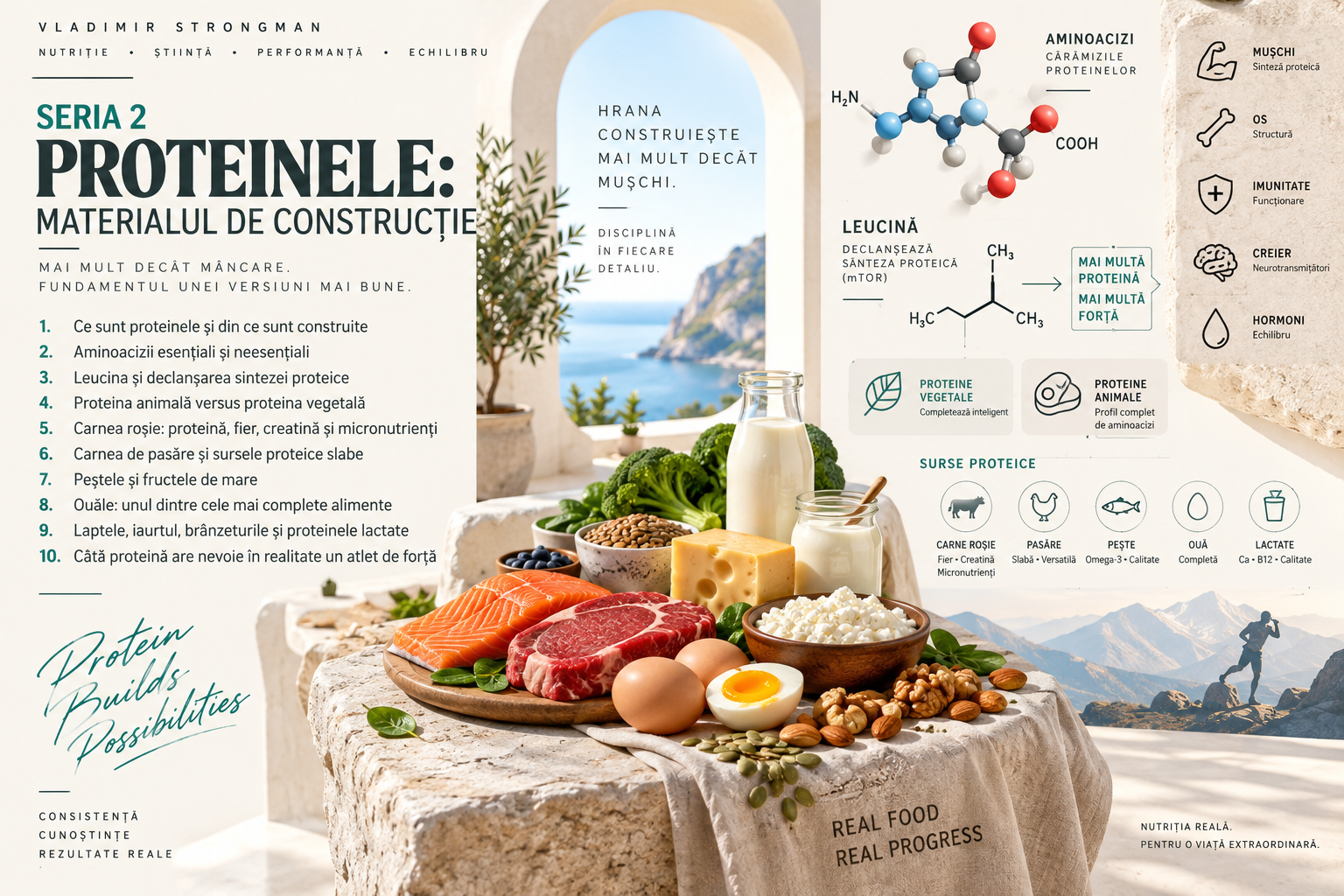
The question “animal protein or plant protein?” is often framed as a duel with one winner. Biology is less theatrical. Both provide amino acids, both can contribute to tissue construction and repair, and their value depends on amount, amino-acid profile, digestibility, processing, food matrix and the rest of the diet.
For a strength athlete, the comparison matters because absolute protein requirements are high and each meal must deliver enough essential amino acids to support recovery and adaptation. Some animal sources do this very efficiently in a small food volume. Some plant sources require larger portions, more deliberate combinations or processing that improves digestibility.
This episode will not turn nutrition into a war between camps. We will compare sources through measurable criteria: essential amino acids, leucine, digestibility, protein density, limiting amino acids and the muscle-protein-synthesis response. The useful conclusion for a strongman is not which food “wins”, but how to build a sufficient and robust protein intake from the sources you choose.
1. The comparison is not a battle between two kinds of molecules
After digestion, the body no longer sees “meat” or “lentils”; it sees amino acids, small peptides and the other components of the meal. Differences between sources arise from amino-acid proportions, how easily protein is digested and how much protein fits into a practical serving. The correct discussion is therefore about efficiency and context, not membership in a dietary camp.
2. The basic chemistry of protein is the same
A milk protein and a pea protein are built from the same general types of amino acids linked by peptide bonds. There are no separate chemical species called “animal amino acids” and “plant amino acids”. What differs is their distribution within the protein, molecular structure, accessibility to digestive enzymes and the composition of the food that contains them.
3. What we mean by animal protein
Animal sources include meat, fish, eggs, milk, yogurt, cheese and proteins isolated from these foods, such as whey and casein. They tend to have a high density of essential amino acids and high digestibility. Yet “animal” is not one nutritional category: a fish fillet, yogurt and a highly processed meat product have very different food matrices and nutritional profiles.
4. What we mean by plant protein
Plant protein comes from legumes, grains, nuts, seeds, soy, peas, potatoes and many concentrated or isolated products. Plants are not “protein-free”; many provide meaningful amounts. The practical difference is that some sources contain less protein per hundred grams, more fiber and a less favorable essential-amino-acid profile for a single serving.
5. Essential-amino-acid profile is the first major criterion
Synthesis of body proteins requires all amino acids specified by the sequence. The nine essential amino acids must come from the diet, and a source that supplies them in proportions close to human requirements is generally more efficient gram for gram. Many animal proteins have a highly favorable profile, whereas some plant proteins are relatively low in one particular essential amino acid.
6. Digestibility is the second major criterion
It is not enough to know which amino acids exist on paper; what matters is how many become available after digestion. Plant cell walls, fiber and some antinutritional compounds can reduce enzyme access to protein. Cooking, fermentation, grinding, concentrating and isolating can substantially narrow these differences. Isolated plant protein may be far more digestible than the whole plant food from which it originated.
7. The food matrix changes the meaning of the comparison
Protein never arrives alone. Animal foods may provide heme iron, vitamin B12, calcium or fatty acids depending on the source. Plant foods may provide fiber, polyphenols, carbohydrate, unsaturated fats and minerals. When comparing real foods, we compare the whole package. A protein-quality score describes amino-acid quality, not the total value of the diet.
8. Leucine is often more concentrated in certain animal proteins
Leucine functions both as an essential amino acid and as a signal for mTORC1. Whey is particularly rich in leucine, and dairy, eggs and meat usually provide substantial amounts relative to protein intake. Some plant proteins contain less, which means a larger total protein serving may be needed to create a comparable anabolic signal.
9. Lysine is often the weak point of grains
Wheat, rice and other grains contain protein but tend to be relatively low in lysine compared with human requirements. That does not make them useless. In a varied diet, legumes, soy and other lysine-rich sources can complement the profile. The idea of a limiting amino acid refers to proportion, not total absence of that amino acid.
10. Methionine can be relatively low in many legumes
Beans, lentils and some other legumes are rich in lysine but may contain lower proportions of sulfur amino acids, especially methionine. Grains tend to offer the complementary pattern. This is the biochemical reason traditional combinations such as rice and beans can create a more balanced overall amino-acid profile.
11. A limiting amino acid does not mean a worthless protein
An amino acid is called limiting when its proportion is the lowest relative to requirements. Protein synthesis may therefore be constrained if the diet depends heavily on one source. In real life, however, people eat mixtures of foods. Amino acids from different sources enter the same metabolic pool and can complement one another across the day.
12. “Complete protein” is a useful label, not an absolute law
A “complete protein” generally means a source that supplies all essential amino acids in adequate amounts. The phrase is practical but can oversimplify. Most plant foods contain all essential amino acids, although sometimes in less favorable proportions. A varied diet can turn several individually imperfect sources into a very well-balanced total intake.
13. Many animal proteins are efficient gram for gram
Eggs, dairy, meat and fish tend to combine high digestibility with a rich essential-amino-acid profile. For an athlete who needs a large amount of protein without enormous food volume, this efficiency can be convenient. The advantage is practical and nutritional; it is not evidence that plant sources cannot support adaptation.
14. Soy is one of the strongest plant-protein options
Soy protein has a favorable essential-amino-acid profile and good digestibility, especially in concentrated or isolated forms. In training studies, sufficient soy protein intake can support gains in muscle mass and strength. Differences from some dairy proteins become smaller when total protein and essential amino acids are adequate.
15. Pea protein can be highly useful in sport
Peas provide protein relatively rich in lysine and BCAAs, while isolates remove much of the fiber and starch and increase protein density. Methionine remains relatively lower, but in a mixed diet this is easily compensated. For athletes who avoid dairy, pea protein is one of the most commonly used practical alternatives.
16. Rice protein has a different profile and can complement pea
Rice protein is relatively lower in lysine but has a different profile from legumes. Blending rice isolate with pea isolate is used precisely for amino-acid complementarity. There is no universal mandatory ratio; the purpose is to increase total essential-amino-acid availability and reduce dependence on the limiting amino acid of a single source.
17. Wheat contains substantial protein but is weak as a sole source
Wheat gluten is genuine protein and can contribute significantly to daily intake, but it is relatively low in lysine. If a diet relied almost exclusively on grains, this would reduce protein quality. Combined with legumes, soy or animal sources, cereal protein becomes part of a far more favorable total profile.
18. Legumes bring protein together with carbohydrate and fiber
Lentils, beans and chickpeas are useful protein sources but also provide carbohydrate, fiber, potassium, magnesium and other nutrients. For a strongman this package can be valuable in high-volume meals. At the same time, very large quantities may become difficult to tolerate gastrointestinally. Protein density and digestive tolerance matter when calorie intake is already very high.
19. Grains contribute more daily protein than they appear to
Bread, pasta, oats and rice are not usually labeled “protein foods”, but at high calorie intakes they can contribute a meaningful amount of protein. For a strongman eating several hundred grams of carbohydrate, grain protein inevitably enters the daily total. Its quality must be interpreted in the context of the other protein sources consumed.
20. Nuts and seeds are energy-dense as well as protein-containing
Peanuts, almonds, pumpkin seeds and hemp seeds provide protein but also substantial fat and energy. They can contribute to intake, yet they are not always the most efficient way to obtain large protein amounts without a considerable calorie surplus. For an athlete managing body composition, energy density has to be calculated alongside protein density.
21. Potato protein is an interesting example of a plant source
Whole potatoes are not very protein-dense, but isolated potato protein has a surprisingly favorable essential-amino-acid profile. Modern research shows that some lesser-known plant sources can support protein synthesis when consumed in sufficient amounts. The category “plant” is far too broad to automatically imply low quality.
22. Quinoa and pseudocereals differ from classic grains
Quinoa, amaranth and buckwheat are often discussed separately from wheat or rice because their amino-acid profiles differ and can contribute more evenly to intake. Yet the amount of protein in a normal serving is still lower than in a protein isolate or a serving of meat. Quality and density are two separate questions.
23. DIAAS attempts to measure digested indispensable amino acids
DIAAS, the Digestible Indispensable Amino Acid Score, compares the amount of essential amino acids digested at the ileal level with a reference requirement pattern. It attempts to capture what becomes available to the body more faithfully than crude protein alone. Many animal proteins score highly, but certain processed plant proteins can also perform well.
24. PDCAAS is useful but has methodological limitations
PDCAAS combines amino-acid profile with protein digestibility, but it uses fecal digestibility and truncates scores at a maximum value. This can hide differences among very high-quality proteins. DIAAS was proposed partly to improve these issues. Neither score, however, can replace evaluation of the whole diet.
25. A quality score alone does not predict athletic results
DIAAS and PDCAAS are nutritional tools, not hypertrophy leaderboards. An athlete can compensate for a lower-scoring source through higher total intake, source combinations and distribution across several meals. Training adaptation depends on weeks and months of nutrition, not the isolated score of one serving.
26. Whole foods and protein isolates are not equivalent
Whole peas and pea protein isolate come from the same plant but behave differently nutritionally. Isolation removes much of the starch, fiber and other material and concentrates the protein. The same principle applies to soy and other sources. Results from isolate studies should not automatically be assumed to be identical to an equivalent serving of the whole food.
27. Cooking can increase accessibility of plant proteins
Heat treatment can denature proteins and inactivate some enzyme inhibitors in plants, making digestion easier. Excessive processing and very high temperatures can also alter availability of certain amino acids. There is no simple rule that raw is always better or that more cooking is always better; effects depend on the food and method.
28. Antinutrients are real but often exaggerated in popular discussion
Phytates, trypsin inhibitors and other plant compounds can influence protein digestion or mineral absorption. In normally prepared foods, their effects are modified by soaking, boiling, fermentation and processing. Turning every antinutritional compound into an argument that plant protein “is not absorbed” is a major biological oversimplification.
29. Fermentation and germination can modify digestibility
Fermentation, germination and other traditional processes can reduce compounds that limit digestion and alter protein structure. Tempeh, for example, is metabolically different from raw soybeans. Food processing does not automatically mean deterioration; sometimes it is precisely the tool that makes a plant source easier to digest and use.
30. Whey is a reference point for a rapid anabolic response
Whey protein is rapidly digested, rich in essential amino acids and especially rich in leucine. It therefore produces a rapid rise in circulating amino acids and is frequently used in muscle-protein-synthesis research. Its advantage is efficiency, but a larger acute response after one meal does not automatically translate into proportionally larger long-term results.
31. Casein is slower but not inherently inferior
Casein forms structures that slow gastric emptying and release amino acids more gradually. It can sustain amino-acid availability over a longer period and is often used before a long interval without food. “Fast” and “slow” describe digestive kinetics, not an absolute hierarchy of protein value.
32. Milk naturally combines whey and casein
Milk proteins combine the rapid whey fraction with the slower casein fraction. Milk and yogurt also provide fluid, carbohydrate, calcium and other nutrients. For an athlete, dairy can function simultaneously as protein source and recovery food. Lactose tolerance and personal preferences remain important practical factors.
33. Egg provides a highly balanced amino-acid profile
Egg protein is well digested and contains all essential amino acids in favorable proportions. Whole eggs also provide fat, choline, vitamins and minerals, while egg whites concentrate protein with fewer calories. The choice between them depends on the rest of the diet, not on the existence of a magically “cleaner” protein in one part of the egg.
34. Meat is dense in protein and essential amino acids
Meat usually provides a large amount of protein in a relatively compact serving and a complete essential-amino-acid profile. Fat content can vary enormously by species and cut. Proper analysis separates protein as a nutrient from characteristics of the whole food. Chicken breast, lean beef and processed meats are not nutritional synonyms.
35. Fish provides high-quality protein with other nutritional advantages
Fish provides readily digestible protein and a favorable essential-amino-acid profile. Fatty species also supply long-chain omega-3 fatty acids, while lean fish can offer substantial protein with relatively few calories. Again, the advantage comes from the characteristics of the specific food, not from an abstract category called animal protein.
36. Collagen is animal-derived but not ideal for hypertrophy
Collagen shows why animal origin does not automatically guarantee a perfect muscle-building profile. It is rich in glycine, proline and hydroxyproline but low in several essential amino acids and is not an efficient leucine source. It may have specific connective-tissue uses, but it should not be treated as the main replacement for complete proteins intended to support muscle protein synthesis.
37. Acute muscle-protein-synthesis responses can differ among sources
In some studies, an equal gram amount of plant protein produces a smaller muscle-protein-synthesis response than whey, milk or other animal sources. Explanations include digestibility, leucine concentration and essential-amino-acid profile. This does not mean plants cannot build muscle; it means dose and composition must be considered.
38. When essential amino acids are matched, differences can shrink
If a plant-protein serving is increased or formulated to provide enough leucine and essential amino acids, the anabolic response can become much closer to that of a reference animal protein. This is one of the central lessons of the episode: gram-for-gram comparison is not always the same as comparing intelligently constructed meals.
39. Total daily protein remains a major determinant
For long-term adaptations, total daily protein intake is one of the major factors. A well-planned and sufficient plant-based diet can outperform an omnivorous diet that simply contains too little protein. Quality matters, but it cannot be separated from quantity. Excellent protein consumed in an insufficient amount is still insufficient.
40. A higher plant-protein intake can compensate for lower average efficiency
When a diet is predominantly plant-based, one simple strategy is to modestly increase total protein and choose sources with good protein density and amino-acid profiles. There is no universal percentage that every athlete must add. The need depends on the sources used, digestibility, calorie intake, body mass and dietary variety.
41. Protein distribution across meals matters regardless of origin
A large daily intake concentrated almost entirely in one meal does not make equal use of repeated opportunities to stimulate protein synthesis. For an athlete, several meals should contain meaningful amounts of protein and essential amino acids. This applies to steak and tofu alike: origin does not erase the importance of distribution.
42. A plant-protein serving may need to be larger for the same signal
If a plant protein contains less leucine and has somewhat lower digestibility, increasing the serving can raise essential-amino-acid intake to the desired level. This does not mean there is one universal dose for all plants. Soy isolate, lentils and bread differ so greatly in composition that they cannot be treated identically.
43. Leucine fortification can alter the response to plant protein
Adding leucine can strengthen anabolic signaling when the base source is relatively low in this amino acid. But the previous episode showed the limit: leucine can help start the signal, but it cannot provide all building blocks by itself. If the remaining essential amino acids are insufficient, fortifying one amino acid does not solve the entire problem.
44. Plant-protein blends can be designed intelligently
A pea-rice blend, soy with grains or legumes with seeds can combine different amino-acid profiles. In sports products, formulation can also increase protein density and control texture. The advantage of a blend is not special alchemy; the limiting amino acid of one component can be complemented by another.
45. Complementary proteins do not have to be eaten in the same bite
A classic myth says plant-based diets must perfectly combine grain and legume at every meal. In a healthy adult eating enough food and variety, the body has an amino-acid pool supplied by meals and protein turnover. Complementarity across the day is generally sufficient, although well-constructed meals remain useful for athletes.
46. Resistance training increases the importance of context, not just source
After resistance training, muscle becomes more responsive to amino acids for an extended period. In this context, adequate protein supports remodeling. The protein does not have to come from a particular species; it must provide sufficient material and an appropriate profile. Mechanical stimulus and amino-acid availability work together.
47. The anabolic window does not decide a winner between plants and animals
The post-training anabolic response does not close minutes after the final repetition. Protein from meals before and after training contributes to amino-acid availability. Source choice should therefore depend more on tolerance, amount, amino-acid profile and convenience than on fear that a slower or plant protein somehow “misses the window”.
48. In an energy surplus, building a plant-based diet is easier
When calorie intake is high, total food intake and therefore protein intake also rise. A strongman at maintenance or in a surplus can more easily reach high protein intake even with many plant sources. The challenge can be food volume, because legumes and whole grains bring substantial fiber and carbohydrate along with protein.
49. In a calorie deficit, protein density becomes more important
When calories are restricted, an athlete must preserve sufficient protein within a smaller energy budget. Lean meats, low-fat dairy, egg whites and protein isolates can be highly efficient. In a plant-based diet, tofu, properly complemented seitan, soy, legumes and isolates can serve the same purpose with careful planning.
50. With age, per-meal protein quality may become more important
Older adults often show reduced anabolic sensitivity, a phenomenon called anabolic resistance. In this context, protein amount and leucine per meal may deserve more attention. EAA-rich animal sources are convenient, but plant meals can also be built with larger portions, concentrated sources and combinations that produce a comparable stimulus.
51. Gastrointestinal tolerance can defeat a perfect theory
A diet can look excellent on paper and be useless if the athlete cannot digest it. Very large quantities of legumes, fiber and certain oligosaccharides can cause bloating or discomfort in some people. Dairy can likewise cause symptoms in people with lactose intolerance. The optimal source is also one the digestive tract handles well.
52. Strongman has the advantage of high calorie intake and the problem of food volume
A 120-150+ kg athlete may consume far more calories than the average adult, making it easy to accumulate many grams of protein from diverse sources. The same scale can turn digestion into a challenge. If every gram of plant protein arrives with large amounts of fiber and bulk, meals can become enormous. Isolates, tofu, tempeh and denser foods can reduce this problem.
53. On competition day, tolerance may matter more than dietary ideology
Between events, the athlete does not need a philosophical debate but foods that are tolerated and easy to consume. A whey drink, a plant-isolate shake or an easy solid food can all be useful. On contest day, sufficient protein, carbohydrate, fluid and sodium need to be integrated without unnecessarily burdening the stomach.
54. A mixed diet makes complementarity easy
For omnivorous athletes, the simplest strategy is often to use both families of foods. Dairy, eggs, meat or fish can provide dense essential amino acids, while legumes, grains, nuts and seeds contribute protein and other dietary components. There is no physiological reason every meal has to belong exclusively to one camp.
55. A vegan diet can support strength and hypertrophy when properly constructed
Removing animal foods does not remove the possibility of building muscle. It does require attention to total protein, source variety, essential amino acids, leucine, energy and micronutrients such as vitamin B12, iron, calcium, iodine and sometimes vitamin D. Performance is possible; planning becomes more important.
56. Ethical and environmental considerations are separate from protein biochemistry
A person may choose more or fewer animal foods for ethical, cultural, economic or environmental reasons. Those reasons are legitimate but should not be confused with the narrower biochemical question of digestibility and amino acids. Sports nutrition can work within different value systems as long as physiological requirements are covered.
57. The health of a diet cannot be inferred from protein origin alone
A diet rich in fish, yogurt and vegetables is very different from one dominated by ultra-processed animal products. Likewise, a plant diet based on legumes, whole grains and nuts differs from one made mostly of refined products. The label animal or plant tells us too little about the complete dietary pattern.
58. Protein supplements are tools of convenience
Whey, casein, soy, pea, rice and plant blends can increase intake without adding enormous food volume. They are not magical compared with foods, but they are useful when schedule, appetite or requirements make targets difficult to reach with solid meals alone. Choice can be based on amino-acid profile, tolerance, cost and preference.
59. A practical framework is more useful than asking which is better
For each source ask: how much protein does the serving provide, how many essential amino acids, how much leucine, how well is it digested, what other calories and nutrients come with it, and how well do you tolerate it? After these questions, animal or plant origin becomes one characteristic rather than the final verdict.
60. Conclusion: animal protein is often more efficient, while plant protein can be equally functional in a well-designed diet
Gram for gram, many animal proteins provide more available essential amino acids, more leucine and higher digestibility. That is a real difference. But it is not a condemnation of plant protein. With sufficient quantity, variety, processing and intelligent combinations, a predominantly or exclusively plant-based diet can supply the material required for adaptation. For strongman, the winning plan is the one that consistently delivers enough usable protein.
The first idea to remember is that the body does not classify amino acids by dietary ideology. After digestion, the useful differences among sources are available essential amino acids, digestibility, leucine and protein density.
The second idea is that many animal proteins are highly efficient gram for gram. Dairy, eggs, meat and fish tend to provide a complete EAA profile and high digestibility, making them convenient for athletes with large protein requirements.
The third idea is that the term plant protein hides enormous diversity. Soy, pea, rice, wheat, potato, legumes and seeds have different profiles, while processing and blending can substantially change their practical value.
The fourth idea is that a difference in quality per gram can be compensated by total amount, larger servings, complementary sources and more concentrated isolates. Long-term results depend on the entire dietary pattern and training, not one shake.
Finally, for strongman the practical question is not whether animal or plant protein is the ideological winner, but whether the diet consistently supplies enough usable protein, enough essential amino acids, enough energy and food the athlete can digest and sustain for months and years.
Sources and recommended reading
1. FAO. Dietary Protein Quality Evaluation in Human Nutrition. FAO expert consultation report on protein-quality evaluation and the DIAAS concept.
2. WHO/FAO/UNU. Protein and Amino Acid Requirements in Human Nutrition. Human protein and amino-acid requirements.
3. van Vliet S, Burd NA, van Loon LJC. The Skeletal Muscle Anabolic Response to Plant- versus Animal-Based Protein Consumption. The Journal of Nutrition.
4. Gorissen SHM, Witard OC. Research on the muscle-anabolic potential and nutritional quality of dairy, meat and plant-based protein sources.
5. Jäger R et al. International Society of Sports Nutrition Position Stand: Protein and Exercise. Journal of the International Society of Sports Nutrition.
6. Phillips SM, Van Loon LJC. Dietary protein for athletes: from requirements to optimum adaptation. Journal of Sports Sciences.
7. Morton RW et al. A systematic review, meta-analysis and meta-regression of protein supplementation and resistance training-induced gains in muscle mass and strength. British Journal of Sports Medicine.
8. Messina M et al. No Difference Between the Effects of Supplementing With Soy Protein Versus Animal Protein on Gains in Muscle Mass and Strength in Response to Resistance Exercise.
9. Hevia-Larraín V et al. High-Protein Plant-Based Diet Versus a Protein-Matched Omnivorous Diet to Support Resistance Training Adaptations. Sports Medicine.
10. Mariotti F, Gardner CD. Dietary Protein and Amino Acids in Vegetarian Diets: A Review. Nutrients.
Editorial note: this article is educational. Protein-source choices should be adapted to energy and protein requirements, digestive tolerance, preferences, health status and any ethical or medical restrictions. An exclusively plant-based diet also requires attention to micronutrients that are not addressed by protein calculations alone.
More From The Journal

Training
The Science of Strongman Training - Episode X: Competition Programming
How to build a complete Strongman competition preparation block: calendar, events, volume, intensity, specificity, simulations, autoregulation, tapering and fatigue management.

Training
The Science of Strongman Training - Episode IX: Peaking
Peaking in Strongman: how to turn months of training into maximal competition performance by reducing fatigue, preserving adaptations and managing specificity.