
Nutrition
Series: Proteins, the Building Material - Episode 2: Essential and Nonessential Amino Acids
September 10, 2026
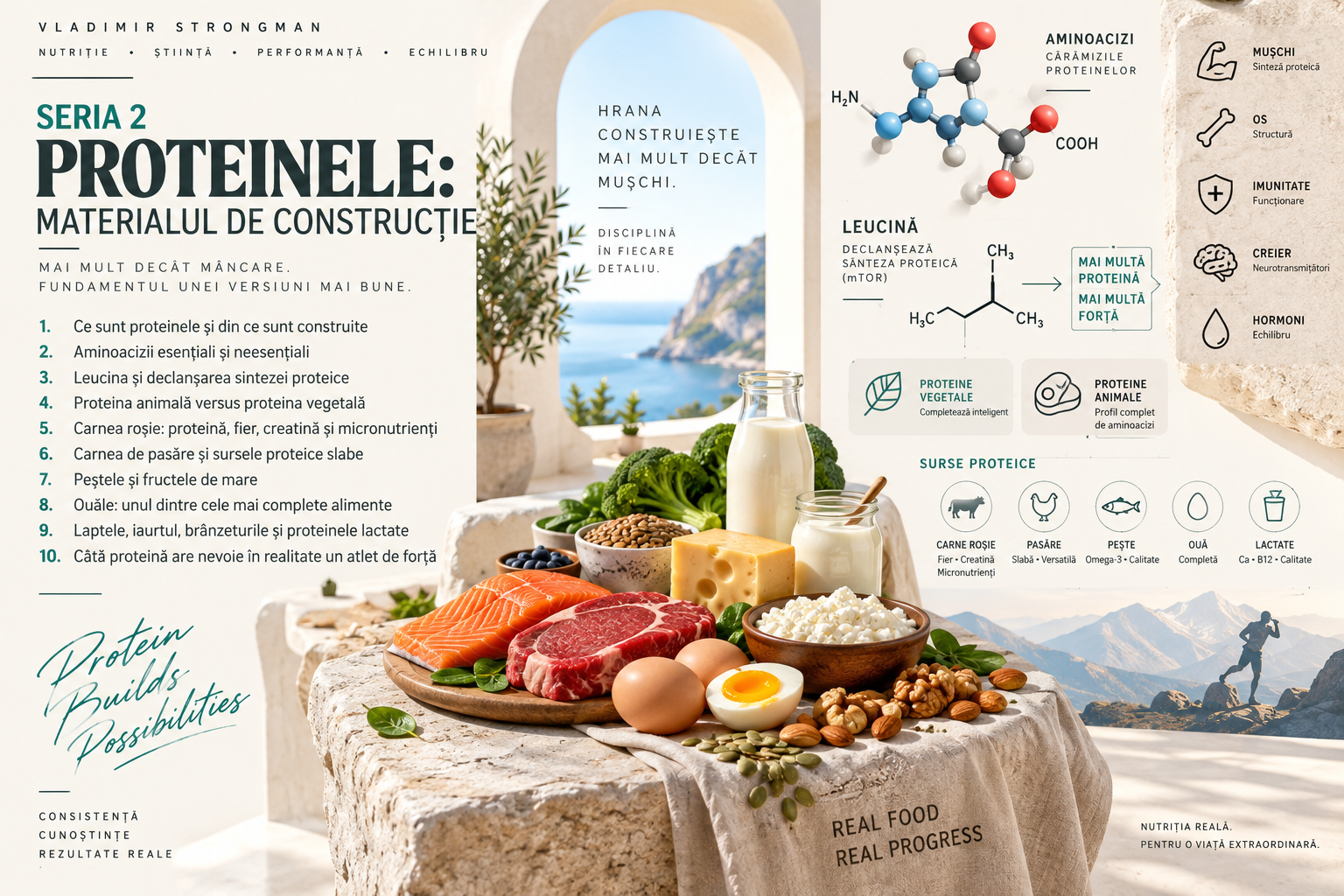
Amino acids are the pieces from which the body builds proteins, but they do not all have the same nutritional status. Some must come from food, while others can be produced from metabolic precursors.
For a strength athlete, the difference matters because synthesis of a muscle protein cannot proceed normally if an indispensable amino acid is unavailable. The body can recycle and transform amino acids, but it cannot make every required structure in sufficient amounts.
This episode examines the protein alphabet from a nutrition perspective: which amino acids are essential, what nonessential and conditionally essential amino acids mean, how food sources complement one another and why the diet must be considered as a whole.
1. Essential describes origin, not importance
An amino acid is called essential when the body cannot synthesize it at all or cannot make enough to meet physiological needs. It therefore has to be supplied by food.
2. Adults have nine essential amino acids
For adults, the indispensable amino acids are histidine, isoleucine, leucine, lysine, methionine, phenylalanine, threonine, tryptophan and valine. Each must be available in sufficient amounts for protein synthesis and its other metabolic roles.
3. The body has no dedicated amino-acid storage depot
There is no inert amino-acid reservoir comparable with glycogen or body fat. Free amino acids form a small dynamic pool, while most are incorporated into functional proteins that are constantly turning over.
4. Protein synthesis needs every required piece
The ribosome builds proteins in an exact genetically determined order. If an essential amino acid required by the sequence is missing, synthesis becomes limited even when all the others are abundant.
5. Histidine does more than build proteins
Histidine is essential and is a precursor of histamine, a molecule involved in immune responses, gastric secretion and neurotransmission. Histidine residues also occur in proteins such as hemoglobin, where they contribute to molecular function.
6. Isoleucine is a BCAA with metabolic roles
Isoleucine is one of the three branched-chain amino acids. It can be oxidized in tissues and contributes to energy metabolism, but its fundamental role remains that of an obligatory component of proteins.
7. Leucine is both material and signal
Leucine is essential and contributes to signaling muscle protein synthesis, including through mTORC1. Activating the signal, however, does not supply all the other amino acids required to build a complete protein.
8. Lysine is often limiting in some cereals
Lysine is an essential amino acid used in protein synthesis and in production of molecules such as carnitine. Some cereals are relatively low in lysine, which is why pairing grains with legumes can improve a meal's amino-acid profile.
9. Methionine brings sulfur into metabolism
Methionine is an essential sulfur-containing amino acid. Through S-adenosylmethionine it participates in numerous methylation reactions, and through other pathways it can contribute to cysteine formation.
10. Phenylalanine can become tyrosine
Phenylalanine is essential, and the body can convert it into tyrosine. Tyrosine then becomes a precursor for catecholamines, thyroid hormones and melanin, illustrating the link between essential and synthesizable amino acids.
11. Threonine supports structural and digestive proteins
Threonine is essential and occurs in many proteins, glycoproteins and mucins. The intestinal lining turns over rapidly, and threonine contributes to the protein infrastructure that protects and maintains the digestive surface.
12. Tryptophan is a precursor for serotonin and melatonin
Tryptophan is essential and can be used to synthesize serotonin, melatonin and niacin. These conversions are tightly regulated, so a higher intake does not automatically produce proportional effects on mood or sleep.
13. Valine completes the BCAA trio
Valine is the third branched-chain amino acid alongside leucine and isoleucine. It participates in protein synthesis and can contribute to energy metabolism, but its usefulness depends on the availability of the full indispensable amino-acid profile.
14. BCAAs are only three of the nine essential amino acids
Leucine, isoleucine and valine have real metabolic characteristics and are heavily studied in sports nutrition. Complete protein synthesis still requires the other six essential amino acids, which is why isolated BCAAs cannot replace complete protein.
15. Nonessential amino acids can be synthesized by the body
Nonessential amino acids are those that human metabolism can produce in adequate amounts under ordinary conditions. Their synthesis uses intermediates from glycolysis, the citric-acid cycle and the metabolism of other amino acids.
16. Alanine links muscle and liver
Alanine can be formed by transamination of pyruvate and helps transport carbon and nitrogen between muscle and liver. In the glucose-alanine cycle, this relationship helps redistribute substrates during exercise and fasting.
17. Aspartate participates in nitrogen transfer
Aspartate is a nonessential amino acid involved in transamination reactions, the urea cycle and nucleotide synthesis. It shows that amino acids are simultaneously building material and metabolic intermediates.
18. Glutamate is a central hub of nitrogen metabolism
Glutamate accepts and donates amino groups in many reactions and can become glutamine or alpha-ketoglutarate. It is one of the main bridges between amino-acid metabolism and the citric-acid cycle.
19. Asparagine can be synthesized from aspartate
Asparagine is produced by amidation of aspartate and is used in protein synthesis and glycosylation processes. Under normal conditions the body can make it, so it is not classified as essential.
20. Serine begins in glucose metabolism
Serine can be synthesized from glycolytic intermediates and contributes to proteins, phospholipids and other molecules. It is another example of the close connection between carbohydrate and amino-acid metabolism.
21. Conditionally essential means demand can exceed production
Some amino acids can normally be made by the body, but in certain physiological or pathological states internal production may not cover demand. They are then described as conditionally essential, a context-dependent category rather than an absolute rule.
22. Glutamine is abundant, but not magical
Glutamine is highly abundant in the body and carries nitrogen between tissues. It can become conditionally essential during severe metabolic stress, but in a healthy athlete supplementation should not be equated automatically with direct muscle gain.
23. Arginine participates in the urea cycle and signaling
Arginine participates in the urea cycle and is a precursor for nitric oxide, creatine and other molecules. Adults can synthesize it, but during growth or certain stress states demand can exceed production.
24. Cysteine partly depends on methionine availability
Cysteine contains sulfur and can be synthesized using sulfur derived from methionine. It contributes to protein structure, disulfide bonds and glutathione synthesis, one of the cell's important antioxidant systems.
25. Tyrosine can be produced from phenylalanine
Tyrosine is considered nonessential when phenylalanine is sufficiently available because it can be synthesized from it. It is a precursor for dopamine, noradrenaline, adrenaline, thyroid hormones and melanin.
26. Glycine is structurally simple but biologically important
Glycine is the smallest amino acid and can be synthesized by the body. It is especially important in collagen, where it appears very frequently, and it also contributes to heme, creatine and glutathione synthesis.
27. Proline has a special geometry
Proline has a cyclic structure that restricts flexibility and strongly influences protein shape. It is important in collagen and connective-tissue structures, making it relevant to tendons, ligaments and extracellular matrix.
28. An amino acid can change category depending on circumstances
Nutritional classification is not completely rigid. Age, growth, illness, trauma and certain metabolic defects can turn a normally synthesizable amino acid into one that must be supplied in greater amounts from outside the body.
29. The free amino-acid pool is small but highly active
Amino acids from food and from breakdown of body proteins enter a common metabolic pool. This pool supplies new protein synthesis and many other molecules, but it does not behave like a large passive storage depot.
30. Protein turnover continuously recycles amino acids
Body proteins are constantly synthesized and degraded. Released amino acids can be reused, oxidized or converted into other molecules, and this recycling reduces dependence on dietary intake from one hour to the next.
31. Transamination moves amino groups between molecules
Through transamination, an amino group can be transferred from an amino acid to a keto acid. These reactions allow the body to produce some nonessential amino acids and concentrate nitrogen into molecules that can later be processed.
32. Deamination releases nitrogen for disposal
When amino acids are used as metabolic substrates, their nitrogen group must be separated and handled. The resulting ammonia is toxic, so metabolism rapidly channels it toward safer forms.
33. The urea cycle converts nitrogen into an excretable form
The liver converts much of the nitrogen produced by amino-acid catabolism into urea. Urea then circulates in blood and is eliminated mainly by the kidneys, allowing the body to process large amounts of protein nitrogen safely.
34. The carbon skeleton of an amino acid can be used for energy
After nitrogen is removed, the carbon portion of an amino acid can enter metabolism as pyruvate, acetyl-CoA or citric-acid-cycle intermediates. In this way amino acids can contribute to ATP production, glucose formation or other metabolic pathways.
35. Glucogenic and ketogenic amino acids enter metabolism differently
Glucogenic amino acids can produce intermediates that contribute to gluconeogenesis, while ketogenic amino acids provide precursors for ketone bodies or lipids. Leucine and lysine are exclusively ketogenic, while several other amino acids have mixed characteristics.
36. Amino acids can be oxidized when intake exceeds immediate needs
The body does not store surplus amino acids in a special depot. When intake exceeds needs for synthesis and other functions, a greater fraction can be catabolized and the carbon skeletons used metabolically.
37. A limiting amino acid can restrict use of the whole protein source
In a protein source, the essential amino acid present in the lowest proportion relative to requirement is called the limiting amino acid. If total dietary intake remains inadequate in that amino acid, use of the others for protein synthesis can be constrained.
38. Complete protein is a useful nutritional shortcut
The phrase complete protein generally describes a source that provides all essential amino acids in adequate proportions. It is a useful concept, but it should not become an absolute division between good and bad foods.
39. Animal proteins tend to be dense in essential amino acids
Eggs, dairy, meat and fish usually provide all essential amino acids and are highly digestible. This does not make them the only useful sources, but they often deliver a concentrated amino-acid profile in a relatively modest serving.
40. Plant proteins can support protein needs very effectively
Legumes, soy, grains, nuts and seeds can make major contributions to protein intake. Some plant sources have a limiting amino acid or lower digestibility, but total quantity, dietary variety and food combinations can compensate for these differences.
41. Protein complementarity works across the diet
Grains tend to be relatively lower in lysine, while some legumes can be relatively lower in sulfur amino acids. Across a varied day of eating, different sources can complement one another without every meal needing a perfectly calculated pairing.
42. Digestibility changes how many amino acids become available
Crude protein content alone does not reveal how many amino acids will be absorbed. Food structure, processing, cooking, antinutritional factors and digestive characteristics influence enzyme access and amino-acid availability.
43. DIAAS attempts to estimate quality through digestible amino acids
DIAAS evaluates indispensable amino-acid profiles together with ileal digestibility. It is useful for comparing sources, but it cannot by itself describe the entire diet, total quantity consumed or an athlete's adaptation.
44. The body responds to meals, not isolated labels
In a real meal, amino acids often come from several foods eaten together. The resulting profile can be more balanced than that of any single ingredient, while digestion and absorption occur in a mixed nutritional context.
45. Total protein intake remains the foundation
An excellent amino-acid profile cannot compensate for an overall protein intake that is too low. For athletes, quality and distribution matter, but they operate on top of the foundation of sufficient daily protein.
46. An effective protein meal should provide enough essential amino acids
The muscle-protein-synthesis response depends not only on total protein quantity but also on essential amino-acid availability after a meal. An adequate serving of high-quality protein supplies leucine together with the rest of the material required for synthesis.
47. The leucine threshold is a useful model, not a perfect switch
Sports-nutrition literature often discusses reaching enough leucine in a meal to produce a robust protein-synthesis response. In reality the response is gradual and depends on dose, age, protein source, training and the availability of the other amino acids.
48. Resistance training increases muscle sensitivity to amino acids
After resistance exercise, mechanical and molecular signals increase the muscle's ability to respond to protein intake. This sensitization lasts much longer than the popular idea of a tiny anabolic window lasting only a few minutes.
49. EAAs provide more complete material than BCAAs alone
A mixture of essential amino acids supplies all dietary components indispensable for protein synthesis, whereas BCAAs provide only three. For that reason, EAAs have a more complete biochemical rationale than isolated BCAAs when the goal is to support synthesis.
50. Complete protein already provides EAAs and BCAAs together
Whey, eggs, dairy, meat, fish, soy and other well-chosen protein sources provide essential amino acids within a complete food matrix. For someone already consuming enough protein, isolated amino-acid supplements may add less than marketing suggests.
51. Energy deficit can increase the importance of protein
During an energy deficit, less energy is available for tissue maintenance and growth, and amino acids may be used more as metabolic substrates. Adequate protein becomes important for preserving lean mass, especially when combined with resistance training.
52. A calorie surplus does not remove the need for essential amino acids
Sufficient energy supports growth processes, but calories cannot replace indispensable amino acids. Extra carbohydrate and fat without enough protein cannot provide the atoms and structures required to build muscle proteins.
53. Age can change the response to amino acids
With advancing age, anabolic resistance can develop, meaning a smaller protein-synthesis response to the same protein dose. Protein quality, the amount per meal and resistance exercise therefore become increasingly relevant.
54. A strongman needs large absolute amounts, not different biochemistry
A 120-150+ kg strength athlete usually carries more lean tissue and has greater absolute protein turnover than an average adult. The same nine essential amino acids remain indispensable and the same metabolic pathways process them; the difference is scale, not biological rules.
55. Digestive tolerance can limit the perfect plan on paper
The large food volumes required by a strongman can make digestion a practical constraint. Spreading protein across meals, choosing well-tolerated sources and avoiding impossible meal sizes can matter more than obsessively chasing a theoretically perfect amino-acid profile.
56. Protein distribution can matter more than the exact minute
For most athletes, obtaining enough protein across the day and distributing it over several meals matters more than consuming amino acids at one exact minute after training.
57. Whole foods provide more than amino acids
A protein-rich food can also provide vitamins, minerals, fatty acids and energy. Evaluating a strongman diet therefore requires looking at the whole food and the whole menu, not only an amino-acid table.
58. Amino-acid supplements are tools, not the foundation
EAAs, BCAAs and individual amino acids can have specific uses, but they do not replace a diet containing enough high-quality protein. The better the underlying diet is built, the smaller the additional value of isolated amino-acid supplements usually becomes.
59. Requirements should be individualized rather than reduced to a magic formula
Body mass, lean mass, training volume, energy intake, age, goals and digestive tolerance all influence protein needs. A strongman cannot be reduced to one grams-per-kilogram number without context.
60. Conclusion: essential and nonessential describe two supply routes
Essential amino acids must come from the diet, while nonessential amino acids can be synthesized by the body, yet both categories participate in the same biological architecture. For a strongman, performance and recovery depend on the availability of the entire amino-acid alphabet, supported by enough protein, energy and well-tolerated nutrition.
The first idea to remember is that essential describes the body's inability to produce enough of an amino acid, not that the amino acid is the only biologically important one.
The second idea is that adults require nine essential amino acids from the diet, and protein synthesis depends on the availability of every amino acid required by a given protein sequence.
The third idea is that nonessential amino acids are not less valuable. They are synthesized from metabolic intermediates and serve structural, energetic, neurological and nitrogen-transport functions.
The fourth idea is that protein sources should be judged by quantity, digestibility and essential amino-acid profile, but always within the context of the whole diet.
Finally, for strongman athletes, chasing one spectacular amino acid matters less than consistently obtaining enough well-distributed, well-tolerated protein within an adequate energy intake.
Sources and recommended reading
1. Nelson DL, Cox MM. Lehninger Principles of Biochemistry. Amino-acid metabolism, transamination, the urea cycle and protein structure.
2. Berg JM, Tymoczko JL, Gatto GJ, Stryer L. Biochemistry. Essential amino acids, nitrogen metabolism and protein synthesis.
3. FAO. Dietary Protein Quality Evaluation in Human Nutrition. Protein-quality evaluation and the DIAAS concept.
4. WHO/FAO/UNU. Protein and Amino Acid Requirements in Human Nutrition. Human requirements for protein and indispensable amino acids.
5. Jäger R et al. International Society of Sports Nutrition Position Stand: Protein and Exercise. Journal of the International Society of Sports Nutrition.
6. Morton RW et al. Protein supplementation and resistance training-induced gains in muscle mass and strength. British Journal of Sports Medicine.
7. Phillips SM, Van Loon LJC. Dietary protein for athletes: from requirements to optimum adaptation. Journal of Sports Sciences.
8. Wolfe RR. Branched-chain amino acids and muscle protein synthesis in humans: myth or reality? Journal of the International Society of Sports Nutrition.
9. Tipton KD, Wolfe RR. Protein and amino acids for athletes. Journal of Sports Sciences.
10. Exercise-physiology and sports-nutrition literature on leucine, mTORC1, essential amino acids, protein turnover and adaptation to resistance training.
Editorial note: this article is educational. Individual protein and amino-acid requirements should be adapted to health status, goals, energy intake and training volume and do not replace assessment by a qualified physician or dietitian.
More From The Journal

Training
The Science of Strongman Training - Episode X: Competition Programming
How to build a complete Strongman competition preparation block: calendar, events, volume, intensity, specificity, simulations, autoregulation, tapering and fatigue management.

Training
The Science of Strongman Training - Episode IX: Peaking
Peaking in Strongman: how to turn months of training into maximal competition performance by reducing fatigue, preserving adaptations and managing specificity.