
Nutrition
Series: Proteins, the Building Material - Episode 10: How Much Protein Does a Strength Athlete Really Need?
September 10, 2026
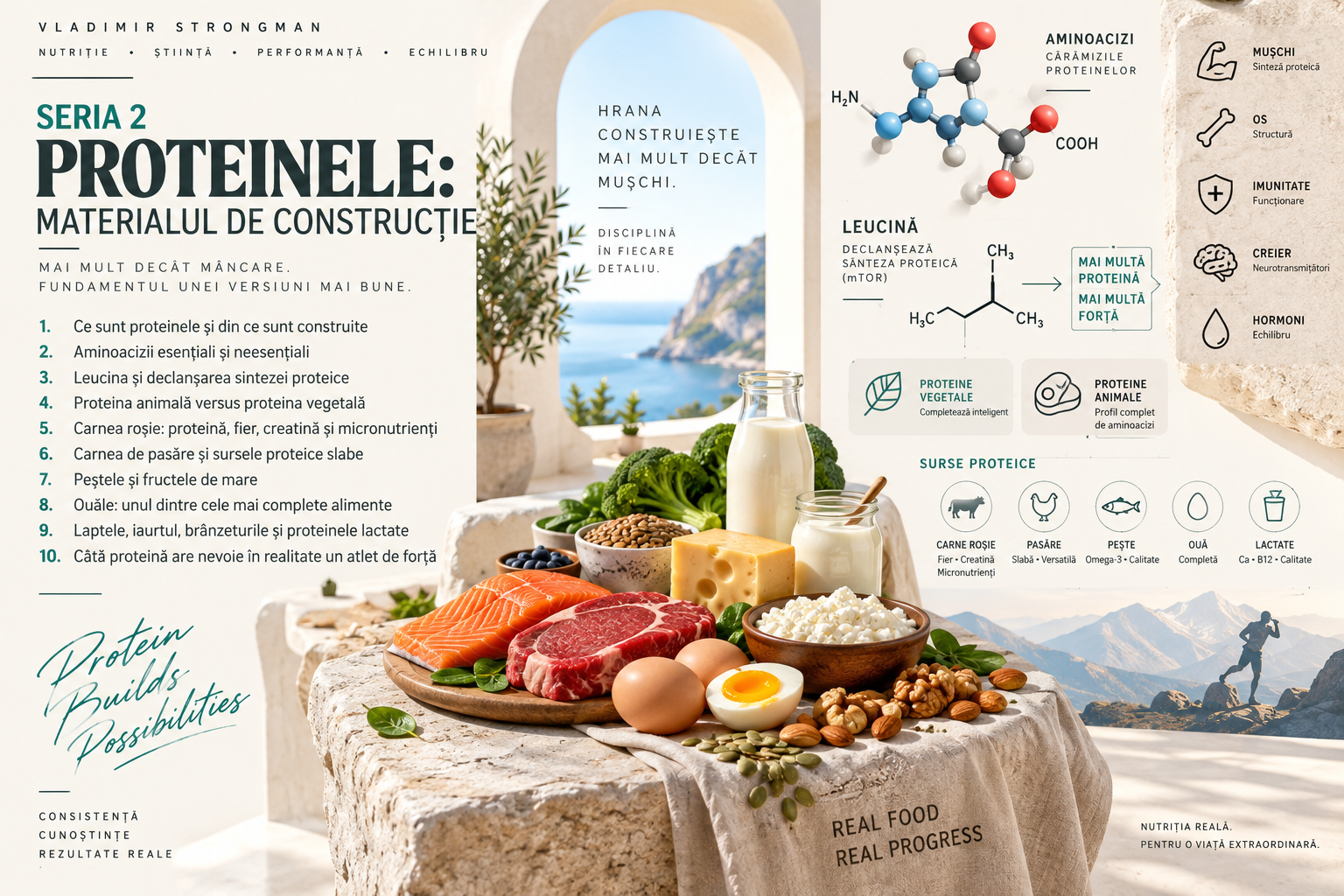
The question of how much protein a strength athlete needs does not have one universal answer. Requirements depend on body mass, body composition, training, energy intake and the goal. There is a clear difference between the minimum that prevents deficiency and the amount that optimizes muscular adaptation.
For most strength athletes, the practical range in the literature sits around 1.6-2.2 grams of protein per kilogram of body weight per day, with adjustments for context. This is not a biological law, but a range in which requirements are usually well covered without pushing the diet unnecessarily toward extremes.
Strongman creates a special problem: a 140-160 kg athlete is not simply an enlarged version of an 80 kg athlete. Mechanically multiplying total body weight by a high coefficient can create excessive protein targets and leave too little room for the carbohydrates needed for performance.
1. Minimum requirement and optimal intake are not the same thing
Population recommendations mainly aim to prevent deficiency. Strength athletes also care about recovery, muscle remodeling and training adaptation, so the intake that supports performance is usually higher than the minimum needed for basic health.
2. 0.8 g/kg is not a performance target for strongman
An intake around 0.8 g/kg/day is associated with general adult requirements rather than maximizing hypertrophy in a hard-training athlete. Protein turnover and recovery demands are higher in the context of resistance training.
3. Around 1.6 g/kg often appears as a high-efficiency point
Meta-analyses of resistance training frequently show that the additional benefits of protein supplementation approach a plateau around 1.6 g/kg/day in many adults. This is not a magical threshold, but a region where additional returns begin to diminish.
4. 2.0-2.2 g/kg often provides a practical safety margin
For serious athletes, an intake around 2.0-2.2 g/kg/day can cover individual variation, imperfect eating days and periods of high training volume. It is not mandatory for everyone, but it makes it unlikely that protein itself becomes the limiting factor.
5. More protein does not produce linear muscle gain
If 1.6 g/kg is effective, 3.2 g/kg does not double hypertrophy. Once requirements are covered, progress depends more on training, energy, sleep and recovery than on another serving of protein.
6. Protein does not build muscle without a mechanical stimulus
Amino acids are construction material, but training is the signal that tells the body where to invest. Without progressive overload, appropriate volume and recovery, very high protein intake cannot replace the missing training stimulus.
7. Body weight is useful, but imperfect
Calculating grams per kilogram is simple, but it assumes every additional kilogram of body mass increases protein requirements to the same degree. In very heavy athletes with different body-fat percentages, that assumption becomes less precise.
8. Lean mass can sometimes be a more logical reference
Muscle and other lean tissues have much more active protein turnover than adipose tissue. In an athlete with very high body mass, using total body weight alone can overestimate the practical requirement.
9. Target body weight can simplify calculations in very heavy athletes
If a 150 kg athlete intends to reach 135 kg, calculating protein from a reasonable target weight can prevent exaggerated recommendations. It is not a perfect method, but it can be more practical than rigidly multiplying current total body weight.
10. A heavy strongman does not automatically need 300-350 g of protein per day
At 150 kg, 2.2 g/kg equals 330 g of protein per day. That may be reasonable in specific circumstances for a very muscular, lean athlete, but for many strongmen it is more than necessary and can reduce room for carbohydrates.
11. Carbohydrates should not be sacrificed to make room for protein
Strongman depends heavily on glycogen for hard sets, medleys, yoke, farmers and timed repetitions. If excessive protein pushes carbohydrates too low, performance can fall. Once protein is sufficient, training energy becomes a priority.
12. Protein needs tend to rise during a calorie deficit
When energy intake is reduced, the body has fewer resources for preserving muscle and amino-acid oxidation may increase. A higher protein intake combined with resistance training helps protect lean mass.
13. The more aggressive the deficit, the harder muscle preservation becomes
A moderate deficit can be managed with adequate protein and good training. In a very large deficit, even high protein intake cannot guarantee complete preservation of muscle and performance.
14. In a calorie surplus, protein requirements do not rise without limit
In an energy surplus, the body has enough calories to support anabolic processes. Once protein intake is adequate, further increases bring diminishing returns, and additional energy can often be directed toward carbohydrates.
15. Beginners and advanced athletes do not respond identically
Beginners can build muscle rapidly because the stimulus is new. Advanced athletes have a slower growth potential even if they eat more protein. Progress increasingly becomes limited by adaptation biology rather than raw protein intake.
16. Age can alter the anabolic response
With advancing age, the muscle-protein-synthesis response to a meal may become less sensitive. Older athletes may benefit from somewhat larger protein servings and careful distribution across the day.
17. Protein quality influences the amount required
A well-digested protein with a complete essential-amino-acid profile supplies building material efficiently. Sources with lower digestibility or a limiting amino acid may require somewhat larger servings or complementary food combinations.
18. Animal proteins are convenient, but not mandatory
Meat, fish, eggs and dairy generally provide complete, highly digestible proteins. A predominantly plant-based diet can still support performance if total intake is sufficient, food sources are varied and essential amino acids are covered.
19. Leucine matters, but does not need obsessive tracking
Leucine helps trigger anabolic signaling. In a diet containing enough high-quality protein, the leucine threshold is usually reached naturally at main meals without obsessive calculation.
20. Total daily protein matters more than the exact minute it is consumed
Distribution matters, but the first objective is reaching the daily target. An athlete who consistently eats enough protein is usually in a better position than one who perfectly times an anabolic window but remains far below daily requirements.
21. The anabolic window is not a door that closes after 30 minutes
Training raises muscle sensitivity to amino acids for hours. A post-workout protein meal is useful, but there is no need to panic if it is not immediate. The meals before and after training matter more than minute-by-minute timing.
22. Distributing protein across 3-5 meals is practical
Dividing protein across several meals provides repeated opportunities to stimulate muscle protein synthesis. Six or eight meals are not mandatory. For most athletes, three to five protein-rich meals are sufficient and sustainable.
23. About 0.4 g/kg per meal is a useful guide, not a hard limit
Distributing roughly 1.6 g/kg/day across four meals gives about 0.4 g/kg per meal. This is a planning tool rather than a threshold above which protein is wasted. Digestion and absorption continue at larger meal sizes.
24. 30-40 grams per meal is not a universal ceiling
A 65 kg athlete and a 150 kg athlete do not have the same muscle mass or absolute requirements. The generic 30-gram rule is too simplistic. Larger athletes can use larger protein servings without the additional amino acids somehow disappearing.
25. The body can digest much more than 30 grams of protein at once
The myth that the body cannot absorb more than 30 grams confuses absorption with immediate use for muscle protein synthesis. The intestine can absorb much larger amounts, and amino acids serve many tissues and processes beyond skeletal muscle.
26. One huge meal does not make daily distribution irrelevant
Eating an enormous amount of protein at dinner does not necessarily produce the same anabolic pattern as distributing it throughout the day. The body will digest it, but a more balanced distribution provides more opportunities to stimulate muscle protein synthesis.
27. Pre-sleep protein can be useful, but it is not mandatory
Casein, yogurt, cottage cheese or another protein source before bed can support amino-acid availability overnight. If daily protein is already well distributed, pre-sleep protein is not a compulsory condition for progress.
28. A very low-protein breakfast can distort daily distribution
Many people eat little protein in the morning and much more at night. For athletes, adding a substantial protein source at breakfast can improve daily distribution without necessarily raising total intake.
29. Whey is a tool, not a separate category of nutrition
Whey protein is concentrated food, not a special anabolic substance. It is useful for convenience, rapid digestion and accurate dosing. If protein intake can be covered comfortably through food, supplementation is optional.
30. BCAAs matter much less when total protein is sufficient
BCAAs provide only three amino acids, while muscle protein synthesis requires the full set of essential amino acids. If an athlete eats enough complete protein, extra BCAAs usually provide little additional benefit.
31. EAAs can be useful, but they do not replace a diet
Essential-amino-acid products can help when appetite is low or solid food is difficult to tolerate. They do not provide the micronutrients, energy and satiety of whole foods. They are a situational tool rather than a nutritional foundation.
32. Collagen should not be counted as a perfect equivalent of muscle-building protein
Collagen has a different amino-acid profile and is relatively low in several essential amino acids important for muscle protein synthesis. It may have a role in connective-tissue strategies, but large collagen intakes can overstate the hypertrophy value of total protein intake.
33. Gelatin and collagen serve a different role from whey
Whey is rich in leucine and essential amino acids, while collagen is rich in glycine, proline and hydroxyproline. They are not interchangeable. Both can exist in the same diet, but for different purposes.
34. Plant proteins may require more attention to dose and combination
Proteins from legumes, grains, soy, peas and other plants can contribute substantially, but some have lower digestibility or limiting amino acids. Combining sources and using a slightly higher total intake can compensate for these differences.
35. Soy is a high-quality plant protein
Soy provides all essential amino acids and has good protein quality. It can be an effective part of an athlete's diet. Claims that ordinary soy protein intake is useless for men are not supported by the broader evidence.
36. Protein from food counts just as much as protein from supplements
Meat, fish, eggs, yogurt and cheese all contribute to the same daily target. Supplements simply concentrate and simplify intake, while whole foods also provide micronutrients and satiety.
37. Protein has a meaningful thermic cost
The thermic effect of protein is high compared with other macronutrients. Some energy is spent on digestion, absorption and metabolism. This may modestly support satiety and weight control, but protein still provides calories.
38. Protein can be used as energy
Amino acids that are not needed for synthesis can be deaminated, and their carbon skeletons can enter energy pathways. Protein is not stored in a special reserve that exists only for muscle.
39. Excess protein does not automatically convert directly into body fat
Converting protein into fat is metabolically more complex than storing dietary fat. However, if total energy intake remains chronically excessive, body-fat gain is still possible regardless of where the calories originated.
40. Very high protein intake can become inconvenient before it becomes useful
Extreme protein intakes can bring excessive fullness, bloating, financial cost, monotonous meals and reduced carbohydrate intake. The relevant question is not only whether the intake can be tolerated, but whether it provides enough benefit to justify those tradeoffs.
41. In healthy kidneys, higher protein intake is not automatically toxic
In healthy people, protein intakes above general population recommendations are not automatically considered harmful to the kidneys. The body adapts to nitrogen handling. This conclusion should not be generalized to people with kidney disease.
42. Kidney disease changes the discussion completely
People with chronic kidney disease, proteinuria or other renal problems should not copy high-protein diets used by healthy athletes. In these situations, protein intake can become part of medical treatment and should be individualized.
43. Hydration still matters in a high-protein diet
Amino-acid metabolism produces nitrogen-containing compounds that must be eliminated, while large athletes can lose substantial fluid through sweat. High protein does not require special rituals, but daily hydration still needs to be appropriate.
44. Higher urea does not automatically mean kidney failure
High protein intake can influence urea, while training and hydration affect other laboratory markers. Results in athletes need contextual interpretation. A single value should not be used for self-diagnosis.
45. Creatinine is influenced by muscle mass too
Very muscular athletes can have higher creatinine than the general population, and creatine supplementation can complicate interpretation. Assessing kidney function in a strongman requires clinical context and sometimes additional markers.
46. Protein does not simply leach calcium from bones
The old claim that high protein automatically weakens bones ignores renal adaptation, calcium intake and the positive effects of protein and resistance training on muscle and skeletal health. The total diet is the correct framework for evaluation.
47. Protein satiety can be an advantage or a disadvantage
During a calorie deficit, greater satiety is useful. For a strongman who needs a very high energy intake, the same fullness can make calorie targets harder to reach. Protein intake must also fit the practical eating demands of the athlete.
48. Protein intake has to fit total food volume
Lean meat, high-protein yogurt and egg whites can create large food volumes. During mass gain, more energy-dense foods may be practical; during a deficit, the same volume can be helpful.
49. Rest days do not require a drastic protein reduction
Recovery and remodeling continue after the training session ends. Protein is not needed only on gym days. Keeping intake relatively consistent from day to day simplifies nutrition and supports recovery.
50. On competition day, digestibility may matter more than protein perfection
During a long contest, the main priorities may be energy, hydration and gastrointestinal comfort. There is no need to hit the exact daily protein target between events. One slightly lower-protein day does not erase months of adaptation.
51. After competition, protein works together with energy and carbohydrates
Post-contest recovery needs amino acids, but also glycogen restoration, fluids, electrolytes and enough total energy. A protein shake alone does not repair an exhausted athlete. Recovery nutrition works as a system.
52. During injury, adequate protein can help limit muscle loss
When training volume drops because of injury, the risk of muscle loss can rise. Adequate protein distributed across the day can help, but total energy should also be adjusted if calorie expenditure falls.
53. Poor sleep cannot be compensated for with another 50 grams of protein
Muscle recovery depends on sleep, stress, energy and training. Protein is essential, but it cannot replace chronically inadequate sleep. Once diet is sufficient, improving sleep may matter more than adding unnecessary protein.
54. A food log is more useful than guessing
Many athletes believe they eat 200 grams of protein without ever calculating it. A few days of accurate tracking can show whether intake is too low, sufficient or excessive and allow adjustments based on real data.
55. A kitchen scale is a temporary tool, not a lifelong obligation
Measuring food for a period can teach portion sizes and protein content. Once the athlete understands meal structure, permanent weighing is not necessary for everyone.
56. A practical target can be a range rather than one exact number
Instead of insisting on exactly 198 grams, an athlete can work with a range such as 180-210 grams, adjusted to body size and goal. Flexibility reduces stress and makes the diet more sustainable. Biology does not operate with barcode precision.
57. For many athletes, 1.6-2.2 g/kg/day is the practical central range
This range covers most strength-training situations well. The lower end may be sufficient during maintenance or a surplus, while the upper end becomes more relevant during a deficit, high training volume or when extra margin is desired.
58. In very heavy athletes, the calculation must be individualized
A 140-160 kg strongman can reach enormous numbers by mechanically applying a high coefficient to total body weight. If body-fat percentage is substantial, lean mass, target weight and energy context may produce more realistic estimates.
59. A practical example for a very heavy strongman
A 145 kg athlete should not automatically assume that more than 300 grams of protein is necessary. If very muscular and dieting, a high intake may be useful; if body fat is higher and calories are already abundant, 220-260 grams of quality protein may already be a very robust intake.
60. Conclusion: enough protein is essential; excess is not a medal
The goal is not the maximum protein intake possible, but enough protein for adaptation and recovery without sacrificing energy, carbohydrates, digestion and adherence. For most strength athletes, 1.6-2.2 g/kg/day is a strong starting point, intelligently adjusted for body composition and goals.
The first key point is that strength athletes need more protein than the general minimum, but benefits do not increase linearly with every additional gram.
The second point is that roughly 1.6-2.2 g/kg/day covers most situations, with the upper end becoming more useful during calorie restriction or very high training volume.
The third point is that very heavy athletes should not mechanically apply the coefficient to total body weight; lean mass, target weight and energy context can create more realistic estimates.
The fourth point is that distributing quality protein across 3-5 meals is useful, but total daily intake matters more than obsessively timing an anabolic window.
Finally, for strongman athletes, protein must leave enough room for the carbohydrates and energy required for performance. A higher-protein diet is not automatically a better diet.
Sources and recommended reading
1. Morton RW et al. A systematic review, meta-analysis and meta-regression of protein supplementation and resistance training adaptations. British Journal of Sports Medicine.
2. Jäger R et al. International Society of Sports Nutrition Position Stand: Protein and Exercise. Journal of the International Society of Sports Nutrition.
3. Schoenfeld BJ, Aragon AA. How much protein can the body use in a single meal for muscle-building? Implications for daily protein distribution.
4. Helms ER et al. Evidence-based recommendations for natural bodybuilding contest preparation: nutrition and supplementation. Considerations for protein intake during calorie restriction.
5. Phillips SM, Van Loon LJC. Dietary protein for athletes: from requirements to optimum adaptation. Research on protein, exercise and muscle protein synthesis.
6. Moore DR et al. Research on the muscle-protein-synthesis response to different protein doses after resistance exercise.
7. Areta JL et al. Research on protein distribution during recovery from resistance exercise.
8. Antonio J et al. Studies of high-protein diets in trained individuals and effects on body composition and health markers.
9. FAO. Dietary Protein Quality Evaluation in Human Nutrition. Protein quality, indispensable amino acids and digestibility.
10. Hall JE. Guyton and Hall Textbook of Medical Physiology; Nelson DL, Cox MM. Lehninger Principles of Biochemistry. Protein, nitrogen and amino-acid metabolism.
Editorial note: this article is educational. People with kidney disease, liver disease, metabolic disorders or other medical conditions should individualize protein intake with their physician and a qualified nutrition professional.
More From The Journal

Training
The Science of Strongman Training - Episode X: Competition Programming
How to build a complete Strongman competition preparation block: calendar, events, volume, intensity, specificity, simulations, autoregulation, tapering and fatigue management.

Training
The Science of Strongman Training - Episode IX: Peaking
Peaking in Strongman: how to turn months of training into maximal competition performance by reducing fatigue, preserving adaptations and managing specificity.