
Nutrition
Series: Proteins, the Building Material - Episode 1: What Proteins Are and What They Are Made Of
September 10, 2026
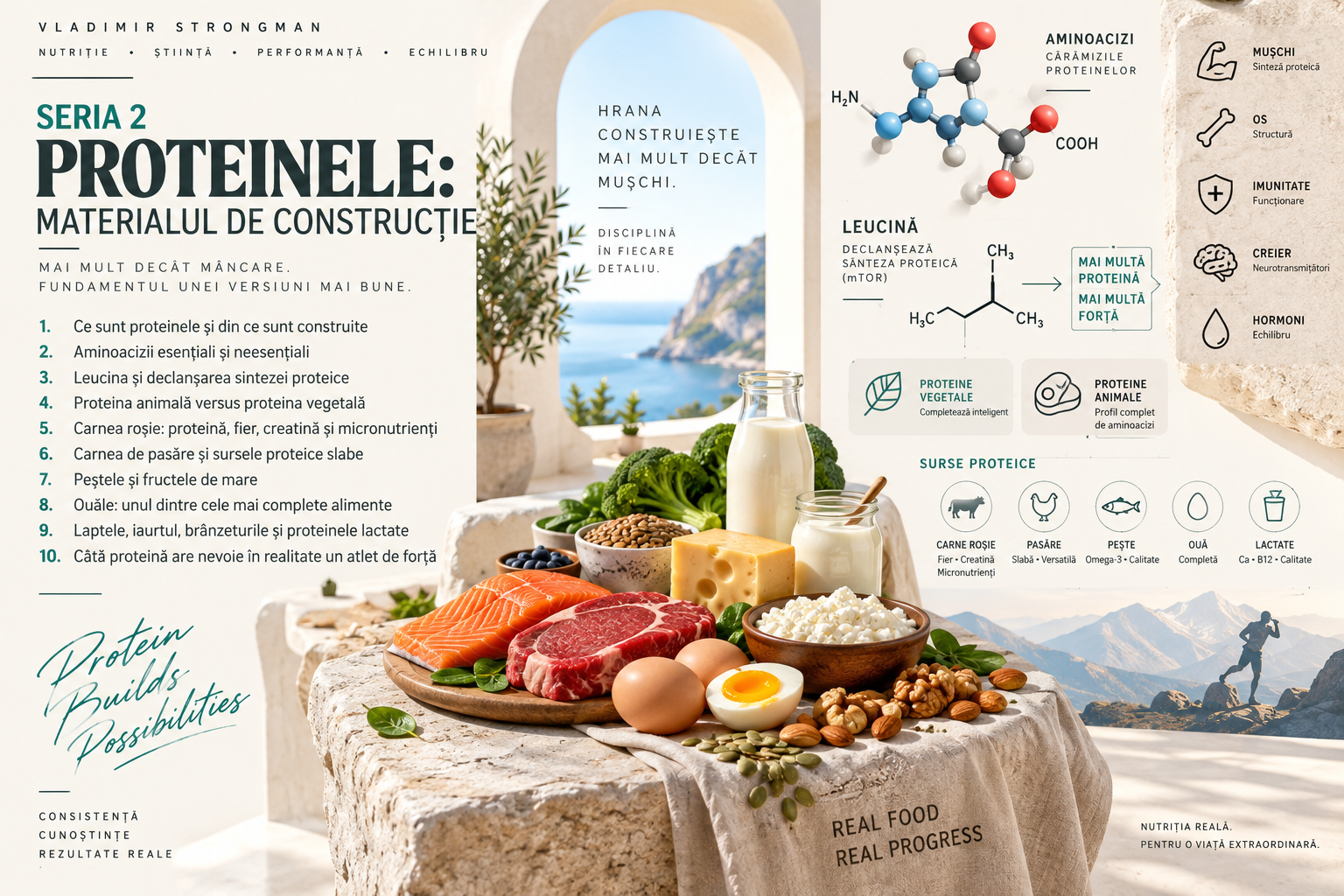
When we say “protein” in sports, the mind almost automatically jumps to muscle. Biologically, however, proteins are far more than raw material for hypertrophy. They are among the most versatile molecules in life: they build structures, generate movement, accelerate chemical reactions, transport substances, transmit signals, participate in immune defense and help tissues repair and adapt.
For a strongman, their importance is easy to see. Contractile muscle is rich in protein, tendons and ligaments depend on collagen, enzymes that manage energy are proteins, and many receptors that allow cells to respond to hormones are proteins as well. Without proteins, strength would have neither a structure nor a working mechanism.
This first episode starts with the foundation: what a protein is, which chemical elements build it, what amino acids are, how they connect and how a simple sequence of units becomes a three-dimensional molecule capable of highly precise jobs. Before discussing how much protein an athlete should eat, it helps to understand what protein actually is.
1. Proteins are biological macromolecules
A protein is a macromolecule made of one or more chains of amino acids. The prefix “macro” matters: proteins may contain anything from a few dozen to thousands of amino acids and can reach very large molecular masses. They are not simply piles of biological material. The order of amino acids and the final shape of the chain determine function, much as the arrangement of parts determines what a machine can do.
2. Amino acids are the basic units
If a protein is a chain, amino acids are its links. Every standard protein-building amino acid has a common framework: a central carbon attached to an amino group, a carboxyl group, a hydrogen atom and a side chain called the R group. The R group differs among amino acids and gives each one particular chemical properties, including water affinity, electrical charge and the ability to form structural interactions.
3. Peptide bonds connect amino acids
Amino acids become a chain when the carboxyl group of one joins the amino group of the next, forming a peptide bond. A molecule of water is removed in the reaction, making it a condensation process. Repeated hundreds of times, the same basic chemistry creates a polypeptide. Inside cells, ribosomes build these bonds with remarkable precision according to genetically encoded instructions.
4. Twenty amino acids build most human proteins
The human body mainly uses twenty standard amino acids to build proteins. From such a small alphabet comes an enormous diversity of structures because chain length, amino-acid order and folding all vary. A muscle protein, a digestive enzyme and an antibody can be made from the same types of “letters”, yet their sequences and architectures are completely different.
5. Essential amino acids must come from the diet
Some amino acids can be synthesized by the body in sufficient amounts, while others cannot. Those that cannot be produced fast enough are called essential amino acids and must be supplied by food. In adults they include histidine, isoleucine, leucine, lysine, methionine, phenylalanine, threonine, tryptophan and valine. “Essential” does not mean that other amino acids are unimportant; it describes their dietary requirement.
6. Nonessential amino acids are not unimportant
The label “nonessential” can be misleading. These amino acids remain essential to biology, but the body can synthesize them from other precursors. Alanine, aspartate and glutamate participate heavily in metabolism, while glycine is fundamental to collagen. Their classification reflects the body's synthetic capacity, not a lack of biological importance.
7. Some amino acids are conditionally essential
There are situations in which internal synthesis no longer fully covers demand. During growth, illness, trauma, severe burns or intense metabolic stress, certain amino acids may become conditionally essential. Arginine, glutamine, cysteine, tyrosine, glycine, proline and others may enter this category depending on context. The concept shows that amino-acid requirements are dynamic rather than rigid.
8. The R group gives each amino acid its chemical personality
Side chains explain much of the difference among amino acids. Some are nonpolar and avoid water, while others are polar, acidic, basic or aromatic. These properties help determine which portions of a chain hide inside the protein, which remain exposed and where electrostatic interactions or hydrogen bonds can form. Three-dimensional protein structure begins with these local chemical preferences.
9. Proteins contain substantial nitrogen
Proteins are composed mainly of carbon, hydrogen, oxygen and nitrogen, with some also containing sulfur. Nitrogen is one of the features that distinguishes protein metabolism from carbohydrate and fat metabolism. Handling amino groups therefore requires specialized pathways, and excess nitrogen is ultimately disposed of largely through the urea cycle.
10. Sulfur appears in amino acids with important structural roles
Methionine and cysteine contain sulfur. Cysteine is especially notable because two cysteine residues can form a disulfide bond, a covalent bridge that stabilizes certain proteins. Such bonds are common in proteins that are secreted or exposed to extracellular conditions. Sulfur chemistry illustrates how a relatively small difference between amino acids can create major structural consequences.
11. Human proteins use almost exclusively L-amino acids
Most amino acids can exist as mirror-image forms called enantiomers. Human protein synthesis uses almost exclusively the L configuration. This stereochemical preference matters because enzymes and ribosomes recognize molecular geometry with high precision. Biology works not only with chemical formulas but with exact three-dimensional arrangements.
12. Primary structure is the order of amino acids
The first level of protein organization is primary structure: the exact sequence of amino acids from one end of the chain to the other. This sequence is dictated by genetic information. A single amino-acid change may sometimes have little consequence, while in other cases it can greatly alter protein stability or function. The sequence is the construction plan from which all higher levels of structure emerge.
13. Secondary structure creates local motifs
As the chain forms, certain segments adopt regular local structures. The best-known examples are the alpha helix and beta sheet. These arrangements are stabilized largely by hydrogen bonds in the peptide backbone. Secondary structure does not yet describe the whole protein, but it provides recurring architectural elements that are incorporated into the final shape.
14. Hydrogen bonds help stabilize shape
Hydrogen bonds are weaker than covalent bonds, but they occur in large numbers and can make a major contribution to protein stability. They form within the backbone, between side chains and with surrounding water molecules. Protein structure is maintained by the sum of many interactions rather than a single molecular glue.
15. Tertiary structure is the three-dimensional shape of a chain
Tertiary structure describes how an entire polypeptide chain folds in space. Hydrophobic interactions, hydrogen bonds, ionic attractions, van der Waals forces and disulfide bridges can all contribute. For many proteins, function depends directly on this geometry: an enzyme needs an active site with the correct shape, while a receptor must recognize specific molecules.
16. Quaternary structure appears when multiple chains work together
Some proteins function as a single chain, while others are assemblies of several polypeptide subunits. Their organization is called quaternary structure. Hemoglobin is a classic example, being composed of four subunits. Many muscle proteins and enzyme complexes likewise depend on coordinated association among multiple components.
17. Folding turns a chain into a biological tool
A newly synthesized amino-acid chain is not automatically a functional protein. It must acquire an appropriate conformation through protein folding. The sequence contains much of the information needed for folding, but the cellular environment, ion concentrations, pH and helper proteins influence the result. Final shape emerges from the physics and chemistry of the chain.
18. Molecular chaperones help proteins fold correctly
Cells use proteins called molecular chaperones to reduce the risk of misfolding or aggregation. Chaperones do not necessarily dictate the final structure, but they create conditions that help other proteins reach functional conformations. Under thermal or cellular stress, some chaperones, including heat-shock proteins, become especially important for protecting the proteome.
19. Denaturation changes shape without necessarily cutting the chain
Heat, extreme pH, solvents and other factors can disrupt the interactions that maintain a protein's three-dimensional structure. This is called denaturation. Peptide bonds may remain intact while shape and often function are lost. Egg white becoming opaque and firm during cooking is a visible example of proteins being reorganized by heat.
20. Hydrolysis breaks proteins into smaller fragments
For dietary proteins to be absorbed and reused, peptide bonds must be broken through hydrolysis. Digestive enzymes reduce proteins to progressively smaller peptides and amino acids. The same principle of controlled breakdown exists inside cells, where old or damaged proteins are degraded. The body does not keep proteins unchanged forever; it continuously builds and dismantles them.
21. Body proteins are in constant turnover
Body proteins are not structures assembled once and preserved forever. Every day some are synthesized, others are degraded, and released amino acids may be reused. This turnover allows damaged molecules to be replaced, tissues to adapt to training and structures to be remodeled. Even a muscle that appears stable is, molecularly, a continuously active construction site.
22. Proteostasis balances synthesis, folding and degradation
Proteostasis describes control over the entire life cycle of proteins: production, folding, localization, repair and removal. Cells must maintain enough functional protein while preventing damaged molecules from accumulating. The ubiquitin-proteasome system and autophagy contribute to disposal. Without this control, proteins could become cellular clutter rather than precise structural and functional tools.
23. Collagen is the dominant structural protein of connective tissue
Collagen is a family of proteins that provides mechanical strength to skin, tendons, ligaments, cartilage and extracellular matrix. Its chains have a distinctive composition rich in glycine, proline and hydroxyproline and organize into highly resistant helical and fibrillar structures. For a strength athlete, protein means not only muscle fibers but also the biological cables that transmit tension.
24. Keratin shows that proteins can become highly durable materials
Keratins form important parts of hair, nails and epithelial structures. Their molecular interactions make them resistant to stretching and wear. Keratin is a useful example because it shows how different the physical properties of proteins can be: some are flexible and dynamic, while others become durable construction materials.
25. Actin and myosin turn chemistry into force
In muscle, actin and myosin are central proteins of contraction. Myosin heads cyclically interact with actin filaments and use ATP to drive filament sliding and sarcomere shortening. Here protein is not merely passive building material. It is a molecular machine that converts chemical energy into mechanical work.
26. The sarcomere is an architecture built largely from proteins
The contractile unit of striated muscle, the sarcomere, is an ordered assembly of filaments and support proteins. Actin, myosin, titin, nebulin and numerous Z-line proteins maintain the geometry required for contraction. Muscular force emerges from the organization of these molecules at microscopic scale and the summed action of millions of sarcomeres.
27. Titin acts as a molecular elastic element
Titin is one of the largest known proteins and spans much of the sarcomere. It helps align the thick filament and contributes to passive elastic properties of muscle fibers. Titin reminds us that strength depends not only on molecules that actively pull, but also on proteins that stabilize, center and manage tension.
28. Dystrophin and the cytoskeleton transmit force beyond the sarcomere
Force generated by sarcomeres must be transferred through the muscle fiber toward connective tissue and tendon. Proteins such as dystrophin and membrane-associated complexes help link the cytoskeleton to the extracellular matrix. Useful contraction is therefore the product of a much wider mechanical chain than the actin-myosin interaction alone.
29. Enzymes are proteins that accelerate reactions
Most enzymes are proteins. They lower activation energy and allow metabolic reactions to proceed rapidly enough for life. Glycolysis, glycogen synthesis, fatty-acid oxidation and many stages of ATP production depend on protein enzymes. Muscle could not effectively use available fuel without this catalytic infrastructure.
30. Protein receptors allow cells to receive signals
Many biological signals cannot produce an effect until they are recognized by a receptor. Numerous receptors are proteins located in membranes or inside cells. Ligand binding can change receptor conformation and initiate signaling cascades. Training adaptation, appetite regulation, insulin action and many hormonal effects depend on these structures.
31. Channels and transporters are protein gates through membranes
Cell membranes are lipid-based, yet many of their key functions depend on proteins. Ion channels regulate sodium, potassium and calcium movement, while transporters move glucose, amino acids and other molecules. Nerve excitation, muscle contraction and nutrient absorption would be impossible without these specialized molecular gates.
32. Some hormones are themselves proteins or peptides
Insulin, growth hormone and many other messengers are peptides or proteins. They are synthesized from amino acids, processed in specialized cells and released to communicate with other tissues. Proteins therefore do more than build tissue; they can carry biological instructions that change cellular metabolism and behavior.
33. Antibodies are proteins of recognition and defense
Immunoglobulins, or antibodies, are proteins with specialized regions that recognize antigens. Their three-dimensional structure allows highly specific molecular discrimination. The immune system provides a striking example of how variation in sequence and shape can turn the same basic amino-acid material into an enormous library of recognition molecules.
34. Albumin is a major protein of transport and plasma balance
Albumin is one of the most abundant plasma proteins. It transports fatty acids, hormones, drugs and other molecules and makes a major contribution to plasma oncotic pressure, helping regulate fluid distribution between blood vessels and tissues. Circulating proteins demonstrate that protein functions are systemic rather than limited to muscle.
35. Hemoglobin is a protein specialized for oxygen transport
Hemoglobin in red blood cells is a protein complex that reversibly binds oxygen through heme groups. Its quaternary structure enables cooperative behavior between subunits, optimizing oxygen loading in the lungs and unloading in tissues. Even repeated physical effort depends indirectly on the properties of a highly sophisticated protein.
36. Digestive enzymes are proteins too
Pepsin, trypsin, chymotrypsin and many other digestive enzymes are proteins that catalyze the breakdown of other proteins. There is an elegant biochemical irony here: the body uses proteins to digest proteins. These enzymes are secreted and activated under tight control because an active protease in the wrong place could attack the body's own structures.
37. Membranes are populated by specialized proteins
A biological membrane is not merely a sheet of fat. It contains proteins that act as receptors, enzymes, pumps, transporters, channels and anchors. These proteins determine what enters, what leaves and how a cell responds to its environment. The functional identity of a membrane depends heavily on its protein population.
38. Muscle is not pure protein
Gym language sometimes reduces muscle to protein, but muscle tissue contains large amounts of water, glycogen, lipids, minerals and other components. Proteins provide contractile and functional infrastructure, not the entire mass of muscle. This is why one kilogram of body mass gained cannot be equated with one kilogram of newly synthesized protein.
39. Myofibrillar and sarcoplasmic proteins serve different roles
Within muscle, we can broadly distinguish myofibrillar proteins directly involved in the contractile apparatus from sarcoplasmic proteins that include enzymes and other functional components. Hypertrophy is therefore more complex than simply adding actin and myosin, because the whole cellular system must adapt to support a larger, more active fiber.
40. Connective tissue belongs to the chain that delivers force to the implement
Force generated by contractile proteins must pass through intramuscular matrix, fascia, tendon and ultimately bone. Collagen and other structural proteins form mechanical continuity between muscle cells and the skeleton. In strongman, where loads are enormous and often unstable, this transmission network is biomechanically as relevant as the contractile engine itself.
41. Dietary protein does not arrive intact in the biceps
A steak, an egg or a serving of whey is not transported intact into muscle. Dietary proteins are denatured and digested, then absorbed mainly as amino acids and very small peptides. Once inside the body, those units join the metabolic pool. The body does not move “chicken protein” directly into the quadriceps; it dismantles dietary proteins and rebuilds its own according to genetic instructions.
42. The amino-acid pool connects diet with tissues
After absorption, amino acids enter a metabolic pool supplied by both food and the breakdown of the body's own proteins. Cells draw from this pool to build new proteins, neurotransmitters, creatine, nitrogenous bases and other molecules. The pool is dynamic and relatively small compared with total body protein, so continuous flux matters more than the idea of a large static reservoir.
43. The body has no dedicated protein store comparable with glycogen or fat
Carbohydrate can be stored as glycogen and lipid energy in adipose tissue. Amino acids do not have an organ designed to hold large amounts as inert reserve. Muscle represents a huge functional reservoir of amino acids, but breaking it down means sacrificing useful tissue. Protein metabolism is therefore best understood as balance among intake, synthesis, recycling and degradation.
44. Protein quality depends on more than grams
Two foods may provide the same crude amount of protein but not the same amount of absorbed essential amino acids. Amino-acid composition, digestibility, food matrix, processing and serving size all influence nutritional value. This is why protein evaluation does not stop at “25 g protein” on a label; what matters is which amino acids actually become available to the body.
45. “Complete protein” is a useful but imperfect shortcut
The term “complete protein” is commonly used for sources that provide all essential amino acids in adequate proportions. In reality, most protein foods contain most or all amino acids, but one or more may be quantitatively limiting. A varied diet can combine different sources and compensate for these limits. The label is practical, but it should not become a rigid division between “good” and “bad” proteins.
46. Digestibility influences how much material becomes available
Not all ingested protein is absorbed identically. Food structure, cooking, enzyme inhibitors, fiber and digestive characteristics can change enzyme access and amino-acid absorption. Animal proteins often have high digestibility, but plant sources can contribute very effectively within a well-designed diet. The full dietary context matters more than a verdict on one food.
47. PDCAAS and DIAAS attempt to quantify protein quality
Evaluation systems such as PDCAAS and DIAAS combine information about indispensable amino acids with digestibility. DIAAS uses ileal amino-acid digestibility and can distinguish certain sources more clearly. No score captures the entire diet, total intake or an athlete's objective. These systems are comparison tools rather than absolute judgments about the worth of a food.
48. Leucine is an important signal, but it cannot build a protein alone
Leucine plays an important role in signaling muscle protein synthesis, including pathways associated with mTORC1. But activating a signal does not provide every building block. Complete protein synthesis requires all amino acids specified by the sequence, and essential amino acids must be available from the diet. An anabolic “switch” cannot replace the bricks.
49. BCAAs cannot replace complete protein
Leucine, isoleucine and valine are the branched-chain amino acids, or BCAAs. They have genuine metabolic roles, yet three amino acids cannot provide the material required to synthesize all muscle proteins. If other essential amino acids are unavailable, synthesis becomes limited. With adequate dietary protein, complete proteins already provide BCAAs together with the rest of the required material.
50. Nitrogen balance is an old but useful window into protein metabolism
Because proteins contain nitrogen, researchers have long compared nitrogen intake with nitrogen loss to estimate whether the body is gaining or losing protein. Positive balance suggests net retention, while negative balance suggests loss. The method has important limitations and does not identify which tissue is changing, but it was fundamental in the study of protein requirements.
51. Excess amino acids are not automatically packaged as muscle
Protein synthesis is regulated by tissue needs, signaling, training, energy status and amino-acid availability. When intake exceeds immediate synthetic demand, amino acids may be oxidized, converted to other compounds or used in glucose and energy metabolism. The idea that every extra gram of dietary protein directly becomes muscle fiber ignores metabolic regulation.
52. Transamination and deamination separate nitrogen from the carbon skeleton
When amino acids enter metabolism, their amino groups must be handled separately from their carbon structures. Transamination transfers amino groups between molecules, while deamination can release nitrogen that enters detoxification pathways. The remaining carbon skeleton can participate in energy metabolism. This split is one of the defining biochemical features of amino acids.
53. The urea cycle converts toxic nitrogen into an excretable form
Ammonia arising from nitrogen metabolism is toxic, particularly to the nervous system. The liver handles much of this burden through the urea cycle, converting nitrogen into the much safer molecule urea, which travels in blood and is eliminated by the kidneys. Protein metabolism therefore depends directly on cooperation among liver, circulation and kidneys.
54. Amino-acid carbon skeletons can enter energy metabolism
After nitrogen is removed, the carbon portion of amino acids can become pyruvate, acetyl-CoA or intermediates of the citric-acid cycle. Depending on the amino acid, these products can contribute to ATP production, gluconeogenesis or other biosynthetic pathways. Protein is not the preferred fuel for every circumstance, but amino acids are deeply integrated into the energy network.
55. DNA determines amino-acid order through RNA
A protein sequence begins with a gene. DNA information is transcribed into messenger RNA, and ribosomes read its codons to add amino acids in the proper order. Transfer RNAs bring the matching amino acids. In this way, instructions stored in nucleic acid become physical structures capable of force production, catalysis or signaling.
56. The ribosome is the molecular factory for proteins
Ribosomes are complexes built from ribosomal RNA and proteins. They coordinate messenger RNA, transfer RNAs and peptide-bond formation. The process is called translation because information written in the language of nucleotides is converted into the language of amino acids. Every newly synthesized protein begins on this microscopic assembly line.
57. Resistance training changes muscle-protein turnover
A strength workout does not simply attach dietary protein to muscle. Mechanical and biochemical signals change rates of protein synthesis and breakdown, and muscle can become more responsive to amino acids after exercise. Adaptation emerges from repeated cycles of training stimulus, nutrition and recovery rather than from a single meal or workout.
58. mTORC1 is a signaling pathway, not a synonym for hypertrophy
mTORC1 integrates signals related to amino acids, energy, growth factors and mechanical tension and contributes to the control of protein synthesis. Fitness language sometimes turns it into a magical switch. In reality, activation of one pathway is only part of a complex system. Long-term hypertrophy depends on the cumulative balance of synthesis, breakdown, training and recovery.
59. Protein requirements are contextual, not a magic number
Protein needs depend on body size and lean mass, training type, energy intake, goals, age and meal distribution. Strength athletes generally require more protein than sedentary people, but an optimal value cannot be derived simply from the label “strongman”. Later episodes will examine amount, distribution and food sources separately.
60. Conclusion: proteins are amino-acid chains whose shape gives them function
At the most fundamental level, a protein is a chain of amino acids linked by peptide bonds. But that definition is only the beginning. Sequence, folding and association with other molecules can turn the chain into a strong tendon, a contractile filament, an enzyme, a receptor or an antibody. For strongman, protein is material, mechanism and biological language at once. Understanding it begins not with the shaker, but with the amino acid.
The first idea to remember is that protein is not one substance but an enormous family of macromolecules built from amino acids. The same twenty basic units can produce thousands of structures with completely different functions depending on their order and folding.
The second idea is that protein function depends on shape. Primary structure defines sequence, secondary structures organize local segments, tertiary structure folds the chain, and quaternary structure can assemble multiple subunits into a single biological mechanism.
The third idea is that an athlete's proteins mean far more than muscle. Actin and myosin produce contraction, collagen transmits tension, enzymes manage energy, receptors interpret signals and transport proteins control the movement of nutrients and ions.
The fourth idea is that dietary proteins are dismantled before being reused. Digestion releases amino acids and peptides, and the body feeds them into a metabolic pool from which it constructs its own proteins according to tissue needs and physiological signaling.
Finally, understanding protein nutrition in strongman should begin with biology rather than supplement marketing. Protein quantity, quality and distribution make sense only after we understand what amino acids are, how they are assembled and what the body actually does with them.
Sources and recommended reading
1. Nelson DL, Cox MM. Lehninger Principles of Biochemistry. Amino-acid structure, peptide bonds, protein folding and nitrogen metabolism.
2. Berg JM, Tymoczko JL, Gatto GJ, Stryer L. Biochemistry. Protein structure, enzymes, hemoglobin, translation and amino-acid metabolism.
3. Alberts B et al. Molecular Biology of the Cell. Protein synthesis, folding, chaperones, proteostasis, membranes and cytoskeleton.
4. Hall JE. Guyton and Hall Textbook of Medical Physiology. Plasma proteins, protein metabolism, skeletal muscle and physiological regulation.
5. FAO. Dietary Protein Quality Evaluation in Human Nutrition. Report on protein-quality evaluation and the DIAAS concept.
6. Jäger R et al. International Society of Sports Nutrition Position Stand: Protein and Exercise. Journal of the International Society of Sports Nutrition.
7. Morton RW et al. A systematic review, meta-analysis and meta-regression of protein supplementation and resistance training-induced gains in muscle mass and strength. British Journal of Sports Medicine.
8. Phillips SM, Van Loon LJC. Dietary protein for athletes: from requirements to optimum adaptation. Journal of Sports Sciences.
9. Wolfe RR. Branched-chain amino acids and muscle protein synthesis in humans: myth or reality? Journal of the International Society of Sports Nutrition.
10. Exercise-physiology and sports-nutrition literature on protein turnover, muscle protein synthesis, essential amino acids and adaptation to resistance training.
Editorial note: this article is educational and explains protein biochemistry and physiology. Individual nutrition recommendations should be adapted to goals, health status, energy intake and training volume and do not replace assessment by a qualified physician or dietitian.
More From The Journal

Training
The Science of Strongman Training - Episode X: Competition Programming
How to build a complete Strongman competition preparation block: calendar, events, volume, intensity, specificity, simulations, autoregulation, tapering and fatigue management.

Training
The Science of Strongman Training - Episode IX: Peaking
Peaking in Strongman: how to turn months of training into maximal competition performance by reducing fatigue, preserving adaptations and managing specificity.