
Training
Strongman Events Explained Scientifically - Episode X: Sandbag, Keg and Loading Events
September 2, 2026
Strongman Events Explained Scientifically - Episode X: Sandbag, Keg and Loading Events
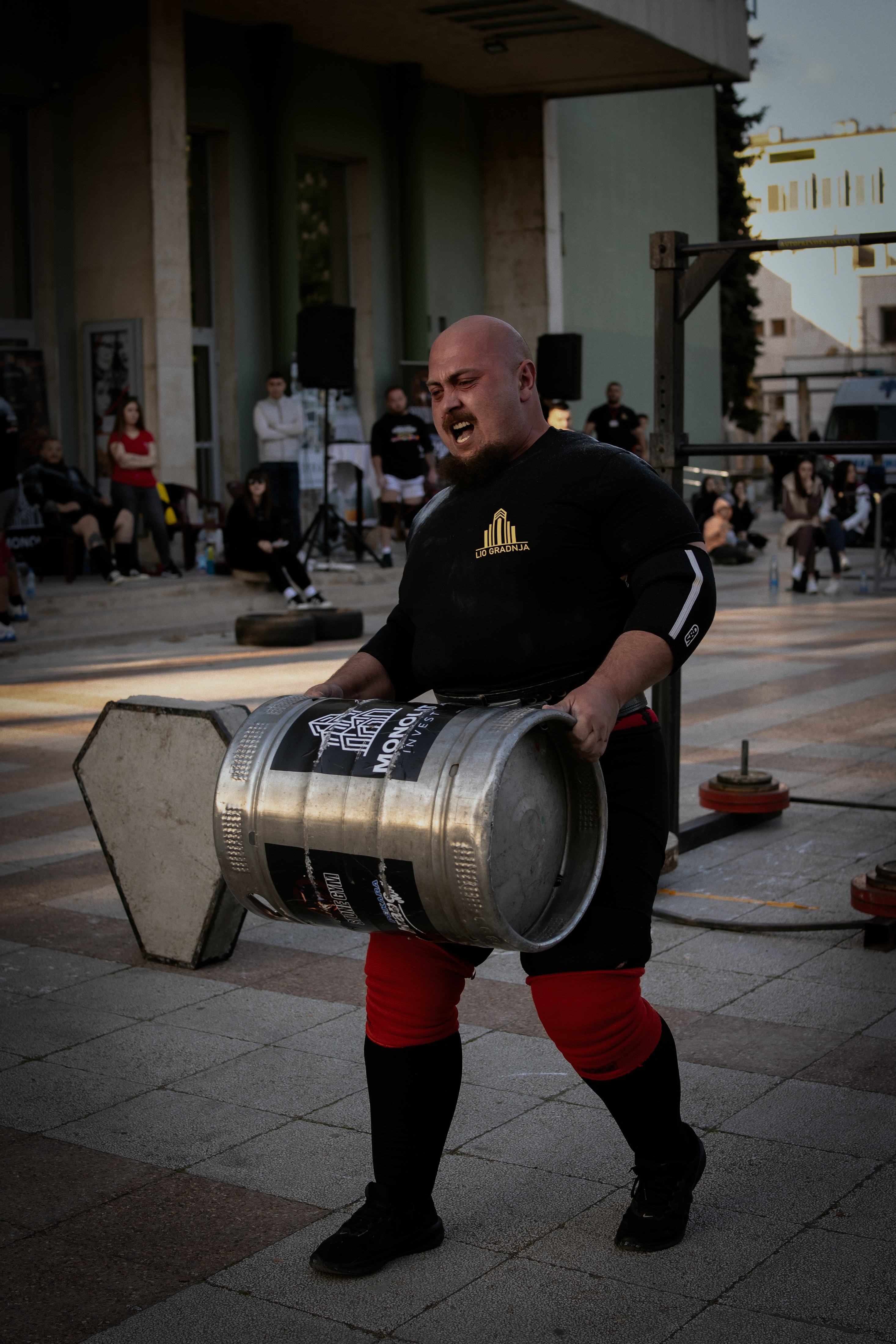
Some Strongman events reveal that weight is only the beginning of the problem. A sandbag deforms and changes shape as it is squeezed. A keg may be carried on the shoulder, hugged against the body or moved using handles, depending on its construction and the rules. A Loading Event combines lifting an object with carrying it and placing it rapidly onto a platform. Here, strength alone is not enough. The athlete must control an object that does not behave like a barbell.
Direct biomechanical literature on sandbags and loading events remains limited. The major Strongman biomechanics review identified only eight exercises with available biomechanical data, including the keg walk, Atlas Stone and Tire Flip, while existing studies frequently used small samples and simplified methods. [1,2] This article therefore separates what is known directly about keg and loading events from what can be cautiously inferred from research on stones, carries and other irregular implements.
1. What are Sandbag, Keg and Loading Events?
Sandbag and Keg can appear as lifting, carrying, loading or medley events. A Loading Event adds a second problem: the object must not only be lifted, but moved quickly enough and positioned onto a target. Competitions may use bags, barrels, kegs, stones, anchors, boxes or objects with completely unusual shapes.
At World's Strongest Man, for example, the Loading Race can involve five objects weighing roughly 100-164 kg that must be carried over a course of about 15 meters and loaded onto a platform. The organizers emphasize that object shape, dimensions and terrain can matter more than mass alone. [3] This is fundamental to understanding the entire category.
2. Why does an unstable implement change biomechanics?
A barbell has relatively predictable geometry. A sandbag does not. As it is compressed, its contents redistribute, its center of mass may shift, and the contact surface between athlete and implement changes. A keg is more rigid, but it can have a large diameter, differently positioned handles and a mass distribution unlike that of a barbell.
The result is that the athlete must produce not only force but continuous adjustments. Trunk and shoulder-girdle muscles must maintain position while the hands and forearms modify pressure on the object. In Strongman, the ability to turn an unstable object into a temporarily controllable system is one of the major differences from standardized lifts.
3. The first phase: lifting from the ground
The first phase resembles a deadlift, but only up to a point. For a sandbag or keg, the starting position is dictated by object size rather than a bar that can be gripped in a standardized position. Knees, hips and trunk must create enough space to bring the object toward the body.
With a sandbag, keeping the object close to the body is particularly important. As its center of mass moves farther from the athlete's joints, the external moment on the trunk increases. A position that keeps the bag close can therefore reduce the external lever arm and improve efficiency, without making the event easy.
4. The lap and loading position: the reorganization phase
Many sandbag and keg variations use an intermediate phase in which the object is brought onto the thighs or the anterior surface of the body. This position allows the athlete to change the grip and prepare for the final lift. Mechanically, it is a reorganization of the system, not a pause.
This resembles the Atlas Stone movement. Stone research shows that the ground-to-lap phase and final extension can be understood as distinct phases, with the lap position allowing transition toward stronger hip and knee extension. [4] For sandbags and kegs, the analogy is useful but should not be mistaken for direct measurement of these events.
5. Sandbag and Keg: why the trunk becomes a force platform
When an object is held anteriorly, the trunk must resist the tendency toward flexion. When it is carried on one shoulder, additional frontal-plane and rotational demands appear. McGill and colleagues included the Keg Walk in their analysis of Strongman events and demonstrated important demands on trunk musculature and spinal stability. [5]
There is no single universal Keg technique. The literature describes one-shoulder carrying, but also notes anterior hugging and handle-based methods. [1] Therefore, object position should be analyzed according to implement geometry, event rules and athlete anthropometry.
6. Loading onto a platform: where strength becomes speed
In a Loading Event, lifting is not the finish. The object must be accelerated toward the platform, and the athlete must reach a position that allows it to be placed over the edge. This requires coordination among lower-limb extension, trunk, arms and object orientation.
The platform introduces another problem: target height. An object may be difficult to lift from the ground and even more difficult to raise to a specific height and push over the edge. During this phase, lever arms change continuously and hand position influences force direction.
7. Sandbag Toss, Sandbag Load and the difference between power and strength
Not every sandbag event requires the same physical quality. A heavy Sandbag Load emphasizes strength and the ability to control a large object. A Sandbag Toss or Bag Toss over a bar shifts the emphasis toward power, velocity and the ability to produce impulse in a very short time.
This distinction matters in training. An athlete can have a huge deadlift and still be slow with an unstable implement because maximal strength does not automatically guarantee rate of force development, coordination or the timing required for an explosive movement. Strongman literature shows that implement events can combine strength and power demands differently from standardized exercises. [1,2]
8. Grip: not just how hard you can squeeze
With a sandbag, grip does not resemble a classic barbell grip. The hands may press, wrap around or compress the material, while the forearms and arms work together to keep the object close to the body. With a keg, handles, diameter and surface can completely change the strategy.
In a loading medley, grip can become limiting even when each individual object could be lifted. The issue is accumulation: lift, carry, reposition and load repeatedly. Grip endurance and the ability to maintain the implement against the body can therefore become as important as maximal strength.
9. Speed, fatigue and strategy in a Loading Medley
A Loading Event is a race against time, but the optimal speed is not necessarily maximal speed from the first second. If the athlete spends too much energy on the first object, later loads may become dramatically slower. Movement economy therefore becomes a performance variable.
Terrain can make the problem even harder. World's Strongest Man describes variations involving sand, snow, rubble and other surfaces. [3] On an unstable surface, the cost of each step can rise, and the athlete must control both the implement and the base of support.
Fatigue is not expressed only as reduced force. Repositioning can slow, trunk posture can become more flexed, breathing can become less efficient, and the athlete may allow the object to drift away from the body. In a medley, these small losses accumulate.
10. How should Sandbag, Keg and Loading Events be trained scientifically?
The general base should include squat and deadlift strength, powerful hip extension, trunk strength and carrying capacity. For sandbag and keg, bear-hug variations, Zercher carries, sandbag-to-shoulder work and progressive platform loading are useful. These exercises develop relevant components, but true specificity appears when the athlete works with the actual object and competition geometry.
Progression should control three variables: object mass, carrying distance or loading height, and effort density. For speed events, time per repetition or per object should be monitored. For strength events, heavy objects and low repetitions may dominate. For medleys, the athlete needs tolerance to accumulating fatigue without losing technique.
A key principle is not to mechanically copy a standard exercise and assume the event has been trained. A deadlift can build the strength needed for the first phase, but it does not automatically teach an athlete to compress a sandbag, bring it to the lap, rotate it onto the shoulder and load it over a platform. Transfer exists, but it is incomplete.
Conclusion: in Loading Events, the object is part of the problem
Sandbag, Keg and Loading Events are one of the clearest expressions of the Strongman philosophy: force must be applied to an object that does not respect barbell geometry. Mass, shape, deformability, hand position, platform height and terrain can completely change difficulty.
The best preparation combines general strength with specific exposure to unstable implements. Performance is not just the ability to lift the weight. The athlete must control the object, keep it close to the body, accelerate its center of mass and place it rapidly where the event requires.
Direct literature on sandbag and loading events remains insufficient for universal technical formulas. Strongman reviews emphasize precisely this limitation: many events remain under-researched, while biomechanical studies often use small samples and simplified methods. [1,2] The strongest conclusions are therefore those that respect mechanical and physiological principles without turning analogies from other events into direct evidence.
Scientific bibliography
1. Hindle BR, Lorimer A, Winwood P, Keogh JWL. The Biomechanics and Applications of Strongman Exercises: a Systematic Review. Sports Medicine - Open. 2019;5:49. doi:10.1186/s40798-019-0222-z. PMID:31820223.
2. Hindle BR, Lorimer A, Winwood P, Keogh JWL. A systematic review of the biomechanical research methods used in strongman studies. Sports Biomechanics. 2020;19(1):90-119. doi:10.1080/14763141.2019.1598480. PMID:31132028.
3. McGill SM, McDermott A, Fenwick CMJ. Comparison of different strongman events: trunk muscle activation and lumbar spine motion, load, and stiffness. Journal of Strength and Conditioning Research. 2009;23(4):1148-1161. doi:10.1519/JSC.0b013e318198f8f7. PMID:19528856.
4. Hindle BR, Lorimer A, Winwood P, Brimm D, Keogh JWL. The biomechanical characteristics of the strongman atlas stone lift. PeerJ. 2021;9:e12066. doi:10.7717/peerj.12066. PMID:34557349.
5. Winwood PW, Hume PA, Cronin JB, Keogh JWL. Retrospective injury epidemiology of strongman athletes. Journal of Strength and Conditioning Research. 2014;28(1):28-42. PMID:23669816.
More From The Journal

Training
The Science of Strongman Training - Episode X: Competition Programming
How to build a complete Strongman competition preparation block: calendar, events, volume, intensity, specificity, simulations, autoregulation, tapering and fatigue management.
Training
The Science of Strongman Training - Episode IX: Peaking
Peaking in Strongman: how to turn months of training into maximal competition performance by reducing fatigue, preserving adaptations and managing specificity.