
Training
Strongman Events Explained Scientifically - Episode VIII: Deadlift Events
September 2, 2026
Strongman Events Explained Scientifically - Episode VIII: Deadlift Events
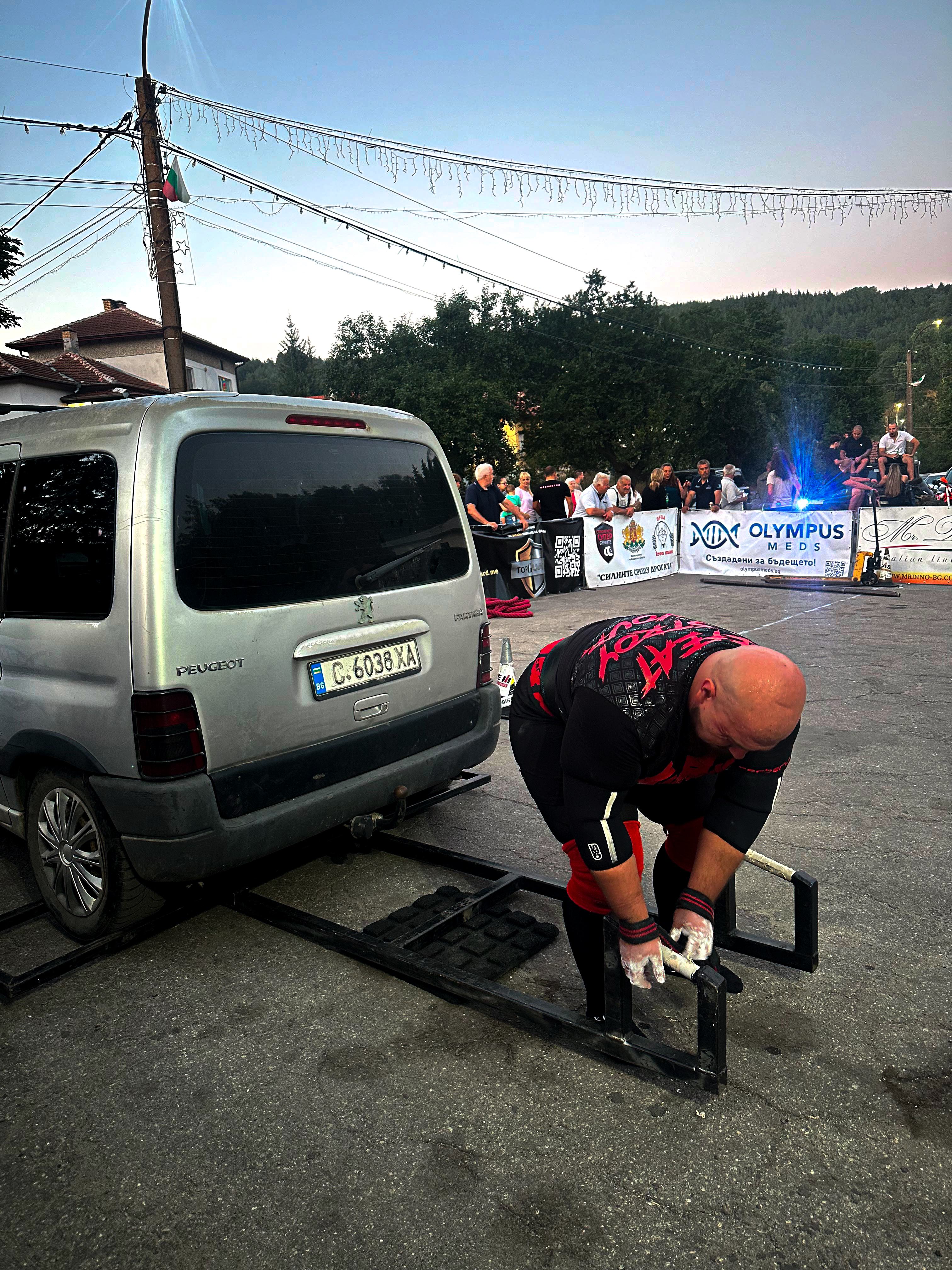
Strongman deadlift is not a single event. It can be a maximal-strength test, a timed repetition event, or a variation in which bar height, handles, frame design or starting position changes the mechanics dramatically. Two events both called 'deadlift' can therefore demand very different performance profiles.
The Strongman biomechanical literature remains limited. Available reviews identify relatively few studies and small samples, with many investigations relying on simplified methods. Nevertheless, deadlifting provides a useful bridge between established deadlift research and the event-specific demands of Strongman. [1,2]
1. Why 'deadlift' in Strongman means more than the standard deadlift
In powerlifting, the deadlift is standardized by clear rules governing the bar, position and completion. In Strongman, organizers can modify starting height, handle diameter or type, use specialized bars or frames, and introduce equipment that changes body position. Mechanically, these modifications change the distances between the joints and the load and therefore alter external joint moments.
A 400 kg deadlift from the floor and a 400 kg deadlift from an elevated platform are not the same biomechanical task. A higher starting position may reduce range of motion, but that does not automatically make the event easy. Different heights can shift emphasis toward hip extension or specific trunk positions, while handle geometry can also change grip demands.
2. The first centimeter: starting position decides much of the battle
The deadlift begins before the bar moves. The athlete must create tension through the kinetic chain, brace the trunk and position the hips and knees so lower-limb force can be transferred to the load. In the initial phase, knee and hip extension must be coordinated while trunk musculature limits unwanted loss of position.
The bar should not be viewed simply as a vertical weight. The athlete's force and the load reaction create moments at the hip, knee and spine. As the load moves farther from the body, the external moment arm increases and so does the demand on the musculature responsible for stabilization and joint extension.
3. Trunk, hips and the posterior chain: the real engine of the event
The deadlift is a coordinated extension task, not simply a 'back pull'. The gluteus maximus, hamstrings and adductors contribute to hip extension, the quadriceps contribute to knee extension, while the spinal extensors and abdominal musculature create the rigidity needed for force transfer. Research comparing deadlift variations confirms that changing technique can alter the distribution of demands across the hip, knee and trunk musculature. [4,5]
In Strongman, this coordination becomes even more important because the bar or frame may have unusual geometry. McGill and colleagues showed that Strongman events can place distinctive demands on the trunk-hip linkage, with trunk stiffening allowing the joints to produce force under mechanically difficult conditions. [6]
4. Max Deadlift versus Deadlift for Reps: two events, two physiologies
A max deadlift is dominated by the ability to produce very high force in a single repetition. Maximal strength, intermuscular coordination, positioning, bracing and the ability to recruit a very high level of neuromuscular output all matter. A deadlift for reps adds a major muscular-endurance and fatigue-tolerance component.
In a repetition event, each rep is not simply a copy of the previous one. As fatigue accumulates, velocity falls, time under tension increases and the athlete must preserve the starting position and trunk rigidity. If the rules allow touch-and-go repetitions or require a complete reset, strategy changes. The same 300 kg can therefore represent a relative-strength test in one format and a strength-endurance event in another.
5. Elevated bars, specialty bars and frame deadlifts: when geometry changes the event
Strongman frequently uses configurations that do not reproduce an Olympic or powerlifting deadlift. A bar elevated on blocks reduces range of motion. A deadlift bar can allow more deformation before the load leaves the floor, changing the initial phase. A frame with handles can change hand position and the relationship between the load and the body.
These differences matter because performance should not be compared only by kilograms. Proper analysis requires the starting height, implement geometry and stiffness, hand position, stance width and repetition rules. A record in one configuration is not automatically biomechanically equivalent to a record in another.
6. Grip: the link that can turn a powerful deadlift into a missed repetition
Leg and hip strength may be enormous, but the load still has to pass through the hands. In Strongman deadlift events, grip can become limiting when the bar is thick, handles are unusual or many repetitions are required. Finger and forearm flexor strength must be sufficient to maintain the connection with the implement throughout the effort.
This highlights the difference between producing force and transmitting it. An athlete can have an extremely strong posterior chain and still lose the event because the hand fails before the hips reach their limit. Event-specific training therefore needs not only heavy deadlifting, but also exposure to the exact grip used in competition.
7. Bar velocity, psyching-up and the decisive repetition
In a maximal deadlift, a heavy repetition may appear to stop. Initial velocity, position and the ability to continue producing force as mechanics change can determine success. The athlete has to convert available force into an efficient load trajectory.
Recent research in strength athletes, including strongmen, suggests that psyching-up strategies before the deadlift can influence performance, showing that the event is not purely mechanical. [7] Psyching-up does not replace physical capacity, however. It has to be integrated with warm-up, positioning, breathing and attempt management.
8. Fatigue: why the deadlift for reps becomes a technical problem
During the first repetitions, the athlete may have enough reserve to correct small errors. After fatigue accumulates, the same error can become decisive. The trunk may lose rigidity, the hips may rise too quickly, the bar may drift away from the body and the grip may begin to open. Fatigue therefore reduces not only available force, but can also change the mechanics of the lift itself.
For timed events, pacing also matters. Starting too aggressively may consume the muscular reserve too early, while being overly conservative can cost repetitions. The optimal strategy depends on the rules, load and individual strength-endurance profile.
9. The lumbar spine: stiffness, loading and the difference between stress and injury
Deadlifting creates substantial trunk demands, but 'high loading' is not synonymous with 'injury'. McGill and colleagues showed that Strongman events can generate high stabilization and spinal-loading demands, although these findings came from small samples and specific biomechanical models. [6]
In practice, the key issue is the athlete's capacity to tolerate the load while maintaining technique. Injury history, total volume, progression, recovery and exposure to heavy loading all influence risk. There is no single magical spinal position that guarantees injury prevention and no universal load threshold that is dangerous for every athlete.
10. How should Strongman deadlift events be trained?
The base can be built with conventional deadlifts, elevated-bar variations, Romanian deadlifts, block pulls, posterior-chain exercises and specific grip work. Programming should then match the event. For a max deadlift, high-force exposures and attempt-specific technique are central. For reps, submaximal sets, effort density and the ability to repeat a strong position under fatigue become equally important.
Strongman competitors commonly combine maximal strength, hypertrophy and power development. In a survey of training practices, 97% of competitors included maximal-strength training, 90% included power training and 88% included Olympic lifting. Conventional deadlifting was the most commonly reported deadlift variation, used by 88% of participants. [3]
Specificity should be introduced progressively. As competition approaches, exposure to the actual implement and rules becomes increasingly valuable. At the same time, not every session needs to reproduce the full competition event. Much of the preparation can be built through variations that develop limiting components without the full fatigue cost of competition-specific maximal work.
Conclusion: in Strongman, the deadlift is a system, not just a bar
Deadlift Events demonstrate one of the clearest principles of Strongman: the same basic movement can become a very different event when geometry, load, time and rules change. The max deadlift tests the ceiling of force. The deadlift for reps tests repeated force under fatigue. Elevated-bar, specialty-bar and frame variations change leverage and load distribution.
Scientifically, performance emerges from the interaction of starting position, external moment, hip and knee force, trunk stiffness, grip, anthropometry, rate of force development, bar velocity and fatigue tolerance. Strongman research still has important gaps, but the broader deadlift literature provides a strong framework for understanding these events. [1,2,4,5]
Scientific bibliography
1. Hindle BR, Lorimer A, Winwood P, Keogh JWL. The Biomechanics and Applications of Strongman Exercises: A Systematic Review. Sports Medicine - Open. 2019;5:49. doi:10.1186/s40798-019-0222-z. PMID:31820223.
2. Hindle BR, Lorimer A, Winwood P, Keogh JWL. A systematic review of the biomechanical research methods used in strongman studies. Sports Biomechanics. 2020;19(1):90-119. doi:10.1080/14763141.2019.1598480. PMID:31132028.
3. Winwood PW, Keogh JWL, Harris NK. The Strength and Conditioning Practices of Strongman Competitors. Journal of Strength and Conditioning Research. 2012. PMID:21993033.
4. Swinton PA, Stewart AD, Agouris I, Keogh JWL. A biomechanical analysis of straight barbell deadlift variations. Journal of Strength and Conditioning Research. Deadlift biomechanics and variation literature.
5. Vigotsky AD, Beardsley C, Contreras B, et al. Electromyographic activity in deadlift exercise and its variants: a systematic review. PLOS ONE. 2020;15(2):e0229507. doi:10.1371/journal.pone.0229507. PMID:32107499.
6. McGill SM, McDermott A, Fenwick CMJ. Comparison of different strongman events: trunk muscle activation and lumbar spine motion, load, and stiffness. Journal of Strength and Conditioning Research. 2009;23(4):1148-1161. doi:10.1519/JSC.0b013e318198f8f7. PMID:19528856.
7. Cusimano K, Moran J, Tod D, Freeman P. The Effects of Psyching-Up on Deadlift Performance in Competitive Strongmen, Strongwomen, and Powerlifters. Journal of Strength and Conditioning Research. 2026;40(5):576-584. doi:10.1519/JSC.0000000000005361. PMID:41628393.
More From The Journal
Training
The Science of Strongman Training - Episode X: Competition Programming
How to build a complete Strongman competition preparation block: calendar, events, volume, intensity, specificity, simulations, autoregulation, tapering and fatigue management.
Training
The Science of Strongman Training - Episode IX: Peaking
Peaking in Strongman: how to turn months of training into maximal competition performance by reducing fatigue, preserving adaptations and managing specificity.