Training
Strongman Events Explained Scientifically - Episode VII: Hercules Hold
September 2, 2026
Strongman Events Explained Scientifically - Episode VII: Hercules Hold
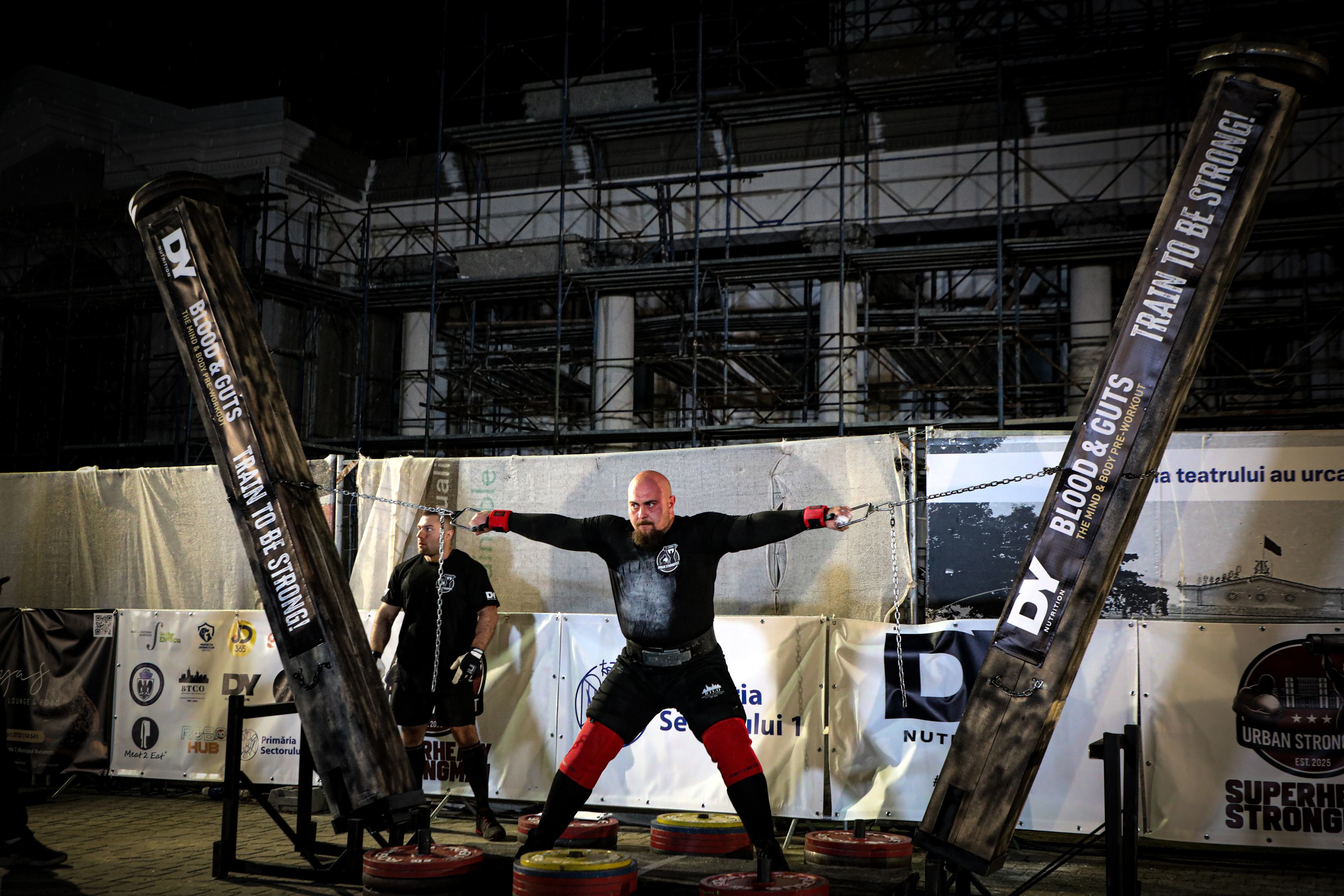
The Hercules Hold is one of the Strongman events in which the load does not have to be moved. It has to be controlled. The athlete stands between two loaded implements that pull the arms outward and downward and must maintain a prescribed arm position for as long as possible. On the surface it looks like a grip test. Biomechanically, it is a combined test of isometric endurance, scapular control, trunk stability, fatigue tolerance and the ability to preserve position as the neuromuscular system begins to fail.
Direct research on the Hercules Hold is much less developed than research on the Farmer's Walk or other Strongman events. Reviews of Strongman biomechanics show a relatively small evidence base, often based on small samples and simplified field methods, while many events still lack quantified biomechanical determinants. [1,2] This article therefore separates direct evidence about Strongman and loaded isometric mechanics from event-specific mechanical interpretation.
1. What is the Hercules Hold and why is it so difficult?
In the Hercules Hold, the athlete stands between two loaded implements or arms, holding one with each hand, usually with the arms positioned out to the sides. The goal is to maintain the required position until the arms drop below the judging limit or control is lost. Unlike the Farmer's Walk, there is no stepping cycle that allows the mechanics to alternate. Unlike a deadlift, there is no repeated concentric phase that provides partial unloading between repetitions. The Hercules Hold is a continuous contest against time.
External load is only one variable. The distance from the body to the point of force application, shoulder angle, arm length, implement height and trunk position also matter. As the external moment arm increases, the shoulder moment required to hold the position increases even if the listed load stays the same. This is why two Hercules Holds with the same nominal weight can have very different difficulty.
2. The shoulder: the engine is not lifting the load, it is preventing the arm from falling
The fundamental feature of the event is its isometric nature. The deltoid and scapular musculature produce force without large changes in muscle length. The objective is not to accelerate the implement, but to maintain joint position. When the external load pulls the arm down and outward, the shoulder must create an opposing moment to preserve the prescribed angle.
The scapula is therefore critical. The trapezius, serratus anterior, rhomboids and other scapular stabilizers contribute to maintaining a stable base for the arm. It is inaccurate to reduce the Hercules Hold to 'deltoid endurance'. The event requires cooperation between the shoulder, scapula, elbow, forearm and trunk. As fatigue develops, changes in scapular position and progressive arm descent may become the links that determine performance.
3. Grip: why the hand can become the limiting factor before the shoulder
The hands must continuously transmit force between the implement and the body. In a static event there are no unloading moments created by stepping or repositioning. The finger and wrist flexors must sustain tension while the forearm tolerates accumulating local fatigue.
This creates an important distinction between maximal grip strength and grip endurance. An athlete may have an extremely strong maximal squeeze and still lose the Hercules Hold because they cannot sustain a submaximal contraction for long enough. Training therefore needs both qualities: the ability to produce force and the ability to sustain it.
4. The trunk and posture: why the legs appear to be doing 'nothing'
Although the Hercules Hold is static, the trunk is not passive. The athlete must create a stable platform from which the arms can produce force. The abdominals, obliques, spinal extensors and hip musculature help limit unnecessary trunk motion.
A tempting strategy is to escape into extension or lean the torso to change the geometry. Such an adjustment may sometimes alter the moment arm temporarily, but it can compromise stability and control. In Strongman, the position that offers the best mechanical advantage is not always the position that can be maintained best under fatigue. The Hercules Hold rewards the ability to remain stable, not merely the ability to find a favorable position for the first few seconds.
5. Isometrics and fatigue: why the final seconds feel completely different
During a sustained isometric contraction, high muscle tension can temporarily reduce local perfusion. As duration increases, burning sensation, metabolite accumulation and declining force capacity become more prominent. In the Hercules Hold this is obvious because the implement cannot be 'hidden' inside another repetition.
Fatigue is also neural. The nervous system must maintain motor-unit recruitment for a task that appears static but becomes progressively harder. As more fatigue-resistant fibers lose capacity, the body must increase recruitment or firing demands to preserve force. When that reserve is no longer sufficient, the arms begin to descend.
6. Breathing and bracing: staying rigid without locking yourself up
A heavy isometric effort creates a temptation to hold the breath to maximize trunk stiffness. Increased intra-abdominal pressure can contribute to stabilization, but prolonged breath holding has a physiological cost and is not a universal strategy for a long-duration event.
For the Hercules Hold, breathing needs to coexist with position maintenance. Controlled breaths, without an abrupt loss of abdominal tension, allow the effort to continue. In competition, breathing should be practiced with the load because coordination between bracing, exhalation and arm position is a specific skill.
7. What determines performance: strength, leverage or endurance?
The answer is all three, but in different proportions. Maximal shoulder and grip strength establish the mechanical ceiling. Anthropometry and implement geometry alter the external moment. Isometric endurance determines how long that force level can be maintained. Technique determines how much energy and control are wasted.
Arm length is a useful example. If the same load is held farther from the shoulder joint, the external moment increases. This does not mean that an athlete with longer arms is automatically disadvantaged in every configuration, because body position, implement height and other anthropometric proportions interact. The correct conclusion is that the Hercules Hold is highly sensitive to geometry.
8. How should the Hercules Hold be trained scientifically?
Training should reflect the nature of the event. Overhead pressing, lateral raises, deltoid and scapular work, loaded carries, grip holds and isometric variations can build the general foundation. The best transfer, however, comes when the athlete learns to maintain the exact position required by the event.
A simple progression can begin with short intervals at a load that permits stable technique, then gradually increase duration or load. There is no need to increase both variables in the same session. For isometric strength, shorter and heavier holds may be useful. For event tolerance and performance, longer holds closer to competition duration become more relevant.
A key principle is not turning every training session into a maximal test. If every Hercules Hold ends with complete arm failure, fatigue may exceed the useful stimulus and interfere with shoulder and forearm recovery. Periodization should include heavy exposures, but also technical-control and submaximal endurance sessions.
9. Injury considerations: what we know and what we still cannot say
There are not enough Hercules Hold-specific epidemiological data to state that the event produces a particular injury at a particular frequency. General Strongman data show that the lower back, shoulder, biceps and knee are among commonly reported injury regions, with muscle and tendon injuries also important. In Winwood and colleagues' retrospective study, 82% of the 213 athletes included reported an injury during the study period. [3] These findings describe Strongman as a whole, not the Hercules Hold.
For the Hercules Hold, particular attention should be paid to the shoulder, elbow, biceps and grip, especially when loading rises or the position is maintained after technical fatigue appears. Pain should not be confused with normal exertion. Load progression, volume management and recovery matter more than trying to eliminate every unpleasant sensation from an event that is inherently demanding.
10. Hercules Hold in competition: the final centimeters are the ones that matter
In competition, the first seconds can feel easy. The real event begins when the system can no longer maintain the same force output with the same efficiency. A well-prepared athlete does not try to create unnecessary maximal tension from the first second. The goal is an economical position, secure grip, controlled breathing and enough tension to keep the arms within the required angle.
As time passes, the objective becomes position preservation. A small drop in the arms can further increase the mechanical disadvantage created by gravity, while a late correction may require a disproportionately large effort. Technique therefore has to be built around control rather than a single burst of strength.
Conclusion: the Hercules Hold does not test how much you can hold, but how long you can remain strong
The Hercules Hold clearly demonstrates that Strongman strength is not only about lifting a load. In this event, the load is not accelerated; it is controlled against gravity for as long as possible. The shoulder, scapula, elbow, forearm, hand and trunk work together in a contraction that becomes progressively more costly.
Scientifically, the most defensible interpretation is that performance emerges from the interaction of external moment, isometric force capacity, local endurance, implement geometry, anthropometry and strategy. Direct Hercules Hold literature remains insufficient to define a universal optimal technique, but the biomechanics of loaded isometrics and existing Strongman research provide a solid framework for understanding the event. [1,2]
Scientific bibliography
1. Hindle BR, Lorimer A, Winwood P, Keogh JWL. The Biomechanics and Applications of Strongman Exercises: A Systematic Review. Sports Medicine - Open. 2019;5:49. doi:10.1186/s40798-019-0222-z. PMID:31820223.
2. Hindle BR, Lorimer A, Winwood P, Keogh JWL. A systematic review of the biomechanical research methods used in strongman studies. Sports Biomechanics. 2020;19(1):90-119. doi:10.1080/14763141.2019.1598480. PMID:31132028.
3. Winwood PW, Hume PA, Cronin JB, Keogh JWL. Retrospective injury epidemiology of strongman athletes. Journal of Strength and Conditioning Research. 2014;28(1):28-42. doi:10.1519/JSC.0b013e3182986c0c. PMID:23669816.
4. McGill SM, McDermott A, Fenwick CMJ. Comparison of different strongman events: trunk muscle activation and lumbar spine motion, load, and stiffness. Journal of Strength and Conditioning Research. 2009;23(4):1148-1161. doi:10.1519/JSC.0b013e318198f8f7. PMID:19528856.
More From The Journal
Training
The Science of Strongman Training - Episode X: Competition Programming
How to build a complete Strongman competition preparation block: calendar, events, volume, intensity, specificity, simulations, autoregulation, tapering and fatigue management.
Training
The Science of Strongman Training - Episode IX: Peaking
Peaking in Strongman: how to turn months of training into maximal competition performance by reducing fatigue, preserving adaptations and managing specificity.