Training
Strongman Events Explained Scientifically - Episode VI: Conan's Wheel
September 1, 2026
Strongman Events Explained Scientifically - Episode VI: Conan's Wheel
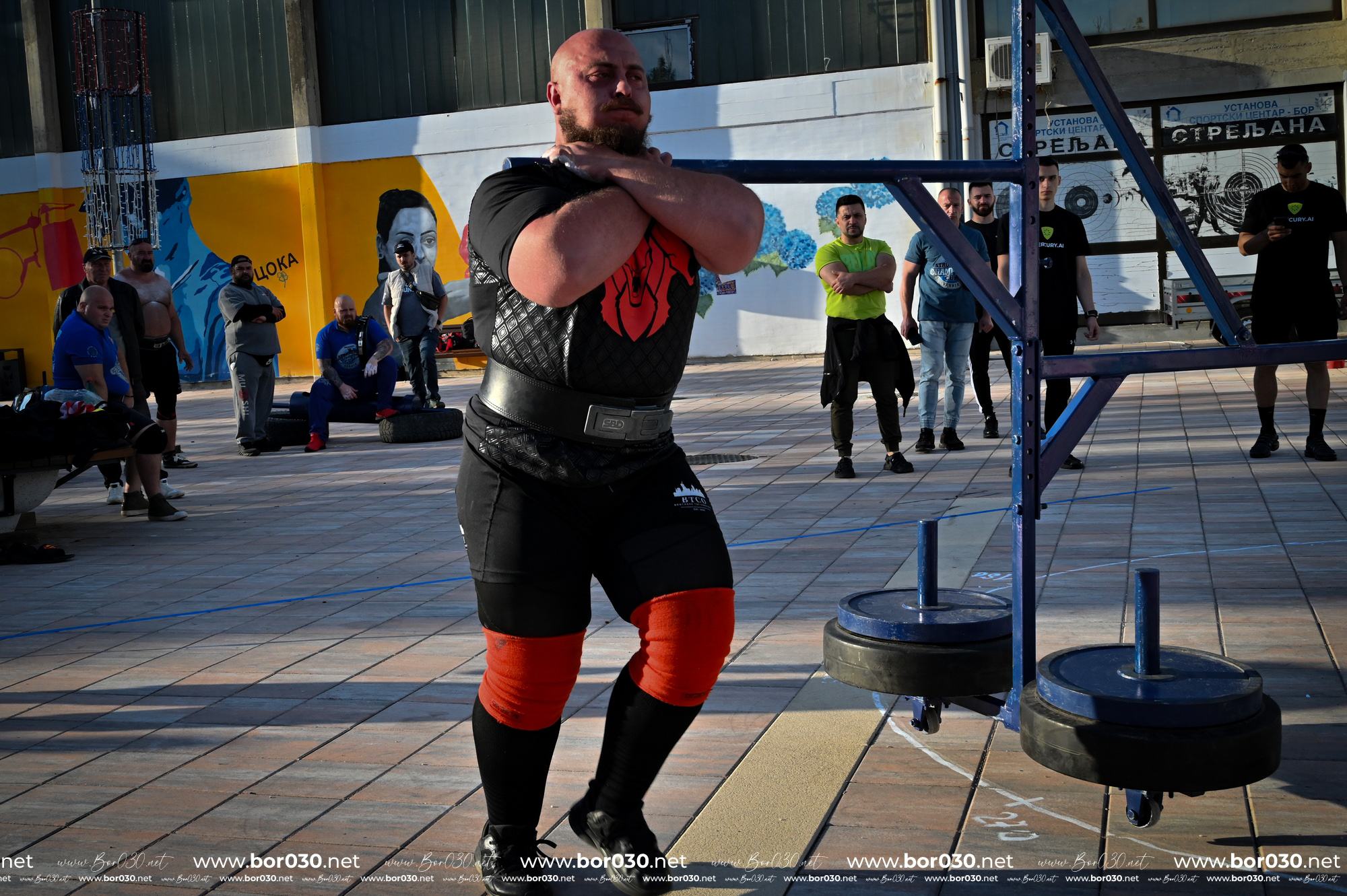
Conan's Wheel is one of the most unusual events in Strongman. The athlete lifts a loaded arm into a Zercher position, carries it in the crooks of the elbows and moves around a central pivot. The movement is not simply linear: the athlete advances while continuously rotating around the center. The event combines isometric trunk strength with gait, breathing under load and control of a load that creates a persistent mechanical moment around the pivot.
Direct biomechanical research on Conan's Wheel is much more limited than research on the Farmer's Walk or Yoke Walk. Strongman biomechanical reviews identify a relatively small research base, with small samples and simplified field methods, and Conan's Wheel does not have the same direct experimental foundation. [1,2] Therefore, this analysis clearly separates direct evidence from conclusions supported by mechanics, physiology and research on related loaded carries such as the Zercher carry.
1. What is Conan's Wheel and why is it different from a normal carry?
In the classic format, the athlete lifts the implement in a Zercher position and walks in a circle around a central point. Modern competition rules commonly require the arm to remain below shoulder height and the implement to be carried in the elbow crease. Distance may be measured until the athlete drops the implement, by a time limit or by completed revolutions, depending on the contest. [3]
This geometry changes the mechanical problem compared with the Farmer's Walk. In a Farmer's Walk, the path is linear and the load is distributed between the two hands. In Conan's Wheel, the load is concentrated anteriorly, the athlete must stabilize an eccentric load and the circular path introduces continuous rotational demands. The athlete is not simply transporting weight; they are controlling the relationship between body, implement arm and central axis.
2. The wheel geometry: the lever that changes difficulty
One of the most important features of Conan's Wheel is that the listed load does not by itself determine difficulty. Arm length, load position relative to the axis, pick height and implement construction all matter. The same mass can produce different mechanical moments when the distance from the pivot changes. [4]
The basic mechanics are straightforward: torque depends on force and perpendicular moment arm. As the geometry changes the distance between the load and pivot, the mechanical demand changes. At the same time, the athlete travels along a circumference proportional to the radius. This creates a trade-off between leverage and the distance covered per revolution.
3. The Zercher position: why the elbows and trunk become central links
The Zercher position places the bar in the elbow creases, anterior to the trunk. This creates a load that tends to pull the torso into flexion. To maintain position, the athlete must create stiffness through the spinal extensors, abdominals, obliques, shoulder-girdle musculature and hips. The arms are not simply hooks. They help secure the implement and keep it in a controlled position.
The Zercher carry is useful for training, but it is not identical to Conan's Wheel. In Conan's Wheel the body does not move in a straight line. The athlete must continuously change orientation relative to the implement and manage lateral and rotational forces. An athlete may therefore have a strong Zercher carry and still require specific adaptation to circular locomotion.
4. Circular gait: when every step changes the direction of force
In linear walking, each step primarily serves forward displacement. In Conan's Wheel, the tangential direction of movement changes continuously. The athlete must produce force into the ground while controlling lateral components needed to maintain the circular path.
This helps explain why short, controlled steps are often useful. There is not enough direct biomechanical evidence to declare one universally optimal technique, but loaded-carry and gait principles support the idea that controlled steps reduce unnecessary oscillation and allow rapid adjustments. In Conan's Wheel, an excessively long step can amplify body rotation and destabilize the implement.
5. The trunk, spine and rotational stability
The trunk is probably the physiological center of the event. The load is held anteriorly and the path is circular, so the athlete must resist flexion, unwanted extension and rotation at the same time. The obliques, transverse abdominis, spinal extensors, quadratus lumborum and hip musculature all contribute to maintaining a stable structure.
Research on other Strongman events shows that carrying very large loads can substantially increase trunk-stabilization demands. In the Yoke Walk, for example, McGill and colleagues observed high spinal loading and substantial trunk muscle co-contraction, while later reviews emphasize the role of stability in loaded carries. [1,5] These findings should not be presented as direct measurements of Conan's Wheel, but they provide relevant mechanical context.
6. Breathing: why the event can become suffocating very quickly
Conan's Wheel creates a distinctive respiratory problem. To stabilize the trunk, the athlete needs intra-abdominal pressure and respiratory musculature that must continue working while the abdomen and rib cage are already challenged by the load. If the athlete tries to maintain a prolonged breath hold, the ability to continue walking can deteriorate rapidly.
The practical solution is not to abandon bracing, but to learn to modulate it. Short, controlled breaths synchronized with steps can preserve a degree of trunk stiffness without completely blocking ventilation. This should be practiced progressively because breathing under load is a specific skill, not a detail that can be improvised on competition day.
7. Fatigue: why Conan's Wheel becomes harder with every revolution
Early in the event, the main limitation may be mechanical. As time under load increases, fatigue develops across the quadriceps and hips, isometric trunk musculature, arms and respiratory system. The same external load begins to feel different because the system can no longer maintain the same stiffness and efficiency.
A key sign is gait change. Steps become longer or less organized, the torso begins to lean, the arms relax and the implement starts to oscillate. These changes increase energetic cost and can accelerate technical breakdown. In a circular event, each oscillation can create the next one, gradually turning a controlled carry into a battle for position.
8. Strength, endurance and specificity: what actually needs to be trained?
Conan's Wheel requires more than maximal strength. Squats, deadlifts, Zercher variations, loaded carries and hip-extension exercises can build the general foundation. But the ability to lift the weight does not guarantee the ability to carry it in a circle for 30, 60 or 90 seconds.
Specific training should develop three components: the pick, the carry and tolerance to time under load. Zercher carries can be an excellent substitute when a wheel is unavailable, but they should be treated as a transfer exercise rather than a perfect equivalent. As competition approaches, exposure to the actual implement becomes increasingly important because the geometry, pick height and circular trajectory are specific.
Progression can manipulate load, distance, duration, revolutions and rest. There is no need to increase every variable at once. One block can emphasize strength with short distances and heavy loads, another can emphasize speed and control, and a pre-competition block can reproduce the event's time and geometry.
9. Injury considerations and the difference between demand and causation
Conan's Wheel can impose substantial demands on the elbows, biceps, trunk, hips and lower limbs. Strongman epidemiology has identified the lower back, shoulder, biceps and knee among commonly reported injury regions. [6] These data concern Strongman as a whole and do not prove that Conan's Wheel causes a specific injury.
Likewise, high biomechanical demand is not synonymous with injury. Risk is influenced by exposure, progression, fatigue, individual history, technique and tissue capacity. Good programming does not attempt to eliminate all high forces, which is impossible in Strongman. It aims to progressively build the capacity to control them.
10. Conan's Wheel in competition: efficiency beats chaos
Competition technique begins before the first step. The pick should be organized, the trunk should be stable and the implement should be lifted without a large initial swing. The opening seconds are important for finding rhythm, foot placement and breathing.
Throughout the event, the goal is to maintain a sufficiently fast rhythm without losing control. There is no universal ideal speed because load, radius, time limit and athlete level change the problem. Different competitions use time, distance or revolutions, and historical results demonstrate how variable event configurations can be. [3,7]
Conclusion: Conan's Wheel is a problem of mechanics, breathing and control
At first glance, Conan's Wheel seems simple: pick up the weight and walk in a circle. In reality, it is one of the most sophisticated forms of loaded carriage in Strongman. The load is anterior, the implement acts as a lever, the athlete moves along a circular path and the trunk must remain sufficiently rigid for the legs to keep producing locomotion.
What we know directly about Conan's Wheel is still limited. There are not enough event-specific studies to define a universal optimal technique or quantify the exact contribution of every muscle group. Strongman biomechanical reviews emphasize precisely these limitations: small samples, simplified methods and many events for which evidence remains preliminary. [1,2]
But the mechanical problem is clear: success comes from converting strength into controlled displacement. The athlete must produce enough force for the pick, resist the anterior moment, stabilize rotation, breathe and repeat the steps without allowing the system to enter a spiral of oscillation and fatigue. Conan's Wheel does not only test how much you can lift. It tests how much control you can preserve while the weight is trying to change your position.
Scientific bibliography
1. Hindle BR, Lorimer A, Winwood P, Keogh JWL. The Biomechanics and Applications of Strongman Exercises: A Systematic Review. Sports Medicine - Open. 2019;5:49. doi:10.1186/s40798-019-0222-z. PMID:31820223.
2. Hindle BR, Lorimer A, Winwood P, Keogh JWL. A systematic review of the biomechanical research methods used in strongman studies. Sports Biomechanics. 2020;19(1):90-119. doi:10.1080/14763141.2019.1598480. PMID:31132028.
3. Examples of modern Strongman competition rules for Conan's Wheel, including Zercher carry position, circular distance and time-based formats.
4. General biomechanical principle: torque equals force multiplied by perpendicular moment arm. Conan's Wheel geometry changes effective mechanical demand through arm length, load position and pick height.
5. McGill SM, McDermott A, Fenwick CMJ. Comparison of different strongman events: trunk muscle activation and lumbar spine motion, load, and stiffness. Journal of Strength and Conditioning Research. 2009;23(4):1148-1161. doi:10.1519/JSC.0b013e318198f8f7. PMID:19528856.
6. Winwood PW, Hume PA, Cronin JB, Keogh JWL. Retrospective injury epidemiology of strongman athletes. Journal of Strength and Conditioning Research. 2014;28(1):28-42. PMID:23669816.
7. Strongman Archives. Historical Conan's Wheel competition results and event configurations, illustrating variation in loads, distances and scoring formats.
More From The Journal
Training
The Science of Strongman Training - Episode X: Competition Programming
How to build a complete Strongman competition preparation block: calendar, events, volume, intensity, specificity, simulations, autoregulation, tapering and fatigue management.
Training
The Science of Strongman Training - Episode IX: Peaking
Peaking in Strongman: how to turn months of training into maximal competition performance by reducing fatigue, preserving adaptations and managing specificity.