
Training
Strongman Events Explained Scientifically - Episode V: Yoke Walk
September 1, 2026
Strongman Events Explained Scientifically - Episode V: Yoke Walk
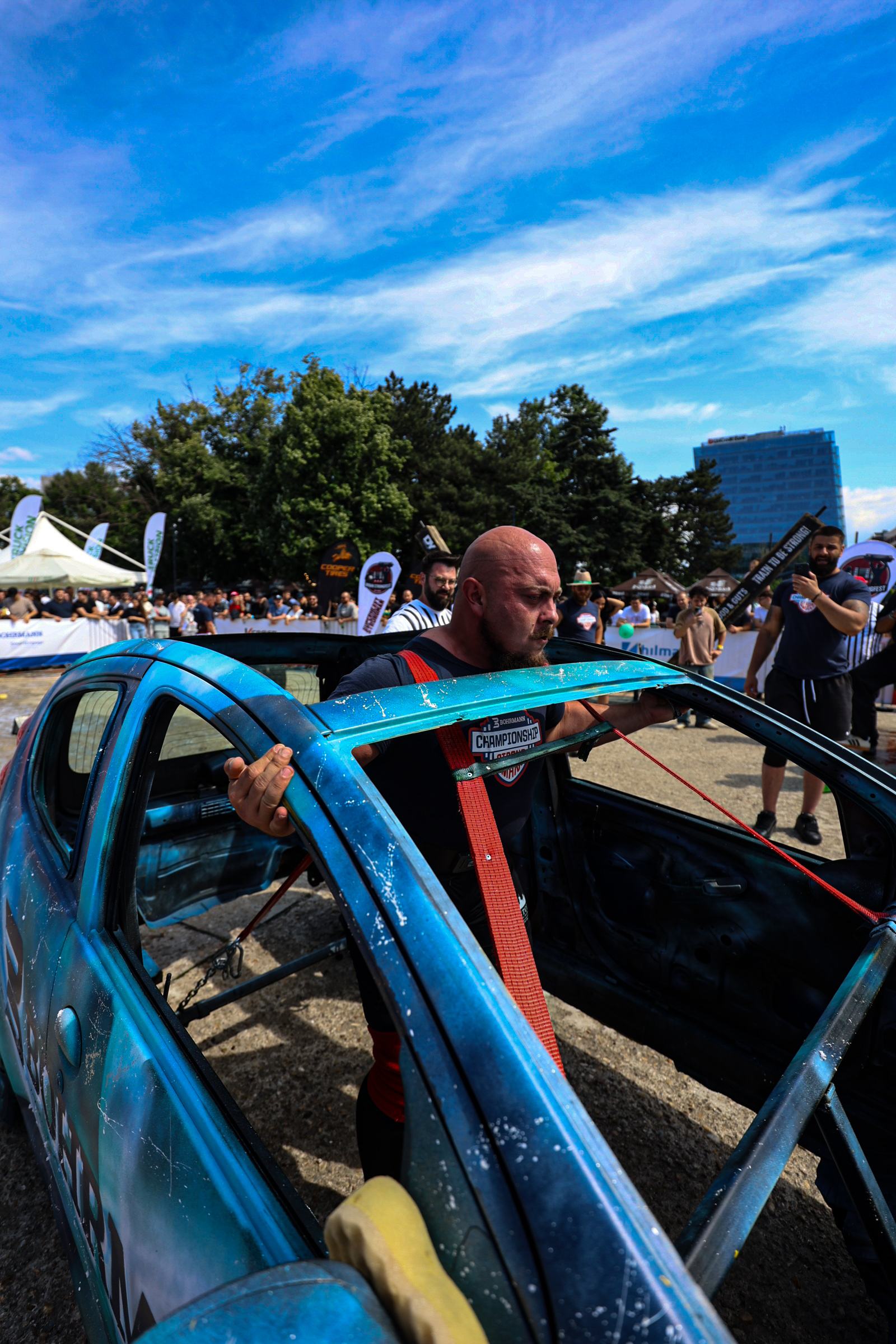
The Yoke Walk is one of the most demanding forms of load carriage in Strongman. Unlike the Farmer's Walk, where the load hangs from each hand, the athlete carries a massive frame supported across the shoulder girdle and trunk. The load therefore becomes part of the structure above the body, and every step must be executed while controlling compression, balance, acceleration and forward displacement. The event looks simple, but biomechanically it is a moving laboratory of stability.
Direct research on the Yoke Walk is more limited than research on the Farmer's Walk, but an important biomechanical study examined 19 Strongman athletes, male and female, performing three 20 m sets at 85% of their 20 m Yoke Walk 1RM. The researchers measured hip and knee angles, velocity, stride length, stride rate and stance duration. The results showed a characteristic pattern of relatively short strides, high stride rates and a gait strategy that changed as athletes accelerated. [1]
1. What is the Yoke Walk and why is it different from the Farmer's Walk?
In the Yoke Walk, the athlete moves under a tall frame, positions it across the shoulders and lifts it clear of the supports. From that moment, the load is no longer supported primarily by the hands. It is supported by the entire body, while the frame must remain sufficiently stable to allow forward movement. This changes the mechanical problem completely. In the Farmer's Walk, the arms and grip are major transmission links. In the Yoke Walk, the trunk and lower limbs become the platform carrying the load.
The elevated position of the load also changes inertia. When the frame moves forward, backward or laterally, the athlete is not controlling only their own mass. They are controlling the mass of the frame as well, and any balance error can be amplified by it. A small movement of the athlete can produce movement of the frame, and movement of the frame can feed back into the athlete. The result is a continuous mechanical feedback system.
The Yoke Walk is also usually one of the heaviest load-carriage events in Strongman. The 2021 biomechanical study notes that it is typically the heaviest load-carriage exercise used by Strongman athletes in training and competition. [1] This means that static strength alone is not enough. The athlete must create movement while the system is loaded close to its mechanical limits.
2. The initial lift and starting position: the first problem is stability
Before the first step, there is a phase that is easy to overlook: lifting and stabilizing the frame. If the athlete raises the Yoke in a poorly organized position, the problem does not disappear once walking begins. It is simply transferred into movement. The starting position must allow the hips and knees to generate extension without the trunk collapsing or the frame beginning to sway.
Mechanically, the initial lift is a coordination problem between the lower limbs and trunk. The legs generate the vertical force needed to clear the frame, while the trunk creates the stiffness required to transfer that force. If stiffness is insufficient, part of the force generated by the legs is lost in unwanted movement of the trunk and frame.
The first step should therefore be considered a continuation of the lift rather than a completely separate event. The athlete must transition from extension into gait without an intermediate period of instability. In competition, this transition can matter enormously because time lost at the start is difficult to recover later in a short course.
3. Gait under the Yoke: why are the steps short and frequent?
The study by Hindle and colleagues provides one of the clearest descriptions of Yoke gait. At 85% of 20 m 1RM, athletes showed hip flexion and slight or near-neutral knee flexion at initial contact, followed by slight hip extension and knee flexion at toe-off. Stride length was relatively short and stride rate was high. [1]
This strategy has a clear mechanical rationale. A heavy Yoke has substantial inertia. If the athlete takes excessively long steps, the system's center of mass may oscillate more and the frame may move vertically and laterally. Shorter steps allow better control of the center of mass and limit unnecessary movement. At the same time, a high stride rate allows displacement to accumulate rapidly.
Importantly, the strategy is not identical throughout the course. During the first 5 m, athletes showed lower velocity, shorter stride length, lower stride rate and longer stance duration. As velocity increased, stride length and stride rate increased while stance duration decreased. [1] The Yoke Walk therefore contains an acceleration phase followed by a faster and more efficient phase of gait.
This has a direct training implication. The athlete should not try to reproduce one static posture throughout the event. They must learn to accelerate the frame and allow the gait pattern to adapt to velocity. Good technique is dynamic.
4. The trunk and spine: the true center of the event
If one region defines the Yoke Walk, it is the trunk. The frame rests across the shoulders, but its stability is transmitted through the thoracic and lumbar spine, pelvis and lower limbs. The athlete must create enough stiffness to carry the load without excessive trunk oscillation.
McGill and colleagues examined three experienced Strongman athletes across several events and found very high spinal compression during the Yoke Walk, associated with the large absolute load and substantial torso muscle co-contraction required for stability. [2] The result is important, but it must be interpreted cautiously because the study involved only three athletes and a very short protocol.
Co-contraction is central. The spinal extensors, abdominals, obliques, quadratus lumborum and hip musculature do not only create movement. They also resist movement. In an event where the frame can shift in multiple planes, this stiffness allows the joints to operate within a more controlled mechanical environment.
This is where loading must be separated from injury. A high force or high compression does not automatically mean an injury will occur. The body adapts to load, and tolerance depends on training history, technique, fatigue, volume and individual capacity. Biomechanics tells us how demanding the task can be. It does not, by itself, predict who will get injured.
5. Hips, knees and ankles: the engine under the load
Above the body is the stability problem. Below it is the engine. To move the Yoke forward, the lower limbs must produce vertical and propulsive force, control every ground contact and allow the center of mass to advance.
The hip has a major role because it contributes to extension and stabilizes the pelvis. The knee allows force absorption and redirection. The ankle provides the final connection with the ground. Under a very heavy Yoke, these joints do not move through a large and elegant range. The movement is relatively compact, precisely because unnecessary frame displacement is costly.
The 2021 study showed that lower-limb range of motion changed between the beginning and later portions of the course. At higher velocities, athletes increased stride length and stride rate and reduced stance duration. [1] Efficiency therefore does not mean eliminating movement. It means using exactly the movement required to create displacement.
6. Acceleration: the moment when the Yoke has to start moving
The opening section of the course is probably one of the most technical. A very heavy frame does not change velocity instantly. The athlete must generate enough impulse to accelerate the combined system of body and Yoke. During this phase, the temptation to take large steps can be counterproductive.
Available data suggest that during the first 5 m, velocity and stride parameters differ from the higher-velocity phase. The study authors suggested that abbreviated lower-limb range of motion during the initial interval may help rapidly increase stride rate and therefore velocity. [1] In practical terms, the athlete must get the machine moving before trying to run it at maximum speed.
This explains why the Yoke Walk is not simply a strength test. An athlete may have enough strength to lift the frame but still lack the ability to accelerate it. Strength has to become impulse, and impulse has to become velocity.
7. Fatigue and loss of control: when the load begins to drive the athlete
As distance increases, the problem is no longer only force production. Peripheral fatigue, central fatigue, respiratory demand and declining trunk stiffness all become relevant. In a Farmer's Walk, a failing grip is often the most obvious signal. In a Yoke Walk, degradation may first appear as progressive loss of frame control.
When the trunk begins to oscillate, athletes may instinctively respond with larger steps or lateral leaning. These corrections can create further oscillation. A feedback loop develops: instability produces corrections, corrections create additional movement, and additional movement increases the energetic and mechanical cost.
Specific Yoke endurance therefore means more than tolerating a longer cardiovascular effort. It means maintaining gait pattern and trunk stiffness while the musculature is fatigued. For a competitive athlete, this ability can separate a fast carry from one in which every meter becomes a battle with the frame.
8. Injury considerations: what we know and what we cannot claim
The Yoke Walk deserves respect because of its loading demands. Strongman injury literature has identified the lower back as one of the frequently reported injury regions, and retrospective data have identified the Yoke Walk as a mechanism for a proportion of injuries. [3] These findings, however, must be kept separate from biomechanical studies.
The fact that an exercise creates high mechanical loading does not prove that the loading causes an injury. Establishing causality would require longitudinal data, quantified exposure, athlete history and control of other factors. The scientifically appropriate conclusion is that the Yoke Walk can impose very high mechanical demands on the trunk and spine, while epidemiological Strongman data show that low-back injuries are relevant to the sport. We cannot claim that a particular position or load inevitably causes an injury.
Practically, obvious technical degradation, repeated loss of frame control, persistent pain or an abrupt change in gait should trigger reassessment of load, distance, volume and technique. Progression should allow the tissues and neuromuscular system time to adapt to increasing exposure.
9. How should the Yoke Walk be trained: strength, speed and specificity
A good Yoke Walk program does not begin and end with more weight. There are at least three distinct qualities: the ability to lift the frame, the ability to stabilize it and the ability to transport it quickly. These qualities have to be developed together.
For general strength, squats, deadlifts, squat variations and hip-extension exercises can build the foundation. For trunk capacity, bracing exercises, carries and isometric variations can be useful. For speed, the Yoke itself should be trained with loads that allow fast, controlled movement. For specificity, nothing fully replaces the actual Yoke Walk.
Progression can manipulate load, distance, set number, rest interval and velocity. An athlete developing specific strength may use heavy loads over short distances. As competition approaches, exposures closer to the competition load and distance become more relevant. For speed development, the load must allow genuine acceleration rather than simple survival under the frame.
Importantly, all variables do not need to increase simultaneously. If load, distance and volume are increased in the same week, it becomes difficult to know what produced adaptation and what produced fatigue. Intelligent progression keeps the training stimulus identifiable.
10. Competition technique and conclusion: Yoke Walk is a test of control under force
In competition, the Yoke Walk is won through a combination of efficient lifting, rapid acceleration and sustained control. The athlete should not be rigid in the sense of refusing to move. They must be rigid enough to control the frame and dynamic enough to move it.
Available biomechanical data show that experienced athletes use a strategy characterized by relatively short strides, high stride rates and changes in stride length and stance time as velocity increases. [1] At the same time, spinal research demonstrates how important trunk stability becomes when the transported mass is very large. [2]
The Yoke Walk is ultimately the conversion of strength into a mobile system. The athlete must lift a large mass, stabilize it above the body, generate impulse, control every ground contact and repeat the process until the finish line. If the Farmer's Walk tests how well you can transport weight in your hands, the Yoke Walk tests how well you can turn the entire body into a structure capable of transporting weight.
The literature is still relatively young. The main biomechanical Yoke Walk study included 19 athletes and provides valuable descriptive data, but it does not establish every determinant of performance or define one perfect technique for every athlete. Reviews of Strongman biomechanical methods also emphasize the frequency of small samples and simplified protocols. [1,4]
The practical conclusion is simple, but not easy: the Yoke Walk is not won by strength alone. It is won by controlling strength. The frame must remain under control, the trunk must remain functional, the legs must produce impulse and the steps must convert that impulse into velocity. When all of these components work together, the Yoke stops looking like an impossible object and becomes what it really is: a complex biomechanical problem solved while walking.
Scientific bibliography
1. Hindle BR, Lorimer A, Winwood P, Brimm D, Keogh JWL. The Biomechanical Characteristics of the Strongman Yoke Walk. Frontiers in Sports and Active Living. 2021;3:670297. doi:10.3389/fspor.2021.670297. PMID:33981993.
2. McGill SM, McDermott A, Fenwick CMJ. Comparison of different strongman events: trunk muscle activation and lumbar spine motion, load, and stiffness. Journal of Strength and Conditioning Research. 2009;23(4):1148-1161. doi:10.1519/JSC.0b013e318198f8f7. PMID:19528856.
3. Winwood PW, Hume PA, Cronin JB, Keogh JWL. Retrospective injury epidemiology of strongman athletes. Journal of Strength and Conditioning Research. 2014;28(1):28-42. PMID:23669816.
4. Hindle BR, Lorimer A, Winwood P, Keogh JWL. A systematic review of the biomechanical research methods used in strongman studies. Sports Biomechanics. 2020;19(1):90-119. doi:10.1080/14763141.2019.1598480. PMID:31132028.
More From The Journal
Training
The Science of Strongman Training - Episode X: Competition Programming
How to build a complete Strongman competition preparation block: calendar, events, volume, intensity, specificity, simulations, autoregulation, tapering and fatigue management.
Training
The Science of Strongman Training - Episode IX: Peaking
Peaking in Strongman: how to turn months of training into maximal competition performance by reducing fatigue, preserving adaptations and managing specificity.