
Training
Strongman Events Explained Scientifically - Episode IX: Tire Flip
September 2, 2026
Strongman Events Explained Scientifically - Episode IX: Tire Flip
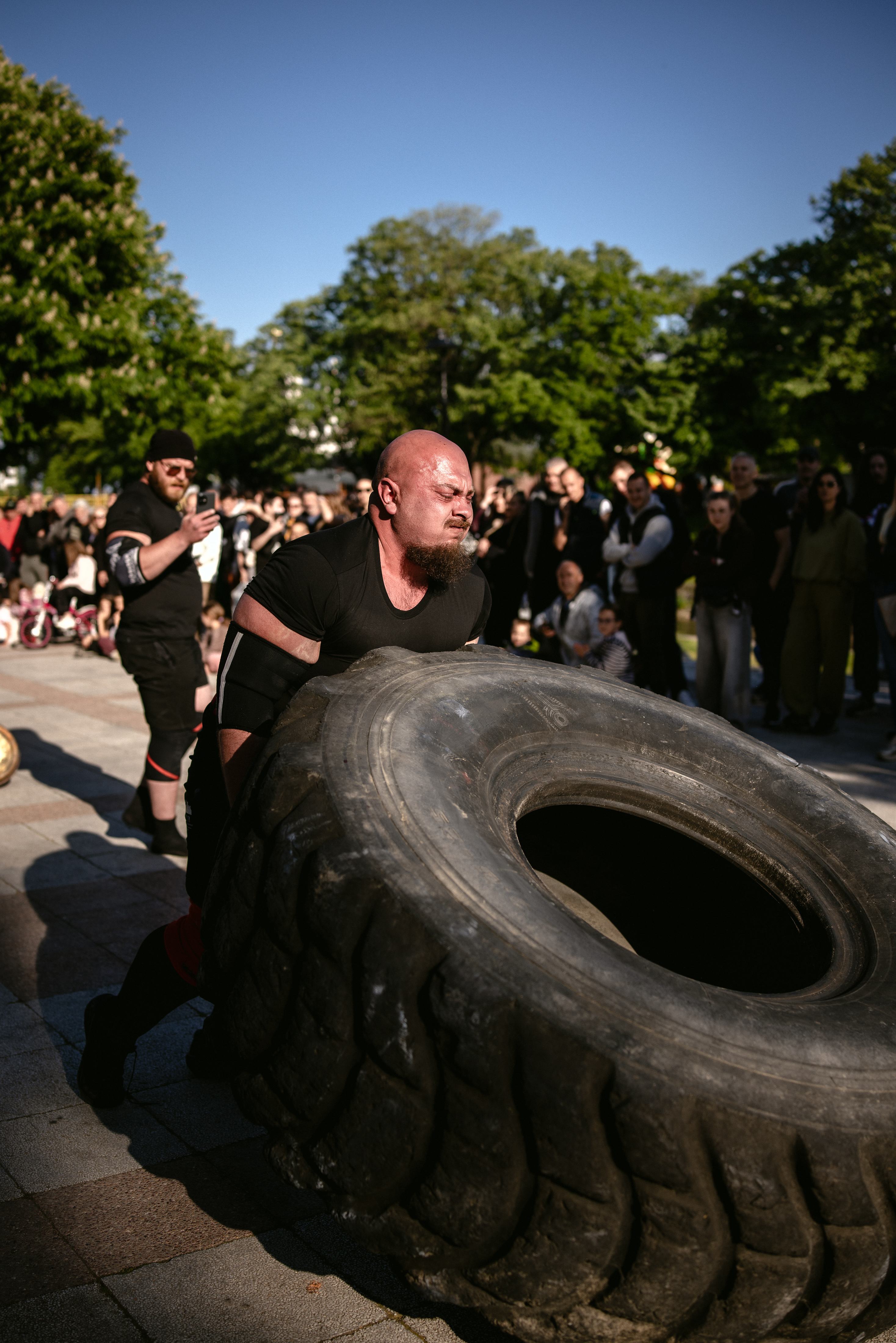
The Tire Flip looks simple at first: approach the tire, lift it, and turn it over. Biomechanically, however, it is one of the most interesting Strongman events because the implement remains in contact with the ground throughout the movement, forcing the athlete to convert lower-body and hip force into a combination of vertical force, horizontal force and finally a pushing action.
The direct literature is limited. Keogh and colleagues studied five experienced subjects who performed two sets of six flips with a 232 kg tire. The study examined phase timing and physiological responses and identified second-pull duration as an important determinant of performance. [1] Later reviews support the importance of this finding while emphasizing that Tire Flip still needs more precise biomechanical research. [2,3]
1. What is the Tire Flip, and why is it not simply a deadlift with a tire?
In a deadlift, the goal is to raise the load through a predominantly vertical trajectory to full extension. In the Tire Flip, the goal is not to lift the tire as high as possible, but to move its center of mass and angle far enough for it to pass its tipping point. The event therefore becomes a problem of rotation and displacement, not simply lifting.
The tire's total mass also does not fully describe difficulty. Diameter, width, sidewall thickness, rubber deformability and ground friction influence how athlete force is transmitted to the implement. The biomechanical review highlights this methodological problem: because the tire remains in contact with the ground, it is difficult to define a single 'lifted load' comparable to a barbell. [2]
2. The first pull: from the ground to above the knee
The first phase begins with the athlete in a relatively low position, with the trunk inclined and the hands positioned to apply force to the tire. The movement partially resembles the beginning of a conventional deadlift, although the stance may be wider and the object has completely different geometry.
The purpose of the first pull is not to complete the flip, but to bring the tire into a position from which the next phase can be accelerated. The legs and hips produce force while the trunk must remain sufficiently rigid to avoid losing energy through unnecessary changes in position.
3. The second pull: the heart of performance
The second pull begins after the tire passes knee level and continues until the hands first leave the implement. One of the most important experimental observations about the Tire Flip occurs here: faster athletes had a significantly shorter second pull. In Keogh and colleagues' study, the two fastest subjects averaged about 0.38 seconds for the second pull, compared with about 1.49 seconds in the slower group. [1]
Within the same athlete, the three fastest trials had a second-pull duration of about 0.55 seconds, compared with about 1.69 seconds in the three slowest trials. This suggests that the ability to accelerate the tire rapidly through this region is highly important. [1]
Biomechanically, the phase can be partially compared with the second pull of the power clean: coordinated ankle, knee and hip extension contributes to implement acceleration. The comparison has limits, however. The tire is not a freely moving bar, and its trajectory and rotational point continuously change. [2]
4. Triple extension and force transfer
Triple extension is central to understanding the event. The ankle, knee and hip contribute sequentially and coordinately to force production. The goal is not to jump with the tire, but to provide enough impulse for the tire to continue rotating.
Efficient transfer requires the athlete to remain connected to the implement. If force is produced in a direction that does not favor tire rotation, part of the athlete's muscular capacity is spent without sufficiently accelerating the object. Body position relative to the tire is therefore critical.
5. Trunk, hips and rotation: why the Tire Flip is not perfectly symmetrical
The tire is large, and the hands are usually positioned in a way that keeps the athlete very close to the implement. In Strongman studies comparing lifting events, the Tire Flip showed more lateral bend and spinal rotation than the Log Lift, while activation of some anterior trunk muscles was greater. [2]
These findings do not mean that every rotation is dangerous. They mean that the event requires control in more planes than a standard deadlift. The athlete must produce force while stabilizing the pelvis and trunk as the tire's geometry changes.
6. The final push: when pulling becomes pushing
Once the tire is sufficiently tilted, the hands reposition and the athlete must push the implement past its tipping point. This phase differs from the first two: the horizontal force component becomes increasingly important as the tire approaches the position in which it can fall onto the opposite side.
Hand position and the height at which force is applied matter. Research discussed in the Strongman review on pushing loaded objects suggests that horizontal force can decrease as the force-application point rises, but the Tire Flip has its own rotational dynamics and should not be treated as a simple cart push. [2]
7. Speed: why a heavy tire can be flipped faster than it looks
In a multiple-flip event, the duration of each repetition matters. But speed does not mean attacking the tire chaotically. An efficient athlete reduces time between phases, maintains a useful body position and enters the next repetition quickly without losing control.
Anthropometry may contribute to performance differences. In the synthesis by Hindle and colleagues, calf girth, flexed arm girth and total system force, calculated from body mass plus 1RM squat, showed moderate to strong relationships with Tire Flip performance, with r values of approximately 0.67, 0.66 and 0.81. These are associations, not proof that a particular muscle circumference directly causes performance. [2]
8. Physiology: the Tire Flip can quickly become a metabolic test
The Tire Flip is not merely a display of strength. In Keogh and colleagues' study, after the second set with the 232 kg tire, mean heart rate was approximately 179 beats per minute and blood lactate reached approximately 10.4 mmol/L. [1] These values show that rapid repeated flips can produce very high physiological stress.
Another study of acute physiological responses to Strongman training included Tire Flip in a session with near-maximal efforts and found significant increases in lactate and heart rate. [4] The event can therefore combine strength, power and metabolic endurance in a single test.
9. Fatigue, technique and injury risk
As fatigue rises, the problem is not simply that the athlete produces less force. Trunk position, extension timing, hand repositioning and the speed of entering the next repetition may also change. In a repetitive event, these small degradations can accumulate.
Available injury data are primarily about Strongman in general, not Tire Flip as a causal factor. In a retrospective study of 213 athletes, 82% reported an injury during the year analyzed, with the lower back, shoulder, biceps and knee among the most frequent regions. The authors found a 1.9-fold greater injury likelihood during Strongman implement training than traditional training after exposure adjustment. [5] These data should be interpreted cautiously and do not demonstrate that Tire Flip specifically causes these injuries.
10. How should the Tire Flip be trained scientifically?
Preparation should develop both general and specific qualities. Squats and deadlift variations can build lower-body and posterior-chain strength. Hip-extension exercises, pushing work and trunk training can develop complementary components. No assistance exercise, however, fully reproduces the geometry and timing of a tire.
Specificity should be introduced progressively. Early stages can emphasize the start position, hand path and control of the first pull. Later, training should target acceleration during the second pull and reduction of time between repetitions. For speed events, quality repetitions are preferable to sets in which fatigue destroys mechanics.
Warm-up should prepare the ankles, knees, hips, trunk, shoulders and elbows, then gradually introduce movement specificity. For an athlete unfamiliar with the tire, technique and loading progression matter more than choosing a spectacularly heavy tire.
Conclusion: Tire Flip is a problem of impulse, position and time
The Tire Flip compresses several qualities into one event: strength, power, coordination, stability and repeated-effort endurance. The first pull brings the tire into position, the second pull accelerates it decisively, and the final push takes it beyond the tipping point.
The strongest experimental conclusion is that second-pull duration is strongly related to performance. The direct study is small, however, and Strongman biomechanical reviews continue to recognize the lack of complete quantitative measurements for Tire Flip. [1,2,3] Technique should therefore be viewed as an individual solution optimized for tire geometry, athlete capacity and event rules, rather than a universal recipe.
Scientific bibliography
1. Keogh JWL, Payne AL, Anderson BB, Atkins PJ. A brief description of the biomechanics and physiology of a strongman event: the tire flip. Journal of Strength and Conditioning Research. 2010;24(5):1223-1228. doi:10.1519/JSC.0b013e3181cc61cd. PMID:20386131.
2. Hindle BR, Lorimer A, Winwood P, Keogh JWL. The Biomechanics and Applications of Strongman Exercises: A Systematic Review. Sports Medicine - Open. 2019;5:49. doi:10.1186/s40798-019-0222-z. PMID:31820223.
3. Hindle BR, Lorimer A, Winwood P, Keogh JWL. A systematic review of the biomechanical research methods used in strongman studies. Sports Biomechanics. 2020;19(1):90-119. doi:10.1080/14763141.2019.1598480. PMID:31132028.
4. Harris NK, Woulfe CJ, Wood MR, Dulson DJ, Gluchowski AK, Keogh JWL. Acute Physiological Responses to Strongman Training Compared to Traditional Strength Training. Journal of Strength and Conditioning Research. 2016;30(5):1397-1408. doi:10.1519/JSC.0000000000001217.
5. Winwood PW, Hume PA, Cronin JB, Keogh JWL. Retrospective injury epidemiology of strongman athletes. Journal of Strength and Conditioning Research. 2014;28(1):28-42. doi:10.1519/JSC.0b013e3182986c0c. PMID:23669816.
6. McGill SM, McDermott A, Fenwick CMJ. Comparison of different strongman events: trunk muscle activation and lumbar spine motion, load, and stiffness. Journal of Strength and Conditioning Research. 2009;23(4):1148-1161. doi:10.1519/JSC.0b013e318198f8f7. PMID:19528856.
More From The Journal

Training
The Science of Strongman Training - Episode X: Competition Programming
How to build a complete Strongman competition preparation block: calendar, events, volume, intensity, specificity, simulations, autoregulation, tapering and fatigue management.

Training
The Science of Strongman Training - Episode IX: Peaking
Peaking in Strongman: how to turn months of training into maximal competition performance by reducing fatigue, preserving adaptations and managing specificity.