
Training
Strongman Events Explained Scientifically - Episode III: Axle Press
September 1, 2026
Strongman Events Explained Scientifically - Episode III: Axle Press
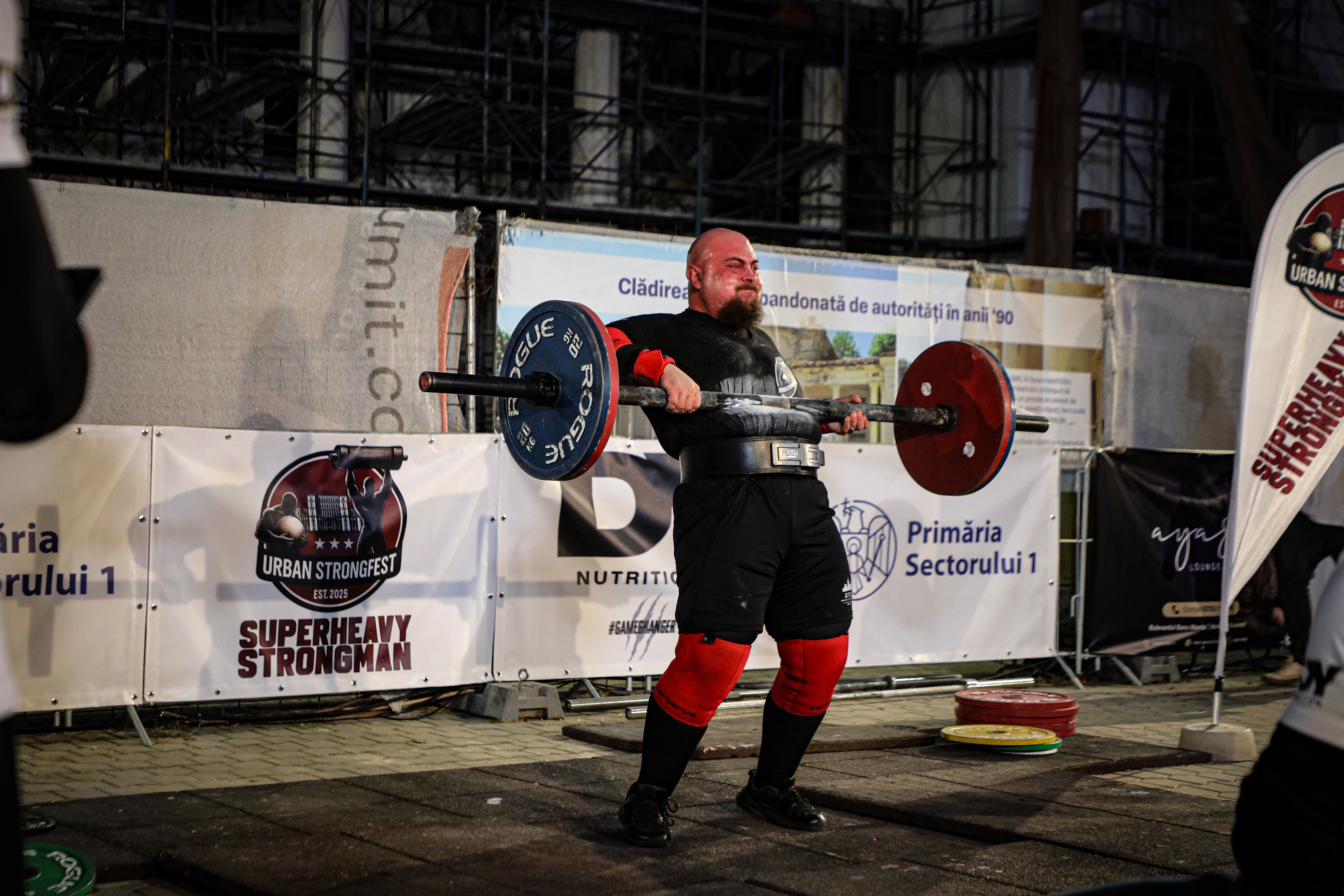
The Axle Press looks deceptively simple: take a bar, move it overhead and lock it out. That apparent simplicity hides a distinct biomechanical problem. A Strongman axle is thicker than a standard Olympic bar, often behaves differently in the hands, and changes grip mechanics, rack position, the relationship between elbows and torso, and the path of the load.
The biomechanical literature is still limited for the Axle Press as an isolated event. Systematic reviews show that Strongman research has focused on a relatively small number of events and that important quantitative gaps remain. This article therefore combines direct Strongman evidence with established strength-biomechanics principles while clearly distinguishing demonstrated findings from plausible mechanical interpretation. [1,2]
1. What is the Axle Press?
The Axle Press is an event in which an athlete raises a large-diameter axle loaded with plates from the starting position to overhead. Depending on the rules, the movement may be performed strictly, with leg drive through a push press, or through a jerk variation. Some competitions begin from the floor, making the clean part of the event, while others provide the implement in the rack.
That distinction matters. An Axle Press from the rack and an Axle Clean and Press are different mechanical and energetic tasks. If the athlete must lift from the floor, the clean may be the first limiting factor. If the axle starts in the rack, vertical force production becomes more dominant.
2. Why does a thick axle change the press?
Large diameter changes grip circumference and wrist position. A rigid axle with limited rotation also creates different control demands than a rotating Olympic bar. It would be incorrect to say that a thicker bar is automatically harder at every stage, but it is accurate to say that it changes the mechanical constraints.
Research on the Strongman Log Push Press has demonstrated that implement diameter can alter force-time characteristics, impulse, velocity and power. The Axle Press is not identical to the Log Press, but the general principle applies: implement geometry can change the mechanics of a movement even when external mass is held constant. [3]
3. Grip: the first major difference
A standard Olympic bar permits a relatively conventional grip and familiar relationship between the palm, fingers and wrist. A thick axle fills more of the hand and reduces how much the fingers can wrap around the bar. For some athletes this changes comfort and control, while for others it changes how the elbow can align beneath the load.
Grip should not be viewed only as a forearm issue. It establishes the distal position of the kinetic chain. A wrist change can influence elbow position, and elbow position influences arm path and shoulder-torso mechanics. A small geometric change at the bar can therefore propagate through several joints.
4. Wrist and forearm
The Axle Press requires strong control of a loaded wrist. The forearm flexors and extensors contribute to grip stabilization, while the brachioradialis and other forearm muscles help control hand position.
A very strong grip does not guarantee a strong press. If the athlete squeezes excessively and loses efficient wrist or elbow positioning, local effort may rise without improving force transfer. The goal is sufficient grip rigidity integrated into an efficient kinetic chain.
5. The rack: the foundation of the press
The rack is the position from which the vertical phase begins. In the Axle Press, rack position is influenced by axle thickness, forearm length, wrist, elbow and shoulder mobility, body mass and thoracic geometry.
An effective rack does not have to look identical between athletes. The biomechanical principle is that the load should remain sufficiently close to the system's center and the elbows should permit efficient force transfer into the axle. Starting too far forward or backward can alter external moments and pressing path.
6. Strict Axle Press
In a strict press, the vertical movement must be performed without meaningful leg-generated impulse. This makes the event a more direct test of force production through the shoulder and triceps, although the entire body continues to contribute to stabilization.
Strict press is valuable for developing pressing strength, but transfer to events allowing a dip-drive is incomplete. In a dynamic event, the athlete must convert lower-limb force into vertical velocity, which strict press does not reproduce.
7. Push Press: when the legs enter the equation
The push press adds rapid knee and hip flexion-extension. The dip creates the loading position and the drive generates vertical impulse. The shoulders and triceps then continue the movement to lockout.
For the Axle Press, the push press can be highly effective because it allows greater loads than strict press. But because the legs contribute, success depends on synchronization. If the arms begin pressing before lower-limb impulse is transferred efficiently, part of the mechanical advantage is lost.
8. The dip: too much, too little, or just enough?
The dip should be fast and controlled enough to allow impulse development. An excessive dip can increase movement time and destabilize the rack. A minimal dip can reduce lower-limb contribution.
There is no universal depth. Limb length, body mass, mobility, rack height and load influence the optimal strategy. Training should emphasize reproducibility and velocity rather than an arbitrary depth imposed on every athlete.
9. Drive and lower-limb extension
Knee and hip extension are major sources of impulse during the push press. The trunk must remain sufficiently rigid to transfer that force into the axle, while the arms receive and continue the movement.
This explains why a large strict press does not automatically produce an exceptional Axle Push Press. Force capacity and the ability to transmit force rapidly through the whole body are distinct qualities.
10. Triceps and shoulder
The triceps contributes substantially to elbow extension, particularly in the final portion of the press. The anterior deltoid contributes to arm elevation, while the scapular musculature participates in shoulder-girdle positioning and stabilization.
It is nevertheless a mistake to treat the Axle Press as an isolated deltoid and triceps movement. In a heavy repetition, legs, hips, trunk, scapula and arms form one force-transfer system.
11. Scapula and overhead position
As the axle rises, the scapula must accommodate arm movement and contribute to overhead stability. The trapezius, serratus anterior and other shoulder-girdle stabilizers participate in this process.
The final position should not be reduced to the idea of forcing the shoulders down or locking the scapula into one rigid posture. Efficient overhead movement requires coordination between the humerus, scapula and thorax. Depending on the rules, the final criterion is usually load control and required extension, not an identical visual position for every athlete.
12. The trunk: the invisible foundation
The trunk links the legs to the arms. In a push press, if the pelvis and thorax are not sufficiently coordinated, energy produced by the legs is not transferred efficiently.
The abdominals, obliques, spinal extensors and posterior trunk musculature contribute to the stiffness required. Stiffness does not mean absolute immobility. It means enough control for the movement to be directed toward the implement.
13. Center of mass and external moment
A load is mechanically more demanding when its center of mass is farther from the joint system controlling it. A thick axle can change this relationship through its position relative to the hands and body.
This is why bar path and trunk position matter. If the axle moves excessively anteriorly, the demands on trunk-control musculature can increase. If it moves too far posteriorly, the athlete may lose balance and the efficient pressing line.
14. Why can the Axle Press feel harder than the same weight on a barbell?
There is no single explanation. Grip, wrist position, limited rotation, bar geometry, rack position and implement path can all alter the effort experience.
A thick bar can also limit comfort and the ability to maintain efficient positions at high loads. The same external mass can therefore feel harder even though gravitational mass has not changed.
15. Axle Clean: the first problem when the bar starts from the floor
When the Axle Press begins from the floor, the clean becomes part of the event. The Axle Clean shares features with a clean, but the large diameter changes grip and interaction with the thighs and torso. The athlete must raise and rotate the axle into the rack without losing position.
This phase can be limited by lower-body and hip strength, but also by timing. A slow, disorganized clean consumes energy before the press begins. In a timed event, that loss of efficiency can become decisive.
16. Axle Clean versus Olympic Clean
The Olympic clean uses a bar diameter and rotation that permit a highly standardized technique. The Axle Clean requires adaptation to the large diameter and implement behavior. A strong power clean is useful but does not replace specific practice.
Transfer is real but incomplete. Deadlifts, cleans, front squats and pulls can develop important components, but the nervous system still has to learn the specific axle pathway.
17. Strength, power and velocity
Strict Axle Press is strongly constrained by force capacity. Push press and dynamic variations add a power component. In timed events, repetition velocity and the time required for each clean can become decisive.
Mechanical power is the product of force and velocity. An athlete can have impressive maximal strength but lose repetitions in an AMRAP if submaximal velocity is poor. Conversely, speed without sufficient force cannot move maximal loads.
18. Fatigue: when pressing becomes a metabolic problem
During long sets, the Axle Press becomes more than a strength test. It becomes a test of the ability to repeat force production under fatigue. Breathing, metabolite accumulation, velocity loss and coordination changes can alter technique.
For AMRAP, strategy may matter more than one spectacular repetition. The athlete must avoid wasting energy during the clean, keep the rack efficient and use the dip-drive without excessive amplitude.
19. Breathing and bracing
Bracing increases the trunk's ability to resist perturbation during lifting. In a heavy repetition, the athlete needs sufficient trunk stiffness before the drive and must then be able to restore breathing rapidly during repeated efforts.
There is no universal breathing pattern. In a 1RM, an experienced athlete may tolerate a short breath-hold coordinated with effort, whereas an AMRAP requires a compromise between stability and respiratory recovery.
20. Axle Press and the lumbar spine
Heavy axle pressing is not inherently harmful to the lumbar spine. However, an anterior load requires the trunk to control external moments. Excessive lumbar extension can be used to create space for the bar or overcome a sticking point, but it should not be treated as a universal requirement.
Biomechanical loading, individual tolerance and epidemiological injury risk must be distinguished. Strongman epidemiology shows that the low back and shoulder are frequently reported injury regions, but these data do not allow an individual injury to be attributed to Axle Press alone. [4]
21. Shoulder and injury risk
In Strongman athletes, the shoulder is one of the frequently affected regions in epidemiological data. A retrospective study of 213 athletes reported the shoulder as the second most frequently injured region after the lower back, with muscle and tendon injuries forming important proportions. The study also found an association between Strongman implement training and higher injury risk than traditional training after exposure adjustment. These data describe the Strongman population and do not demonstrate that Axle Press alone causes these injuries. [4]
22. Elbow and triceps
Repeated elbow extension under load can create substantial demands on the triceps and surrounding structures. Tolerance is influenced by volume, intensity, frequency and training history.
If an athlete simultaneously adds heavy Axle Press, bench press, dips, strict press and other triceps-dominant exercises, cumulative exposure may become more important than any single movement. Programming should therefore consider total elbow and shoulder volume.
23. Anthropometry and mechanical advantages
Arm length, torso length, body mass, mobility and segment girths can influence the Axle Press. Shorter arms may reduce displacement distance compared with longer arms, while longer arms change the extension requirement. Greater body mass can also influence stability and positioning.
These advantages are relative. No body type guarantees performance. Technique, strength, power, mobility and event-specific experience interact.
24. Why the Axle Press should not be trained only with the Axle Press
Specificity is essential for performance but insufficient for complete development. Intelligent programming uses exercises that develop limiting components: strict press for force, push press for lower-limb transfer, front squat for rack-position strength, deadlift and clean for pulling, and explosive derivatives for power.
An accessory exercise should be judged by its transfer to the athlete's actual limitation. If the clean is the weak link, more triceps work will not solve the problem. If lockout is limiting, triceps and pressing variations may have greater value.
25. Programming principles
A program can be organized around four components: general strength, specific strength, power and specific endurance. During accumulation, general development may receive greater emphasis. As competition approaches, the proportion of event-specific axle work should increase.
For a maximal event, high intensities and low repetitions are relevant. For AMRAP, the athlete must also develop repeatability, transition speed and energetic efficiency. For a medley, the ability to recover rapidly between events becomes an additional performance factor.
26. Load progression
Progression does not mean only adding kilograms. It can mean more repetitions at the same load, faster execution, shorter rest, greater specificity or transition toward the exact competition geometry.
With a very thick axle, progression can begin with an intermediate bar to adapt the grip and wrist, followed by the competition diameter. This allows tissue adaptation without making every session a maximal test.
27. Warm-up
Warm-up should prepare the wrist, elbow, shoulder, thorax, hips and the specific movement pattern. For an experienced athlete, an effective progression can move from general movement to light strict press, then push press and progressively heavier axle sets.
Strongman competition-preparation research shows that most athletes use a warm-up, commonly involving dynamic movement and tissue-preparation strategies. The goal is readiness, not depletion before the event. [5]
28. Axle Press in competition: technique meets strategy
In a 1RM, the athlete can accept a slower repetition if position remains controlled and the rules allow it. In an AMRAP, the same strategy may be inefficient. Every second spent in the rack, every slow clean and every excessively deep dip consumes resources.
Performance is therefore the product of physical capacity and effort management. The athlete must know not only how much can be lifted, but how quickly the movement can be repeated before velocity collapses.
29. What can transfer from the Log Lift?
Log Lift and Axle Press share some components: rack, dip-drive, press and the need to stabilize a load anteriorly. The implements are not identical. The log distributes mass and contacts the body differently, while the axle provides a linear bar with a thick grip.
A strong Log Lifter may have advantages in coordination and specific strength, but should not assume automatic technical transfer. The Axle Press must be practiced to learn the exact grip, rack and bar path.
30. What does the literature tell us, and where are the limits?
The 2019 Strongman biomechanics review included the Log Lift and other events but highlighted the lack of clear quantitative determinants of Log Lift performance. The 2020 methods review showed that existing studies often use small samples and simplified methods, limiting generalization. [1,2]
For the Axle Press, this limitation is even more important. There are not enough dedicated studies to define a single perfect technique or universal strength profile. The strongest practical approach is to combine established biomechanical principles with individual performance measurement: velocity, repetitions, load, position and tolerance to volume.
31. Conclusion: the Axle Press is a whole kinetic-chain test
The Axle Press is not simply an overhead press with a thick bar. Diameter changes grip, grip changes wrist-elbow mechanics, and implement geometry changes the rack and load position. From there, the mechanical chain continues through the trunk, hips, knees, ankles, shoulder and elbow.
In strict press, the limiting factor is largely the ability to produce force without meaningful lower-limb impulse. In push press, the athlete converts leg and hip extension into vertical impulse. In a jerk variation, velocity and coordination become even more important. If the event begins from the floor, the clean adds another major problem.
Strongman research supports the idea that the implement matters, not just its mass. Studies of other events, particularly the Log Lift, show that changing geometry can alter force, velocity, impulse and power. At the same time, direct Axle Press literature remains insufficient for universal conclusions. [1,2,3]
Ultimately, high-level Axle Press performance is the ability to organize the whole body around a load that does not behave like an Olympic barbell. Arm strength is necessary but rarely sufficient. Performance emerges when grip, rack, trunk, legs, hips, shoulder and elbow work in the same direction at the right time.
Scientific bibliography
1. Hindle BR, Lorimer A, Winwood P, Keogh JWL. The Biomechanics and Applications of Strongman Exercises: A Systematic Review. Sports Medicine - Open. 2019;5:49. doi:10.1186/s40798-019-0222-z. PMID:31820223.
2. Hindle BR, Lorimer A, Winwood P, Keogh JWL. A systematic review of the biomechanical research methods used in strongman studies. Sports Biomechanics. 2020;19(1):90-119. doi:10.1080/14763141.2019.1598480. PMID:31132028.
3. Renals L, Lake J, Keogh J, Austin K. Strongman Log Push Press: The Effect Log Diameter has on Force-Time Characteristics. Journal of Strength and Conditioning Research. 2018;32(10):2693-2700. PMID:30052599.
4. Winwood PW, Hume PA, Cronin JB, Keogh JWL. Retrospective injury epidemiology of strongman athletes. Journal of Strength and Conditioning Research. 2014;28(1):28-42. PMID:23669816.
5. Winwood PW, Pritchard HJ, Wilson D, Dudson M, Keogh JWL. The Competition-Day Preparation Strategies of Strongman Athletes. Journal of Strength and Conditioning Research. 2019;33(9):2308-2320. doi:10.1519/JSC.0000000000003267. PMID:31343547.
More From The Journal

Training
The Science of Strongman Training - Episode X: Competition Programming
How to build a complete Strongman competition preparation block: calendar, events, volume, intensity, specificity, simulations, autoregulation, tapering and fatigue management.
Training
The Science of Strongman Training - Episode IX: Peaking
Peaking in Strongman: how to turn months of training into maximal competition performance by reducing fatigue, preserving adaptations and managing specificity.