
Training
Strongman Events Explained Scientifically - Episode II: Log Lift
September 1, 2026
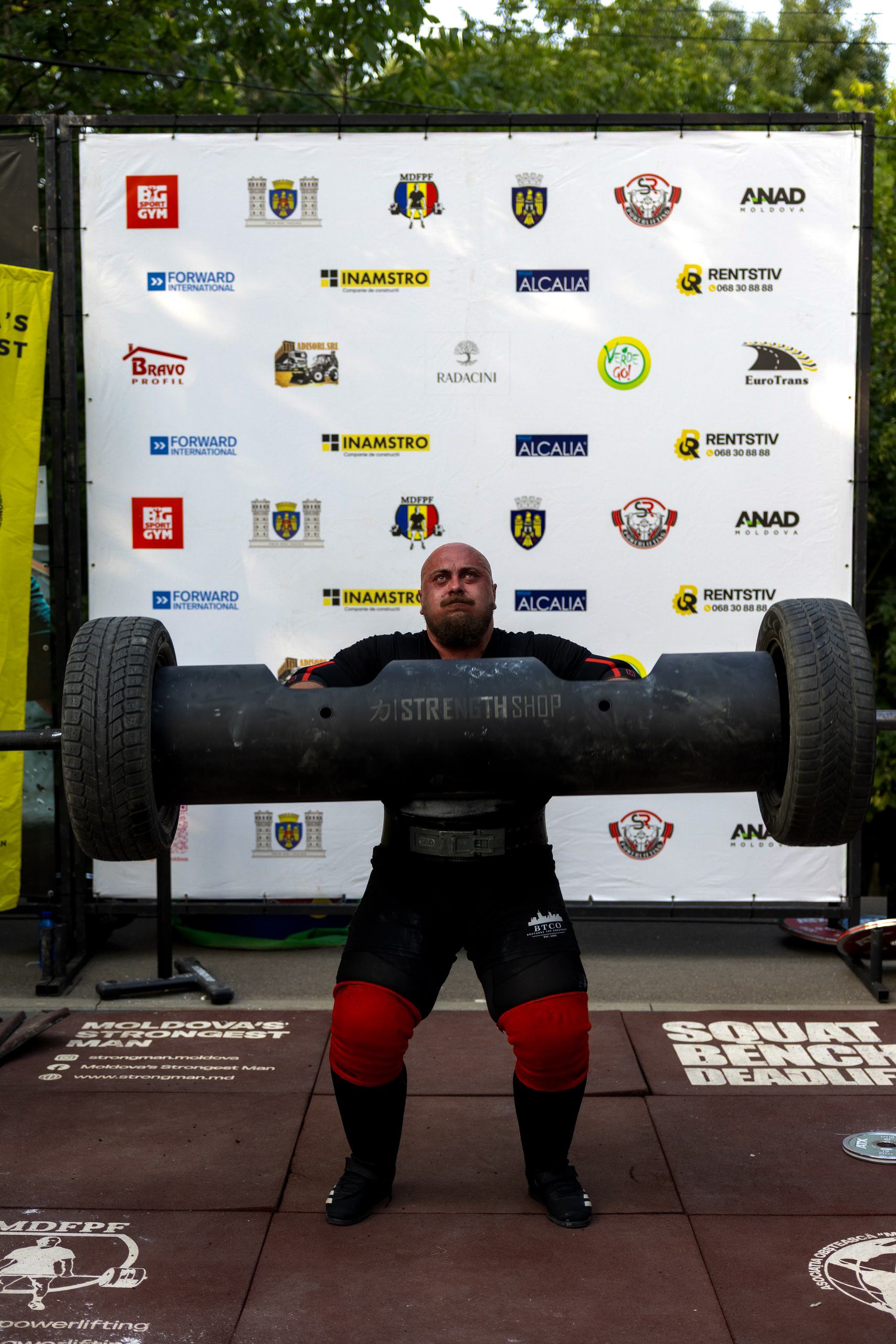
Strongman Events Explained Scientifically - Episode II: Log Lift
If the Atlas Stone is one of the clearest demonstrations of applied strength against an object without a conventional handle, the Log Lift presents a different fundamental Strongman problem: how can an athlete produce vertical force and transfer it through a bulky object whose geometry changes the relationship between the load and the body? At first glance, the Log Lift resembles a clean followed by a press or push press. Biomechanically, however, that comparison is useful only up to a point. The log changes hand position, system center of mass, trunk position, the distance between the load and the body, and the mechanics of the final overhead phase.
The Strongman literature has studied the Log Lift more extensively than many other events, although the evidence base remains modest. Winwood and colleagues compared six experienced male Strongman athletes performing the Log Lift and clean and jerk at 70% of their clean-and-jerk 1RM. The Log Lift demonstrated greater trunk and hip range of motion, while the clean and jerk produced higher peak velocities and greater power in specific propulsive phases. A later systematic review concluded that clear biomechanical similarities exist between the Log Lift, clean and jerk, squat and other strength exercises, but that important mechanical differences justify event-specific training.
This episode therefore treats the Log Lift as a complex sporting event rather than simply a shoulder exercise. It examines log geometry, the clean, lap and rack positions, dip-drive mechanics, triple extension, the contribution of the lower limbs, hips, trunk, shoulder girdle and arms, the effect of log diameter, strength, power, velocity, anthropometry, fatigue, differences from the barbell, injury considerations and evidence-informed programming.
1. What is the Log Lift?
The Log Lift is an event in which an athlete lifts a cylindrical implement fitted with internal handles to a rack position and then moves it overhead to the height required by the rules. Depending on the competition, it may be performed as a maximal lift, for repetitions within a fixed time, or as part of a larger event sequence.
Unlike a conventional Olympic barbell, the log has a large diameter and a geometry that fixes the hands in a relatively constrained relationship to the implement. Its size places the load farther anteriorly from the body, which can alter external moments around the trunk and the stabilization requirements.
2. Why is the Log Lift not simply a clean and jerk with a different object?
The similarity is real: both movements involve lifting a load, transitioning it to a rack position, and then generating vertical propulsion. But the log changes the geometry of the entire system. Winwood et al. reported approximately 24% greater trunk range of motion and approximately 9% greater hip range of motion in the Log Lift than in the clean and jerk under their testing conditions. Conversely, the clean and jerk produced higher peak velocities in the second pull and jerk.
This is a central biomechanical principle. The same external mass does not necessarily create the same mechanical task. A large log changes the distance between the load and the body, limits the hand configuration, and changes the pathway through which force is transferred.
3. Log geometry: the variable that changes the event
Log mass is only one variable. Diameter, length, handle placement, handle spacing and the position of the center of mass all matter. A larger diameter can place the implement farther anteriorly and alter trunk and shoulder mechanics.
Research on the Strongman Log Push Press demonstrated that log diameter affects force-time characteristics. At 65% of 1RM, different log sizes produced different braking and propulsive force, velocity, impulse and power characteristics, while the barbell permitted substantially greater propulsive outputs than the logs. Therefore, 100 kg on a log is not mechanically equivalent to 100 kg on a barbell.
4. Phase I: approaching the log and establishing the grip
Before the log moves, the athlete must establish a stable relationship with the implement. The internal handles provide a more controllable grip than an Atlas Stone, but the hand position is more constrained than with many barbell variations. This geometry affects elbow position and the distance between the implement and the torso.
An efficient start allows the lower limbs to generate force without allowing the log to drift unnecessarily forward. The farther the load moves anteriorly, the greater the demand on trunk control. The starting position is therefore a mechanical decision, not merely a matter of comfort.
5. Phase II: first pull and separation from the floor
The first lifting phase resembles a modified deadlift and shares features with the first part of a clean. The athlete produces coordinated knee and hip extension while the trunk transmits force to the implement. Efficient execution keeps the log moving without excessive forward displacement.
The Strongman systematic review noted that the early phases of the Log Lift can be interpreted alongside the clean and Atlas Stone. The analogy should not be confused with identity, however, because the log has different geometry, grip and mass distribution from a barbell.
6. The lap: the reorganization point
As the log passes the knees, the athlete brings it into a lap position, temporarily supported on the thighs. Conceptually this resembles the Atlas Stone lap, but the interface with the body is different. The log can be rolled or pulled toward the torso, and the athlete must create a position from which a second extension can be produced.
The lap is not a passive pause. It is a mechanical reorganization. If the position is lost, the athlete may be forced to rely more heavily on the arms and trunk and less on efficient lower-limb extension.
7. The specific Log Clean
The log clean differs from the Olympic clean because the implement is rolled toward the body and then raised within a geometry determined by its diameter. The athlete does not have the same freedom to keep a thin bar close to the thighs and move it through a highly vertical pathway.
The Log Clean should therefore be considered a distinct motor skill. An athlete may possess excellent power-clean capacity and still require specific adaptation to the log. Timing between hip extension, elbow movement, log rotation and rack entry must be learned through event-specific practice.
8. The rack position: the center of the event
The rack is the position in which the log is stabilized in front of the torso before the pressing phase. Because of its diameter, the implement may remain relatively anterior, changing the demands placed on trunk extension and stabilization.
An effective rack allows the athlete to generate force from the legs without losing trunk position. Elbows, wrists, thorax and abdomen create a combined platform. The rack is therefore not simply a resting position; it is the starting platform for transferring force into the press.
9. The trunk: why the Log Lift is more than a shoulder exercise
The Log Lift requires the trunk to control a load positioned anteriorly. The comparative study with the clean and jerk found greater trunk range of motion in the Log Lift. This does not mean that trunk flexion or extension is automatically harmful; it means that log geometry requires a different positioning strategy.
The abdominal muscles, obliques, spinal extensors, latissimus dorsi and shoulder-girdle musculature contribute to controlling the system. Their role is not to lift the log independently but to allow lower-limb force to be transmitted without major losses of position.
10. The dip: loading the system
Before the press, the athlete rapidly lowers through a small amount of knee and hip flexion. This is the dip. Its purpose is not to turn the movement into a squat but to create a position from which the lower limbs can generate vertical impulse.
An excessively deep dip can increase transition time and compromise log position. An excessively shallow dip can limit impulse. Optimal depth is individual and depends on load, anthropometry, mobility and event format.
11. The drive: the legs initiate the press
During the dip-drive, rapid knee and hip extension transfers impulse to the log. The shoulders and triceps complete the movement, but the initial propulsion depends strongly on the lower limbs.
This explains why the Log Lift should not be programmed simply as a shoulder press. An athlete who attempts to move the entire load through the deltoids and triceps gives up one of the movement's major sources of power: the impulse generated by the legs and hips.
12. Triple extension and force transfer
Coordinated ankle, knee and hip extension is a fundamental similarity between the Log Lift and other explosive lifting movements. Winwood et al. suggested that the Log Lift can provide a useful stimulus for rapid extension, although the clean and jerk produced greater propulsive power in the conditions tested.
In practical terms, the Log Lift develops and tests the ability to connect lower-limb force production to the movement of a heavy implement. Triceps strength can finish the repetition, but it cannot fully compensate for insufficient initial drive.
13. The final press: when force must become position
After the drive, the log continues toward the overhead position. The anterior deltoid, triceps, shoulder girdle and trunk stabilizers contribute strongly. Success, however, is not determined by pushing strength alone. The athlete must control the implement's path and reach a sufficiently stable overhead position for a valid repetition.
The final centimeters can therefore decide the event. If the log remains too far anterior, external trunk moments increase. If the athlete loses shoulder-girdle position or elbow extension, sufficient muscular force may exist while the repetition still fails.
14. The shoulder and scapular girdle
The Log Lift challenges the shoulder differently from a conventional military press. The implement is larger, the hands are separated, and the object begins anteriorly. Scapular motion must accommodate arm movement while contributing to overhead stability.
The anterior deltoid, triceps, trapezius and serratus anterior contribute to overhead completion and stabilization. Stability should not, however, be reduced to one muscle. It emerges from coordination between the entire shoulder girdle and trunk.
15. Biceps and elbow: a different role from Atlas Stones
In the Log Lift, the biceps contributes to the clean and to control of the rack, but the mechanics differ from Atlas Stones. During the press, the elbow moves from flexion toward extension and the triceps becomes the principal elbow extensor.
The complete event therefore requires several successive capacities: pulling and controlling the log during the clean, stabilizing it in the rack, producing impulse during the dip-drive, and extending the elbows during the final phase.
16. Strength versus power
A maximal Log Lift is strongly constrained by the ability to produce enough force to move the load. At submaximal loads and in timed events, however, velocity becomes critical. Mechanical power is the product of force and velocity, and the athlete must produce enough force within a short time.
Log Push Press research demonstrates meaningful differences between barbell and log in force, impulse, velocity and power. A program that only increases 1RM may therefore leave an important component of performance underdeveloped.
17. Log diameter and its consequences
Diameter is one of the most important external variables. A large log increases the distance between the load and the body and can change trunk position and arm angles. Renals et al. demonstrated that log size can significantly alter the mechanical characteristics of the push press.
This has direct competition implications. An athlete who trains only with a small-diameter log may be surprised when the same mass is placed on a larger implement. Specificity therefore includes kilograms plus the geometry of the implement.
18. Anthropometry: who has an advantage?
Arm length, torso length, chest circumference, shoulder mobility, body mass and segment proportions can all influence the Log Lift. A bulky log may be easier to stabilize for one set of body proportions than another.
Strongman literature has reported calf girth, flexed arm girth and total system force as variables associated with Log Lift performance. These relationships should not be interpreted as proof that one muscle determines performance. They indicate that body size and global force-producing capacity are relevant.
19. Log Lift and the center of mass
In a mechanical system, the distance between the load's center of mass and the body's joints influences external moments. A bulky log can position its center of mass more anteriorly than a bar held close to the torso. For the same mass, this may increase the demand for trunk control.
Efficient technique therefore seeks to minimize unnecessary displacement and maintain an effective relationship between the implement and the body. The goal is not to eliminate distance, which the geometry makes impossible, but to avoid increasing it unnecessarily.
20. Fatigue and technical degradation
In an AMRAP event, the Log Lift changes progressively. Early repetitions may be dominated by power, while later repetitions are increasingly constrained by fatigue management. As fatigue accumulates, the dip may slow, rack stability may decline, and the transition from clean to press may become less efficient.
The same external load can therefore become mechanically harder as velocity and coordination decline. In timed events, the ability to maintain sufficiently efficient technique under fatigue is a performance quality in its own right.
21. Breathing and intra-abdominal pressure
The Log Lift combines periods of high force production with rapid execution. Breathing and bracing must be coordinated with that alternation. During the clean and rack, trunk stability is critical; during the dip-drive, pressure and trunk control must remain sufficient to transfer force.
In longer sets, breathing strategy must balance stability with the need to recover quickly between repetitions. There is no single universal pattern that is optimal for every event format.
22. Log Lift and the lumbar spine
An anterior log can increase trunk-control demands, particularly during the clean and rack. It is not scientifically justified to claim that the Log Lift is inherently harmful to the spine. Mechanical loading depends on technique, mass, geometry, range of motion, fatigue and individual tolerance.
The same methodological distinction used in the Atlas Stone analysis applies here: biomechanics describes the demands of a movement, while epidemiology describes injury occurrence within a population. Both forms of evidence must be considered together.
23. The shoulder and injury risk
The shoulder is one of the regions frequently reported in Strongman injury literature. The Log Lift loads it through the combined demands of the rack, dip-drive and overhead phase. Risk cannot be assigned to one phase alone because cumulative exposure, volume, training history and technique influence tissue tolerance.
The practical implication is that strength development should be accompanied by development of control and tolerance to specific volume. A maximal press does not reproduce the total demand of a repeated Log Lift series.
24. The elbow and triceps
The final repetition requires active elbow extension. The triceps is a major force producer in this phase, but it works with the deltoid, shoulder girdle and trunk. Strong elbows cannot fully compensate for insufficient drive or an unstable rack.
Triceps isolation can therefore have supporting value, but it should not be treated as a substitute for specific practice. Specificity matters because the implement and pathway alter several variables simultaneously.
25. Why the Olympic barbell remains useful
Specificity does not make the barbell irrelevant. Cleans, push presses, jerks, front squats, deadlifts and other variations can develop components of performance. The bar allows precise loading, easy progression and standardized development of strength and power.
But transfer has limits. Biomechanical research shows that clean and jerk can produce higher velocities and power in certain phases, while the Log Lift produces greater trunk and hip range of motion under the studied conditions. The two exercises are therefore better viewed as complementary than interchangeable.
26. How should the Log Lift be trained scientifically?
A robust program should build general strength, power, event-specific skill and tolerance for repeated efforts. Their relative emphasis should change according to the training phase and competition format.
General strength
Deadlifts, front squats, back squats, push presses, strict presses and clean variations can build the foundation. Front squats help develop force production from positions resembling the rack, while push press develops the relationship between dip-drive and press.
Power
Olympic derivatives, jump squats, dynamic push presses and other explosive movements can support rate of force development. Transfer should nevertheless be verified through Log Lift performance rather than assumed.
Specific strength
The log itself must be trained. The clean, lap, rack and press should be progressively exposed to competition-relevant loads. Where a clear limitation exists, training can isolate components through log clean, clean to rack, rack holds, push press and log press.
Specific endurance
For AMRAP formats, sets should be introduced progressively. The goal is to maintain speed and technical efficiency rather than turn every session into a maximal test. Quality under fatigue matters as much as repetition count.
27. Load progression
Progression can occur through load, repetitions, velocity, target height, shorter rest periods or greater log diameter. Progress does not have to be expressed only in kilograms.
An important principle is separating development from testing. Frequent 1RM testing may be useful for assessment, but it is not the whole adaptation process. The athlete must become capable of producing force rapidly, repeatedly and within the geometry of the event.
28. Warm-up for the Log Lift
Warm-up should prepare the exact systems that will be loaded: muscle temperature, relevant mobility, hips, thorax, shoulder girdle, elbows and wrists, as well as the specific clean and dip-drive pattern. Strongman competition-preparation research shows that most athletes use a warm-up before events.
For an experienced athlete, the specific warm-up can progress from general movement to an empty or very light log, then intermediate loads and finally competition-like loading. The objective is preparation, not fatigue.
29. Log Lift and competition performance
Performance can be measured by 1RM, repetitions in a fixed interval, time to a prescribed number of repetitions, execution velocity or percentage of valid repetitions. The metric should reflect the competition format.
In a maximal event, force capacity dominates. In AMRAP, transitions between repetitions, dip-drive velocity and rack efficiency become much more important. The best Log Lifter is therefore not defined by one biomechanical quality.
30. What does the literature tell us, and what does it not yet tell us?
The Log Lift has a stronger research base than many Strongman events, but important gaps remain. The 2019 systematic review identified a lack of clear quantitative biomechanical determinants of Log Lift performance. Existing studies have focused heavily on between-exercise comparisons and geometry rather than every factor separating elite from lower-performing athletes.
Many studies also use small samples and simplified laboratory methods. This matters when applying findings to real competitions, women, different weight classes, Masters athletes or logs with different geometries.
31. Conclusion: the Log Lift is a force-transfer problem
The Log Lift combines strength, power, coordination, stabilization, mobility and technical efficiency. The log is not simply a thicker bar. Its geometry changes the relationship between the body and the load, and therefore changes the mechanics of every phase.
The clean requires force production from the legs and hips, the lap reorganizes the system, the rack creates the working platform, the dip-drive converts lower-limb force into vertical impulse, and the press completes the transfer to the overhead position. No link can be completely ignored.
Research shows meaningful similarities between the Log Lift and clean and jerk, but they are not identical. The Log Lift can involve greater trunk and hip range of motion, while the Olympic barbell can permit greater velocity and power under certain conditions. Log diameter also changes force, impulse, velocity and power demands. The central lesson is therefore that load must always be considered together with implement geometry.
Ultimately, a strong Log Lift is not simply a strong press. It is the ability to transform whole-body force into coordinated movement of a bulky object from the floor to overhead. That is the essence of the event: not merely pushing the weight, but organizing the entire human system around it.
Scientific bibliography
1. Winwood PW, Cronin JB, Brown SR, Keogh JWL. A Biomechanical Analysis of the Strongman Log Lift and Comparison with Weightlifting's Clean and Jerk. Sports Technology. 2015;10(5):869-876. doi:10.1260/1747-9541.10.5.869.
2. Hindle BR, Lorimer A, Winwood P, Keogh JWL. The Biomechanics and Applications of Strongman Exercises: A Systematic Review. Sports Medicine - Open. 2019;5:49. doi:10.1186/s40798-019-0222-z. PMID:31820223.
3. Renals L, Lake J, Keogh J, Austin K. Strongman Log Push Press: The Effect Log Diameter has on Force-Time Characteristics. Journal of Strength and Conditioning Research. 2018;32(10):2693-2700. PMID:30052599.
4. Hindle BR, Lorimer A, Winwood P, Keogh JWL. A systematic review of the biomechanical research methods used in strongman studies. Sports Biomechanics. 2020;19(1):90-119. doi:10.1080/14763141.2019.1598480. PMID:31132028.
5. Winwood PW, Keogh JWL, Harris NK. The Strength and Conditioning Practices of Strongman Competitors. Journal of Strength and Conditioning Research. 2012. PMID:21993033.
6. Winwood PW, Pritchard HJ, Wilson D, Dudson M, Keogh JWL. The Competition-Day Preparation Strategies of Strongman Athletes. Journal of Strength and Conditioning Research. 2019;33(9):2308-2320. doi:10.1519/JSC.0000000000003267. PMID:31343547.
7. Winwood PW, Hume PA, Cronin JB, Keogh JWL. Retrospective injury epidemiology of strongman athletes. Journal of Strength and Conditioning Research. 2014;28(1):28-42. PMID:23669816.
8. McGill SM, McDermott A, Fenwick CMJ. Comparison of different strongman events: trunk muscle activation and lumbar spine motion, load, and stiffness. Journal of Strength and Conditioning Research. 2009;23(4):1148-1161. doi:10.1519/JSC.0b013e318198f8f7. PMID:19528856.
More From The Journal

Training
The Science of Strongman Training - Episode X: Competition Programming
How to build a complete Strongman competition preparation block: calendar, events, volume, intensity, specificity, simulations, autoregulation, tapering and fatigue management.
Training
The Science of Strongman Training - Episode IX: Peaking
Peaking in Strongman: how to turn months of training into maximal competition performance by reducing fatigue, preserving adaptations and managing specificity.