
Training
Strongman Events Explained Scientifically - Episode I: Atlas Stones
September 1, 2026
Strongman Events Explained Scientifically - Episode I: Atlas Stones
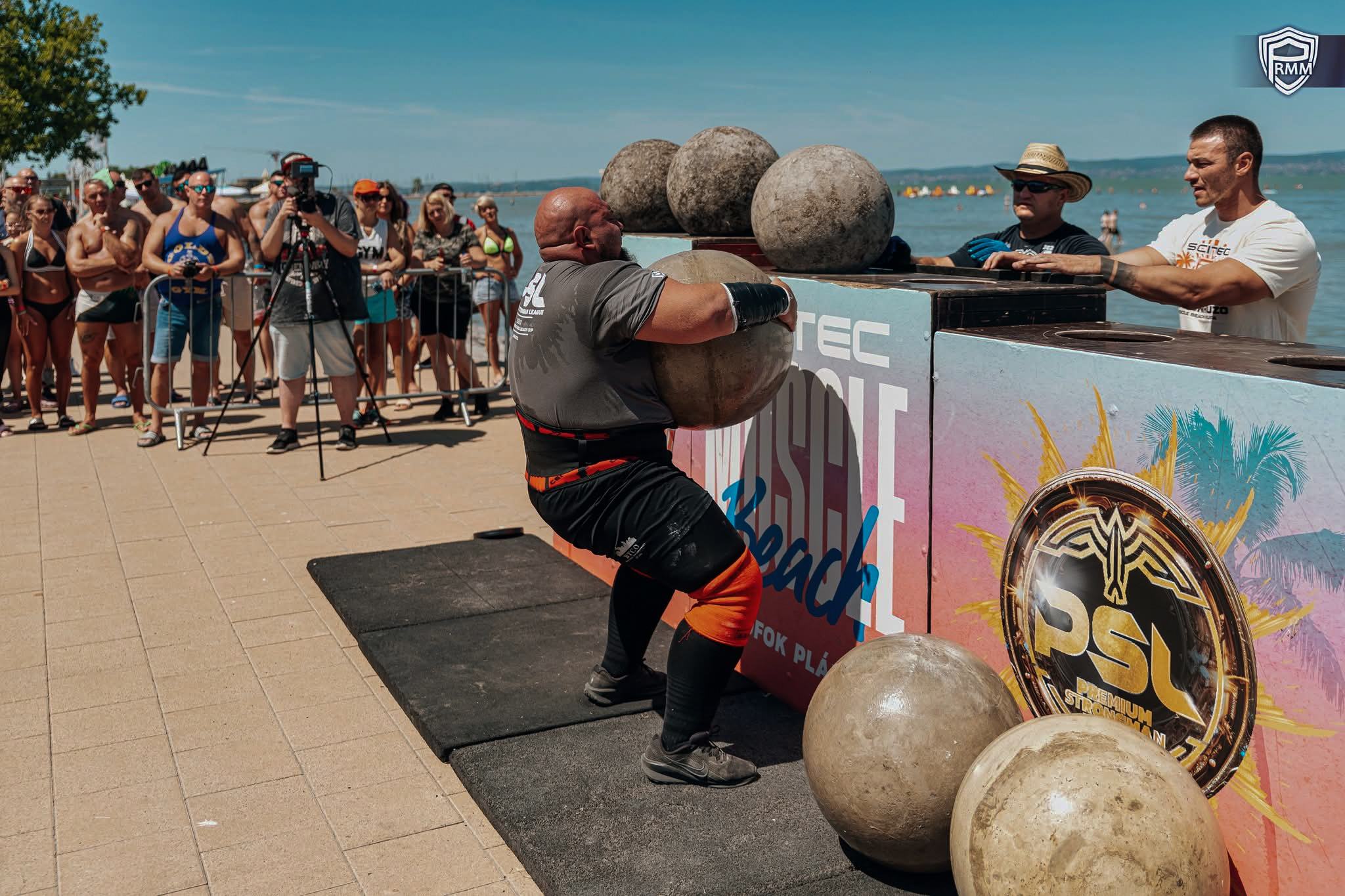
Strongman contains events in which weight is only part of the problem. Atlas Stones is one of the clearest examples. The athlete does not lift a bar with conventional handles. Instead, a large, spherical object with no standardized handhold must be embraced, separated from the floor, brought into the lap, repositioned, and then driven to a prescribed height. Mechanically, this is a combination of lifting, keeping a mass close to the body, rapid hip and knee extension, and whole-body stabilization.
The scientific literature already provides a useful biomechanical foundation for Atlas Stones, although the evidence base remains small. Hindle and colleagues studied 20 experienced male and female Strongman athletes performing progressive stone series up to approximately 85% of one-repetition maximum. They identified five phases of the movement: recovery, initial grip, first pull, lap, and second pull, demonstrating that the mechanical demands are reorganized throughout the lift.
This article is not intended to reduce a complex event to a list of technical tricks. Its purpose is to explain what happens when an athlete lifts a 100, 150, or 200 kg stone. We will examine object mechanics, center of mass, moment arms, hip, knee and ankle function, trunk control, biceps and forearm demands, grip, breathing and trunk stabilization, fatigue, anthropometry, technique, injury considerations, and transfer to other exercises.
1. What is the Atlas Stone event?
Atlas Stone is an event in which the athlete lifts a large stone, usually spherical and commonly made from concrete or a similar material, from the floor onto a platform, over a bar, or to a prescribed height. Competitions may use a single stone for maximum repetitions within a time limit or a series of progressively heavier stones that must be loaded as quickly as possible.
The defining difference from a deadlift is object geometry. A bar provides a relatively standardized grip and predictable load position. A stone does not. The athlete must create contact with a convex object, while the hands and forearms help compress and stabilize it against the chest and abdomen. Consequently, the same absolute mass can create very different mechanical demands depending on stone diameter, surface, target height, and athlete proportions.
2. Why is an Atlas Stone not simply a deadlift with a stone?
There is an important similarity between the first part of the lift and a Romanian deadlift or modified deadlift: the athlete must create hip and knee extension to separate the mass from the floor. However, the mechanics change substantially once the stone approaches the body. Instead of remaining suspended away from the athlete, it is brought into the lap and its center of mass changes relative to the body.
The systematic review of Strongman biomechanics described the Atlas Stone as a static lift with similarities to traditional resistance exercises and to loaded-carriage tasks. The first pull can be compared conceptually with a hip hinge, the lap phase with rising from a squat-like position, and the second pull with strong hip and knee extension while the load is positioned anteriorly.
3. The five biomechanical phases of the lift
Hindle et al. identified five phases: recovery, initial grip, first pull, lap, and second pull. This division is useful because it demonstrates that Atlas Stone is not one mechanically uniform action. It is a sequence of strategies in which the relationship between the athlete and the object changes continuously.
Recovery
In a series of stones, recovery is the interval between loading one stone and preparing for the next. Although it does not directly lift the object, it matters in timed events. The athlete must restore the working position quickly without wasting energy.
Initial grip
The first problem is specific to the stone: finding an effective grip on a convex surface. Hand position, arm width, forearm contact, and the ability to bring the chest toward the stone determine how effectively the mass can be controlled during the first centimeters of the lift.
First pull
The first pull is the phase in which the stone leaves the floor. Experimental data show substantial hip flexion, moderate knee flexion and ankle dorsiflexion at the beginning, followed by large hip movement. Hip extensors, thigh musculature, and trunk must work together to raise the object without losing contact.
Lap
The lap is the reorganization point. The stone is temporarily supported on the thighs while the athlete changes hand position and prepares for the second extension. Mechanically, the objective changes from separating the stone from the floor to bringing its center of mass closer to the body and preparing for the final drive.
Second pull
During the second pull, the athlete starts from a flexed position and again produces hip and knee extension. At completion, large hip and knee extension and ankle plantarflexion occur. This phase propels the stone toward the platform and requires coordination between the lower limbs, trunk, and upper limbs.
4. The stone's center of mass: the hidden problem in geometry
With a barbell, the center of mass is relatively easy to predict. With a spherical stone, the center of mass is geometrically clear, but its relationship to the athlete's joints changes throughout the movement. When the stone is far from the body, its external moment arm relative to the hip and spine can increase. When it is brought closer, the external moment can decrease for the same mass.
This is a central principle of the event: performance depends not only on how heavy the stone is, but also on where its mass sits relative to the athlete. The ability to keep the stone close is therefore a mechanical strategy, not merely a stylistic preference.
5. The hip: the primary engine of the lift
The hip extensors, particularly the gluteus maximus together with the hamstrings, have a central role. The first pull requires strong hip extension, and the second pull repeats this demand after the stone has been brought into the lap. The 2021 biomechanical study showed that hip motion is one of the defining characteristics of the movement.
This explains why deadlifts, Romanian deadlifts, hip-hinge training, and other hip-extension exercises can provide useful transfer. Transfer is not the same as specificity, however. An athlete may possess a very large deadlift and still be limited by the ability to control a bulky stone in the lap or finish it to a given height.
6. Knee and ankle: the contribution that should not be ignored
The knee contributes to force production in both pulling phases, while the ankle helps transmit force to the ground and contributes to final extension. In the 20-athlete study, the beginning of the second pull involved substantial knee flexion and ankle dorsiflexion, followed by extension and plantar flexion at completion.
This sequence demonstrates that Atlas Stone is a whole kinetic-chain movement. There is no single 'stone muscle'. Force must be generated by the lower limbs, transmitted through the pelvis and trunk, and applied to the object through the arms and torso.
7. The trunk and lumbar spine: stability, not absolute rigidity
Atlas Stone creates an unusual relationship between trunk and load. The athlete must bend around the stone, and the spine does not remain in one configuration throughout the lift. A classic study by McGill, McDermott, and Fenwick examined muscle activation, lumbar motion, and spinal loading across Strongman events, including a 110 kg stone lifted to 1.07 m. In that very small sample, Atlas Stone produced the lowest lumbar compression among the events examined.
That result must be interpreted cautiously. Only three athletes were studied, and such a small biomechanical sample cannot establish a universal rule. In addition, estimated spinal loading in a laboratory and real-world injury occurrence are different phenomena.
McGill and colleagues also observed event-specific coordination, with hip extensors integrated before the back extensors during the Atlas Stone lift. The important concept is that the trunk should not be considered in isolation. It acts as a force-transmission platform between the hips and the stone.
8. Arms, biceps, and forearms: the contact system
The arms are not the primary engines of the lift, but they are essential for object control. In Atlas Stone, the athlete uses a combination of elbow flexion, forearm pressure, and torso contact to prevent the stone from moving away from the body.
This helps explain why the biceps appears repeatedly in Strongman injury discussions. In a retrospective study of 213 athletes, biceps injuries accounted for 11% of all reported injuries, and the analysis of specific mechanisms linked stone work with biceps and lower-back injuries.
This does not mean that any particular elbow position or any spinal flexion automatically causes a rupture. Injury is an interaction between loading, tissue capacity, history, fatigue, technique, and the circumstances of the specific repetition.
9. Hands and grip: why an object without a handle changes everything
The grip on a stone is not a conventional grip. There is no handle around which the fingers can close. The athlete creates contact through the palms, fingers, forearms, and pressure of the body against the stone.
Consequently, surface texture and stone diameter can change difficulty without changing mass. A larger stone may require a different arm position and may alter the distance between the center of mass and the torso. A slippery surface may make grip the limiting factor rather than hip extension.
10. Anthropometry: why the same stone is not the same event for two athletes
Arm length, femur length, height, torso dimensions, body mass, and segment proportions can alter the geometry of the lift. Hindle et al. found differences between male and female athletes in hip angles and second-pull duration and interpreted some of these differences in relation to anthropometry.
This matters for programming as well. A platform height or stone diameter that is favorable for one athlete may be less favorable for another. Atlas Stone performance should therefore be evaluated relative to event geometry, not only by mass lifted.
11. Platform height: the final centimeters can change the event
Loading a stone onto a 1.0 m platform is not mechanically identical to passing it over a 1.3 m bar. Target height changes the range and the point at which the athlete must transfer the stone from torso contact into the final loading position.
An athlete may therefore possess sufficient strength to lift the stone from the floor yet fail at the top. The final phase is a problem of positioning, extension, and object control, not simply absolute strength.
12. Speed and rate of force development
In a timed series, being able to lift the stone is not enough. It must be lifted quickly. This introduces rate of force development and the ability to produce high force within a short time interval.
Biomechanical data show distinct temporal roles for the first and second pulls. Depending on the athlete's level, training may use deadlift variations, squats, Olympic-lifting derivatives and other dynamic exercises to develop the physical qualities required. The final step, however, must remain specific exposure to the stone itself. The systematic review recommends using biomechanical similarities between Atlas Stone and traditional exercises to support development.
13. Fatigue: when the same stone begins to behave differently
One of the most interesting findings from the 2021 study was that phase durations and total repetition duration increased as the series progressed. The authors attributed these changes to increasing stone mass and acute fatigue. Changes in hip and ankle range of motion were also observed.
In practical terms, fatigue can change strategy without the athlete consciously deciding to change it. Extension can become slower, the lap transition can become less efficient, torso-to-stone contact can deteriorate, and rhythm between the first and second pulls can be lost. In multi-stone events, fatigue management is therefore part of technique.
14. Atlas Stones and the lumbar spine: between myth and reality
It is tempting to say that a heavy stone is automatically 'bad for the back'. The evidence does not support such a simple conclusion. The McGill study found relatively low lumbar compression in its small sample, while Strongman injury epidemiology shows the lower back to be one of the most frequently injured regions and stone work to be associated with lower-back injuries.
The apparent discrepancy is not necessarily a contradiction. A biomechanical model estimates loading during a particular execution at a particular time. Epidemiology reflects cumulative exposure to training and competition, variation in technique, fatigue, acute incidents, and individual history. An event can therefore have a particular mechanical profile in a laboratory while still contributing to injuries under real-world volume and intensity.
15. Atlas Stones and the biceps: why the risk deserves attention
Because the stone is controlled through contact between the arms and body, the biceps can be exposed to high force in unusual positions. Strongman injury epidemiology identifies the biceps as a frequent injury site, and a later clinical case report described rehabilitation after a distal biceps rupture in a Strongman athlete, emphasizing individualized load progression after repair.
This does not mean Atlas Stones should be avoided. It means that specific exposure to the event should be treated as an adaptation of the entire system rather than as an automatic extension of barbell strength.
16. Which muscles actually work?
Atlas Stones recruit a broad system: gluteus maximus, hamstrings, quadriceps, adductors, trunk musculature, spinal erectors, obliques, quadratus lumborum, latissimus dorsi, biceps, brachialis, forearm musculature, and shoulder-girdle muscles. The relative contribution of each changes across phases.
For this reason, it is not useful to classify the event simply as a 'back exercise' or 'leg exercise'. It is an integration movement. Performance occurs when lower-limb force production is transmitted through a sufficiently stable trunk to an object that offers no conventional handle.
17. Breathing and trunk pressure
Very heavy lifting requires respiratory and trunk-stabilization control. Intra-abdominal pressure can contribute to trunk stiffness during strength efforts, but it should not be treated as the sole explanation for spinal stability. In Atlas Stones, the athlete must coordinate breathing with the first pull, lap, and second pull, particularly when several repetitions are performed.
In timed events the problem becomes more complex: prolonged breath holding may increase pressure and discomfort, while insufficiently controlled breathing may compromise trunk control. The strategy should be individualized and practiced under competition-like conditions.
18. Tacky, surface, and contact with the stone
Atlas Stones is sensitive to contact conditions. Surface texture, the use of tacky where competition rules permit it, and skin protection can substantially alter the ability to keep the stone close. These factors do not change the stone's mass, but they change friction and therefore the external conditions of control.
Scientifically, it is important to distinguish internal body mechanics from external object conditions. Final performance is the product of both.
19. Why technique cannot be reduced to one 'perfect' shape
Athletes do not have identical proportions, and Atlas Stones do not have identical geometry across competitions. The 20-athlete study found sex differences and changes across repetitions, including hip range of motion. These findings support the idea that stable biomechanical principles exist, but meaningful individualization remains.
The general principles matter more than copying a picture: the stone must be controlled, its center of mass should be brought closer to the body when possible, force should be produced progressively through the kinetic chain, and the transition from lap to second pull should allow an efficient finish. The exact posture can vary.
20. How should Atlas Stones be trained scientifically?
An effective program should develop three components simultaneously: general force-production capacity, specific ability to control the stone, and the ability to repeat performance under fatigue. None completely replaces the others.
General strength
Deadlifts, Romanian deadlifts, squats, front squats and other hip- and knee-extension exercises can build the physical foundation. Survey data on Strongman training show that competitors commonly use maximal strength, power, hypertrophy, and Olympic-lifting derivatives as part of general preparation.
Specific strength
The stone itself should be introduced progressively. Mass, diameter, target height, repetition count, and execution speed can all be manipulated. For beginners, the first objective should be movement control and learning the floor-to-lap-to-finish sequence, rather than repeated maximal testing.
Power and speed
Olympic-lifting derivatives, jump squats, rapid extension movements, and dynamic exercises can support the ability to produce force quickly. They should be considered supporting tools, however, rather than perfect substitutes for stone-specific practice.
Specific endurance
If the event consists of a stone series, the ability to move rapidly from one repetition to the next must also be trained. The Hindle et al. study showed that phase and total duration changed as mass and fatigue increased, supporting controlled exposure to specific series work.
21. Loading: why progression must be smarter than simply adding kilograms
An athlete can progress through more weight, but also through more quality repetitions, a higher target, a larger stone, a shorter time, or better movement efficiency. In Atlas Stones, these represent different forms of loading.
A sensible progression can begin with a relatively manageable stone, consolidate technique, and then gradually increase mass and complexity. There are not enough specific data to prescribe one universal loading percentage for every athlete. The experimental study used approximately 60%, 70%, 80%, and 85% of 1RM across a four-stone series, but that was a research protocol, not a universal programming rule.
22. Warm-up and event preparation
Survey data from 132 Strongman athletes showed that 94% used a competition warm-up, typically lasting about 16 minutes. The main reasons reported were injury prevention, activation, and increasing blood flow, temperature, and heart rate.
For Atlas Stones, the warm-up should prepare the actual demands of the event: temperature, relevant mobility, posterior-chain activation, trunk control, and progressive contact with the implement. The warm-up should prepare the athlete rather than fatigue them before the event.
23. Injury: what does the literature actually say?
In the retrospective study of 213 Strongman athletes, 82% reported at least one injury during the period studied. The lower back accounted for 24% of injuries, the shoulder 21%, and the biceps and knee 11% each. Muscle strains and tears and tendon injuries were the most common injury types.
Within this literature, Atlas Stone or stone work appears as an important source of injuries among Strongman exercises. This does not prove that the stone is intrinsically dangerous. It indicates that it is an event with distinctive mechanical demands that must be progressed and managed.
24. What does the conflict between biomechanics and epidemiology teach us?
This is one of the most important methodological lessons from the event. A laboratory study can show that a particular execution produces a particular load. An epidemiological study can show that the same event appears frequently in injury histories. The two findings should not be forced to answer the same question.
Biomechanics tells us what happens during the movement. Epidemiology tells us what happens in an exposed population over time. A complete understanding of risk requires both.
25. Atlas Stones and transfer to other exercises
Atlas Stones can be supported by deadlifts and Romanian deadlifts for hip extension, squats and front squats for force production from flexed positions, Olympic-lifting derivatives for power, and trunk training for stabilization. None fully reproduces the problem of controlling a large object without a handle.
Conversely, Atlas Stones can develop skills relevant to carrying and manipulating bulky loads. The Strongman systematic review highlights this potential transfer to loaded carriage and other unconventional loading tasks.
26. Atlas Stones in the physiology of Strongman
Atlas Stones is not purely a strength event. Repeated efforts create metabolic demand. Research on Strongman training shows meaningful cardiovascular and metabolic responses, including increased lactate and heart rate.
In competition, this matters because the athlete may reach the stone event after another demanding event. Performance therefore depends not only on the stone 1RM, but also on the ability to produce force when the cardiovascular, muscular, and nervous systems are already fatigued.
27. What does high-level Atlas Stone performance actually mean?
A high-performing athlete is not necessarily the person who can lift the heaviest stone in a single test. Depending on the event format, performance can mean maximal strength, repetition speed, technical efficiency, consistency, or the ability to load several stones with minimal rest.
Assessment should therefore include multiple dimensions: maximum mass, time for a standardized stone, number of stones in a fixed interval, success rate, technical quality under fatigue, and recovery between events.
28. Conclusion: Atlas Stone is applied strength, not isolated strength
Atlas Stones concentrates much of Strongman's biomechanical philosophy into one movement. The object is heavy, but mass alone does not explain the difficulty. Object shape, center of mass, diameter, target height, athlete anthropometry, trunk position, hip and knee extension, arm control, and fatigue interact to determine the outcome.
Current research shows that the movement can be divided into distinct phases and that strategy changes as mass and fatigue increase. Earlier biomechanical work provides information about trunk activation and lumbar loading, while injury epidemiology highlights the lower back and biceps as regions deserving careful load management.
From a training perspective, the main lesson is simple but deep: Atlas Stone must be built as a skill. General strength provides the engine, power provides speed, the trunk provides transmission, the arms and torso control the object, and technique coordinates the system. When these components are developed progressively, the stone becomes less a fight against an object and more an efficient whole-body movement.
Ultimately, Atlas Stone may be one of the clearest demonstrations that in Strongman you are not simply lifting a weight. You are lifting a mass that offers no cooperation, bringing it into a controlled relationship with your body, and then moving it toward a target. The science of the event begins exactly there: in the relationship between human, object, time, and force.
Scientific bibliography
1. Hindle BR, Lorimer A, Winwood P, Brimm D, Keogh JWL. The biomechanical characteristics of the strongman atlas stone lift. PeerJ. 2021;9:e12066. doi:10.7717/peerj.12066. PMID:34557349.
2. Hindle BR, Lorimer A, Winwood P, Keogh JWL. The Biomechanics and Applications of Strongman Exercises: A Systematic Review. Sports Medicine - Open. 2019;5:49. doi:10.1186/s40798-019-0222-z. PMID:31820223.
3. McGill SM, McDermott A, Fenwick CMJ. Comparison of different strongman events: trunk muscle activation and lumbar spine motion, load, and stiffness. Journal of Strength and Conditioning Research. 2009;23(4):1148-1161. doi:10.1519/JSC.0b013e318198f8f7. PMID:19528856.
4. Winwood PW, Hume PA, Cronin JB, Keogh JWL. Retrospective injury epidemiology of strongman athletes. Journal of Strength and Conditioning Research. 2014;28(1):28-42. PMID:23669816.
5. Hindle BR, Lorimer A, Winwood P, Keogh JWL. A systematic review of the biomechanical research methods used in strongman studies. Sports Biomechanics. 2020;19(1):90-119. doi:10.1080/14763141.2019.1598480. PMID:31132028.
6. Harris NK, Woulfe CJ, Wood MR, Dulson DJ, Gluchowski AK, Keogh JWL. Acute Physiological Responses to Strongman Training Compared to Traditional Strength Training. Journal of Strength and Conditioning Research. 2016;30(5):1397-1408. doi:10.1519/JSC.0000000000001217. PMID:26439778.
7. Winwood PW, Keogh JWL, Harris NK. The Strength and Conditioning Practices of Strongman Competitors. Journal of Strength and Conditioning Research. 2012. PMID:21993033.
8. Winwood PW, Pritchard HJ, Wilson D, Dudson M, Keogh JWL. The Competition-Day Preparation Strategies of Strongman Athletes. Journal of Strength and Conditioning Research. 2019;33(9):2308-2320. doi:10.1519/JSC.0000000000003267. PMID:31343547.
9. Lorenz D. Progressive Loading in a Strongman Following Distal Biceps Repair: Re-Thinking Load Progression - A Case Report. International Journal of Sports Physical Therapy. 2022;17(7):1430-1441. doi:10.26603/001c.39796. PMID:36518828.
More From The Journal

Training
The Science of Strongman Training - Episode X: Competition Programming
How to build a complete Strongman competition preparation block: calendar, events, volume, intensity, specificity, simulations, autoregulation, tapering and fatigue management.
Training
The Science of Strongman Training - Episode IX: Peaking
Peaking in Strongman: how to turn months of training into maximal competition performance by reducing fatigue, preserving adaptations and managing specificity.