
Physiology
Peptides, Secretagogues and Modulators - Episode 9: MGF and the Myths of Muscle Repair
September 8, 2026
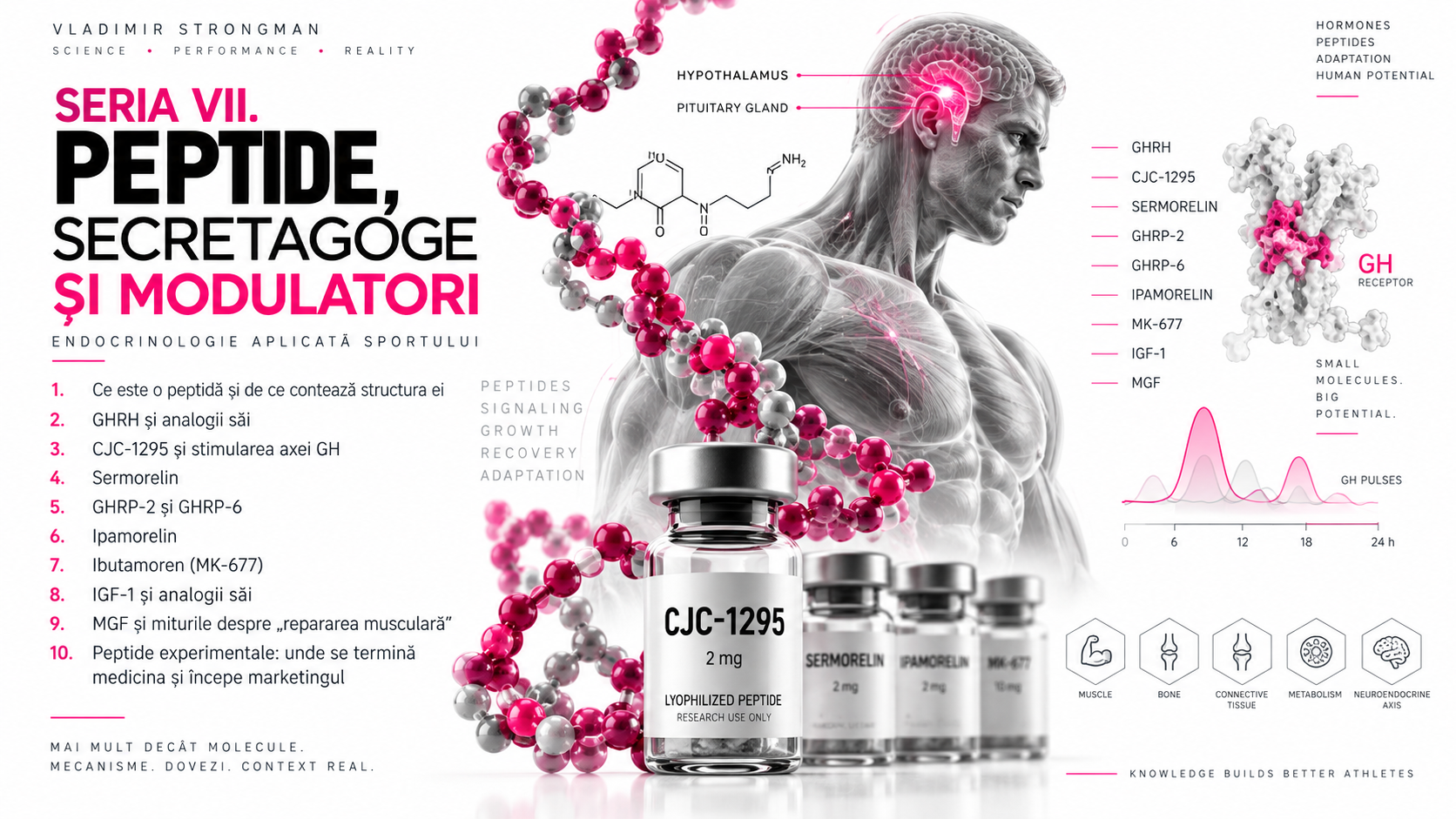
1. MGF is first a biological concept, not a product
Mechano Growth Factor, or MGF, is a term used to describe a local response related to IGF-1 gene expression in muscle after mechanical stimulation. Popular discussions sometimes present MGF as a separate substance that instantly repairs muscle. The biology is much more nuanced. The starting point is the IGF-1 gene and the way it can generate different transcripts under different conditions.
2. IGF-1 is not a single molecular sentence
The same gene can generate different messenger RNA variants through alternative processing. In the case of IGF-1, this has led to descriptions of multiple transcripts with distinct sequence features and expression patterns. MGF is especially associated with discussion of an IGF-1 variant expressed in muscle after mechanical loading.
3. Why the name Mechano Growth Factor can mislead
The name sounds as though there were an entirely separate hormone specialized only in muscle repair. In reality, the term emerged from research into IGF-1 transcripts associated with mechanical responses. It is therefore more accurate to start with IGF-1 biology and local gene expression than with the idea of a separate repair serum.
4. Muscle responds to mechanical tension with local signals
Strength training deforms muscle fibers, extracellular matrix, and structures that sense tension. These changes initiate mechanotransduction. The cell converts mechanical information into biochemical signals that change gene expression, protein synthesis, and remodeling processes.
5. Mechanotransduction is the real key
For hypertrophy and adaptation, the body must translate tension into molecular language. Integrins, the cytoskeleton, adhesion complexes, mechanosensitive channels, and pathways such as mTOR participate in this conversion. The IGF-1 family is one part of this puzzle, not the entire machine.
6. Local expression is not the same as circulating hormone
IGF-1 measured in blood largely reflects systemic production, including hepatic output. Muscle also has local production with paracrine and autocrine roles. This distinction matters for MGF because the core idea is a local response to mechanical stress, not simply a rise in serum IGF-1.
7. What autocrine and paracrine mean
An autocrine signal acts on the same cell that produces it, whereas a paracrine signal acts on nearby cells. Muscle makes extensive use of this local communication. Training adaptation is coordinated across tissue rather than commanded by a single hormone arriving through the bloodstream.
8. Satellite cells enter the discussion
Satellite cells are progenitor cells associated with muscle fibers. Under certain conditions they activate, proliferate, and can contribute new nuclei to fibers or participate in regeneration. IGF-1 signaling is relevant to this system, which helped drive interest in MGF.
9. Myth: MGF repairs every damaged muscle fiber
Muscle repair is not a single process and does not have a single switch. It includes controlled inflammation, removal of damaged components, satellite-cell activity, extracellular-matrix remodeling, protein synthesis, and restoration of function. MGF cannot be reduced to a biological glue that completes all these stages.
10. Myth: muscle soreness means MGF is working
Delayed-onset muscle soreness is influenced by inflammation, nociceptor sensitization, and tissue stress, particularly after unfamiliar exercise. It is not a direct biomarker of MGF expression or of hypertrophy quality.
11. Myth: more muscle damage means more growth
Excessive muscle damage can reduce training capacity and prolong recovery. Hypertrophy does not require repeatedly destroying the fiber. Mechanical tension and tolerable training volume matter more than deliberately chasing injury.
12. Repair and hypertrophy overlap but are not identical
Repair restores structure toward function after stress or injury. Hypertrophy means increasing fiber size and accumulating contractile material. The two processes can share signaling pathways but should not be confused. Intense repair does not guarantee large hypertrophy.
13. IGF-1 and the IGF-1 receptor
Many classic effects attributed to the IGF-1 family involve the IGF-1 receptor, a receptor tyrosine kinase that activates pathways such as PI3K-AKT. These pathways can influence cell survival, protein synthesis, and growth. But the presence of a local transcript does not automatically mean its effects are identical to exposure to mature IGF-1 ligand.
14. E-peptides complicated the story
IGF-1 precursors contain regions removed during processing of the mature molecule. These extensions are often called E-peptides. Some MGF literature has proposed that particular E-peptide sequences may have biological effects of their own. The evidence here is less straightforward than many commercial descriptions imply.
15. MGF nomenclature needs caution
Terms used for IGF-1 isoforms vary between papers, species, and experimental contexts. Expressions such as IGF-1Ec, MGF, and related labels are sometimes used too loosely. A serious discussion must identify the exact transcript, species, and molecule being measured.
16. What studies after exercise show
Some studies have observed changes in expression of IGF-1 transcripts in muscle after mechanical loading or training. This supports the idea that tissue modifies local signaling after stress. It does not prove the existence of one mandatory pathway that can be isolated from the rest of adaptation.
17. Gene expression is not the same as functional outcome
An increase in messenger RNA for a particular transcript does not by itself tell us how much active protein is produced, how long it persists, or what the final physiological effect will be. Many steps separate transcription from performance. Confusing mRNA with a final biological effect is a common mistake in interpreting molecular studies.
18. Myth: a peptide called MGF perfectly reproduces the natural phenomenon
A synthetic product labeled MGF is not automatically equivalent to the local, timed, and processed expression of the IGF-1 gene inside living muscle. Localization, concentration, duration, precursor processing, and interaction with other signals may all be different.
19. Myth: PEG-MGF is simply longer-lasting MGF
Pegylation can substantially change a molecule's pharmacokinetics. Adding a PEG chain may alter persistence, distribution, and tissue access. A pegylated derivative should therefore not be treated as if it were merely the natural form that stays in the bloodstream a little longer.
20. Local does not automatically mean more effective
Local signaling makes biological sense because it arises in the tissue that was actually loaded. Externally placing a molecule in a particular area does not automatically recreate the natural signaling architecture. Molecular distribution does not obey the simplistic rule of put it here, therefore it acts only here.
21. Controlled inflammation is part of adaptation
After hard exercise, inflammatory signals help coordinate cleanup and tissue remodeling. Excessive inflammation can be harmful, but eliminating the inflammatory signal completely is not necessarily beneficial. Adaptation is a balance rather than a race to suppress all inflammation.
22. Macrophages and muscle repair
Macrophages participate in the transition between inflammatory and repair phases. They communicate with satellite cells and other cells in the tissue. This network again shows why muscle repair cannot be explained by a single peptide.
23. The extracellular matrix matters just as much
Muscle fibers are surrounded by a matrix that transmits force and organizes tissue. Remodeling collagen and extracellular matrix influences recovery and function. A repaired muscle means more than new or larger fibers; it also requires a functional support architecture.
24. Tendons do not respond exactly like muscle
The popularity of the MGF concept has sometimes led to extrapolation toward tendons and ligaments. These tissues have different biology, vascular supply, and remodeling rates. A mechanism observed in muscle cannot automatically be transferred to tendon.
25. Muscle needs more than growth signals
Hypertrophy requires repeated mechanical stimulation, amino acids, energy, sleep, neural function, and time. Growth signals matter in context, but they cannot compensate for missing training stimulus or biological resources.
26. Faster repair is not always the correct objective
Some adaptations require time. Tissue remodeling after training includes processes that should not necessarily be accelerated at all costs. Optimal recovery means restoring function and adapting to load, not merely making soreness disappear quickly.
27. What research can say and what it cannot
Cell studies can reveal signaling. Animal studies can show effects in biological models. Human studies can measure expression, structure, and function. None of these levels should be carelessly extrapolated into another. Many spectacular MGF claims arise from mixing these levels.
28. Why the MGF literature is difficult to read
The topic combines alternative splicing, precursors, derived peptides, tissue expression, and experiments in different models. If an author does not specify exactly what was measured, the term MGF can hide different molecules and biological phenomena.
29. MGF should not be confused with circulating IGF-1
Serum IGF-1 is a marker of the systemic GH-IGF-1 axis. MGF belongs to a discussion about local expression of particular IGF-1 variants in muscle. The concepts overlap but are not synonyms.
30. MGF is not an anabolic steroid
MGF does not activate the androgen receptor and does not belong to the anabolic-steroid family. Any biological role attributed to it sits within the network of growth factors and local responses to mechanical stress.
31. Why the myths are attractive in strength sports
An athlete who trains hard constantly deals with microdamage, soreness, and the need for recovery. The idea of a molecule that repairs exactly where you trained is intuitively seductive. That is precisely why the simple story must be separated from the real biology, which is much more distributed and context-dependent.
32. More signaling does not automatically mean more performance
Performance emerges from hypertrophy, neural function, coordination, technique, tendons, energy availability, and the ability to tolerate training. Even if a growth factor modifies one cellular process, the jump from cell signaling to performance is enormous.
33. The key idea of Episode 9
MGF is best understood as part of the local IGF-1 system's response to mechanical loading rather than as a magical repair molecule. Evidence supports complex local responses to exercise, but it does not justify turning the term MGF into a universal explanation for regeneration, hypertrophy, or recovery.
Editorial and safety note
This article is educational and discusses IGF-1 physiology, local expression, and the MGF literature. It does not provide doses, schedules, combinations, administration methods, or instructions for peptide use for doping, performance enhancement, or accelerated recovery.
More From The Journal

Training
The Science of Strongman Training - Episode X: Competition Programming
How to build a complete Strongman competition preparation block: calendar, events, volume, intensity, specificity, simulations, autoregulation, tapering and fatigue management.

Training
The Science of Strongman Training - Episode IX: Peaking
Peaking in Strongman: how to turn months of training into maximal competition performance by reducing fatigue, preserving adaptations and managing specificity.