
Pharmacology
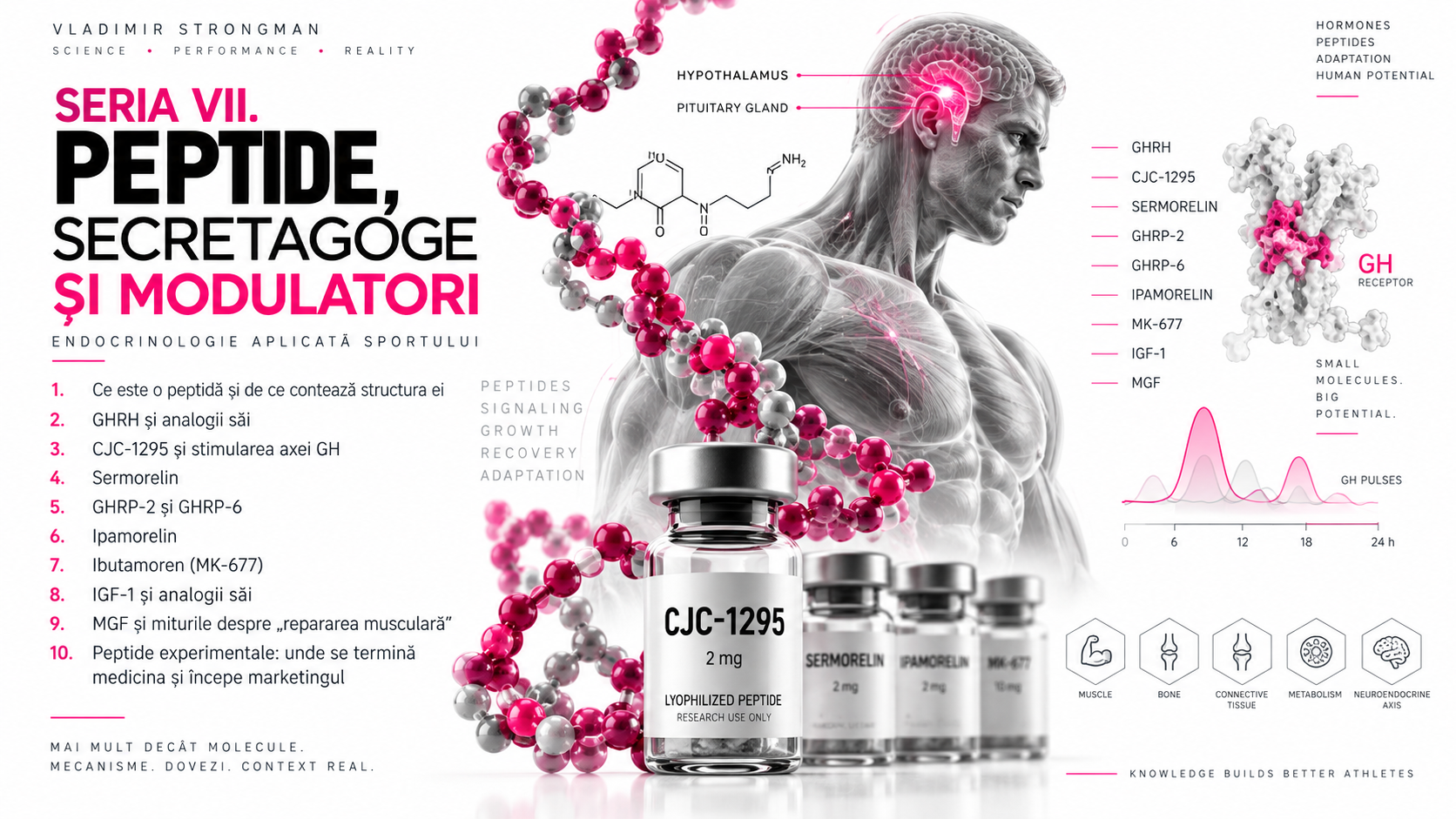
Peptides, Secretagogues and Modulators - Episode 8: Ibutamoren (MK-677) and Prolonged GH-Axis Stimulation
September 8, 2026
1. Why a second episode on ibutamoren is worthwhile
The previous episode introduced ibutamoren, also known as MK-677, as a non-peptide agonist of GHSR. This episode goes further and asks the harder question: what happens when that signal is not only a short pulse but influences the GH-IGF-1 axis over a longer period? Time, feedback, sleep, appetite, glucose control, fluid retention, and physiological adaptation then become just as important as receptor activation itself.
2. MK-677 is not a peptide
Although it is often discussed alongside GHRP-2, GHRP-6, or ipamorelin, ibutamoren is not a peptide. It is a small non-peptide molecule designed to activate the growth-hormone secretagogue receptor, GHSR. This changes its pharmacology because small molecules can have different stability, absorption, and persistence compared with peptides that are more vulnerable to enzymatic degradation.
3. GHSR remains the main target
GHSR is the receptor through which ghrelin transmits important parts of its message. Activating it can influence GH secretion, appetite, energy integration, and other neuroendocrine functions. MK-677 is not ghrelin, but it mimics enough of that receptor signal to activate the same molecular gateway.
4. The major difference is signal duration
A relatively short-acting peptide secretagogue and a more persistent non-peptide molecule do not deliver the same temporal message even when they use the same receptor. In endocrinology, duration is part of the signal. Longer activation can modify GH pulse patterns, response amplitude, and the average level of signaling across the day.
5. GH biology is not only about peaks
Discussions about growth hormone often focus on how high a hormonal peak becomes. Yet two profiles with the same peak may have different biological effects if one is brief and the other persists. The body responds to both signal intensity and signal duration.
6. Physiological pulsatility still matters
Naturally, GH is secreted in pulses with periods of very low concentration between them. Deep sleep produces some of the largest peaks. More persistent GHSR stimulation can alter this landscape without turning GH secretion into a perfectly flat line. This is why endocrine architecture matters more than a single laboratory number.
7. From GHSR to GH
GHSR activation sends signals through hypothalamic and pituitary networks and promotes GH release from somatotroph cells. MK-677 does not contain GH and does not directly activate the GH receptor. It changes the upstream command, while the pituitary generates the hormonal response.
8. From GH to IGF-1
Circulating GH stimulates the liver and other tissues to produce IGF-1. More persistent GH stimulation can therefore be followed by a more sustained change in IGF-1 signaling. The relationship remains indirect: MK-677 is not IGF-1 and does not directly bind the IGF-1 receptor.
9. IGF-1 is a marker, not the whole story
A higher IGF-1 level indicates a more active GH-IGF-1 axis, but it does not by itself predict how much muscle will be built, how much fat will be lost, or how much strength will increase. An endocrine marker is a window into mechanism, not a certificate of athletic outcome.
10. Appetite is one of the signatures of the ghrelin receptor
Because GHSR is the ghrelin receptor, activating it can influence hunger. In practice, that indirect effect may be large. A person who eats more can change body weight, glucose control, and body composition through energy intake independently of the direct hormonal effects.
11. Weight gain does not automatically mean muscle gain
If appetite increases, calorie intake may rise. If the GH axis changes, water retention can also appear. If muscle glycogen changes, it pulls water into tissue. All of these can raise body weight without the entire difference being new contractile muscle.
12. Lean mass is broader than muscle mass
Lean mass includes muscle, water, glycogen, organs, and connective tissue. When a study reports an increase in lean mass, it does not automatically mean every new kilogram is force-producing contractile muscle.
13. Fluid retention can change how results look
The GH axis can promote sodium and water retention. This may influence body weight, tissue appearance, and the sensation of fullness. Once again, body-composition changes need careful interpretation because water is not the same as hypertrophy.
14. Sleep is one of the interesting areas of MK-677 research
Ghrelin, GHSR, sleep, and GH secretion are interconnected. Research on ibutamoren has examined changes in sleep architecture as well. The important caution is that altering particular sleep stages does not mean a molecule solves every recovery problem or replaces sufficient, regular sleep.
15. Deep sleep and GH have a natural relationship
In normal physiology, one of the most important GH pulses occurs near the beginning of deep sleep. This relationship shows that the GH axis is integrated into circadian rhythm and sleep architecture. Any intervention in the axis has to be understood within that context.
16. More GH can change glucose metabolism
GH has anti-insulin effects in some tissues and can reduce insulin sensitivity. Longer GH-axis stimulation should therefore not be viewed only through recovery or connective-tissue effects. It is also a metabolic intervention, making blood glucose relevant.
17. Insulin sensitivity is one of the major physiological limits
If GH signaling stays elevated for longer, effects on glucose handling can become more visible. Some studies have reported higher glucose or reduced insulin sensitivity. This matters because it contrasts with the simplistic image of GH as only a growth and recovery hormone.
18. Fat and glucose metabolism are linked
GH promotes fatty-acid mobilization and can push the body toward using more fat as fuel. But if calorie intake rises substantially because of appetite, energy balance can counteract that effect. Real biology is a sum of signals that can sometimes pull in opposite directions.
19. Why MK-677 is not a fat burner
The fact that GH can increase lipolysis does not make ibutamoren a compound that guarantees adipose-tissue loss. Fat loss ultimately depends on energy balance and long-term metabolic adaptation.
20. Connective tissue responds to the GH-IGF-1 axis
GH and IGF-1 participate in regulating fibroblasts, collagen, and extracellular matrix. This is one reason the axis is discussed in relation to tendons and recovery. But a hormonal signal does not automatically repair structural injury or replace progressive mechanical loading.
21. More collagen does not automatically mean a better tendon
Tendon strength depends on fiber organization, collagen orientation, vascular supply, extracellular matrix, and adaptation to load. Collagen quantity is only one part of the puzzle.
22. MK-677 and muscle: mainly an indirect relationship
Ibutamoren does not activate the androgen receptor and is not an anabolic steroid. Any effect on muscle mass passes through the GH-IGF-1 axis, metabolism, body water, food intake, and recovery. This mechanism is fundamentally different from androgen signaling.
23. Strength does not follow lean mass linearly
Strength depends on the nervous system, technique, coordination, muscle architecture, tendons, and specific experience. An increase in lean mass or IGF-1 does not automatically translate into a proportional increase in maximal strength.
24. Strongman performance is even more complex
Strongman combines maximal strength, speed, local endurance, mobility, technique, and tolerance to effort. One hormonal signal cannot explain performance on yoke, farmers walk, atlas stones, or truck pull.
25. Endocrine feedback does not disappear
Rising GH and IGF-1 send feedback signals to the hypothalamus and pituitary. The body continually tries to limit large deviations from balance. MK-677 changes the input into the system but does not erase regulatory mechanisms.
26. Receptor adaptation matters
Receptors and endocrine circuits can adapt to repeated stimulation. The response seen at the beginning of exposure should not automatically be assumed to remain identical over longer periods. Receptor pharmacology is dynamic.
27. Why chronic exposure differs from an acute test
A test measuring a GH peak after one exposure tells us something about immediate secretory capacity. It does not automatically tell us what happens after weeks of altered signaling, when feedback, metabolic adaptations, and receptor sensitivity changes become relevant.
28. Difference from ipamorelin
Ipamorelin is a peptide; MK-677 is a small non-peptide molecule. Both activate GHSR, but their pharmacokinetics and signal duration differ. That temporal difference may matter more than the fact that the receptor is the same.
29. Difference from GHRP-2 and GHRP-6
GHRP-2 and GHRP-6 are peptide secretagogues that also use GHSR. MK-677 belongs to the same functional receptor family but not the same chemical class. Appetite profile, duration of effect, and pharmacokinetics also differ.
30. Difference from sermorelin and CJC-1295
Sermorelin and CJC-1295 activate the GHRH receptor. MK-677 activates GHSR. These are two distinct branches that converge on GH secretion. Similar hormonal outcomes do not mean identical mechanisms.
31. Why metabolic effects are part of the mechanism
Appetite, water retention, and changes in insulin sensitivity are not unrelated side notes. They occur because GHSR and the GH axis are involved in energy regulation, metabolism, and fluid balance.
32. A favorable hormonal profile does not guarantee a favorable clinical profile
Higher GH and IGF-1 may look attractive when viewed in isolation. But the body may pay for that shift through higher glucose, fluid retention, or other adaptations. Serious evaluation requires looking at the entire picture.
33. Why unregulated products complicate the discussion
A molecule studied in controlled research is one thing, while a product from an unregulated source may be another. Identity, purity, and concentration are not automatically guaranteed by the label. Real-world risk includes that uncertainty.
34. The key idea of Episode 8
Ibutamoren is interesting not only because it can activate GHSR and increase GH and IGF-1, but because it does so with a temporal profile different from classic peptide secretagogues. That persistence brings metabolism, appetite, sleep, fluid retention, feedback, and the difference between an endocrine marker and real performance into the foreground.
Editorial and safety note
This article is educational and explains the general physiology and pharmacology of ibutamoren. It does not include doses, schedules, frequencies, combinations, administration methods, or instructions for using it for doping, performance enhancement, or body-composition manipulation.
More From The Journal

Training
The Science of Strongman Training - Episode X: Competition Programming
How to build a complete Strongman competition preparation block: calendar, events, volume, intensity, specificity, simulations, autoregulation, tapering and fatigue management.

Training
The Science of Strongman Training - Episode IX: Peaking
Peaking in Strongman: how to turn months of training into maximal competition performance by reducing fatigue, preserving adaptations and managing specificity.