
Physiology
Peptides, Secretagogues and Modulators - Episode 6: Ipamorelin
September 7, 2026
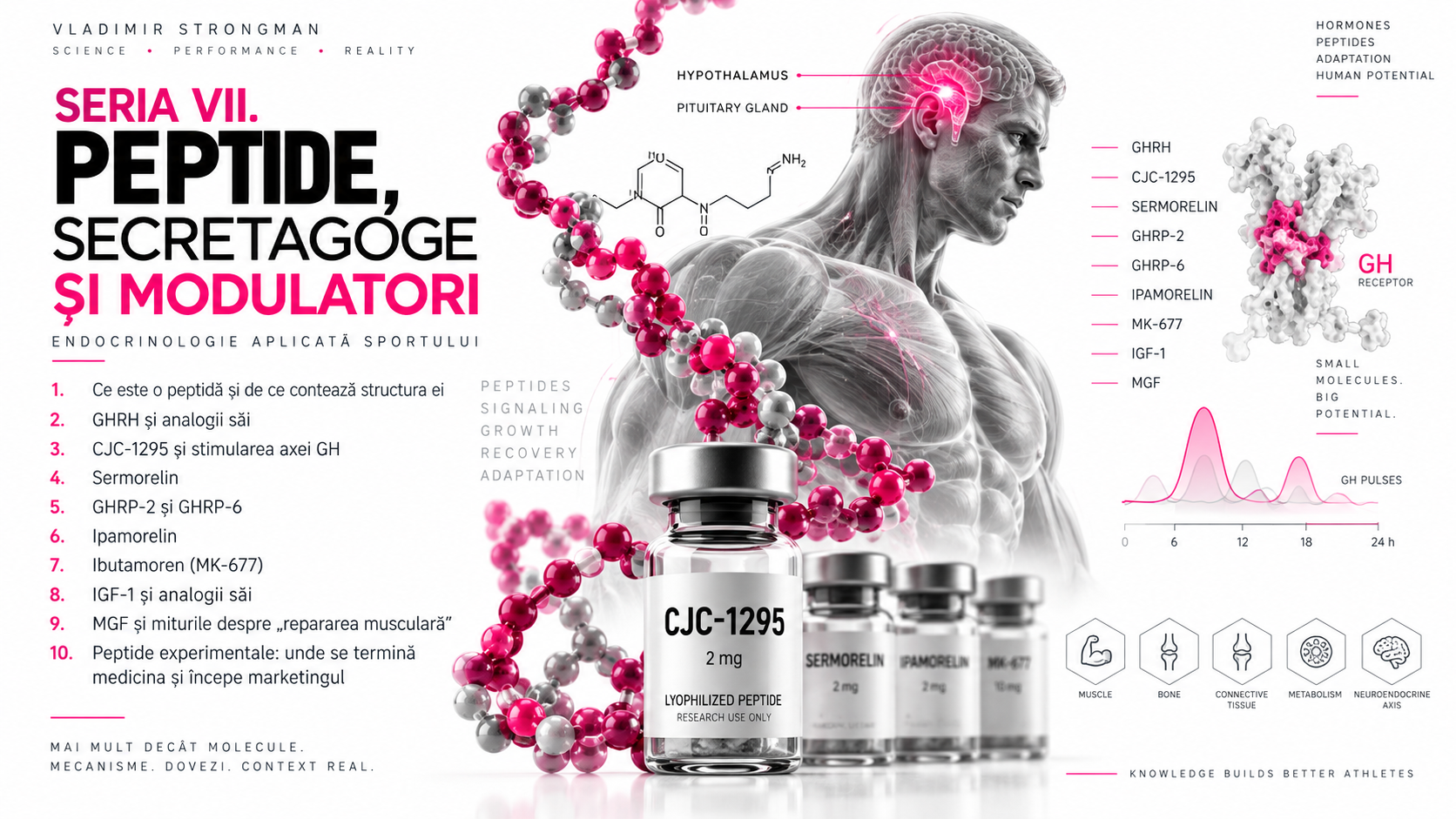
1. Ipamorelin is a growth-hormone secretagogue
Ipamorelin is a synthetic peptide belonging to the growth-hormone secretagogue family. It is not growth hormone and is not a fragment of GH. Its role is to activate a receptor that participates in the body's natural control of GH secretion. The easiest way to understand it is as a messenger pressing an endocrine control button rather than as the final hormone circulating through the body.
2. Ipamorelin is not GHRH and does not use the GHRH receptor
Sermorelin and CJC-1295 act through the GHRH receptor. Ipamorelin belongs to another branch. It activates the growth-hormone secretagogue receptor, GHSR, now best known as the ghrelin receptor. Both families may increase GH release, but they enter the endocrine axis through different molecular gates.
3. The central receptor is GHSR
GHSR is a G protein-coupled receptor expressed in the pituitary and in parts of the central nervous system. Its physiological ligand is ghrelin. By binding GHSR, ipamorelin sends a signal that can promote GH release from somatotroph cells. It uses the same receptor family as GHRP-2 and GHRP-6.
4. What it means that ipamorelin is a GHSR agonist
An agonist is a molecule that binds to a receptor and activates it. The receptor can be imagined as a molecular lock and the agonist as a key. Ipamorelin is not identical to the natural key, ghrelin, but its structure allows it to activate the same lock. Receptor activation then triggers intracellular signaling.
5. GHSR signaling involves intracellular calcium
GHSR signals predominantly through Gq/11-related pathways, phospholipase C, IP3 and DAG. These mechanisms increase intracellular calcium availability, and calcium helps promote exocytosis of GH-containing granules. In simple terms, ipamorelin does not manufacture GH itself. It helps the somatotroph release hormone that is already stored and supports the wider secretory response.
6. The pituitary remains the real engine of the response
For ipamorelin to produce a response, the pituitary needs functioning somatotroph cells capable of releasing GH. The peptide does not replace pituitary function and does not completely bypass endocrine regulation. This is why stimulating a receptor and administering the final hormone are pharmacologically different interventions.
7. Ipamorelin belongs to the same functional family as GHRP-2 and GHRP-6
GHRP-2, GHRP-6 and ipamorelin can all be grouped as GHSR-activating secretagogues. Family resemblance does not mean pharmacological identity. The structure of each peptide changes receptor interactions, the intensity of some secondary endocrine effects, and the overall response profile.
8. Why ipamorelin is often discussed as being more selective
Ipamorelin attracted research interest because it was described as having greater selectivity for GH stimulation than some earlier secretagogues. In certain experimental models, effects on prolactin and cortisol were smaller. Selectivity does not mean absolute exclusivity. Endocrine receptors operate inside networks, and even a relatively selective signal can have indirect consequences.
9. Selectivity is a pharmacological concept, not a marketing label
When a molecule is called more selective, it means that under defined conditions it tends to favor one target or output more than others. It does not mean the molecule acts inside a perfectly isolated tunnel. Concentration, receptor density, tissue context, and physiological state can all modify the observed profile.
10. Ipamorelin and ghrelin are not the same molecule
Ipamorelin uses the ghrelin receptor but is not ghrelin. Natural ghrelin has multiple roles in hunger, gastrointestinal function, energy balance, and GH secretion. Ipamorelin is a synthetic ligand designed to activate GHSR with a narrower pharmacological profile. Sharing a receptor does not reproduce the whole biology of the natural hormone.
11. What happens after GH is released
After pituitary stimulation, GH enters the circulation and acts in many tissues. The liver can increase IGF-1 production, adipose tissue can alter fatty-acid mobilization, and muscle, bone, and connective tissue receive signals within the broader GH-IGF-1 network. Ipamorelin influences the beginning of this chain rather than directly producing all downstream effects.
12. The relationship with IGF-1 is indirect
Ipamorelin does not activate the IGF-1 receptor. If it increases GH secretion enough, the liver and other tissues may subsequently alter IGF-1 production. The logical chain is GHSR, pituitary, GH, and then IGF-1. Keeping that order clear prevents attributing to the peptide effects that belong to downstream mediators.
13. GH remains a pulsatile hormone
GH is not normally released as a constant stream. Secretion occurs in pulses of different amplitudes, separated by periods of very low concentration. Sleep, circadian timing, GHRH, somatostatin, ghrelin, and metabolic state all contribute to this pattern. A secretagogue intervenes in a system that already has its own rhythm.
14. Somatostatin remains the brake
The hypothalamus sends inhibitory as well as stimulatory signals. Somatostatin suppresses GH secretion. Even when GHSR is activated, the endocrine system retains this brake. Final output reflects the balance between stimulation, inhibition, and the ability of somatotroph cells to respond.
15. Feedback through GH and IGF-1 limits the system
Rising GH and IGF-1 signal back that the axis is active. This negative feedback can reduce further stimulation through hypothalamic and pituitary mechanisms. A secretagogue changes the input into the system but does not erase feedback control.
16. Ipamorelin and appetite
Because GHSR is the ghrelin receptor, appetite inevitably enters the discussion. GHRP-6 is famous for a strong orexigenic effect. Ipamorelin is generally described as having a less pronounced appetite profile. Individual responses still vary, and GHSR activation remains biologically connected to systems controlling hunger and energy balance.
17. Difference from GHRP-6
GHRP-6 and ipamorelin use the same receptor family, but their profiles are not identical. GHRP-6 is much more strongly associated with appetite stimulation and a broader endocrine signature. Ipamorelin was developed toward relatively more selective GH stimulation. This is a difference in profile, not a different main receptor.
18. Difference from GHRP-2
GHRP-2 is a potent secretagogue and has been studied in testing of the GH axis. Compared with it, ipamorelin is known especially for attempts to separate GH stimulation more clearly from other endocrine responses. The point is not that ipamorelin works in isolation, but that the relative pattern of effects is different.
19. Difference from sermorelin
Sermorelin is GHRH(1-29) and stimulates the GHRH receptor. Ipamorelin activates GHSR. The two peptides therefore sit on different branches of the same endocrine axis. One mimics the GHRH signal, while the other mainly mimics the secretagogue side of ghrelin-related signaling.
20. Difference from CJC-1295
CJC-1295 belongs to the GHRH-analog family and was designed around longer persistence of GHRH signaling. Ipamorelin neither uses that receptor nor follows the same pharmacokinetic logic. The fact that both may increase GH secretion does not make them equivalent. They enter the axis through different doors.
21. Why GHRH and GHSR pathways can cooperate physiologically
Somatotroph cells integrate multiple inputs. GHRH strongly engages cAMP-related signaling, while GHSR strongly engages calcium-related pathways. When different systems converge on the same cell, the resulting response can be more complex than a simple sum. This interaction is relevant to physiology, but explaining it is not a recommendation to combine substances.
22. Ipamorelin is not a direct muscle-anabolic hormone
Ipamorelin does not enter muscle fibers to directly switch on contractile-protein synthesis, nor does it bind the androgen receptor. Its relationship with muscle is indirect through GH, IGF-1, metabolism, and the recovery environment. Hypertrophy still depends on mechanical tension, energy intake, protein, sleep, and neural adaptation.
23. Lean mass is not synonymous with new contractile muscle
The GH axis can alter body water, glycogen, connective tissue, and other compartments counted as lean mass. Body-composition changes therefore need careful interpretation. One kilogram of lean mass is not automatically one kilogram of newly formed contractile muscle tissue.
24. GH influences fat metabolism
If ipamorelin increases GH-axis signaling, one downstream consequence may be altered fatty-acid mobilization and substrate use. But mobilizing stored fat is not identical to net fat loss. Long-term energy balance remains decisive for actual reduction in adipose tissue.
25. GH also influences glucose metabolism
GH can reduce insulin sensitivity in some contexts and change how the body allocates glucose and fatty-acid use. GH-axis stimulation should therefore not be viewed only through the lens of growth or recovery. It is also a metabolic intervention.
26. Connective tissue is part of the equation
GH and IGF-1 participate in regulation of fibroblasts, collagen, and extracellular matrix. This does not mean ipamorelin automatically repairs a tendon or mechanically protects a joint. Connective-tissue adaptation is slow and depends on loading, vascular supply, nutrition, and time.
27. Sleep changes the endocrine background
One of the largest physiological GH pulses is linked to deep sleep. Fragmented or insufficient sleep changes the normal architecture of the axis. Activating a receptor does not make these processes irrelevant. Endocrinology is not a collection of independent buttons.
28. Age and body composition influence the response
GH secretion changes with age, and obesity is associated with reduced GH pulse amplitude. Free fatty acids, glucose, sleep quality, and pituitary function can also modify responsiveness. The same molecule will not automatically produce the same effect in two different people.
29. Tolerance and desensitization are relevant concepts
Receptors can adapt to repeated or persistent stimulation. This general principle of pharmacology means acute responses seen in experiments should not be mechanically extrapolated to repeated exposure. Endocrine systems adapt, and receptor sensitivity is dynamic.
30. Ipamorelin is not equivalent to direct GH exposure
Ipamorelin asks the endocrine system to release GH through GHSR. Direct GH exposure places the final hormone into circulation and bypasses that control level. In the first case, pituitary function, somatostatin, feedback, and metabolic state remain major determinants. These are interventions at different levels of the axis.
31. More selective does not mean risk-free
A more selective endocrine profile does not make a molecule biologically neutral. Any intervention capable of changing GH secretion can influence glucose metabolism, fat metabolism, fluid balance, and other aspects of GH physiology. Risk depends on context and cannot be inferred from reputation alone.
32. Unregulated products add another layer of uncertainty
In research, peptide identity and purity are controlled. Outside regulated pharmaceutical channels, a label does not automatically guarantee the declared molecule or concentration. Peptide stability, degradation, contamination, and substitution can substantially alter risk.
33. In strength sports, a hormonal effect is not the same as performance
Strength emerges from muscle mass, muscle architecture, neural function, technique, tendons, coordination, sleep, and training experience. Ipamorelin can modify one hormonal link, but it cannot replace the rest of the system. A rise in an endocrine marker does not automatically produce a proportional rise in performance.
34. The key idea of Episode 6
Ipamorelin is a peptide agonist of GHSR, the receptor family also used by ghrelin. It stimulates pituitary GH secretion without being GH and without using the GHRH receptor. Compared with GHRP-2 and GHRP-6, it is known especially for a relatively more selective GH-secretagogue profile and less pronounced effects on some other endocrine outputs. Understanding it requires looking at the receptor, pituitary, feedback, IGF-1, metabolism, and the complete physiological context.
Editorial and safety note
This article explains the physiology and general pharmacology of ipamorelin for educational purposes. It does not provide doses, schedules, frequencies, combinations, administration methods, or instructions for peptide use for doping, performance enhancement, or body-composition manipulation.
More From The Journal

Training
The Science of Strongman Training - Episode X: Competition Programming
How to build a complete Strongman competition preparation block: calendar, events, volume, intensity, specificity, simulations, autoregulation, tapering and fatigue management.

Training
The Science of Strongman Training - Episode IX: Peaking
Peaking in Strongman: how to turn months of training into maximal competition performance by reducing fatigue, preserving adaptations and managing specificity.