
Physiology
Peptides, Secretagogues and Modulators - Episode 5: GHRP-2 and GHRP-6
September 7, 2026
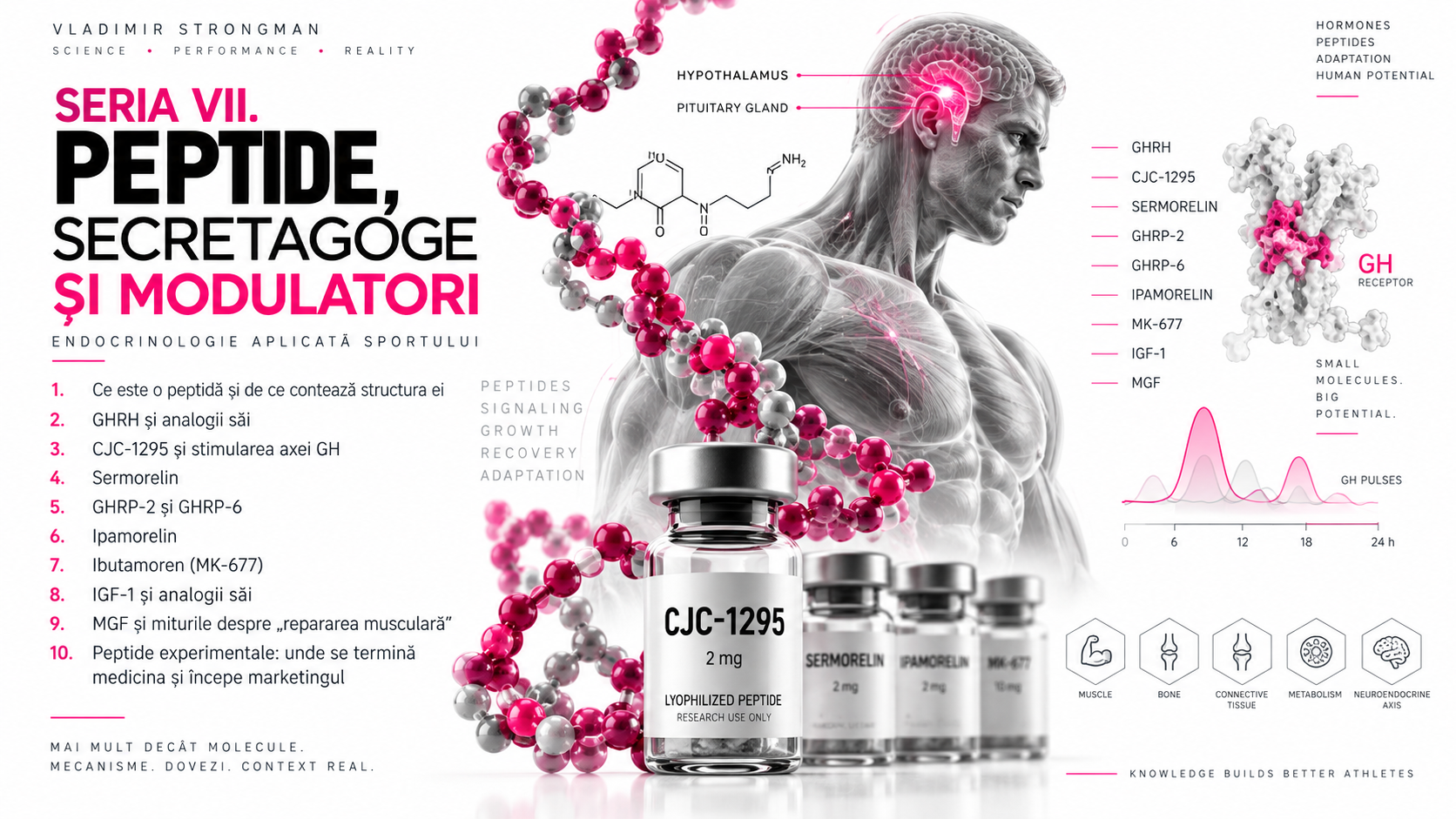
1. GHRP-2 and GHRP-6 are growth-hormone secretagogues
GHRP-2 and GHRP-6 belong to a family of synthetic peptides developed to stimulate growth-hormone secretion. GHRP stands for growth hormone-releasing peptide. The name can be misleading because these molecules are not GHRH and are not fragments of GHRH. They use another molecular gateway, the growth-hormone secretagogue receptor, now best known as the ghrelin receptor, GHSR.
2. They are peptides, not steroids and not GH
Chemically and pharmacologically, GHRP-2 and GHRP-6 are peptides. They are not anabolic steroids, androgens, or growth hormone. They do not activate the androgen receptor or the GH receptor. Their role is to stimulate regulatory systems that can cause the pituitary to release endogenous GH.
3. The central receptor is GHSR
GHRP-2 and GHRP-6 act mainly through GHSR, a G protein-coupled receptor. The same receptor is physiologically activated by ghrelin. GHSR is present in the pituitary and in parts of the central nervous system, which helps explain why this pathway is linked not only to GH secretion but also to appetite, feeding behavior, and metabolic integration.
4. Ghrelin was discovered after the GHRPs were developed
A fascinating historical detail is that synthetic secretagogue peptides were studied before the natural ligand of their receptor had been identified. Ghrelin was discovered later. It is produced mainly in the gastrointestinal tract and is known both for stimulating GH secretion and for regulating hunger and energy balance. GHRP research therefore helped reveal an entire hormonal system.
5. GHSR sends a different signal from the GHRH receptor
The GHRH receptor and GHSR are different receptors. GHRH-receptor signaling is classically associated strongly with cAMP, whereas GHSR predominantly activates Gq/11-related pathways, phospholipase C, IP3, DAG, and intracellular calcium. Both pathways can promote GH release, but they reach that outcome through different molecular circuitry.
6. The pituitary integrates several signals at once
Somatotroph cells do not operate with one simple switch. They receive stimulatory signals through GHRH and GHSR, inhibitory signals through somatostatin, and information about the body's metabolic state. Final GH output reflects integration of all these inputs. A secretagogue therefore cannot be understood correctly in isolation from the rest of the axis.
7. Why GHRPs can generate a GH pulse
By activating GHSR, GHRP-2 and GHRP-6 can amplify mechanisms that lead to pituitary GH release. They do not contain GH and do not carry it through the body. They send a message to the endocrine system, while the pituitary generates the response using its own stores and synthetic capacity.
8. GHRP-2 and GHRP-6 are similar but not identical
Both activate the GHSR system and can stimulate GH secretion, but their profiles are not identical. Structural differences alter receptor interactions, the intensity of some endocrine effects, and influence on appetite. This is another example of how a few amino-acid changes can substantially alter peptide pharmacology.
9. GHRP-6 is well known for its effect on appetite
GHRP-6 is frequently associated with a noticeable increase in hunger. This fits with activation of the ghrelin receptor and the role of ghrelin-GHSR signaling in appetite regulation. It is a clear reminder that an endocrine receptor rarely has only one function. A pathway that stimulates GH can simultaneously influence feeding behavior and energy homeostasis.
10. GHRP-2 tends to be perceived as less orexigenic
Compared with GHRP-6, GHRP-2 is often described in experimental contexts as producing a less obvious appetite effect, although responses vary between individuals. This difference does not imply a different receptor. Different ligands can activate the same receptor with somewhat different physiological profiles.
11. GHRP-2 can produce a robust GH response in endocrine testing
GHRP-2 has been studied as a potent GH secretagogue and has been used in some experimental or diagnostic contexts to evaluate somatotropic-axis capacity. A robust GH response should not be confused with a direct muscle effect. Many biological steps separate hormone secretion from a final tissue outcome.
12. GHRPs and somatostatin
Part of the effectiveness of GHSR-type secretagogues comes from how they interact with hypothalamic-pituitary architecture, including the inhibitory influence of somatostatin. Somatostatin does not disappear from the system, however. Feedback and control mechanisms remain active, and GH secretion does not become unlimited.
13. Why GHRH and GHSR signaling can be complementary
GHRH activates the GHRH receptor, while GHRPs activate GHSR. These pathways can cooperate at somatotroph and hypothalamic levels. Physiologically, this helps explain why different signals can amplify the same hormonal pulse. Explaining this interaction is a description of mechanism, not a recommendation to combine substances.
14. GH secretion remains pulsatile
GH is secreted in waves, with peaks separated by periods of very low concentrations. Secretagogues can alter the amplitude of some responses, but the axis remains influenced by circadian rhythm, sleep, nutrition, exercise, and feedback. Time is part of the endocrine message.
15. GHRP-2 and GHRP-6 are not ghrelin
Although they use the ghrelin receptor, GHRP-2 and GHRP-6 are not ghrelin molecules. They are synthetic ligands that imitate part of ghrelin-related signaling. Sharing a receptor does not mean molecular identity. Natural ghrelin has its own structure, secretion pattern, and complex physiological roles.
16. Their relationship with IGF-1 is indirect
GHRP-2 and GHRP-6 do not activate the IGF-1 receptor. If their stimulation increases GH secretion, this can later affect hepatic and local IGF-1 production. The chain is therefore GHSR, pituitary, GH, and then the GH-IGF-1 network. This order prevents attributing to the peptide an effect actually produced by a downstream mediator.
17. GHRPs can influence other hormones
GHRP secretagogues are not perfectly selective for one hormonal output. In some studies, GHRP-2 and related peptides have been associated with changes in prolactin and cortisol. The magnitude depends on the molecule, context, and individual response. This imperfect selectivity is pharmacologically important.
18. Cortisol shows that endocrine axes communicate
If a secretagogue can also influence cortisol, it demonstrates that endocrine systems are not isolated pipelines. The hypothalamus and pituitary coordinate several axes, and regulatory circuitry can overlap. Interpreting a peptide only through GH misses part of the picture.
19. Prolactin may also be affected
Under some experimental conditions, secretagogues can produce modest prolactin changes. This is a useful example of imperfect selectivity: a molecule may have a main target while indirectly modifying other hormonal systems. The magnitude should not be generalized without context.
20. Appetite is a biological effect, not a side note
For GHRP-6, the orexigenic effect is one of the clearest expressions of GHSR activation. In a system regulating hunger, body mass, and energy availability, that consequence can indirectly change many outcomes. Altered food intake can influence weight and body composition independently of any direct hormonal effect.
21. GH influences fat metabolism
If a secretagogue increases GH-axis signaling, consequences may appear in fatty-acid mobilization and substrate use. Mobilizing fat is not the same as losing net adipose tissue, however. Long-term energy balance remains decisive.
22. GH also influences glucose metabolism
GH can reduce insulin sensitivity in some contexts and change how the body allocates glucose and fatty-acid use. Stimulating the GH axis is therefore not only a story about growth or recovery. It is also a metabolic intervention.
23. GHRP-2 and GHRP-6 do not directly build muscle
These peptides do not bind the androgen receptor and do not directly activate contractile muscle machinery. Their relationship with muscle is indirect through GH, IGF-1, metabolism, and the recovery environment. Hypertrophy still depends on mechanical tension, energy intake, protein, sleep, and neural adaptation.
24. Lean mass is not automatically the same as new contractile muscle
The GH axis can influence body water, glycogen, and connective tissue. Any increase in lean mass therefore needs careful interpretation. Lean mass is a broader body-composition category than contractile muscle mass.
25. Connective tissue is part of the GH-IGF-1 story
GH and IGF-1 participate in collagen and extracellular-matrix remodeling. This does not mean GHRP-2 or GHRP-6 automatically heal tendons or prevent injury. Connective-tissue adaptation still depends on loading, time, nutrition, and mechanical organization.
26. Sleep changes the background on which secretagogues act
One of the largest physiological GH pulses is associated with deep sleep. Sleep deprivation or fragmentation can alter endogenous secretion and the sensitivity of the wider system. GHSR activation does not make sleep architecture irrelevant.
27. Age and body composition influence the response
GH secretion generally declines with age, while obesity is associated with major changes in GH pulsatility. The same GHSR stimulus can therefore produce different responses in different people. Pharmacology does not erase physiological context.
28. Feedback through GH and IGF-1 remains active
When GH and IGF-1 rise, the system receives information that the axis is active. Negative feedback can reduce further stimulation and alter hypothalamic signaling. A secretagogue changes the input but does not remove regulation.
29. Tolerance and desensitization are important concepts
Receptors and endocrine systems can adapt to repeated or persistent stimulation. Response intensity is not guaranteed to remain identical under every condition. This general rule of receptor pharmacology is one reason acute experimental responses should not be simplistically extrapolated to chronic stimulation.
30. GHRP-2 and GHRP-6 differ from sermorelin and CJC-1295
Sermorelin and CJC-1295 belong to the GHRH family and activate the GHRH receptor. GHRP-2 and GHRP-6 activate GHSR. Both families may ultimately increase GH release, but they use different receptors and intracellular pathways. This distinction is essential for understanding the peptides correctly.
31. The unregulated market introduces another problem
In research, peptide identity and purity are controlled. Outside regulated pharmaceutical channels, a product label does not guarantee that molecular identity, concentration, or purity match the claim. Peptide stability and degradation are real issues, while contamination or substitution can substantially alter risk.
32. In strength sports, reputation is not the same as mechanism
In performance culture, GHRPs are sometimes framed through promises about recovery, muscle, or fat loss. Their real mechanism is more indirect: GHSR, pituitary, GH, IGF-1, metabolism, and feedback. Final performance still emerges from a much larger system that includes neural function, technique, tendons, and training.
33. The key idea of Episode 5
GHRP-2 and GHRP-6 are peptide secretagogues that stimulate GHSR, the same receptor system used by ghrelin. They can promote GH release without being GH themselves and without using the GHRH receptor. GHRP-6 has a more obvious orexigenic profile, while GHRP-2 is known for robust GH stimulation and a different appetite profile. Understanding them requires looking at the receptor, pituitary, feedback, metabolism, and endocrine effects beyond GH.
Editorial and safety note
This article explains the physiology and general pharmacology of GHRP-2 and GHRP-6 for educational purposes. It does not provide doses, schedules, frequencies, combinations, administration methods, or instructions for using peptides for doping, performance enhancement, or body-composition manipulation.
More From The Journal

Training
The Science of Strongman Training - Episode X: Competition Programming
How to build a complete Strongman competition preparation block: calendar, events, volume, intensity, specificity, simulations, autoregulation, tapering and fatigue management.

Training
The Science of Strongman Training - Episode IX: Peaking
Peaking in Strongman: how to turn months of training into maximal competition performance by reducing fatigue, preserving adaptations and managing specificity.