
Physiology
Peptides, Secretagogues and Modulators - Episode 4: Sermorelin
September 7, 2026
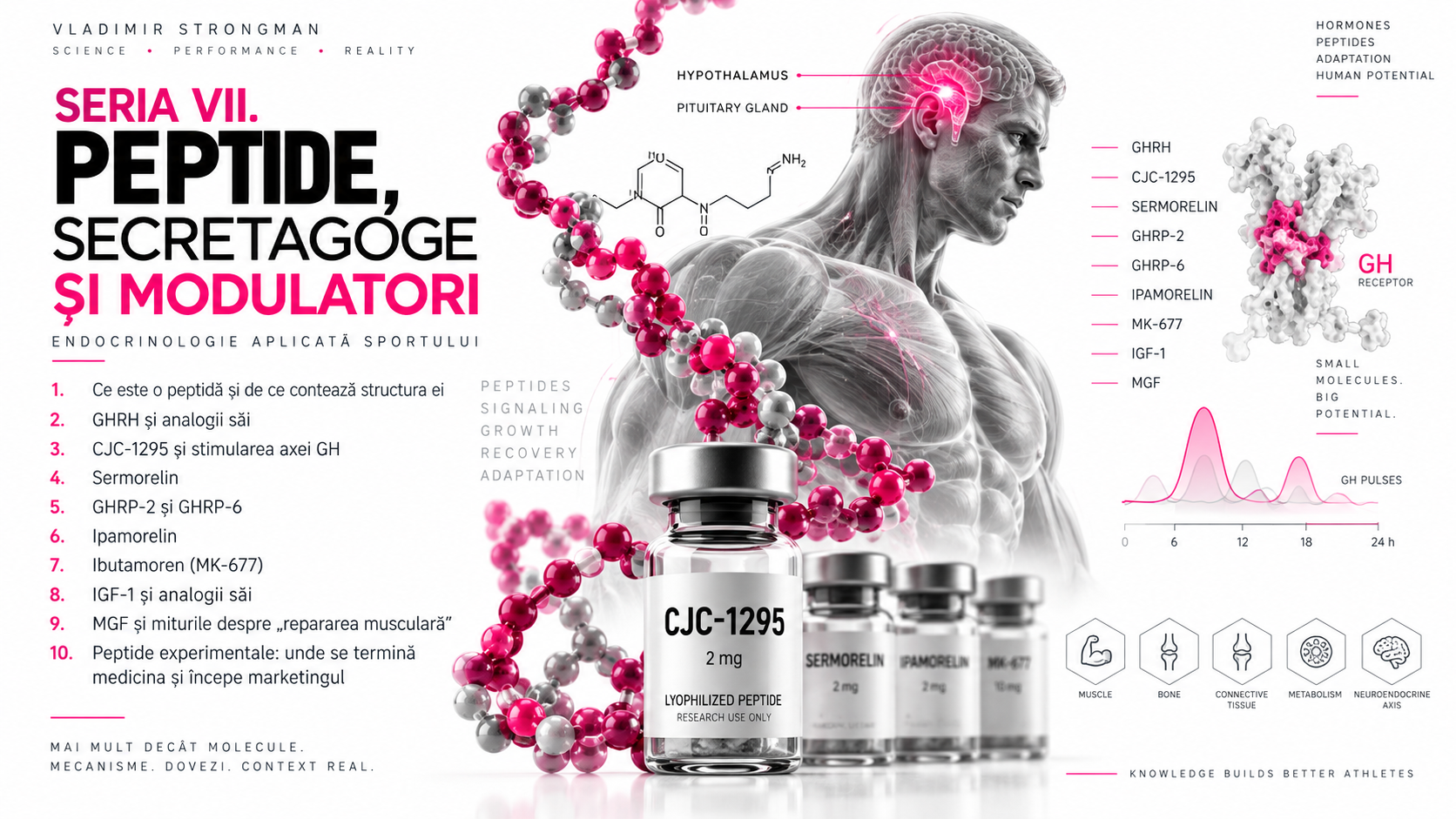
1. Sermorelin is an active fragment of GHRH
Sermorelin is a peptide corresponding to GHRH(1-29), the first 29 amino acids of growth hormone-releasing hormone. This region contains the structural information essential for activating the GHRH receptor. The entire natural GHRH molecule is not required for receptor recognition. The active fragment preserves the molecular key needed to trigger the signal.
2. Sermorelin is not growth hormone
This is the first crucial distinction. Sermorelin is not GH and does not behave as a copy of GH. It acts further upstream, at the pituitary level, stimulating somatotroph cells to release growth hormone made by the body. Direct GH exposure bypasses this step. Sermorelin instead depends on the pituitary's capacity to respond.
3. Why GHRH(1-29) matters
The notation GHRH(1-29) identifies the amino-acid positions in the fragment. The first 29 amino acids are sufficient to activate the GHRH receptor. The remaining natural sequence contributes other structural and biological features, but the N-terminal region contains the functional core of the signal. Sermorelin illustrates that peptide function depends not simply on total length, but on the exact position and order of receptor-interacting residues.
4. The GHRH receptor is the main target
Sermorelin binds the GHRH receptor on anterior-pituitary somatotroph cells. This receptor belongs to the G protein-coupled receptor family. Binding initiates intracellular signaling that supports GH secretion and synthesis. Sermorelin does not activate the androgen receptor, so its pharmacology is fundamentally different from anabolic-androgenic steroids.
5. cAMP is a major intracellular messenger
GHRH-receptor activation stimulates adenylyl cyclase and raises intracellular cAMP. cAMP relays the receptor's message to downstream proteins and transcriptional mechanisms. This contributes to release of stored GH and supports later synthesis. In simple terms, sermorelin rings the bell, the receptor answers, and the somatotroph's internal secretory machinery begins to work.
6. Sermorelin uses the body's own GH-producing system
A GHRH agonist depends on functioning somatotroph cells, available GH stores, continued GH synthesis, and an intact regulatory network. This means biological limits remain in place. Sermorelin does not turn the pituitary into an unlimited source of hormone.
7. Somatostatin remains the brake
The hypothalamus sends inhibitory signals as well as stimulatory ones. Somatostatin suppresses GH release and can blunt pituitary responses even when the GHRH receptor is being stimulated. The final response reflects a balance between acceleration and braking.
8. Why pulsatile secretion matters
GH is normally secreted in pulses rather than as a constant stream. GHRH contributes to peaks, somatostatin to quieter intervals, and sleep, circadian timing, exercise, and metabolism modify the pattern. Sermorelin operates inside a system that already has its own rhythm.
9. Sermorelin is relatively short-lived
Like many peptides close to natural sequences, sermorelin is susceptible to enzymatic degradation. This limits how long it remains available to receptors and distinguishes it from analogs engineered specifically for prolonged persistence.
10. Stability and potency are not the same thing
A short-lived peptide can still be highly effective at its receptor while present. A longer-lived molecule is not automatically more potent. Pharmacokinetics describes persistence and distribution, whereas pharmacodynamics describes receptor effects.
11. Sermorelin follows the biological logic of natural GHRH
Because sermorelin preserves the active GHRH region, its mechanism closely resembles physiological GHRH signaling. That does not mean it reproduces every temporal feature of endogenous secretion. In endocrine systems, receptor identity, concentration, duration, and timing all matter.
12. What happens after GH is released
Once the pituitary releases GH, the hormone enters the circulation and affects multiple tissues. The liver produces more IGF-1, adipose tissue changes fatty-acid mobilization, and muscle, bone, and connective tissues receive signals within the wider GH-IGF-1 network. Sermorelin influences the beginning of this chain rather than acting directly on all those tissues.
13. Sermorelin and IGF-1
If GHRH stimulation increases GH secretion, IGF-1 signaling may rise downstream. Sermorelin is not IGF-1 and does not directly activate the IGF-1 receptor. The relationship is indirect: pituitary stimulation first, GH second, IGF-1 changes later.
14. Negative feedback limits the axis
GH and IGF-1 feed information back to the hypothalamus and pituitary. This can reduce further stimulation and increase inhibitory tone. Receptor activation therefore does not imply limitless hormonal output.
15. Sermorelin differs from CJC-1295 in pharmacological design
Sermorelin is closely related to the active GHRH(1-29) fragment and is relatively short-lived. CJC-1295 was developed with modifications intended to prolong signal persistence. Both can target the GHRH receptor, but their time profiles differ. One is closer to a brief message; the other was designed around a more persistent one.
16. Sermorelin also differs from tesamorelin
Tesamorelin is a modified GHRH analog designed for improved stability and has a defined medical role in specific settings. Sermorelin is structurally closer to the natural active fragment. They belong to the same functional family but are not the same molecule.
17. Sermorelin differs from ghrelin-type secretagogues
Sermorelin activates the GHRH receptor. Ghrelin and ghrelin-mimicking secretagogues act through GHSR. Both pathways can promote GH release, but they enter the system through different molecular gates.
18. Why GHRH and GHSR signaling can cooperate
Physiologically, GHRH and ghrelin-related signaling can reinforce pituitary GH secretion because somatotroph cells integrate multiple inputs. Understanding that cooperation is useful for physiology, but it is not the same as recommending substance combinations.
19. Age changes the response to GHRH
GH pulse amplitude generally declines with age. Sleep, body composition, hypothalamic signaling, and responsiveness of the entire axis change. The same GHRH-type stimulus can therefore produce different responses in different physiological contexts.
20. Sleep strongly influences the GH axis
A major GH pulse is associated with deep sleep. GHRH is part of this neuroendocrine architecture. Fragmented or insufficient sleep changes the background in which the axis operates, so receptor stimulation cannot be understood independently of sleep physiology.
21. Metabolic state modifies the response
Glucose, free fatty acids, energy availability, and fasting can alter GH secretion. Hyperglycemia and elevated free fatty acids may blunt GH responses in some settings. Receptor activation therefore does not guarantee the same output under every metabolic condition.
22. Sermorelin is not a direct muscle-anabolic hormone
Sermorelin does not bind a muscle receptor and directly command hypertrophy. Its relationship with muscle passes through GH, IGF-1, metabolism, and the wider recovery environment. Mechanical tension, nutrition, energy availability, sleep, and neural adaptation remain central.
23. Lean mass is not identical to contractile muscle mass
The GH axis can influence body water, glycogen, connective tissue, and other lean compartments. A rise in lean mass should therefore not automatically be translated into the same amount of new contractile muscle.
24. Connective tissue is part of the story
GH and IGF-1 influence fibroblasts, collagen, tendons, and extracellular matrix. Sermorelin can modify the hormonal environment surrounding these processes, but this does not imply automatic healing or guaranteed injury prevention. Connective-tissue remodeling remains slow and load-dependent.
25. GH also influences fat metabolism
Through GH stimulation, GHRH signaling can influence fatty-acid mobilization and substrate use. Peptides that alter the GH axis therefore cannot be discussed only in terms of muscle. GH is an important metabolic hormone as well.
26. GH also influences insulin sensitivity
GH can exert anti-insulin effects in certain settings. Excessive or persistent GH-axis activity may affect glucose control and insulin sensitivity. Any discussion of GH-axis stimulation must therefore include metabolic consequences.
27. The response depends on pituitary function
For sermorelin to stimulate GH release, somatotroph cells must be capable of responding. If severe dysfunction is located at the pituitary level, activating the GHRH receptor may not produce the expected response. This principle is also relevant in endocrine diagnostics.
28. Historical role in evaluating the GH axis
GHRH analogs, including sermorelin, have been used and studied to evaluate pituitary GH secretory capacity. The principle is straightforward: stimulate the GHRH receptor and observe the GH response. Clinical interpretation, however, depends on age, context, and other endocrine testing.
29. Unregulated marketplace products are not equivalent to defined pharmaceutical molecules
In medicine and research, a peptide has controlled identity, purity, and manufacturing conditions. Outside regulated pharmaceutical channels, a label saying sermorelin does not guarantee chemical identity, concentration, or stability. For peptides, degradation and contamination can substantially change what is actually delivered.
30. In strength sports, mechanism should be separated from promises
Sermorelin is sometimes marketed as a simple answer for recovery, muscle gain, or fat loss. The biology is more complex: it stimulates a receptor that can increase GH secretion, after which feedback, IGF-1, metabolism, sleep, nutrition, and tissue response determine what happens next. There is no single endocrine switch for performance.
31. The essential difference from direct GH exposure
Sermorelin asks the pituitary to release GH. Direct GH exposure places the final hormone into circulation and bypasses the GHRH-receptor step. In the first case, pituitary function, somatostatin, and feedback remain central. These are different levels of the same endocrine axis.
32. Why 'more physiological' does not mean risk-free
Using a natural signaling pathway does not mean every intensity or duration of stimulation reproduces normal physiology. Endocrine systems are defined by timing as well as receptor identity. A natural pathway can still be driven in an unnatural pattern.
33. The key idea of Episode 4
Sermorelin is the active GHRH(1-29) fragment capable of stimulating the GHRH receptor on pituitary somatotroph cells. It is not GH, IGF-1, or an anabolic steroid. It acts upstream through GHRH-receptor signaling, cAMP, GH secretion, and then the wider GH-IGF-1 network. Compared with longer-acting analogs, sermorelin is a clear example of relatively brief GHRH-type signaling that remains dependent on the body's own rhythm and feedback.
Editorial and safety note
This article is educational and explains sermorelin physiology and general pharmacology. It does not provide doses, schedules, combinations, administration methods, or instructions for peptide use for doping, performance enhancement, or body-composition manipulation.
More From The Journal

Training
The Science of Strongman Training - Episode X: Competition Programming
How to build a complete Strongman competition preparation block: calendar, events, volume, intensity, specificity, simulations, autoregulation, tapering and fatigue management.

Training
The Science of Strongman Training - Episode IX: Peaking
Peaking in Strongman: how to turn months of training into maximal competition performance by reducing fatigue, preserving adaptations and managing specificity.