
Physiology
Peptides, Secretagogues and Modulators - Episode 3: CJC-1295 and Stimulation of the GH Axis
September 7, 2026
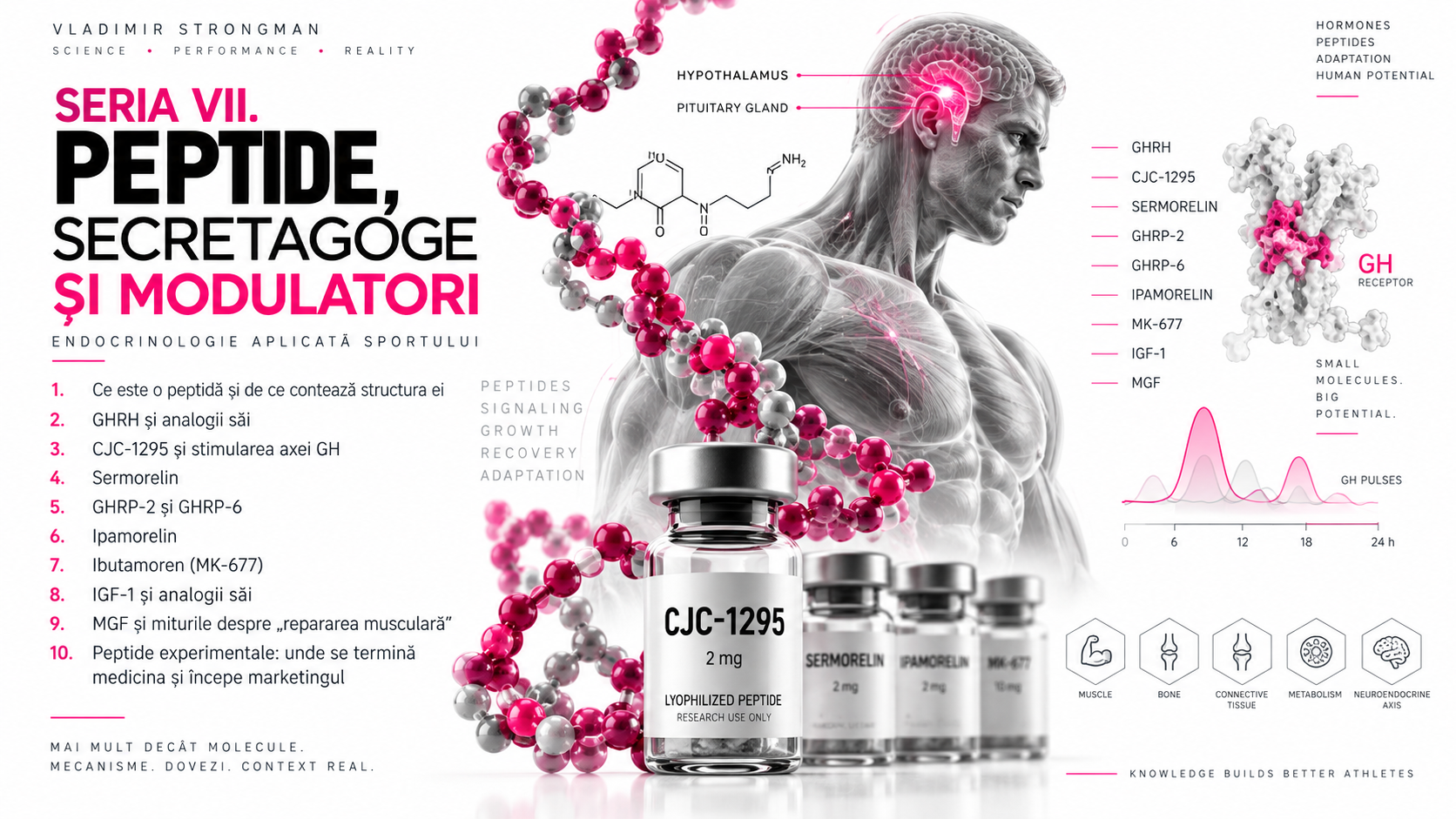
1. CJC-1295 belongs to the GHRH-analog family
CJC-1295 is the name used for a synthetic analog of growth hormone-releasing hormone, or GHRH. The basic idea is simple: the molecule is not GH and does not act as GH. It targets an upstream control level, the GHRH receptor on pituitary somatotroph cells. CJC-1295 is therefore best understood as a modulator of the hypothalamic-pituitary-GH-IGF-1 axis rather than a direct replacement for growth hormone.
2. The GH axis is a chain of command, not a single hormone
To understand CJC-1295, follow the whole pathway. The hypothalamus produces GHRH, GHRH stimulates the pituitary, the pituitary releases GH, and GH acts in multiple tissues while also stimulating hepatic IGF-1 production. A molecule that activates the GHRH receptor therefore intervenes near the beginning of the chain. Its final effects depend on every step downstream.
3. CJC-1295 is not an anabolic steroid
Chemically and pharmacologically, CJC-1295 is a peptide GHRH analog. It is not a steroid, not an androgen, and does not activate the androgen receptor. Peptides and anabolic steroids are often discussed in the same performance-related spaces, but their mechanisms should not be merged. CJC-1295 works through a membrane receptor involved in GH secretion, not a nuclear androgen receptor.
4. The GHRH receptor is the main gateway
Somatotroph cells in the anterior pituitary display GHRH receptors on their surface. When a compatible ligand binds, the receptor activates intracellular pathways that support GH secretion and synthesis. CJC-1295 was designed to preserve the structural features required for receptor recognition. The key has been modified, but it still has to fit the same lock.
5. cAMP and signaling inside the somatotroph
GHRH-receptor activation classically stimulates adenylyl cyclase and raises cAMP. This internal messenger helps activate proteins and transcriptional programs that support GH release and somatotroph function. CJC-1295 does not carry GH through the bloodstream. It sends a signal that asks the pituitary to use its own secretory machinery.
6. Why more stable GHRH analogs were developed
Native GHRH is rapidly degraded by enzymes. Physiologically this is useful because a short signal is easy to switch on and off. Pharmacologically, however, very short persistence limits exposure. GHRH analogs were developed to change this vulnerability while preserving receptor activity.
7. CJC-1295 structure changes signal duration
CJC-1295 is associated with structural modifications intended to increase stability compared with native GHRH. In experimental designs, a major part of the concept was prolonging persistence in circulation. This transforms the problem from a very brief signal into one that can remain available longer. Pharmacologically, that is a major difference even when the target receptor is unchanged.
8. CJC-1295 with DAC and popular naming conventions are not always clear
A common source of confusion is the broad use of the CJC-1295 name for different molecules. In research, CJC-1295 was associated with a drug-affinity-complex strategy intended to prolong persistence through albumin association. Online, labels such as CJC-1295 without DAC are sometimes applied to shorter-acting related peptides. Scientifically, these should not automatically be treated as the same entity.
9. Albumin can act as a circulating carrier
Albumin is one of the most abundant proteins in blood. If a molecule is designed to associate with albumin, it may be partly protected from rapid clearance and remain available longer. This does not automatically make it a stronger receptor agonist. It primarily changes pharmacokinetics, meaning how the body transports and removes the molecule.
10. Half-life and potency are different concepts
A molecule that remains in blood for a long time is not necessarily more potent at its receptor. Half-life describes persistence, while potency describes the concentration needed to produce a response. Understanding CJC-1295 requires keeping those concepts separate. Long duration and receptor activity are different dimensions of the pharmacological profile.
11. What happens after GHRH-receptor activation
After receptor activation, somatotroph cells can release stored GH and support further synthesis. GH enters the circulation and signals to liver, adipose tissue, muscle, bone, and other structures. In the liver, GH stimulates IGF-1 production, so CJC-1295 influences IGF-1 mainly indirectly through stimulation of the GHRH-GH axis.
12. CJC-1295 does not turn the pituitary into an unlimited pump
The endocrine axis retains control mechanisms. Somatostatin can inhibit GH release, pituitary stores are not infinite, receptor responsiveness varies with context, and feedback from GH and IGF-1 can reduce upstream stimulation. The relationship between receptor activation and GH output is therefore not an endlessly rising straight line.
13. Physiological GH secretion is pulsatile
GH normally appears in blood as peaks separated by quieter periods. GHRH contributes to stimulatory phases, somatostatin contributes to braking, and sleep and metabolic state alter pulse amplitude. This matters greatly when discussing longer-acting analogs. A persistent GHRH signal is not identical to a brief natural pulse even when both use the same receptor.
14. A longer signal can alter the temporal pattern of the axis
When receptors are exposed to an agonist for longer, the axis may receive a more persistent stimulatory background. This can alter the relationship between GH peaks and baseline periods. Natural physiology may not disappear, but the timing of the signal is no longer identical. In endocrinology, time is part of the message.
15. CJC-1295 and IGF-1
Greater stimulation of the GH axis can increase IGF-1 signaling, particularly through hepatic production. IGF-1 has its own receptor and effects on growth, metabolism, and tissue remodeling. CJC-1295 is not IGF-1 and does not directly activate the IGF-1 receptor. It acts further upstream, with IGF-1 changes emerging through the hormonal axis.
16. GH and IGF-1 form a feedback system
When GH and IGF-1 rise, the body receives information that the axis is active. This information feeds back to the hypothalamus and pituitary and contributes to reducing further stimulation. Negative feedback helps prevent unlimited escalation. A GHRH analog changes the input signal but does not erase this biological logic.
17. Why responses differ between people
The GH axis is influenced by age, sex, sleep, body composition, free fatty acids, glucose, nutritional status, pituitary function, and other endocrine factors. Two people exposed to the same type of signal can therefore respond differently. Pharmacology does not eliminate biological variability.
18. Sleep remains a major part of the system
One of the major physiological GH pulses is associated with deep sleep. This shows that the axis does not operate in isolation. GHRH signaling, circadian rhythm, and sleep architecture are interconnected. A GHRH analog modifies one link but does not make sleep or circadian timing irrelevant.
19. Glucose metabolism is part of the equation
GH can have anti-insulin effects in some contexts and can reduce insulin sensitivity. If an intervention increases GH-axis signaling, GH's metabolic effects must be considered alongside any changes in IGF-1 or body composition. The GH axis is a metabolic axis as well as a growth axis.
20. Lipolysis is part of GH physiology
GH promotes mobilization of fatty acids from adipose tissue and can alter fuel use. Any discussion of GH-axis stimulation therefore needs to include fat and glucose metabolism rather than focusing only on muscle. The same hormone can regulate multiple systems at once.
21. CJC-1295 does not act as a direct muscle-building hormone
CJC-1295 does not bind a muscle receptor and directly order hypertrophy. Its relationship with muscle is indirect, passing through GH secretion, IGF-1 changes, metabolism, and the broader recovery environment. Muscle growth still depends on mechanical tension, nutrition, sleep, and neural adaptation.
22. Lean mass and muscle mass are not perfectly synonymous
Changes in the GH axis can influence body water, connective tissue, and other components of lean mass. A change in lean mass should therefore not automatically be translated into an equal amount of new contractile muscle tissue. This distinction is essential when interpreting body-composition effects.
23. Connective tissue also responds to the GH-IGF-1 environment
Tendons, ligaments, fibroblasts, and collagen are influenced by the GH-IGF-1 environment. This does not mean that a GHRH analog automatically heals tendons or prevents injury. Connective-tissue remodeling still depends on time, mechanical loading, vascular supply, nutrition, and extracellular-matrix organization.
24. CJC-1295 and ghrelin use different pathways
CJC-1295 acts through the GHRH receptor. Ghrelin and ghrelin-mimicking secretagogues act through GHSR. Both pathways can promote GH secretion, but they enter the system through different molecular gates. Sharing a final hormonal outcome does not make the pathways identical.
25. Why synergy is often discussed
Physiologically, GHRH and GHSR pathways can cooperate in the regulation of GH secretion. This is useful for understanding the axis because it shows that the pituitary integrates multiple signals. Explaining biological synergy, however, is not the same as recommending combinations of substances. Mechanism can be described without turning the explanation into a use protocol.
26. CJC-1295 is not the same as sermorelin or tesamorelin
All can be discussed within the GHRH or GHRH-analog family, but they differ in structure and pharmacokinetic properties. Sermorelin is related to the active fragment of GHRH, tesamorelin is a modified analog with a defined medical use, and CJC-1295 was developed around the idea of prolonged GHRH signaling. Family membership does not mean molecular identity.
27. Clinical research and the peptide marketplace are different worlds
A molecule described in a clinical study has a defined chemical identity and controlled manufacturing. Products sold outside pharmaceutical channels may use the same names without the same assurance of identity, purity, or stability. This matters because peptide pharmacology depends on what the molecule actually is, not what the label says.
28. Risks do not disappear because the mechanism is indirect
Stimulating the body's own GH production does not mean every level of stimulation is automatically physiological or consequence-free. Excessive or persistent GH-axis signaling can affect glucose regulation, insulin sensitivity, fluid balance, and other systems. An indirect mechanism is still an active biological mechanism.
29. In strength sports, performance cannot be reduced to GH
Strength emerges from muscle mass, muscle architecture, neural function, technique, tendons, sleep, energy availability, and training experience. Changing the GH axis may influence parts of the biological environment, but it does not automatically translate into a proportional increase in strength performance.
30. The most important distinction: axis stimulation versus direct hormone exposure
CJC-1295 stimulates a control level upstream of GH. Direct GH exposure bypasses that level. This changes dependence on pituitary function, feedback, somatostatin, and the natural architecture of the axis. The two concepts should therefore not be treated as pharmacological synonyms.
31. The key idea of Episode 3
CJC-1295 is a GHRH analog designed to stimulate the GHRH receptor and, through the pituitary, the GH-IGF-1 axis. Its defining pharmacological feature is not only receptor activation but also the way structural design can change signal persistence. To understand it correctly, follow the complete pathway: GHRH receptor, somatotroph cell, GH, IGF-1, feedback, and metabolic effects. In endocrinology, signal intensity and signal duration are two different dimensions of the same story.
Editorial and safety note
This article explains the mechanism of CJC-1295 and GH-axis physiology for educational purposes. It does not provide doses, schedules, combinations, administration methods, or instructions for using peptides for doping, performance enhancement, or body-composition manipulation.
More From The Journal

Training
The Science of Strongman Training - Episode X: Competition Programming
How to build a complete Strongman competition preparation block: calendar, events, volume, intensity, specificity, simulations, autoregulation, tapering and fatigue management.

Training
The Science of Strongman Training - Episode IX: Peaking
Peaking in Strongman: how to turn months of training into maximal competition performance by reducing fatigue, preserving adaptations and managing specificity.