
Physiology
Peptides, Secretagogues and Modulators - Episode 2: GHRH and Its Analogs
September 7, 2026
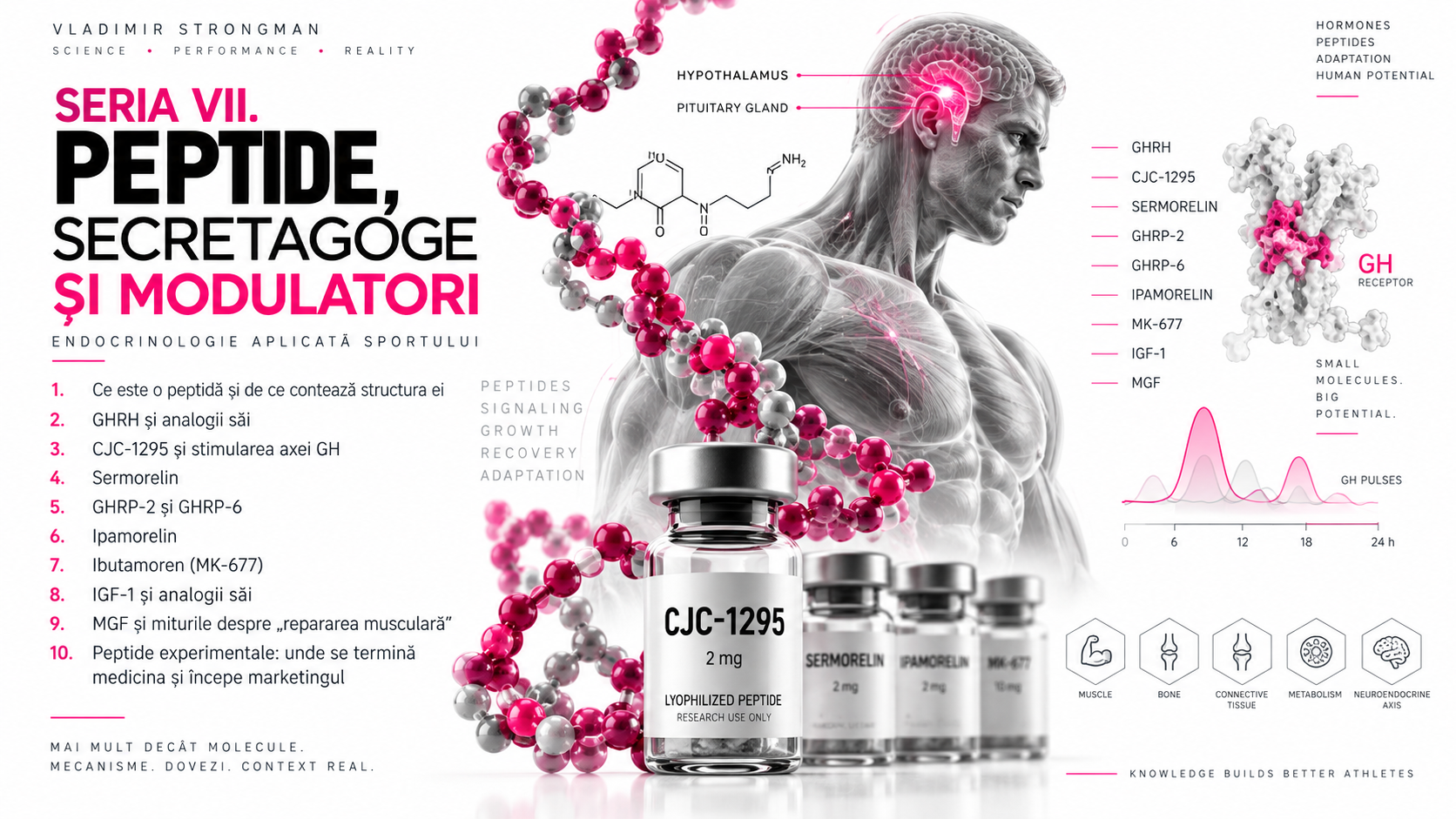
1. GHRH is the signal by which the brain tells the pituitary to release GH
GHRH stands for growth hormone-releasing hormone. It is produced in the hypothalamus, a small brain region that acts as an endocrine control center. GHRH is not growth hormone and does not replace it. Its role is to tell the pituitary that it is time to release GH. A simple analogy is that GHRH is the order sent to the factory, while GH is the product that leaves the factory and travels through the body.
2. The hypothalamus and pituitary form a two-step control system
The hypothalamus produces regulatory signals, while the pituitary responds by releasing hormones into the bloodstream. In the somatotropic axis, the hypothalamus sends GHRH and somatostatin to the anterior pituitary. GHRH stimulates GH release, while somatostatin restrains it. The result is not a continuous stream but a series of pulses. This alternation between acceleration and braking helps explain why GH appears in blood in bursts.
3. GHRH acts on pituitary somatotroph cells
The anterior pituitary contains specialized cells called somatotrophs. They produce and store growth hormone. GHRH receptors are present on their surface. When GHRH binds, the cell receives a chemical signal that promotes release of stored GH and supports processes involved in GH production over longer periods. In simple terms, GHRH can open the warehouse door and also influence how the factory operates.
4. The GHRH receptor is a membrane receptor
GHRH is a peptide and does not easily cross the cell membrane. Its receptor is therefore located on the cell surface and belongs to the G protein-coupled receptor family. After GHRH binds, the message is relayed inside the cell through chemical messengers. This is a direct example of structure determining function: the peptide's shape determines which receptor recognizes it and which cellular circuit is activated.
5. cAMP is one of the main intracellular messengers
Activation of the GHRH receptor classically stimulates adenylyl cyclase and increases intracellular cAMP. cAMP acts as an internal messenger and contributes to activation of proteins and transcriptional mechanisms that favor GH secretion and synthesis. GHRH does not physically push GH into the bloodstream. It starts a signaling cascade that makes the pituitary cell respond.
6. GHRH does not work alone
GH secretion is produced by a network. GHRH stimulates, somatostatin inhibits, and ghrelin-related signaling through the growth hormone secretagogue receptor can amplify release. Sleep, exercise, glucose, free fatty acids, stress, age, and nutritional state also influence the system. GHRH is therefore a major command signal, but not the only switch controlling GH.
7. Why GH is secreted in pulses
The body does not normally maintain GH at one constant level throughout the day. There are long periods of very low concentrations and shorter peaks. These pulses arise through coordination between GHRH and somatostatin, with additional influence from sleep, circadian timing, and metabolic signals. A major pulse often occurs around deep sleep. This pulsatile architecture matters because tissues may respond differently to intermittent and persistent signaling.
8. GHRH stimulates the body's own GH-producing system
This is a crucial distinction. GHRH is not GH. It stimulates the pituitary to release hormone that the gland itself produces. The response therefore depends on pituitary capacity, GH synthesis and storage, inhibitory signals, and physiological feedback. If the system cannot respond normally, the presence of a GHRH signal does not guarantee a normal GH response.
9. Direct GH exposure and GHRH stimulation are biologically different concepts
When GH enters the circulation directly, the hypothalamic-pituitary step is bypassed. A GHRH agonist instead activates an upstream regulatory level and asks somatotroph cells to generate the response. One supplies the final hormone, while the other stimulates the control system that produces it. They should not be treated as interchangeable versions of the same mechanism.
10. What is a GHRH analog?
An analog is a molecule designed from the structure of a natural ligand but modified so that selected properties change. GHRH analogs retain structural features needed for GHRH receptor recognition, while substitutions can alter stability, resistance to enzymes, receptor affinity, or duration of signaling. A useful image is a key based on the original design but reinforced at vulnerable points so it survives longer.
11. Why natural GHRH is short-lived
Natural peptides are often rapidly degraded by enzymes. GHRH is vulnerable to enzymatic cleavage, including degradation involving dipeptidyl peptidase-4 near its N-terminus. Physiologically, short-lived signals make sense because they can be turned on and off rapidly. Pharmacologically, this vulnerability motivated the development of more degradation-resistant analogs.
12. Why the N-terminal region matters
For many peptides, the N-terminal region is critical for biological activity and can also be highly vulnerable to enzymatic attack. If an enzyme clips the molecule at a crucial site, receptor activation may rapidly disappear. Carefully changing amino acids in this region can improve resistance to degradation without necessarily eliminating receptor recognition. This is structure-function pharmacology in its clearest form.
13. GHRH analogs are not all the same
The term GHRH analog describes a family rather than a single molecule. Some are active fragments of the natural sequence, others contain amino-acid substitutions, and some include modifications designed to markedly prolong persistence. Two substances can both be called GHRH analogs while having very different pharmacokinetic profiles and durations of biological signaling.
14. Sermorelin is a well-known example of an active GHRH fragment
Sermorelin corresponds to an N-terminal fragment of GHRH that retains biological activity at the GHRH receptor. It has been used and studied in medical and diagnostic settings related to the GH axis. Its importance for understanding peptide pharmacology is that it demonstrates how a specific segment of a larger natural peptide can contain enough structural information to activate the receptor.
15. Tesamorelin shows how structural modification changes pharmacology
Tesamorelin is a modified GHRH analog designed to have greater stability than native GHRH. It activates the GHRH receptor and stimulates the GH-IGF-1 axis, but its pharmacological properties are not identical to endogenous GHRH. It is a useful example of how a relatively small structural change can transform a very short-lived peptide into a ligand with a different practical pharmacokinetic profile.
16. CJC-1295 is often discussed, but the name can hide important distinctions
In popular peptide discussions, the label CJC-1295 is sometimes used broadly. From a chemical and pharmacological perspective, it is important to distinguish molecules with modifications intended to greatly prolong persistence from related peptides that may be marketed under similar informal names. This illustrates a recurring problem in the peptide world: internet labels can collapse structurally and kinetically different molecules into one category.
17. What does a longer duration of action mean?
If a molecule is degraded more slowly or remains available in circulation for longer, receptors may be exposed to its signal for a longer period. That does not automatically mean the effect is simply better. Endocrine biology uses rhythms, pauses, and feedback. A prolonged signal can create a different physiological pattern from a natural peptide that appears and disappears rapidly. Duration is a pharmacological property, not a synonym for quality.
18. Why pulsatile secretion still matters
The GH axis normally operates through pulses. GHRH helps generate stimulatory phases while somatostatin contributes to the pauses. If an analog lasts much longer than the natural signal, the temporal pattern of receptor activation can change. Therefore the question is not only how much GH is released, but how the signal unfolds over time.
19. Somatostatin remains the brake
Even when GHRH stimulates the pituitary, somatostatin can suppress GH release. Stimulating one pathway does not remove the body's other control systems. The final GH response reflects an ongoing integration of stimulatory and inhibitory signals.
20. Ghrelin and GH secretagogues use a different receptor
GHRH and ghrelin can both promote GH secretion, but they do not use the same receptor. GHRH acts through the GHRH receptor, while ghrelin and ghrelin-like secretagogues act through GHSR. These pathways can cooperate and amplify pituitary responses. The same final outcome can therefore arise through different molecular entry points.
21. Age changes the response
GH secretion generally declines with aging. Changes occur at several levels, including pulse amplitude, body composition, sleep, hypothalamic signaling, and system responsiveness. The same GHRH stimulus may therefore produce different responses in different physiological contexts.
22. Sleep is a major physiological context for the GHRH-GH axis
Deep sleep is associated with a major GH pulse, and GHRH contributes to the neuroendocrine architecture that favors this response. Fragmented or insufficient sleep can change the environment in which the axis operates. GH secretion cannot be understood independently of sleep-wake timing.
23. Glucose and free fatty acids influence the response
The GH axis is sensitive to metabolic state. Hyperglycemia and elevated free fatty acids can blunt GH responses in some settings, while fasting changes the axis in other ways. Even with GHRH receptor activation, the metabolic environment can alter the amplitude of the final response.
24. GHRH and IGF-1 are linked by feedback
GHRH promotes GH release, GH stimulates IGF-1 production, and GH and IGF-1 participate in negative feedback on the axis. When downstream signaling is sufficiently strong, upstream stimulation is reduced through multiple mechanisms. This feedback architecture is a defining feature of endocrine systems.
25. More GHRH does not automatically mean proportionally more GH
Receptors have limits, somatostatin can inhibit secretion, GH stores vary, and feedback can reduce the response. Biology contains ceilings and adaptive mechanisms. The relationship between stimulus and response is not an infinitely rising straight line.
26. GHRH analogs are not the same as ghrelin-mimicking peptides
Both groups may be described broadly as GH secretagogues because they can promote growth hormone release, but their receptors and mechanisms differ. GHRH analogs work through the GHRH receptor, whereas ghrelin-like agonists work through GHSR. Combining them into one undifferentiated category hides the pharmacology that matters.
27. Why analog structure changes pharmacokinetics
Pharmacokinetics describes what the body does to a molecule: how quickly it is degraded, how it distributes, and how long it remains available. In peptides, replacing one amino acid, protecting a vulnerable region, or adding a structural feature that changes interactions in circulation can dramatically alter these properties. Two molecules acting at the same receptor can therefore create very different time profiles.
28. Pharmacodynamics is a different question
Pharmacodynamics describes what the molecule does to the body. This includes receptor affinity, efficacy, and downstream signaling. A very stable molecule is not necessarily a very strong receptor agonist, and a strong agonist may disappear rapidly. Both dimensions are needed to understand a GHRH analog.
29. What does this mean for muscle tissue?
GHRH is not a hormone that binds directly to muscle and orders it to grow. Relevant tissue effects occur indirectly through altered GH secretion, the GH-IGF-1 network, and associated metabolic effects. Muscle adaptation still depends on mechanical tension, energy availability, protein intake, sleep, neural factors, and the wider hormonal environment.
30. In strength sports, mechanism should be separated from reputation
In strength-sport culture, peptides are often known by reputation before their biology is understood. GHRH analogs may be discussed directly in relation to muscle mass or recovery, but biologically they are first and foremost modulators of pituitary GH secretion. Their relationship to a final performance outcome is indirect and passes through a long chain of physiological processes.
31. An analog is not automatically superior to the natural hormone
An analog may resist degradation or be easier to use in a defined medical or research context, but those features do not make it universally better. The natural hormone evolved within a system based on pulses, feedback, and timing. Changing the molecule can alter that temporal pattern. Superiority only makes sense when a specific goal is defined.
32. Medical use and performance use are not the same context
A compound can have a well-defined medical role with indications, patient selection, and monitoring without implying that nonmedical use is equivalent or risk-free. Endocrine effects on glucose metabolism, IGF-1, fluid balance, and other systems must be interpreted in the clinical context of the individual.
33. The key idea of Episode 2
GHRH is the hypothalamic hormone that tells the pituitary to release GH. It acts through the GHRH receptor on somatotroph cells and intracellular signaling that prominently involves cAMP. GHRH analogs follow the same biological logic, but structural modifications can alter enzyme resistance, duration, and the temporal profile of signaling. To understand them correctly, keep three layers separate: the molecule giving the command, the pituitary generating the response, and GH entering the circulation.
Editorial and safety note
This article explains GHRH physiology and the general pharmacology of its analogs for educational purposes. It does not provide doses, schedules, combinations, administration methods, or instructions for using peptides for doping, performance enhancement, or body-composition manipulation.
More From The Journal

Training
The Science of Strongman Training - Episode X: Competition Programming
How to build a complete Strongman competition preparation block: calendar, events, volume, intensity, specificity, simulations, autoregulation, tapering and fatigue management.

Training
The Science of Strongman Training - Episode IX: Peaking
Peaking in Strongman: how to turn months of training into maximal competition performance by reducing fatigue, preserving adaptations and managing specificity.