
Scientific Research
Peptides, Secretagogues and Modulators - Episode 10: Experimental Peptides - Where Medicine Ends and Marketing Begins
September 8, 2026
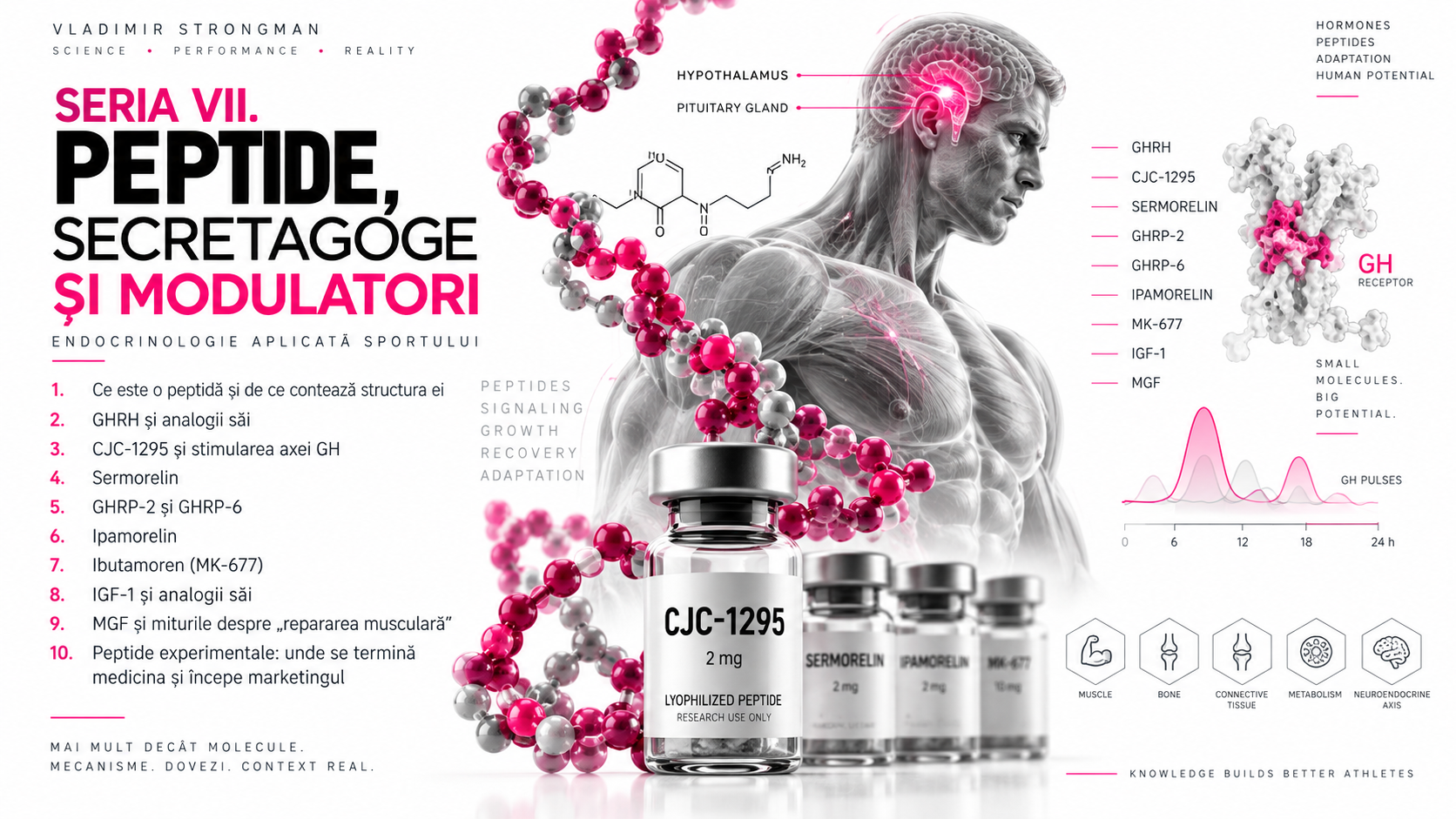
1. What “experimental peptide” really means
An experimental peptide is, in rigorous terms, a molecule somewhere on the path between a biological hypothesis and a validated medicine. It may have an interesting mechanism, work in cells or animals, and even have preliminary human data without automatically being a proven treatment. In marketing, “experimental” is sometimes framed as “advanced,” while in medicine it more often means “not yet sufficiently demonstrated.”
2. Medicine begins with a question, not a promise
Serious research starts with a question: which receptor does this molecule activate, which pathway does it modify, and what measurable effect does it produce? Marketing often starts with the conclusion: “recovers,” “heals,” “burns fat,” or “builds muscle.” In science, claims grow with evidence. In marketing, claims often arrive before the evidence.
3. The first level: biological plausibility
A molecule may make biological sense if it binds a known target or changes a relevant pathway. That matters, but it is only the beginning. A logical mechanism does not prove that an intervention is effective in humans.
4. Cell studies are useful but limited
Cell cultures can show whether a molecule activates a receptor, changes gene expression, or alters proliferation. But a cell in a laboratory dish has no liver, kidneys, immune system, complete metabolism, or whole-body pharmacokinetics. An elegant in vitro effect is a mechanism clue, not proof of therapy.
5. Animal studies add complexity, not certainty
Animal models let researchers study distribution, toxicity, and functional effects in an intact organism. Yet species differences can be large. A positive result in rodents is a reason to investigate humans, not a license for clinical promises.
6. When clinical research truly begins
The key transition is to controlled studies in humans. At that point researchers must measure not only biomarkers but also safety, efficacy, and clinical relevance. A peptide can change a biological marker without changing the outcome that actually matters to the patient.
7. Phase I: safety first
Early human studies usually focus on tolerability, pharmacokinetics, and initial safety signals. Reaching Phase I does not mean efficacy has been demonstrated. It means the molecule has progressed far enough to justify controlled human testing.
8. Phase II: does it actually work?
Phase II looks for efficacy signals while refining the safety profile. Many seemingly promising compounds fail here. Biology that looked perfect on paper meets the variability of real people.
9. Phase III: serious comparison
Phase III studies are larger and aim to confirm whether a benefit is real, reproducible, and important enough relative to risk. A treatment becomes medicine not because its molecular story is persuasive, but because it repeatedly passes tests of efficacy, safety, and quality.
10. Approval is not an administrative formality
Drug approval involves evaluation of composition, manufacturing, pharmacology, clinical trials, risks, and benefits. An online product carrying the same chemical name does not automatically inherit that validation.
11. “Research use only” does not mean “almost a medicine”
The label “research use only” means a product is intended for research rather than human treatment. Online, that wording can be used as a legal curtain around products implicitly promoted to consumers. It does not guarantee purity, efficacy, or clinical safety.
12. The molecule, the vial, and the patient are three different things
A molecule can be well defined in scientific literature. A vial can carry that molecule’s name. And the person using it is a complex organism with diseases, interactions, and individual variation. Marketing tends to compress all three levels into one sentence. Medicine separates and validates them one by one.
13. Quality control is part of medicine
For a medical product, substance identity, purity, contaminants, sterility, stability, and concentration must be controlled. For unregulated products, the label may not accurately reflect the contents. That is a risk separate from the pharmacology of the molecule itself.
14. A certificate of analysis does not solve everything
A certificate of analysis can provide useful information, but it must be evaluated critically. Who performed the analysis, which batch was tested, which methods were used, and can the document be independently verified? A laboratory-looking PDF does not automatically turn an unregulated supply chain into a validated pharmaceutical system.
15. A biomarker is not the same as clinical benefit
Changes in GH, IGF-1, collagen, or inflammatory markers may be biologically interesting. But the clinical question is different: does the patient function better, recover faster, relapse less, or live longer? Marketing loves biomarkers because they can sound impressive before meaningful benefit has been demonstrated.
16. A real mechanism can support a false conclusion
Some of the most persuasive advertisements begin with correct information. A pathway may truly participate in angiogenesis, collagen regulation, or cell proliferation. The error appears when that fact is turned directly into claims such as “heals tendons” or “regenerates muscle.” The mechanism may be real while the commercial conclusion is still false.
17. Why recovery is fertile ground for marketing
Recovery is difficult to measure and naturally varies from day to day. Pain, sleep, inflammation, perceived fatigue, and performance can change for many reasons. That makes it easy for a new intervention to receive credit for an improvement that may have occurred naturally.
18. Regeneration is a dangerously powerful word
In medicine, regeneration must be defined precisely: which tissue, which structure, which measurement method, and which functional outcome? In marketing, “regeneration” can mean almost anything, from less pain to the claim that a tendon or muscle has been rebuilt. Without definitions, the word becomes a slogan rather than a scientific concept.
19. Extrapolating from animals to athletes
An induced injury model in a mouse is not equivalent to chronic overload in an athlete. Healing rates, tissue size, mechanical loads, and metabolic context differ. When advertising converts an animal study into a promise for human performance, it makes a leap the data do not justify.
20. Pharmacokinetics changes the story
Two molecules with similar targets can behave very differently if one is rapidly degraded and the other persists. Absorption, distribution, metabolism, and elimination are part of the effect. Changes such as pegylation or amino-acid substitutions are therefore not minor technical details.
21. Selectivity is often presented too simply
A compound that appears selective in one experiment can have broader effects in a whole organism. Receptors exist in multiple tissues and signaling networks intersect. The claim that a molecule acts only where intended is rarely a realistic description of pharmacology.
22. No reported adverse effects does not mean safe
If a molecule has been tested in few people or for short periods, rare events and chronic effects may remain invisible. Safety is built through time and large datasets. Absence of evidence of harm is not evidence of absence of harm.
23. Long-term data are often the missing link
Many claims around experimental peptides rely on short exposures or preclinical models. Yet endocrinology, cell proliferation, glucose metabolism, and tissue remodeling can change over time. A tolerable short-term profile does not guarantee long-term safety.
24. Medicine evaluates benefit against risk
A medicine does not need to be risk-free. Its demonstrated benefit must justify its risks for a defined indication. In unregulated use for wellness or performance, the benefit is often uncertain, making the risk harder to justify.
25. Marketing often borrows scientific language without scientific standards
Phrases such as “clinically researched,” “science-backed,” “regenerative,” or “optimized” may sound academic but say little about evidence quality. The useful questions are: which study, which population, which comparator, which outcome, and what limitations?
26. Personal testimonials are persuasive but weak evidence
A person can sincerely report feeling better after an intervention. Yet placebo effects, natural variation, training changes, sleep, physiotherapy, and time can create the same impression. That is why controlled and randomized studies exist.
27. “It worked for me” and “it works” are different statements
Personal experience matters to the individual, but it does not establish general efficacy. Medicine tries to learn what happens on average and for whom, not merely whether one person had a favorable experience.
28. Athletes are a difficult population for extrapolation
A strength athlete may differ substantially from the patient population in which a molecule was studied. Body mass, mechanical stress, training, other substances, and goals may all differ. Even real human data may be poorly applicable when the studied population does not resemble the users.
29. Anti-doping adds another boundary
A substance can be medically experimental while also being relevant to anti-doping rules. Lack of drug approval does not make it invisible or acceptable in sport. Medicine, product regulation, and sporting rules are distinct systems.
30. Marketing red flags
Classic warning signs include universal promises, claims of no adverse effects, using animal studies as proof for humans, absence of a validated pharmaceutical product, “rapid healing” language, and presenting a molecular mechanism as a guaranteed outcome. The greater the commercial certainty compared with the certainty of the data, the further the message has moved from medicine.
31. How to read a peptide claim critically
Useful questions are straightforward: which exact molecule was studied, in what model, in how many people, for how long, what outcome was measured, was there a control group, was the finding independently replicated, and is the commercial product actually the same as the researched material? This filter removes a large amount of noise.
32. Where medicine ends
Medicine ends where the evidence no longer supports the claim being made. A mechanism may be real without demonstrated clinical efficacy. A human study may exist without enough safety data. The boundary is not a single line, but a sequence of thresholds of certainty.
33. Where marketing begins
Marketing begins when gaps in the evidence are filled with certainty. When “may” becomes “does,” when “changed a marker” becomes “heals,” or when “worked in an animal model” becomes “works in athletes,” the message has moved from research into commercial storytelling.
34. The key idea of Episode 10
Experimental peptides are neither automatically scams nor automatically revolutionary therapies. Some may become important medicines. Others will disappear when evidence fails to confirm the original promise. The correct criterion is not how futuristic a molecule sounds, but how strong the evidence chain is from mechanism to real benefit and acceptable safety.
Conclusion of the series
From GHRH and GHSR to ipamorelin, ibutamoren, and MGF, the same lesson keeps returning: a molecule's chemistry, the receptor it activates, and a changed biomarker are only the beginning. Physiology is a network, and medicine requires demonstration. The clearest way to discuss peptides is to keep mechanism, evidence, and marketing in separate compartments, then identify exactly where they meet.
Editorial and safety note
This article is educational. It does not provide doses, schedules, combinations, administration methods, purchasing sources, or instructions for using experimental peptides for doping, performance enhancement, body-composition manipulation, or treating injuries without medical supervision.
More From The Journal

Training
The Science of Strongman Training - Episode X: Competition Programming
How to build a complete Strongman competition preparation block: calendar, events, volume, intensity, specificity, simulations, autoregulation, tapering and fatigue management.

Training
The Science of Strongman Training - Episode IX: Peaking
Peaking in Strongman: how to turn months of training into maximal competition performance by reducing fatigue, preserving adaptations and managing specificity.