
Nutrition
Series: Strongman Nutrition: Food That Builds Strength - Episode 9: The Thermic Effect of Food and the Cost of Digestion
September 10, 2026
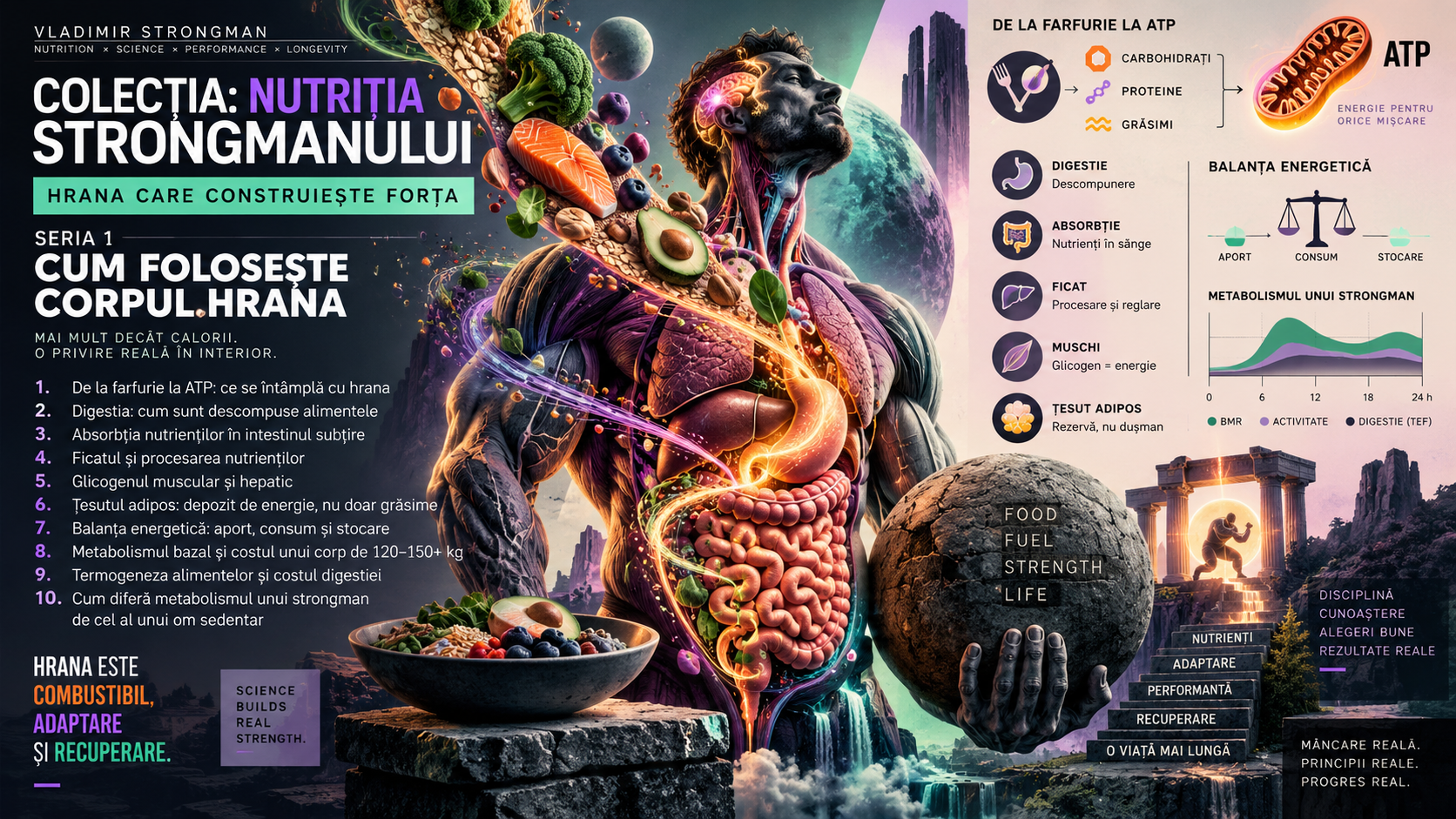
Food does not enter the body without a cost. From the moment chewing begins until amino acids, glucose and fatty acids are absorbed, transported, transformed and stored, the body spends energy. This expenditure is known as the thermic effect of food or diet-induced thermogenesis.
For a strongman who may consume thousands of kilocalories above the population average, the thermic effect of food is not an academic detail. It changes real energy balance, influences post-meal heat and satiety, and helps explain why the energy written on a label is not processed identically regardless of nutrient source.
This episode follows the energetic cost of food step by step, from chewing and digestive secretions to absorption, protein synthesis, glycogen restoration and fat storage. The central idea is simple: macronutrients require different amounts of metabolic work before their energy becomes usable or stored.
1. What the thermic effect of food is
The thermic effect of food is the rise in energy expenditure after eating, caused by digestion, absorption, transport and metabolic processing of nutrients. It is commonly abbreviated TEF or described as diet-induced thermogenesis, DIT.
2. Why the body produces heat after a meal
Part of food's chemical energy is used to process that food and is inevitably dissipated as heat. After a large meal, intestinal blood flow rises, digestive secretions increase, cells transport molecules and the liver begins processing absorbed substrates. All of this requires energy.
3. TEF is part of daily energy expenditure
Total daily energy expenditure includes resting metabolism, physical activity, NEAT and the thermic effect of food. TEF is usually smaller than basal metabolism, but in a very high-calorie diet it can amount to several hundred kilocalories per day.
4. Chewing also has an energetic cost
The chewing muscles work, saliva is secreted and the nervous system prepares the gastrointestinal tract. The calorie cost of chewing is small compared with later metabolic processes, but it demonstrates that food processing begins before food reaches the stomach.
5. Digestive secretions require energy
Producing gastric acid, pancreatic enzymes, bicarbonate and bile requires ion transport, protein synthesis and cellular work. Digestive glands do not operate for free, and large meals demand a substantial secretory response.
6. Gastrointestinal motility consumes energy
The stomach mixes food, the intestine propels and segments its contents, and smooth muscle remains active for hours after a meal. This work is small compared with exercise but still contributes to the overall cost of digestion.
7. Active absorption uses ATP directly or indirectly
Intestinal transporters use ion gradients to move glucose, amino acids and other nutrients into enterocytes. The sodium-potassium pump maintains those gradients by consuming ATP, directly linking absorption to cellular energy metabolism.
8. The liver adds a second layer of metabolic cost
After absorption, the liver receives a large share of nutrients and decides whether to oxidize, transform, store or redistribute them. Glycogen synthesis, the urea cycle, lipid synthesis and plasma-protein production all have their own energetic costs.
9. Protein has the highest thermic effect
Protein generally produces a much larger thermic effect than carbohydrate or fat. A meaningful share of its energy is spent on digestion, absorption, protein synthesis, transamination, deamination and nitrogen disposal.
10. Why protein is metabolically expensive
Amino acids do not have a dedicated storage reservoir comparable with glycogen or adipose tissue. Once absorbed, they must be distributed, used for synthesis or metabolically handled if present in excess. Removing nitrogen and producing urea adds a significant energetic cost.
11. Protein TEF can reach relatively high percentages
Estimates vary by method and context, but protein is often associated with a thermic effect in the approximate range of 20-30% of ingested energy. These are not fixed constants for every meal; they illustrate protein's comparatively high processing cost.
12. Carbohydrate has an intermediate cost
Carbohydrate usually has a lower thermic effect than protein and a higher one than fat. Its cost comes from monosaccharide absorption, transport, oxidation and, when required, restoration of liver and muscle glycogen.
13. Storing glucose as glycogen costs energy
Converting glucose into glycogen is not a simple transfer into storage. Glucose must be phosphorylated, activated and incorporated into the glycogen polymer. These reactions consume energy, though substantially less than converting carbohydrate into fat.
14. Fat has the lowest thermic effect
Dietary fat can be stored relatively efficiently. After digestion and absorption, fatty acids are reassembled into triglycerides, transported in chylomicrons and taken up by adipose tissue with a comparatively low energetic cost.
15. Dietary fat is therefore stored efficiently
The chemical structure of dietary fat is already close to the form in which energy is stored in adipocytes. The body does not need to radically rebuild the molecule before storage. This efficiency helps explain the low thermic effect of fat.
16. Alcohol has a distinct thermic effect
Alcohol provides energy and carries its own metabolic cost because the liver prioritizes its oxidation. Its thermic effect does not make alcohol useful for weight control and does not compensate for potential negative effects on sleep, hydration and recovery.
17. A mixed meal has a mixed TEF
Real meals contain combinations of nutrients. Meat, rice, vegetables and oil produce a thermic response determined by their proportions of protein, carbohydrate and fat, but also by the volume, texture and physical structure of the foods.
18. Whole foods often require more processing
Less processed foods often require more chewing and digestion and may have a physical matrix that slightly reduces metabolizable energy. The difference is not dramatic, but it shows that food texture and structure can affect processing cost.
19. Highly processed foods are often easier to digest
Grinding, refining and intensive processing can reduce the mechanical and enzymatic work required to access nutrients. Two meals with the same labeled energy may therefore have slightly different digestive costs, without making total calorie intake irrelevant.
20. Liquid form changes digestive logistics
A shake requires no chewing and may leave the stomach faster than a comparable solid meal. Its nutrients still need to be absorbed and metabolically processed. Liquid does not mean thermically free; it mainly reduces part of the mechanical workload.
21. Meal size influences the thermic response
A larger meal contains more nutrients to process and therefore produces a larger thermic effect in absolute terms. For a strongman, very high-calorie meals can create a noticeable rise in body heat and digestive activity.
22. Meal frequency does not create energy from nothing
The idea that six meals dramatically accelerate metabolism compared with three is overstated. When calories and macronutrients are comparable, total daily TEF is driven mainly by how much and what is eaten, not by a magical meal frequency.
23. TEF is not the same as basal metabolism
Basal metabolism is the energy required to sustain vital functions at rest. TEF is the additional increase in energy expenditure caused by processing food. Both contribute to daily expenditure, but they arise from different physiological processes.
24. TEF is not the same as NEAT
NEAT is the energy spent on daily movement and activities outside formal exercise. TEF comes from processing food. Higher intake may influence both in some people, but through entirely different mechanisms.
25. The sympathetic nervous system contributes to post-meal thermogenesis
Eating triggers hormonal and neural changes that can increase metabolic activity and heat production. The sympathetic nervous system contributes to this response, though its magnitude varies with meal size and composition, metabolic sensitivity and individual context.
26. Insulin coordinates postprandial processing
After a meal containing carbohydrate and protein, insulin facilitates glucose uptake, glycogen synthesis and anabolic processes. These pathways involve energetic transfers. Insulin does not create thermogenesis by itself, but it is part of the metabolic orchestra after eating.
27. Protein synthesis is energetically expensive
Building proteins requires amino-acid activation, initiation, elongation, termination and quality control. These steps consume ATP and GTP. Part of protein's high thermic effect comes from the cost of using amino acids for synthesis.
28. The urea cycle contributes to protein's cost
Amino acids used for energy leave nitrogen that must be handled safely. The liver converts it into urea through an energy-consuming pathway. This is one reason excess protein is more metabolically costly than storing dietary fat directly.
29. Gluconeogenesis is metabolically expensive
Making glucose from amino acids, lactate or glycerol requires ATP and GTP. When gluconeogenesis becomes more active, the body pays an energetic price to maintain blood glucose and transform substrates.
30. De novo lipogenesis also has a cost
Converting carbohydrate into fatty acids requires a complex metabolic pathway that consumes energy. In humans this is not usually the first destination of dietary carbohydrate, but it can become more relevant during large and prolonged energy surpluses.
31. High-protein meals produce a larger TEF
When two meals contain the same total energy, the one richer in protein usually produces a larger thermic response. The difference is not unlimited, but it can influence total energy expenditure and satiety during maintenance or dieting.
32. Protein is not a free calorie
A greater fraction of protein energy may be lost as heat, but protein still contributes to energy balance. At sufficiently high intakes, it can contribute to an energy surplus. High TEF does not make protein metabolically invisible.
33. TEF helps explain protein satiety
Protein tends to produce strong satiety through several mechanisms, and its high processing cost is one part of the picture. Gastrointestinal hormones, digestion rate and signaling to the brain are also important.
34. Fiber changes metabolizable energy
Human enzymes do not fully digest fiber. Some fibers are fermented by the microbiota and yield short-chain fatty acids, while others pass largely unused. The metabolizable energy of a high-fiber diet is therefore not identical to a simple gross calculation.
35. The microbiota contributes to energy extraction
Gut bacteria ferment substrates human enzymes cannot digest. The products can be absorbed and used as energy. The contribution varies between people and diets, adding another layer between energy on paper and energy actually extracted.
36. Food temperature does not radically change energy balance
The body must bring food and drinks toward internal temperature, but the energy involved is small compared with total metabolism. Very cold drinks are not a meaningful way to increase calorie expenditure.
37. Spices can modestly alter thermogenesis
Compounds such as capsaicin can modestly increase thermogenesis and influence appetite in some people. The effect is small compared with calorie intake, body mass and physical activity. Spices are not a metabolic shortcut.
38. Caffeine can temporarily increase energy expenditure
Caffeine stimulates the central nervous system and may modestly increase thermogenesis and substrate mobilization. Tolerance develops, and this effect should not be confused with the thermic effect of a meal itself. Its ergogenic role is usually more important than the extra calories expended.
39. Meal timing can alter the response without rewriting physics
Circadian rhythms can influence insulin sensitivity, nutrient handling and thermogenesis. Timing differences do not erase long-term energy balance. For athletes, meal timing must also account for training, sleep and gastrointestinal tolerance.
40. Insufficient sleep can alter post-meal metabolism
Sleep deprivation affects appetite, insulin sensitivity and energy regulation. TEF remains only one component, but meals consumed in a sleep-deprived body are processed in a different hormonal and behavioral context.
41. A huge meal can impair comfort before it supports performance
In strongman, the goal of pushing in calories quickly collides with anatomy and physiology. Gastric distension, reflux, sleepiness and digestive workload can turn a very large meal into a performance problem if it is eaten too close to an event.
42. Digestion and exercise compete for circulatory resources
After eating, the gastrointestinal tract receives more blood. During intense exercise, working muscle and skin also demand blood flow. The body can manage these priorities, but a massive meal immediately before maximal effort can worsen gastrointestinal discomfort.
43. Post-meal heat matters on a hot competition day
Diet-induced thermogenesis produces heat that must be dissipated. During a hot competition, especially in a very large athlete, enormous meals can add a small but real thermal load on top of environmental heat and exercise.
44. A large body can have a large absolute TEF
A strongman eating 5000-7000 kcal per day may spend more energy on food processing in absolute terms than someone eating 2000 kcal. The percentage can be similar, but the calorie base is much larger.
45. TEF explains part of the gap between intake and maintenance
When an athlete maintains body mass on an apparently enormous intake, the thermic effect of food is one piece of the explanation, together with resting metabolism, body mass, NEAT and training. It is never the only explanation.
46. During a deficit, protein can support energy expenditure
Adequate protein during an energy deficit helps preserve lean mass, increases satiety and produces a higher thermic effect than a diet with the same calories but less protein. This advantage is real, but it does not replace the need for an actual calorie deficit.
47. During a surplus, TEF does not automatically prevent fat gain
A sufficiently large energy surplus remains a surplus even when part of its energy is lost as heat. TEF reduces net available energy, but it does not turn unlimited overeating into energy balance.
48. TEF changes with calorie intake
Eat more and the absolute amount of energy required to process food generally rises. Eat less and it falls. TEF is therefore a component of expenditure that tends to move in the same direction as calorie intake.
49. Metabolic adaptation also changes the thermogenic picture
During prolonged weight loss, total energy expenditure may fall beyond what simple weight change predicts. Lower food intake automatically reduces TEF, while NEAT and resting metabolism may adapt at the same time.
50. Overfeeding can increase energy expenditure
As intake rises, TEF rises because more substrate must be processed. Some people also increase NEAT. These responses can buffer part of a surplus, but they cannot be relied upon to neutralize it.
51. Feeling hot does not accurately measure TEF
Sweating after a meal does not reveal how many calories were spent digesting it. Environmental temperature, spices, meal size, body composition and autonomic activity all influence the sensation. Rigorous measurement requires methods such as indirect calorimetry.
52. Indirect calorimetry can measure the post-meal response
By measuring oxygen consumption and carbon dioxide production before and after a meal, researchers can estimate the increase in energy expenditure associated with food processing. Results depend on the monitoring period and the composition of the test meal.
53. A calorie label is an estimate, not a metabolic scan
Food labels use standardized energy factors and remain extremely useful for planning. They do not perfectly capture absorption, TEF or individual variation. Real changes in body mass and performance therefore remain essential feedback for adjusting a diet.
54. Extreme protein intake should not be used only to raise TEF
Once protein intake is sufficient for recovery and muscle retention or growth, pushing it much higher solely for its thermic effect may unnecessarily displace carbohydrate and fat needed for performance. Strongman still depends heavily on glycogen and adequate energy density.
55. Very high protein can make large diets harder to tolerate
Huge protein intakes can increase fullness, food volume and gastrointestinal burden. For an athlete who needs very high calories, maximizing thermogenesis is not always the right objective.
56. Before competition, digestibility can matter more than TEF
In the hours before an event, the goal is not to maximize calories burned through digestion but to fuel without heaviness or symptoms. Familiar meals with moderate fat and fiber and well-tolerated carbohydrate sources are often more practical.
57. Between events, digestive cost must be managed
During a long strongman competition, food between events must deliver energy without overloading the gastrointestinal tract. Easily digested carbohydrate, fluids and moderate portions can support progressive refueling with a manageable digestive burden.
58. After competition, TEF becomes part of recovery
Recovery meals reactivate protein synthesis, glycogen restoration and hepatic processing. The thermogenesis associated with these processes is the energetic signature of rebuilding, not something that needs to be avoided.
59. An effective diet balances cost and usefulness
A strongman needs enough protein for adaptation, enough carbohydrate for glycogen and enough fat for energy density and physiological function. TEF should be understood as a property of this combination, not as a separate target.
60. Conclusion: digestion has a real energetic price
The body spends energy turning food into usable molecules, absorbing them and storing or using them. Protein is the most metabolically expensive, fat the most efficiently stored, and carbohydrate lies between them. For strongman, TEF matters, but it is never the whole energy-balance equation.
The first key idea is that digestion is not passive. Chewing, secretion, motility, intestinal transport and hepatic processing all consume energy and generate heat.
The second is that macronutrients do not have equal thermic costs. Protein demands the most processing, carbohydrate has an intermediate cost and fat can be stored with high energetic efficiency.
The third is that TEF depends on the amount and composition of food. In an athlete eating very high calories, absolute thermogenesis can be substantial even when its percentage of intake remains ordinary.
The fourth is that meal frequency, spices or food temperature cannot bypass energy balance. Their effects are secondary compared with calorie intake, activity and macronutrient composition.
For strongman, digestive cost should be viewed practically: enough energy and protein for recovery, but meals digestible enough that the gastrointestinal tract does not become another event to survive.
Sources and recommended reading
1. Hall JE. Guyton and Hall Textbook of Medical Physiology. Sections on energy metabolism, digestion and body-temperature regulation.
2. Westerterp KR. Diet induced thermogenesis. Nutrition & Metabolism. Reviews of the thermic effect of food.
3. Tappy L. Thermic effect of food and sympathetic nervous system activity. Literature on postprandial thermogenesis.
4. Acheson KJ and colleagues. Calorimetry studies comparing thermogenesis from protein, carbohydrate and fat.
5. Schutz Y. Macronutrients and energy balance. Literature on the energetic costs of oxidation and storage.
6. Jeukendrup AE, Gleeson M. Sport Nutrition. Concepts of digestion, absorption and fueling for performance.
7. Thomas DT, Erdman KA, Burke LM. Nutrition and Athletic Performance. Academy of Nutrition and Dietetics, Dietitians of Canada and ACSM.
8. Literature on food processing, metabolizable energy and postprandial thermogenesis.
9. Literature on dietary protein, satiety, protein synthesis and the energetic cost of nitrogen disposal.
10. Exercise-physiology literature on splanchnic blood flow, thermoregulation and gastrointestinal tolerance during exercise.
Editorial note: percentages commonly cited for the thermic effect of macronutrients are approximate ranges, not universal constants. Real energy expenditure varies with body size, diet composition, metabolic state and measurement method.
More From The Journal

Training
The Science of Strongman Training - Episode X: Competition Programming
How to build a complete Strongman competition preparation block: calendar, events, volume, intensity, specificity, simulations, autoregulation, tapering and fatigue management.

Training
The Science of Strongman Training - Episode IX: Peaking
Peaking in Strongman: how to turn months of training into maximal competition performance by reducing fatigue, preserving adaptations and managing specificity.