
Nutrition
Series: Strongman Nutrition: Food That Builds Strength - Episode 6: Adipose Tissue: An Energy Depot, Not Just Body Fat
September 10, 2026
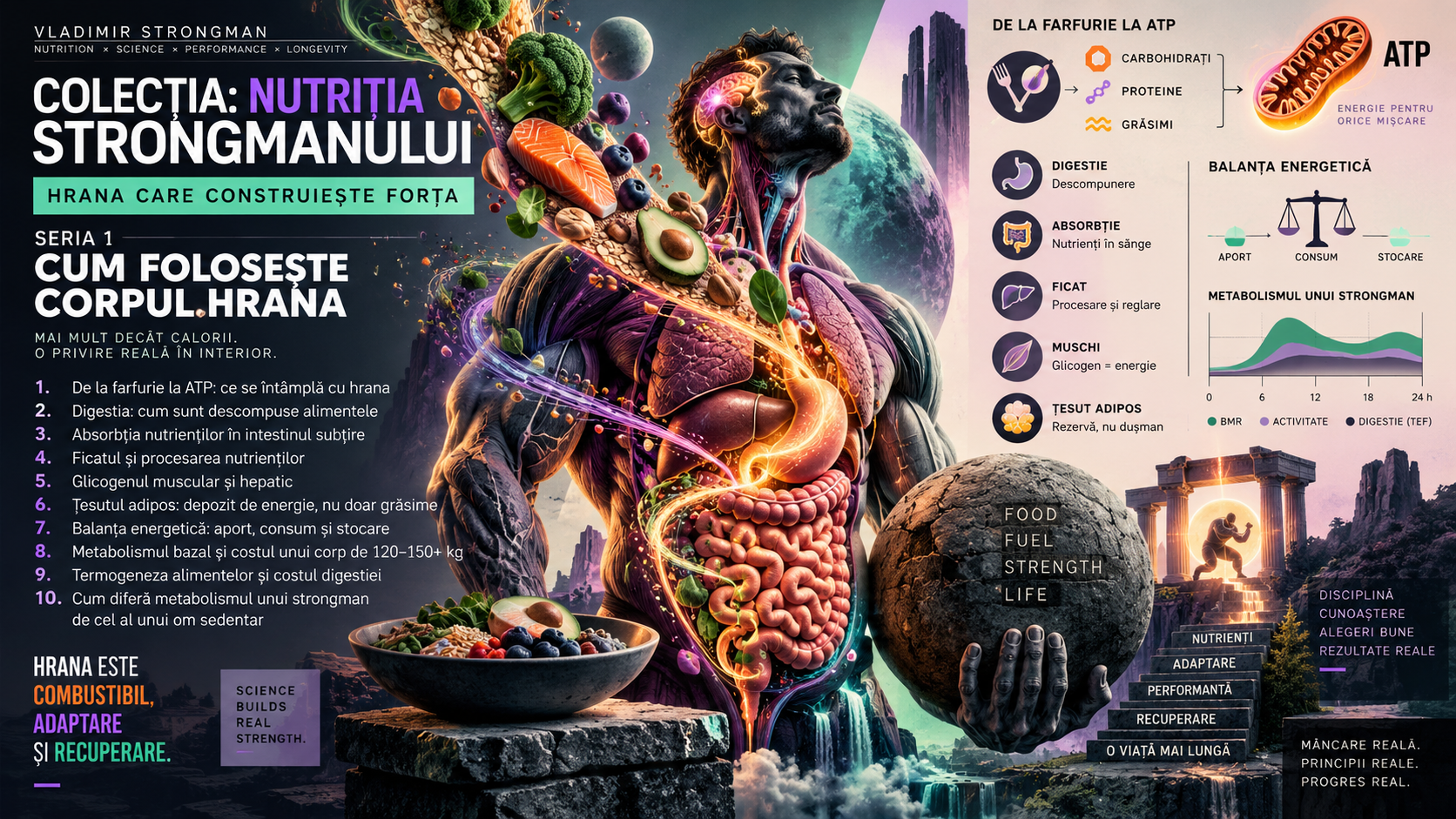
Adipose tissue is often reduced to a single idea: body fat. Biologically, however, it is an active metabolic organ that stores energy, releases it when needed, and sends hormonal signals to the brain, liver, muscle and pancreas.
For a strength athlete, this perspective matters. Fat stores do not directly produce a deadlift or log press, but they influence energy availability, insulin sensitivity, inflammation, appetite, thermoregulation, and how the body handles periods of caloric surplus or deficit.
This episode follows adipose tissue from the adipocyte to performance: how triglycerides are stored, how lipolysis mobilizes them, how insulin and catecholamines regulate the process, why fat distribution matters, and why more body fat does not automatically mean more immediately usable energy.
1. Adipose tissue is a metabolic organ, not an inert warehouse
Adipocytes store lipids, but adipose tissue also contains blood vessels, nerves, immune cells and precursor cells. It responds to hormones and secretes signaling molecules of its own, making it function much more like an endocrine organ than a passive storage bag.
2. The adipocyte is built for efficient energy storage
A mature white adipocyte is dominated by a large lipid droplet that pushes the nucleus toward the edge of the cell. This architecture allows a large amount of triglyceride to be stored in a relatively compact space and makes adipose tissue an efficient long-term energy reserve.
3. Triglycerides are the main currency of the adipose depot
Most lipids stored in adipocytes are triglycerides, molecules made of glycerol and three fatty acids. They can be packed into lipid droplets with little associated water, which makes fat storage far more compact than carbohydrate storage as glycogen.
4. Fat stores a great deal of energy in a small space
Lipids provide roughly twice as much energy per gram as carbohydrates or protein, and triglycerides are stored with very little water. From a metabolic standpoint, this makes adipose tissue an exceptionally dense reserve for periods when food-derived energy is unavailable.
5. Energy storage and release are dynamic processes
Adipocytes continuously perform both lipid storage and lipid breakdown. What changes from hour to hour is the balance between them. Storage tends to dominate after meals, while fasting and exercise shift the system toward mobilization of fatty acids.
6. Subcutaneous fat is the largest compartment in most people
Subcutaneous adipose tissue lies beneath the skin and usually represents the largest share of total fat mass. It functions as an energy reservoir and provides mechanical and thermal insulation. Metabolically, it is not equivalent to visceral fat.
7. Visceral fat carries a different metabolic meaning
Visceral adipose tissue surrounds abdominal organs and has different metabolic and inflammatory characteristics from subcutaneous depots. Larger visceral stores are more strongly associated with insulin resistance and cardiometabolic risk than an equivalent amount of fat stored mostly under the skin.
8. Ectopic fat appears when excess lipid accumulates outside dedicated fat depots
When adipose storage capacity is exceeded or lipid flux becomes very high, fat can accumulate in the liver, muscle, pancreas and around other organs. These ectopic deposits can interfere with cellular function and insulin signaling.
9. White adipose tissue specializes in energy storage
White adipocytes have a very high capacity for triglyceride storage and form the body's principal long-term energy reserve. They also release adipokines that influence appetite, insulin sensitivity, inflammation and whole-body metabolism.
10. Brown adipose tissue burns fuel to produce heat
Brown adipocytes contain many mitochondria and express UCP1, a protein that allows part of metabolic energy to be dissipated as heat. Their main role is thermogenesis rather than large-scale energy storage, and adults generally have much less brown than white adipose tissue.
11. Beige adipocytes can acquire thermogenic properties
Under certain conditions, cells within white fat depots can acquire features resembling brown adipose tissue and increase thermogenic protein expression. The phenomenon is biologically interesting, but it does not turn body fat into a simple fat-burning switch controlled by dietary tricks.
12. Adipogenesis creates new adipocytes
Adipose tissue can expand not only by enlarging existing cells but also by forming new adipocytes from precursor cells. This process, adipogenesis, is governed by transcription factors and hormonal signals and may influence how safely fat depots accommodate excess energy.
13. Adipocyte hypertrophy and hyperplasia are not the same
Hypertrophy means enlargement of existing adipocytes, whereas hyperplasia means an increase in cell number. Strongly hypertrophied depots may become metabolically stressed, hypoxic and inflamed. The ability to create new functional adipocytes can provide a safer route for storing excess lipid.
14. Lipoprotein lipase helps circulating fat enter tissues
Lipoprotein lipase, or LPL, acts at capillary surfaces and breaks triglycerides in chylomicrons and VLDL into fatty acids. These fatty acids can then enter adipocytes and be re-esterified for storage. LPL activity differs between tissues and changes with nutritional and hormonal state.
15. Insulin favors energy storage in adipocytes
After a meal, insulin stimulates glucose uptake into adipocytes, supports adipose LPL activity and suppresses lipolysis. The metabolic message is that fuel is available and part of it can be stored. Insulin does not create fat from nothing; it regulates substrate flow within the broader context of energy balance.
16. GLUT4 allows glucose to enter the adipocyte
Adipocytes express the insulin-sensitive transporter GLUT4, as skeletal muscle does. Glucose entering the cell can provide energy and can also generate glycerol-3-phosphate, which is needed to esterify fatty acids into triglycerides.
17. Glycerol-3-phosphate helps package fatty acids
To build a triglyceride, the adipocyte needs a glycerol backbone on which fatty acids can be attached. Glucose metabolism supplies much of the glycerol-3-phosphate used for this task, illustrating how closely carbohydrate and fat metabolism are linked.
18. De novo lipogenesis can turn carbohydrate into fat
The body can synthesize fatty acids from carbohydrate through de novo lipogenesis, especially in the liver and to a smaller degree in adipose tissue. Direct storage of dietary fat is often more efficient, but chronic energy surplus can also increase lipid synthesis from carbohydrate.
19. Chylomicrons deliver dietary fat to adipose tissue
After a fat-containing meal, the intestine packages triglycerides into chylomicrons. LPL releases fatty acids from these particles, allowing adipocytes to take them up and store them. Part of a meal's energy can therefore enter adipose depots within hours of eating.
20. VLDL also delivers triglycerides produced by the liver
The liver exports triglycerides in VLDL particles. These are also substrates for LPL, allowing fatty acids to reach adipose tissue or muscle. Adipose tissue is therefore connected both to dietary fat and to lipids processed and redistributed by the liver.
21. ATGL starts the breakdown of stored triglycerides
When the body needs fuel, triglycerides in the lipid droplet are dismantled step by step. ATGL performs a major first step by releasing one fatty acid and forming diacylglycerol. Lipolysis is a regulated process rather than a spontaneous melting of body fat.
22. HSL continues fatty-acid mobilization
Hormone-sensitive lipase, or HSL, acts mainly on diacylglycerol and helps release additional fatty acids. Together with ATGL and other enzymes, it converts stored triglyceride into a stream of potentially usable fuel.
23. Catecholamines accelerate lipolysis
Adrenaline and noradrenaline can activate adrenergic pathways that increase lipolysis. During exercise, this raises fatty-acid availability for tissues capable of oxidizing them, although the exact response differs between fat depots and receptor types.
24. Insulin puts a brake on lipolysis
Insulin is a powerful physiological inhibitor of lipolysis. After a meal, it reduces fatty-acid release and favors re-esterification, matching the use of stored fuel to the availability of energy arriving from food.
25. Fasting shifts the balance toward fat mobilization
Between meals and during fasting, lower insulin reduces the restraint on lipolysis. Fatty-acid flux from adipocytes increases, allowing the body to use more fat for energy while conserving some glucose for tissues that depend more heavily on it.
26. Exercise mobilizes fat, but intensity determines how much can be used
During exercise, catecholamines rise and insulin may fall, favoring fatty-acid mobilization. Yet actual oxidation depends on exercise intensity, oxygen delivery and mitochondrial capacity. Releasing fat from an adipocyte does not guarantee that muscle will burn it.
27. Free fatty acids circulate largely bound to albumin
Non-esterified fatty acids are poorly soluble in water and circulate in plasma largely bound to albumin. This transport protein carries them toward muscle, liver and other tissues that can use or repackage them.
28. Glycerol travels mainly toward the liver
Lipolysis also releases glycerol. A meaningful fraction enters the circulation and is taken up by the liver, where it can contribute to gluconeogenesis or other metabolic pathways.
29. Beta-oxidation converts fatty acids into usable energy
In cells that use them, fatty acids are activated and transported toward mitochondria, where beta-oxidation progressively breaks them into acetyl-CoA units. These units then support ATP production through oxidative metabolism.
30. The liver can turn fatty acids into ketone bodies
During prolonged fasting or low carbohydrate availability, the liver receives a large fatty-acid flux and can convert part of the resulting acetyl-CoA into ketone bodies. These are exported and used as energy by other tissues.
31. Fuel selection changes with exercise intensity
At low and moderate intensities, fat oxidation can contribute substantially to energy production. As intensity rises, the body relies increasingly on carbohydrate because it can support rapid ATP demand more effectively.
32. Fat is a slower fuel than glycogen
Fatty-acid oxidation can yield large amounts of ATP, but it requires multiple steps and depends strongly on aerobic metabolism. Glycogen can support intense work more rapidly, so large fat stores cannot replace carbohydrate during explosive events.
33. A maximal deadlift is not directly fueled by adipose tissue
During an effort lasting only a few seconds, stored muscular ATP and the phosphocreatine system dominate immediate energy production. Body fat cannot be mobilized, transported and oxidized quickly enough to power that maximal contraction directly.
34. Between events, fatty acids can support background metabolism
During rest periods and lower-intensity activity between events, fat oxidation can contribute more to total energy needs. This does not remove the need for carbohydrate to restore glycogen, but it shows how adipose reserves support the broader energy economy of a long competition day.
35. Chronic caloric surplus expands adipose stores
When energy intake repeatedly exceeds expenditure, part of the excess is stored in adipose tissue. Increasing fat mass reflects cumulative positive energy balance over time rather than the isolated effect of one food or one macronutrient.
36. Caloric deficit forces greater use of stored energy
During an energy deficit, food intake does not cover all requirements and the body mobilizes more fuel from its reserves. Adipose tissue becomes an important fatty-acid source, while hormonal and behavioral adaptations can make continued weight loss progressively harder.
37. Leptin informs the brain about energy reserves
Leptin is secreted mainly by adipocytes, and its level tends to reflect fat mass and energy status. It acts on hypothalamic circuits involved in appetite and energy expenditure. In obesity, leptin resistance can develop, so high circulating leptin does not necessarily mean an effective signal.
38. Adiponectin is associated with more favorable metabolic function
Adiponectin is an adipokine involved in insulin sensitivity and fatty-acid oxidation. Its levels are often lower in the setting of excess visceral fat and metabolic dysfunction, although the relationship is complex and influenced by many factors.
39. Adipose tissue also communicates through inflammatory signals
Hypertrophied fat depots can become infiltrated by immune cells and release more inflammatory mediators. Cytokines such as TNF-alpha and IL-6 can influence whole-body metabolism. This low-grade chronic inflammation differs from the normal acute inflammatory response to training.
40. Chronic inflammation can disrupt insulin signaling
Persistent inflammatory signaling can interfere with intracellular pathways used by insulin. Over time, muscle, liver and adipose tissue may respond less effectively, requiring more insulin to produce the same metabolic effect.
41. Insulin resistance changes how lipids are handled
When adipocytes respond less effectively to insulin, control of lipolysis can weaken and fatty-acid release into blood may increase. At the same time, muscle and liver may handle glucose less efficiently, linking adipose dysfunction to whole-body metabolism.
42. Excess circulating fatty acids can become a problem
Free fatty acids are useful fuels, but chronically high flux can exceed the ability of tissues to oxidize or safely store them. Lipid intermediates may accumulate in liver and muscle and contribute to impaired insulin signaling.
43. Visceral fat is more closely linked to metabolic risk
Visceral depots are metabolically active and partly drain toward the portal circulation. Their expansion is more strongly associated with insulin resistance, fatty liver and cardiovascular risk than total body-fat mass alone.
44. Subcutaneous fat can act as a safer metabolic storage site
When subcutaneous adipose tissue can expand without major dysfunction, it may store excess energy away from the liver and other organs. The issue is therefore not only how much fat exists, but where it is stored and how healthfully the depot can expand.
45. Fatty liver is an example of ectopic storage
Excess triglyceride can accumulate in the liver when fatty-acid delivery and synthesis exceed oxidation and export. Hepatic steatosis is frequently associated with insulin resistance and illustrates why functional adipose tissue is valuable as a specialized storage organ.
46. Muscle also contains intramuscular triglycerides
Some lipid is stored in droplets inside muscle fibers. These intramuscular triglycerides can contribute energy, particularly during prolonged exercise. Their presence is not automatically pathological because metabolic context and oxidative capacity matter greatly.
47. Athletes can store intramuscular fat while remaining insulin sensitive
Well-trained muscle may contain substantial intramuscular lipid while maintaining good insulin sensitivity because mitochondrial capacity and lipid turnover are high. This so-called athlete's paradox shows that fat quantity alone does not reveal metabolic health.
48. Body weight alone does not describe body composition
Two athletes at the same body weight can carry different amounts of muscle, adipose tissue, water and glycogen. For strongman, the scale is useful for logistics and categories, but it does not by itself describe the quality of body mass or metabolic condition.
49. Heavier does not automatically mean stronger
Greater body mass can help stability, inertia or certain leverage situations, but adipose tissue does not generate contractile force. Beyond a point, additional mass may raise the cost of movement, thermoregulation and cardiovascular work without producing proportional strength gains.
50. Body mass can provide a mechanical advantage in some strongman events
In truck pulls, pushes, some carries and movements where stability matters, body mass can influence traction and center-of-mass behavior. The advantage is mechanical and event-specific; it does not turn adipose tissue into contractile tissue.
51. Adipose tissue influences thermoregulation
Subcutaneous fat provides thermal insulation. That can be useful in cold environments, but high body mass can make heat dissipation more difficult in hot conditions. For very heavy strongmen, heat can amplify cardiovascular stress and hydration demands.
52. Adipose tissue participates in appetite regulation
Through leptin and other signals, adipose mass communicates with brain circuits controlling hunger and energy expenditure. When fat stores fall, appetite may rise and spontaneous energy expenditure may decrease, making prolonged dieting harder.
53. Adipose tissue also participates in steroid-hormone metabolism
Adipocytes and stromal cells express enzymes such as aromatase that can convert certain androgens into estrogens. The amount and distribution of adipose tissue can therefore influence the hormonal environment, although the relationship varies between individuals and is not simply linear.
54. Cortisol can influence fat mobilization and distribution
Glucocorticoids affect lipolysis, appetite, insulin sensitivity and fat distribution. Chronically elevated cortisol exposure can favor central fat accumulation, but the outcome depends on the broader hormonal and energy-balance context.
55. Insufficient sleep can disturb energy regulation
Sleep deprivation can alter appetite, insulin sensitivity, stress responses and food choices. Its effect on adipose tissue is largely indirect through energy balance and the hormonal environment. For an athlete, sleep is part of body-composition management as well as muscle recovery.
56. Weight loss triggers adaptations that defend energy reserves
As fat mass falls, leptin tends to decline and energy expenditure can drop beyond what body-weight change alone would predict. Hunger may increase. These adaptations help explain why fat loss often becomes more difficult as a diet progresses.
57. Healthy weight gain also depends on adipose expandability
During caloric surplus, adipose tissue must accept and store additional energy. Predominantly subcutaneous expansion with functional adipocytes may be metabolically more favorable than visceral and ectopic accumulation. Genetics, sex, activity and diet quality influence this pattern.
58. Body-fat percentage can be estimated, but no method is perfect
DEXA, bioelectrical impedance, skinfolds and imaging methods estimate body composition in different ways. Hydration, glycogen and body size can affect some measurements. For monitoring, using the same method consistently and watching trends is often more useful than obsessing over one number.
59. Nutrition strategy should protect performance and metabolic health together
In strongman, a certain body mass may be competitively useful, but surplus should not be pursued without limit. Diet quality, aerobic fitness, blood pressure, glucose regulation and lipid profile matter alongside gym performance.
60. Conclusion: adipose tissue is an intelligent energy reservoir, not just extra weight
Adipose tissue stores triglycerides, releases fatty acids, secretes hormones and influences whole-body metabolism. For a strength athlete it can provide energy reserve and sometimes mechanical advantage, but distribution and metabolic function matter more than quantity alone. A high-performing body needs fat stores that can handle energy safely rather than becoming a source of dysfunction.
The first essential idea is that the adipocyte is not inert. It stores energy as triglycerides, responds to insulin and catecholamines, and helps regulate fuel flow between meals and during exercise.
The second idea is that location matters. Subcutaneous, visceral and ectopic fat have different metabolic consequences, so total fat mass alone does not describe metabolic risk.
The third idea is that body fat is an enormous energy reserve, but it cannot replace ATP, phosphocreatine and glycogen when intensity is maximal. The speed of energy delivery matters as much as the size of the reservoir.
The fourth idea is that adipose tissue is also endocrine tissue. Leptin, adiponectin and inflammatory mediators connect the size and health of fat depots with appetite, insulin action and metabolic health.
For strongman, the goal should not simply be maximum body mass, but mass that contributes to performance without disproportionate metabolic cost. Strength, conditioning and metabolic health belong in the same picture.
Sources and recommended reading
1. Hall JE. Guyton and Hall Textbook of Medical Physiology. Sections on lipid metabolism, adipose tissue and energy regulation.
2. Boron WF, Boulpaep EL. Medical Physiology. Sections on metabolism, insulin signaling and adipose physiology.
3. Nelson DL, Cox MM. Lehninger Principles of Biochemistry. Beta-oxidation, lipid synthesis, ketogenesis and energy metabolism.
4. Frayn KN. Metabolic Regulation: A Human Perspective. Fatty-acid flux and integration of metabolism across tissues.
5. Rosen ED, Spiegelman BM. Foundational literature on adipocyte differentiation and endocrine functions of adipose tissue.
6. Kershaw EE, Flier JS. Literature on adipose tissue as an endocrine organ and the biology of adipokines.
7. Exercise-physiology literature on lipolysis, fatty-acid transport and fuel selection across exercise intensities.
8. Literature on visceral and ectopic adipose tissue and their relationships with insulin resistance and cardiometabolic risk.
9. Literature on leptin, adiponectin, adipose inflammation, appetite regulation and energy balance.
10. Sports-nutrition guidelines and consensus papers on body composition and energy surplus and deficit in athletes.
Editorial note: this article is educational. Body composition, fat distribution and metabolic markers should be interpreted in individual clinical context. Large rapid weight changes or prolonged restrictive diets can affect health and performance and are best managed with qualified professional guidance.
More From The Journal

Training
The Science of Strongman Training - Episode X: Competition Programming
How to build a complete Strongman competition preparation block: calendar, events, volume, intensity, specificity, simulations, autoregulation, tapering and fatigue management.

Training
The Science of Strongman Training - Episode IX: Peaking
Peaking in Strongman: how to turn months of training into maximal competition performance by reducing fatigue, preserving adaptations and managing specificity.