
Nutrition
Series: Strongman Nutrition: Food That Builds Strength - Episode 5: Muscle and Liver Glycogen
September 10, 2026
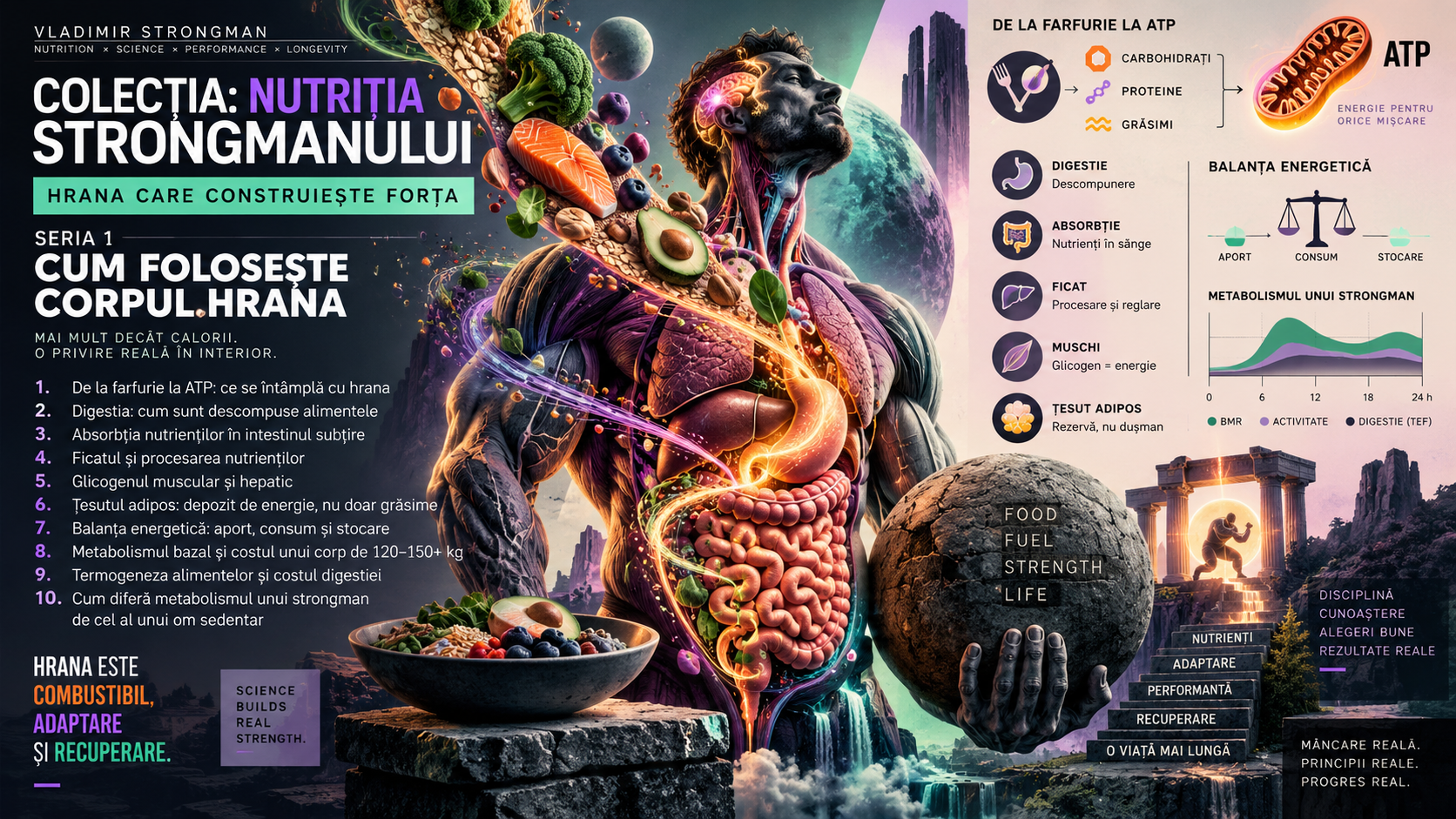
Glycogen is the form in which the body stores part of its available glucose for rapid use. The two major stores, muscle and liver glycogen, share the same chemical structure but serve different purposes: muscle keeps fuel for contraction, while the liver helps maintain blood glucose for the whole body.
For strongman, this distinction matters. A maximal lift lasting a few seconds relies first on ATP and phosphocreatine, but warm-ups, repetitions, medleys, carries and repeated events progressively increase glycolytic contribution and muscle-glycogen use.
This episode follows glycogen synthesis, storage, mobilization and restoration, the roles of insulin, glucagon and adrenaline, the difference between liver and muscle stores, and the way carbohydrate availability can shape performance and recovery during demanding strongman training and competition.
1. Glycogen is the rapid storage form of glucose
Glycogen is a highly branched polymer built from glucose molecules. Its branches allow enzymes to add or release glucose at many sites at once. This makes glycogen well suited to situations in which energy demand rises abruptly.
2. There is no single common glycogen tank
Muscle and liver glycogen are separate stores. Muscle uses its glycogen mainly locally, while the liver mobilizes glycogen to support blood glucose. Treating them as one reservoir creates confusion when discussing fasting, exercise or pre-competition feeding.
3. Glycogenesis builds the stores
After carbohydrate intake, glucose can be converted into glycogen. Glycogen synthase adds glucose units to existing chains and branching enzyme creates the compact structure. Insulin promotes this storage process after meals.
4. Glycogenolysis releases stored fuel
When energy is needed, glycogen phosphorylase releases glucose units as glucose-1-phosphate. These become glucose-6-phosphate, which can enter glycolysis in muscle or be converted into free glucose in the liver.
5. The liver stores glycogen for the organism
Liver glycogen acts as a buffer for blood glucose. After a meal, the liver stores glucose; between meals it can release glucose again. This helps the brain, red blood cells and other tissues receive fuel when intestinal delivery has fallen.
6. Muscle keeps glycogen for contraction
Muscle glycogen is stored directly inside fibers and can rapidly supply glycolysis. It is a local fuel. In strongman this becomes important when the same muscle groups are repeatedly used in yoke, farmers, deadlift, loading or similar events.
7. Total muscle glycogen can exceed liver glycogen
The liver may contain a high concentration of glycogen relative to its own mass, but total skeletal-muscle mass is much larger. Therefore the absolute amount of muscle glycogen can greatly exceed the hepatic store, especially in a muscular athlete.
8. Storage capacity is not fixed
Glycogen levels depend on recent diet, muscle mass, prior activity, training status and insulin sensitivity. Partly depleted muscle can take up and store glucose efficiently after exercise. Textbook values are averages rather than identical capacities for every athlete.
9. Muscle cannot freely export glucose
Skeletal muscle lacks meaningful glucose-6-phosphatase activity, the enzyme required to produce free glucose for export. Muscle glycogen therefore remains primarily local, whereas the liver can release glucose into the circulation.
10. Liver glycogen protects blood glucose between meals
As glucose from the previous meal leaves circulation, the liver increases glycogen breakdown. With longer fasting and lower liver glycogen, gluconeogenesis becomes increasingly important. Both processes work together to stabilize blood glucose.
11. Insulin favors glycogen restoration
After carbohydrate intake, insulin increases muscle glucose uptake through GLUT4 and promotes glycogen-synthase activity. In the liver it also favors storage and suppresses signals that promote glucose production.
12. Glucagon acts mainly on the liver
When blood glucose falls, glucagon stimulates hepatic glycogenolysis and gluconeogenesis. Skeletal muscle does not respond to glucagon in the same way, highlighting the distinct functions of the two glycogen stores.
13. Adrenaline rapidly mobilizes glycogen during effort
Catecholamines rise during intense effort. In muscle, adrenaline accelerates local glycogen breakdown for rapid ATP production. In the liver it also contributes to glucose release into blood, matching fuel availability to increased demand.
14. Muscle contraction activates local glycogenolysis
Rising intracellular calcium and changes in cellular energy status activate pathways that mobilize glycogen. Muscle does not need to wait for a circulating hormone. Fuel can be released at the moment the fiber begins working.
15. Exercise increases glucose uptake through GLUT4
Muscle contraction stimulates GLUT4 translocation independently of insulin. Active muscle can therefore take up more glucose during and after exercise. This mechanism combines with insulin action to facilitate post-exercise glycogen restoration.
16. Training improves insulin sensitivity
After exercise, muscle becomes temporarily more insulin sensitive and glycogen synthase is more active. Regular training also creates longer-term adaptations that improve glucose transport and carbohydrate handling.
17. High intensity increases carbohydrate dependence
As exercise intensity rises, the body increasingly favors fuels that can supply ATP rapidly. Glucose and glycogen have an advantage over fat in this respect. Many strongman events are intense and long enough for glycolysis to become crucial.
18. Phosphocreatine and glycogen work together
The first seconds of maximal effort are dominated by ATP and phosphocreatine, but glycolysis begins almost immediately. As repetitions accumulate or effort continues, glycogen contribution rises. Energy systems operate simultaneously rather than switching on one at a time.
19. Muscle glycogen enters glycolysis quickly
Muscle glycogen supplies glucose-6-phosphate without the first ATP-consuming phosphorylation step required for blood glucose. During intense work, this fast local route helps support accelerated ATP production through glycolysis.
20. Lactate does not mean glycogen was wasted
During intense exercise, pyruvate can be converted to lactate to regenerate NAD+ and allow glycolysis to continue. Lactate can later be oxidized by other tissues or transported to the liver. It is a useful metabolite, not merely waste.
21. Glycogen is not distributed uniformly inside muscle
Different fibers and different regions within a fiber can contain different glycogen concentrations. Fibers recruited heavily during an event may become more depleted than those that were less active. Local fatigue can therefore develop before whole-body stores are exhausted.
22. Depletion is specific to the muscle groups used
A heavy yoke can deplete quadriceps and gluteal glycogen more than arm muscles. Event order therefore matters metabolically. Two consecutive events using the same muscle groups can magnify fatigue even when each event is relatively short.
23. Liver glycogen falls overnight
During an overnight fast, the liver releases glucose to maintain blood sugar. By morning, liver glycogen can be substantially lower than at bedtime, while muscle glycogen remains relatively well preserved if no exercise occurred.
24. Fasting affects liver glycogen faster than muscle glycogen
At rest, periods without food primarily draw on liver glycogen to support blood glucose. Muscle preserves its own stores when inactive. Saying that all glycogen is empty after a night without food is therefore an oversimplification.
25. Breakfast can preferentially restore liver glycogen
Carbohydrates consumed after the overnight fast help restore liver glycogen and stabilize glucose availability. Before competition, the goal is not to overfill the stomach but to provide useful carbohydrate without gastrointestinal discomfort.
26. A multi-event day progressively drains reserves
One event may not dramatically deplete total glycogen, but warm-ups, attempts, walking, stress, heat and repeated events accumulate. Over a long competition day, carbohydrate availability can matter more than the duration of any single event suggests.
27. Yoke and farmers demand more than the stopwatch suggests
Heavy carries may last only tens of seconds, but they involve enormous muscular tension and rapid ATP production. Longer distances, turns and multiple segments increase glycolytic demand and glycogen use.
28. Medleys are highly glycolytic events
Loading medleys, sandbags and carry-loading combinations lasting 30 to 90 seconds strongly challenge glycolysis. In this range, muscle glycogen becomes a central fuel for maintaining speed and force output.
29. A single maximal repetition depends less directly on glycogen
During a single maximal log press or deadlift, glycogen is not the main fuel for the decisive seconds. However, warm-ups, previous attempts and recovery between efforts consume carbohydrate. Very low stores can worsen the context in which the maximal lift is performed.
30. Recovery between events also relies on aerobic metabolism
Between events, phosphocreatine must be restored, lactate redistributed and ionic balance recovered. Aerobic metabolism supports these processes, while carbohydrate availability contributes to efficient recovery and preparation for the next event.
31. Glycogen synthase becomes more active after exercise
Glycogen depletion and muscle contraction increase glycogen-synthase activity and insulin sensitivity. Muscle becomes more receptive to glucose, especially in the first hours after exercise, favoring restoration of depleted stores.
32. The first hours matter when recovery time is short
If another demanding effort is only a few hours away, beginning carbohydrate intake soon after exercise can accelerate glycogen resynthesis. If the next session is the following day, total daily carbohydrate intake becomes more important than exact minute-by-minute timing.
33. Total carbohydrate intake remains central
Complete restoration cannot be achieved with a supplement if the diet provides too little carbohydrate. Total intake should match training volume and frequency. Competition-day needs can differ greatly from rest-day needs.
34. Glycogen resynthesis has a limited rate
Muscle cannot instantly convert a huge carbohydrate dose into glycogen. Glucose transport and enzyme activity impose a restoration rate. When time is short, spreading carbohydrate across repeated feedings can be more effective than one enormous meal.
35. Rapidly digested carbohydrates have a strategic role
Easy-to-digest carbohydrate sources can be useful when recovery must be accelerated. On ordinary days, not every carbohydrate needs to be fast. Context determines whether immediate restoration or a mixed, more satiating meal is the priority.
36. Fructose can efficiently support liver-glycogen restoration
A large share of fructose metabolism occurs in the liver, allowing fructose to contribute effectively to liver-glycogen restoration. This does not justify excessive intake, but mixed carbohydrate sources can distribute substrate between liver and muscle after exercise.
37. Glucose is effective for muscle-glycogen restoration
Absorbed glucose can be taken up by muscle, especially when contraction and insulin increase GLUT4 activity. After exercise, depleted muscle has a strong metabolic priority for replenishing its own glycogen stores.
38. Glucose and fructose can restore two compartments together
Glucose-fructose combinations can support both muscle and liver glycogen restoration and use different intestinal transport systems. This is most relevant after prolonged exercise or when another session follows within a short time.
39. Carbohydrates can be periodized around training
Hard training days may justify placing more carbohydrate before and after exercise, while rest days may require less. Periodization means matching intake to actual glycogen demand rather than imposing permanent restriction.
40. Protein does not replace carbohydrate for rapid restoration
Amino acids can contribute to gluconeogenesis, but protein is not equivalent to carbohydrate for rapid glycogen resynthesis. Protein has its own essential roles in repair and remodeling. The two macronutrients should be treated as complementary rather than competing fuels.
41. Fat cannot replace glycogen's speed
Fat oxidation yields large amounts of energy but at a slower rate. During very intense repeated effort, the speed of ATP resynthesis matters. Strong fat-oxidation capacity is useful, but it does not remove the need for glycogen in highly glycolytic events.
42. Glycogen is stored together with water
As glycogen stores rise, associated tissue water also increases. Reintroducing carbohydrate after a low-carbohydrate period can therefore raise scale weight quickly without an equivalent gain in body fat. Rapid weight fluctuations often reflect glycogen and water.
43. Scale weight can reflect glycogen depletion and restoration
Several low-carbohydrate days can rapidly reduce body weight through lower glycogen and its associated water. Refeeding carbohydrate can restore those kilograms just as quickly. In weight-class sports this can be manipulated, but aggressive strategies may compromise hydration and performance.
44. Carbohydrate loading is not only for endurance athletes
Entering competition with good glycogen availability is relevant to strongman as well. Extreme depletion-and-loading protocols are usually unnecessary. Avoiding carbohydrate deficit and maintaining adequate intake in the preceding days is often enough.
45. Strongman is not only a phosphocreatine sport
Strongman includes 30- to 90-second events, warm-ups, repeated attempts, loaded running and hours of activity. Glycogen therefore matters even though the athlete is not covering endurance distances. Competition metabolism is more complex than a single lift.
46. Very low-carbohydrate diets can limit repeated intensity
The body can partly adapt to low carbohydrate by increasing fat oxidation. Yet when exercise requires a high glycolytic flux, limited glycogen availability can reduce the ability to repeat maximal or near-maximal intensity.
47. Ketosis does not make glycogen irrelevant
During ketosis the body uses more fat and ketone bodies, but muscle still relies on glycolysis at sufficiently high intensities. Being able to function on less carbohydrate does not automatically mean optimal performance across all strongman events.
48. Supercompensation means storing above baseline
After depletion followed by high carbohydrate intake, muscle can temporarily store glycogen above its usual baseline. The phenomenon is well established in endurance research. In strongman, its usefulness depends on the actual volume of competition and does not automatically justify extreme protocols.
49. Inactivity changes glucose handling
During injury or reduced training, energy demand falls and insulin sensitivity can decline. A carbohydrate intake suited to high-volume training may become excessive. Nutrition should follow actual activity rather than athletic identity alone.
50. Training improves storage and utilization capacity
Repeated training produces adaptations in glucose transport, glycolytic enzymes and glycogen storage. A well-trained athlete can handle carbohydrate differently from a sedentary person, which is why recommendations must be tied to training context.
51. Creatine and glycogen support complementary systems
Creatine increases phosphocreatine availability, while glycogen fuels glycolysis. Repetition events and medleys draw on both systems. Good phosphocreatine stores do not eliminate carbohydrate needs, and glycogen does not replace creatine's role.
52. Feeling tired does not directly measure glycogen
Fatigue can come from neural factors, muscle damage, heat, dehydration, poor sleep or pain. An athlete may have adequate glycogen and still feel exhausted. Symptoms are useful context, but they are not a direct glycogen measurement.
53. Low glycogen can increase perceived effort
When carbohydrate availability falls, maintaining intensity can become harder and perceived exertion may rise. In competition this can appear as slower movement, fewer repetitions or poorer recovery between events.
54. Glycogen can be measured, but not easily in daily practice
Research can assess muscle glycogen through biopsy, magnetic-resonance spectroscopy and other methods. Everyday athletes instead estimate adequacy from recent diet, training load, body weight, performance and recovery.
55. Glycogen is also a metabolic signal
Glycogen status can influence signaling pathways involved in training adaptation. A severely depleted muscle responds differently from a well-fueled one. Training-low strategies are therefore contextual tools, not a universal ideal for strength performance.
56. Depletion activates energy-conservation signals
When cellular energy falls, pathways such as AMPK become more active and favor ATP-producing processes. This response supports adaptation, but it is not necessarily the ideal environment for every session aimed at maximal force and high-quality training volume.
57. Full glycogen stores do not justify permanent overfeeding
Glycogen storage capacity is limited. Chronic energy surplus cannot be explained by endlessly filling glycogen. When intake consistently exceeds expenditure, fat storage rises and metabolic changes can develop in the liver.
58. Insulin resistance changes carbohydrate handling
When insulin sensitivity is reduced, glucose uptake and storage become less efficient and the liver may continue producing glucose when it should not. Physical activity, body composition, diet and sleep all influence this system.
59. Practical strategy starts with actual demand
Optimal carbohydrate intake depends on body mass, training volume, event duration, session frequency and weight goals. There is no magic daily number. Requirements can vary greatly between an easy day and one filled with repeated maximal efforts.
60. Conclusion: the liver protects blood glucose, muscle protects its work
Liver and muscle glycogen are two stores of the same molecule with different missions. The liver stabilizes glucose availability for the body, while muscle keeps fuel for contraction. Strongman performance benefits when both compartments are fueled intelligently according to real demand.
The first key idea is the separation of the two stores: muscle glycogen is primarily local, while liver glycogen helps maintain blood glucose for the entire organism.
The second is that high intensity raises carbohydrate importance. Even though maximal effort begins with ATP and phosphocreatine, repetitions and medleys quickly increase glycolytic contribution.
The third is that recovery depends less on a magical minute and more on the time until the next effort plus total carbohydrate intake. Shorter recovery windows make prompt repeated carbohydrate feeding more relevant.
The fourth is that rapid body-weight changes after altering carbohydrate intake often reflect glycogen and water rather than large changes in body fat.
Finally, carbohydrate intake should match energetic demand: enough to support intensity and recovery without turning performance nutrition into permanent overfeeding.
Sources and recommended reading
1. Hall JE. Guyton and Hall Textbook of Medical Physiology. Carbohydrate metabolism, insulin, glucagon and blood-glucose regulation.
2. Nelson DL, Cox MM. Lehninger Principles of Biochemistry. Glycogenesis, glycogenolysis, glycolysis and metabolic control.
3. Berg JM, Tymoczko JL, Gatto GJ, Stryer L. Biochemistry. Glycogen metabolism and hormonal regulation.
4. Hargreaves M, Spriet LL. Exercise-physiology literature on carbohydrate metabolism and muscle glycogen.
5. Burke LM and colleagues. Sports-nutrition literature on carbohydrate availability and glycogen restoration.
6. Jeukendrup AE, Gleeson M. Sport Nutrition. Carbohydrate, glycogen and fueling during exercise.
7. Thomas DT, Erdman KA, Burke LM. Nutrition and Athletic Performance. Academy of Nutrition and Dietetics, Dietitians of Canada and ACSM.
8. Literature on GLUT4, insulin sensitivity and post-exercise glycogen resynthesis.
9. Literature on intramuscular glycogen compartmentalization, fiber types and the relationship between depletion and fatigue.
10. Literature on liver glycogen, overnight fasting, fructose metabolism and glycogen restoration.
Editorial note: this article is educational. Diabetes, recurrent hypoglycemia, insulin resistance and other metabolic disorders require individualized medical evaluation. Performance carbohydrate strategies do not replace diagnosis or treatment.
More From The Journal

Training
The Science of Strongman Training - Episode X: Competition Programming
How to build a complete Strongman competition preparation block: calendar, events, volume, intensity, specificity, simulations, autoregulation, tapering and fatigue management.

Training
The Science of Strongman Training - Episode IX: Peaking
Peaking in Strongman: how to turn months of training into maximal competition performance by reducing fatigue, preserving adaptations and managing specificity.