Nutrition
Series: Strongman Nutrition: Food That Builds Strength - Episode 3: Nutrient Absorption in the Small Intestine
September 9, 2026
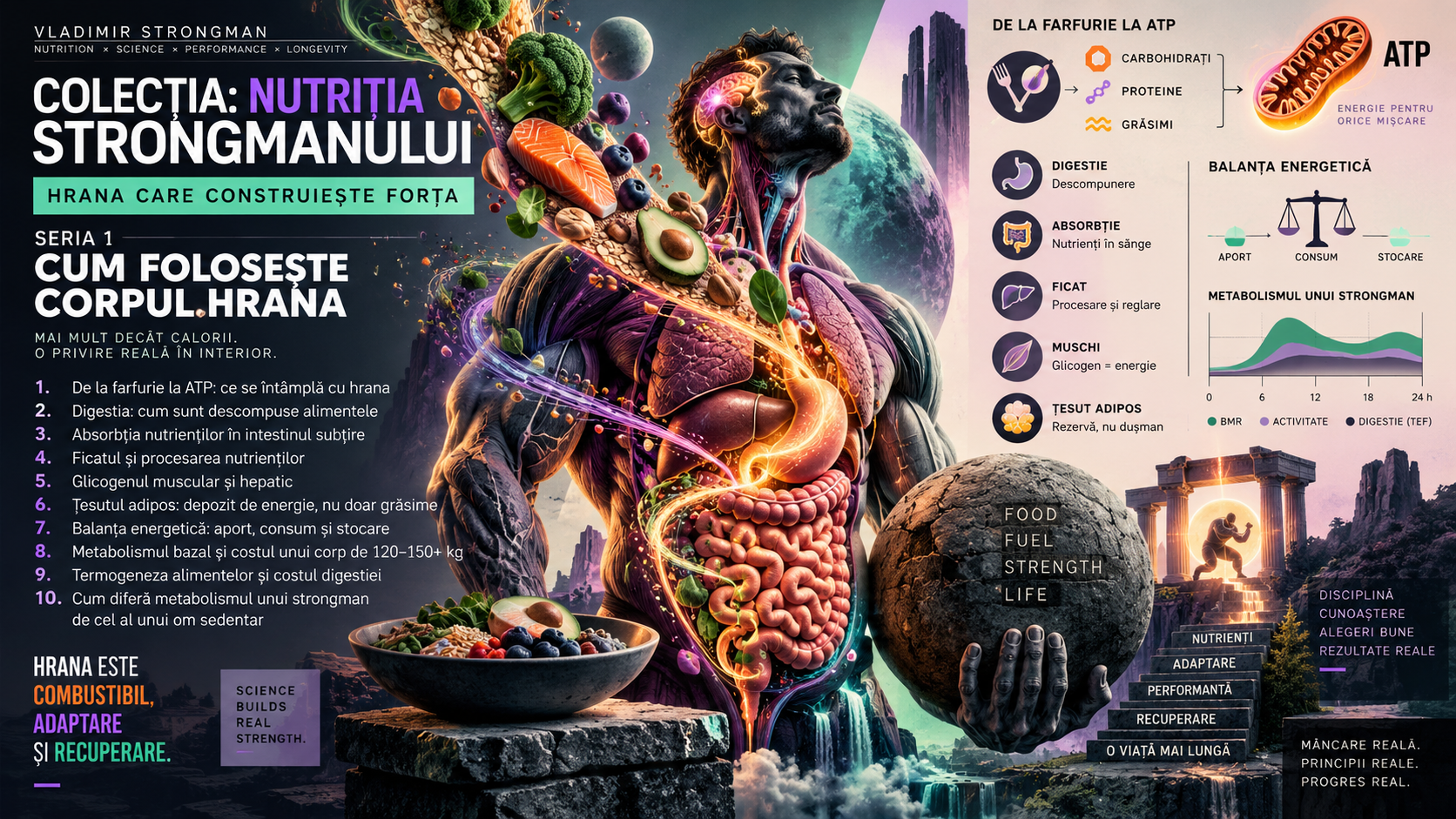
Digestion is not enough. Starch may be broken into glucose, proteins into amino acids and fats into fatty acids, but those products cannot support muscle while they remain inside the digestive tract. To truly become part of the body's internal environment, they must cross the intestinal epithelium and enter blood or lymph.
The small intestine is built precisely for this task. Folds, villi and microvilli multiply surface area, while enterocytes use different transporters, channels, pumps and packaging systems for each nutrient class. Glucose does not cross in the same way as fat, and iron is not absorbed like vitamin B12.
For a strongman, absorption is the bridge between a diet calculated on paper and the actual availability of energy and building material. This episode follows that microscopic passage from the intestinal lumen to portal blood, lymph, the liver and finally the tissues that must be fueled.
1. Absorption begins where digestion ends
Digestion converts large molecules into units small enough for intestinal uptake. Absorption is the next step: movement of those molecules across the intestinal epithelium into the internal environment. The processes are tightly linked but not identical. A nutrient may be digested normally yet absorbed poorly if the mucosa or transport systems are impaired.
2. Duodenum, jejunum and ileum share the work
The small intestine has three main segments. The duodenum receives gastric chyme, bile and pancreatic secretions and is important for several minerals. The jejunum handles a large share of carbohydrate, amino-acid, lipid and vitamin absorption, while the ileum recovers vitamin B12 and bile salts and continues absorbing water and electrolytes.
3. Circular folds increase usable surface
The intestinal wall is not a smooth pipe. Circular folds slow and redirect contents while increasing contact with the mucosa. This architecture allows a relatively compact organ to process large nutrient loads after meals.
4. Villi are absorptive units
Villi are finger-like projections extending from the intestinal mucosa. Each contains blood capillaries and a central lymphatic vessel called a lacteal. This design allows absorbed nutrients to be collected immediately and transported onward through either portal blood or lymph.
5. Microvilli take surface area to the microscopic scale
The apical surface of each enterocyte is covered in microvilli, creating the brush border. Final digestive enzymes and many transporters are located here. The intestine therefore multiplies absorptive area several times over, allowing high efficiency without requiring an impossibly long organ.
6. The enterocyte is the main gateway
Enterocytes are the dominant absorptive cells of the intestinal epithelium. One side faces the lumen and the other faces interstitial fluid and blood. Transporters are distributed differently across these membranes, allowing directional nutrient movement from the gut into the body.
7. Tight junctions control passage between cells
Enterocytes are linked by junctions that limit uncontrolled movement between cells. Some ions and small molecules can use paracellular routes to a degree, but permeability is regulated. Epithelial integrity matters for absorption and for maintaining the barrier between intestinal contents and the internal environment.
8. The water layer at the mucosal surface matters
A thin fluid layer lies near the intestinal membrane and molecules must diffuse through it before reaching transporters. Water-soluble nutrients do this relatively easily, while lipids rely on micelles to move efficiently through this aqueous environment.
9. Blood and lymph are the two main highways
Carbohydrates, amino acids, many vitamins, minerals and water enter blood capillaries and travel through the portal vein to the liver. Most long-chain dietary fats are packaged into chylomicrons and enter lymph first. The route depends on chemical properties and particle size.
10. The portal vein takes nutrients directly to the liver
Blood leaving the intestine does not flow immediately into general circulation. It travels first through the portal vein to the liver. This first pass allows the liver to take up glucose, amino acids and micronutrients, store or transform them and regulate what the rest of the body receives.
11. The sodium-potassium pump powers many transport systems
On the basolateral membrane, the sodium-potassium pump uses ATP to keep intracellular sodium low. That gradient becomes an indirect energy source for moving glucose, galactose and several amino acids from the lumen. Nutrient absorption is therefore literally tied to cellular energy metabolism.
12. SGLT1 brings glucose in with sodium
SGLT1 uses the sodium gradient to move glucose and galactose into enterocytes. Glucose does not simply diffuse across this membrane; it travels together with sodium. This mechanism explains why glucose-sodium combinations are so effective in oral rehydration solutions.
13. Glucose and galactose share the same apical gate
After starch and lactose digestion, glucose and galactose mainly use SGLT1 for luminal uptake. Its capacity is high but finite. At very large carbohydrate intakes, transporter saturation can affect how well rapid fueling is tolerated.
14. Fructose mainly uses GLUT5
Fructose has a different apical route based mainly on GLUT5. Absorptive capacity varies between individuals and can be exceeded by large isolated doses. This separation is useful in sport because glucose-fructose combinations can increase total carbohydrate delivery.
15. GLUT2 moves monosaccharides toward blood
Once inside the enterocyte, glucose, galactose and fructose must leave through the opposite membrane. GLUT2 plays an important role in transfer toward interstitial fluid and blood capillaries. From there the sugars enter portal circulation and reach the liver rapidly.
16. Different carbohydrate transporters can increase total absorption
When glucose and fructose are consumed together, they can use different entry pathways and reduce dependence on a single transporter. This concept underlies multiple-transportable carbohydrate strategies in endurance nutrition. For strongman, it is most relevant during long competition days and between events rather than at every ordinary meal.
17. Water largely follows osmotic gradients
Absorption of sodium, glucose and other solutes alters local osmolarity and promotes water movement from the lumen into the body. Water moves through and between cells. Fluid absorption is therefore linked to electrolyte and nutrient transport rather than being a completely separate process.
18. Sodium is an ally of hydration
Sodium is absorbed through several mechanisms, including cotransport with glucose and amino acids. Water follows osmotically, which helps explain why a properly formulated drink containing sodium and carbohydrate can be absorbed efficiently. For heavy sweaters, this physiology matters far more than the simplistic idea that salt merely retains water.
19. Amino acids use multiple transporter families
There is no single gate for all amino acids. Transporters differ according to electrical charge and molecular structure, and several depend on sodium gradients. This diversity allows efficient absorption of the complex amino-acid mixture produced from a protein-containing meal.
20. Dipeptides and tripeptides use PepT1
A meaningful portion of protein digestion products enter not as free amino acids but as dipeptides and tripeptides. PepT1 uses a proton gradient to transport them into enterocytes. The system has high capacity and contributes to rapid protein absorption.
21. Peptides are broken down inside the enterocyte
After dipeptides and tripeptides enter through PepT1, intracellular peptidases hydrolyze most of them into individual amino acids. These are then moved across the basolateral membrane into blood. Small peptides are therefore efficient transport forms rather than the major final form circulating through the body.
22. Amino acids enter portal circulation
After crossing enterocytes, amino acids enter villus capillaries and travel through the portal vein to the liver. The liver uses part of the incoming supply immediately while the rest reaches systemic circulation. Muscle therefore receives amino acids after a first metabolic pass through the liver.
23. The liver decides what to do with the first amino-acid wave
The liver can use amino acids for plasma proteins, enzymes, metabolic precursors or energy and converts excess nitrogen mainly into urea. Branched-chain amino acids are metabolized to a greater degree in peripheral tissues including muscle. Absorption is only the beginning of nutrient distribution.
24. Fat reaches the membrane through micelles
Long-chain fatty acids, monoglycerides, cholesterol and fat-soluble vitamins are brought close to the enterocyte membrane in micelles formed with bile salts. Micelles do not enter the cell intact. They serve as vehicles that carry lipids through the watery layer to the absorptive surface.
25. Fatty acids and monoglycerides enter enterocytes
Lipid components leave the micelle and cross the enterocyte membrane through diffusion and transport proteins. Once inside, long-chain fats are not simply dumped into blood. They undergo an important rebuilding step first.
26. Enterocytes rebuild triglycerides
Fatty acids and monoglycerides are re-esterified in the enterocyte and form triglycerides again. Digestion dismantled them so they could move through the lumen and membrane, and the cell then rebuilds them for transport. It is a clear example of breakdown followed by immediate reassembly.
27. Chylomicrons package dietary fat
Reassembled triglycerides are combined with cholesterol, phospholipids and apolipoproteins to form chylomicrons. These particles have a hydrophobic core and a surface compatible with body fluids, allowing large quantities of lipid to be transported through an aqueous environment.
28. Lacteals take up chylomicrons
Blood capillaries in villi cannot efficiently accept particles as large as chylomicrons. These particles therefore enter the central lymphatic vessels of villi, called lacteals. Lymph eventually carries them into venous circulation, initially bypassing the liver.
29. Dietary fat does not reach the liver immediately
Unlike glucose and amino acids, chylomicrons enter systemic circulation through lymph before their remnants are later taken up by the liver. In circulation, lipoprotein lipase releases fatty acids toward muscle and adipose tissue. This route helps explain why lipid absorption is slower and more logistically complex.
30. Short- and medium-chain fatty acids can take a more direct route
Shorter fatty acids are more water-soluble and do not always require extensive chylomicron packaging. They can reach portal blood more directly, often bound to albumin. Carbon-chain length therefore changes both absorption and metabolism.
31. Vitamins A, D, E and K travel with fat
Fat-soluble vitamins enter micelles and are absorbed together with lipid digestion products. They can then be incorporated into chylomicrons. Disorders of bile secretion or pancreatic fat digestion can therefore affect vitamin A, D, E and K status as well.
32. Water-soluble vitamins use their own transporters
B vitamins and vitamin C are absorbed through specific systems, many of which are transporter-dependent and concentration-sensitive. They generally enter portal circulation. Being water-soluble does not mean unlimited absorption; several of these pathways can saturate.
33. Vitamin B12 follows one of the most complex routes
Vitamin B12 must be released from food proteins, bind temporary carrier proteins and then attach to intrinsic factor produced by the stomach. The B12-intrinsic-factor complex is recognized by specific receptors in the ileum. Gastric or ileal disease can therefore reduce absorption even when dietary B12 is adequate.
34. Folate is absorbed mainly in the proximal intestine
Dietary folates are processed into absorbable forms and taken up particularly in the duodenum and proximal jejunum through dedicated transport systems. Deficiency can result from low intake, increased needs or intestinal disease. Its role in DNA synthesis and blood-cell production makes it important for athletes, but not a direct ergogenic agent.
35. Iron is absorbed mainly in the duodenum
Heme and non-heme iron use different mechanisms. Non-heme iron often needs to be reduced to a more transportable form, and absorption is tightly regulated according to body stores. Hepcidin controls iron export from enterocytes through ferroportin and can reduce absorption when stores or inflammation are high.
36. Vitamin C can enhance non-heme iron absorption
Vitamin C helps keep non-heme iron in a chemical form that is more favorable for absorption and can form soluble complexes with it. The effect matters especially in plant-based meals. Iron absorption, however, still depends strongly on body status rather than on a single food combination.
37. Calcium uses active and passive routes
Calcium can be absorbed actively, especially in the duodenum through vitamin-D-regulated mechanisms, and passively through paracellular pathways when luminal concentrations are higher. Efficiency varies with need, vitamin D status, age and diet composition.
38. Magnesium is absorbed along the intestine
Magnesium uses both paracellular pathways and specific transporters, with a substantial share absorbed in the small intestine. Very large supplement doses that remain unabsorbed can draw water into the lumen and cause a laxative effect, illustrating the practical difference between dose swallowed and dose absorbed.
39. Zinc uses regulated transport systems
Zinc enters enterocytes through specialized transporters and is then exported toward blood. The body can adapt absorption according to intake and need. Phytates in some plant foods can bind zinc and reduce bioavailability.
40. Potassium and chloride complete electrolyte transport
Potassium is absorbed efficiently, largely through passive mechanisms, while chloride moves through electrical gradients and exchanges with other ions. Together with sodium they support osmotic balance and fluid volume. Intestinal absorption is the first stage before the kidneys take over fine regulation.
41. Bile salts are recovered in the ileum
After helping form micelles, most bile salts are actively reabsorbed in the terminal ileum. They are not discarded after every meal but returned to the liver. This recycling system conserves resources and keeps fat digestion efficient.
42. Enterohepatic circulation reuses bile
Reabsorbed bile salts travel through portal blood to the liver, are captured and secreted into bile again. They can complete this circuit several times in a day. Ileal disease or resection can disrupt the system and impair fat absorption.
43. The small intestine absorbs enormous amounts of water
The digestive tract receives not only the fluids we drink but also liters of saliva, gastric juice, pancreatic secretions and bile each day. Most of that water is recovered in the small intestine. If absorption is overwhelmed or secretion becomes excessive, too much fluid reaches the colon and diarrhea develops.
44. Meal osmolarity can change water movement
A solution extremely concentrated in sugars or other particles can temporarily draw water into the intestinal lumen. If transport systems cannot clear the solutes rapidly enough, fullness, cramping or loose stools may follow. More concentrated does not automatically mean more rapidly absorbed.
45. Fiber can slow or modify absorption
Soluble fiber can increase intestinal viscosity and slow access of some nutrients to the enterocyte surface. Certain fibers can also bind minerals under some conditions. These effects do not make fiber harmful; they explain why a high-fiber meal behaves differently from a glucose drink.
46. Phytates and oxalates can reduce mineral bioavailability
Phytates can bind iron, zinc and other minerals, while oxalates can reduce calcium availability from certain foods. Soaking, fermenting and cooking can alter these compounds. In a varied diet the effect is usually manageable, but it becomes more relevant when eating patterns are extremely repetitive.
47. The food matrix changes what becomes available
Nutrients are not isolated inside foods. They are embedded in starch structures, proteins, fiber, membranes and plant cells. Two foods containing the same theoretical amount of a nutrient can have different bioavailability. Processing and chewing alter the matrix and change enzyme and transporter access.
48. Cooking can increase nutrient accessibility
Heat gelatinizes starch, denatures proteins and softens plant cell walls, often making nutrients easier to digest and absorb. Some heat-sensitive vitamins may be partially lost, however. There is no single cooking method that optimizes every nutrient at once.
49. Gastric emptying controls how quickly the intestine receives nutrients
Absorption can only be rapid if nutrients reach the intestine. A large meal rich in fat and fiber empties more slowly from the stomach and spreads absorption over a longer period. A carbohydrate drink may reach the duodenum faster. Absorption speed is therefore also shaped by what happens upstream.
50. Intense exercise can temporarily reduce intestinal blood flow
During very intense exercise, blood flow is prioritized toward working muscle, the heart and temperature regulation. Splanchnic flow can fall and gastrointestinal comfort may worsen. This is one reason very large meals immediately before maximal effort can become problematic.
51. Heat and dehydration place extra pressure on the intestine
When plasma volume falls and more blood is sent to the skin for cooling, intestinal perfusion may be reduced further. Under extreme conditions, barrier function and gastrointestinal tolerance can suffer. Adequate hydration therefore supports not only muscle function but also absorption during competition.
52. Transporters can saturate
Many absorptive mechanisms have a maximum capacity. If more substrate appears in the lumen than can be transported over a given period, some remains temporarily unabsorbed and may draw in water or be fermented. A very large dose taken at once therefore does not guarantee proportionally greater absorption.
53. There is no absorption window that suddenly shuts
The intestine continues digesting and absorbing a meal for hours. Nutrients do not become useless because they were not consumed within a few minutes after training. Timing can matter for recovery and comfort, but absorption is continuous rather than a door that closes at a fixed hour.
54. A large protein meal is not simply wasted
The intestine can absorb substantial amounts of amino acids from a large meal. What changes is their later use: muscle protein synthesis has a dose-response ceiling at a given time, while additional amino acids can be used by other tissues, oxidized or converted. The limit of muscle protein synthesis is not the same as the limit of intestinal absorption.
55. For a strongman, food volume may become the practical limit
A very large athlete may consume impressive amounts of food. A healthy intestine has high absorptive capacity, but comfort, gastric emptying, osmolarity and meal frequency can become the practical limits. An effective diet is not only one with enough calories but one that can be processed day after day without major symptoms.
56. Malabsorption has warning signs
Unexplained weight loss, persistent diarrhea, greasy stools, anemia, repeated vitamin or mineral deficiencies and severe bloating can suggest impaired digestion or absorption. In a high-intake athlete these signs may be masked for a time, but they should not be normalized as an inevitable part of eating for size.
57. Celiac disease can reduce absorptive surface
In untreated celiac disease, the immune response to gluten can damage intestinal villi and reduce functional absorptive area. Iron, folate and other nutrient deficiencies may occur even when intake appears adequate. Diagnosis requires medical evaluation rather than empirical gluten elimination alone.
58. The pancreas and bile indirectly determine absorption
The intestine cannot efficiently absorb what has not been prepared for absorption. Pancreatic insufficiency can leave macronutrients incompletely digested, while inadequate bile impairs micelle formation and fat absorption. A problem that looks like malabsorption can therefore begin in an upstream organ.
59. The intestine can adapt partly to repeated intake
Repeated exposure to planned carbohydrate intake during training can improve gastrointestinal tolerance and the ability to handle fueling, sometimes called gut training. Adaptation is not unlimited, but it explains why competition nutrition should be practiced rather than attempted for the first time on event morning.
60. Conclusion: nutrients become useful only after crossing the intestinal barrier
The small intestine is where nutritional theory becomes biological reality. Glucose enters through transporters, amino acids and peptides use dedicated systems, fats are packaged into chylomicrons and vitamins and minerals follow specialized routes. For strongman, efficient absorption turns food into fuel and building material that can actually support performance and recovery.
The first key idea is that the small intestine is not a passive tube. Villi and microvilli create enormous surface area, while enterocytes use specialized pumps and transporters to control what enters the body.
The second is that nutrients use different routes. Glucose and amino acids travel mainly through portal blood to the liver, while most long-chain fats enter lymph first as chylomicrons.
The third is that absorption has limits and regulatory systems. Transporters can saturate, osmolarity alters water movement, and minerals such as iron and calcium are absorbed according to body needs and hormonal signals.
The fourth is that intake and absorption are not the same thing. Pancreatic digestion, bile, villus integrity, meal composition and intestinal disease can all change how much of what is eaten becomes biologically available.
Finally, a strongman needs more than a high-calorie, high-protein plan. The gastrointestinal system must be able to convert that plan into absorbed nutrients. Performance is also built at the microscopic level, across a barrier only a few cells thick.
Sources and recommended reading
1. Hall JE. Guyton and Hall Textbook of Medical Physiology. Sections on intestinal absorption, water and electrolyte transport, and gastrointestinal physiology.
2. Boron WF, Boulpaep EL. Medical Physiology. Chapters on intestinal epithelium, transmembrane transport and gastrointestinal circulation.
3. Nelson DL, Cox MM. Lehninger Principles of Biochemistry. Membrane transport and carbohydrate, amino-acid and lipid metabolism.
4. Ferraris RP, Diamond J. Physiology literature on regulation of intestinal carbohydrate transporters and absorptive adaptation.
5. Jeukendrup AE. Sports-nutrition literature on intestinal transporters, multiple-transportable carbohydrates and fueling during exercise.
6. Thomas DT, Erdman KA, Burke LM. Nutrition and Athletic Performance. Academy of Nutrition and Dietetics, Dietitians of Canada and ACSM.
7. Gastroenterology literature on absorption of iron, calcium, vitamin B12 and fat-soluble vitamins.
8. Literature on PepT1 and intestinal transport of dipeptides, tripeptides and amino acids.
9. Literature on chylomicron formation, lymphatic lipid transport and enterohepatic circulation of bile salts.
10. Clinical literature on malabsorption, celiac disease, pancreatic insufficiency and micronutrient absorption disorders.
Editorial note: this article is educational. Unexplained weight loss, persistent diarrhea, greasy stools, anemia, recurrent micronutrient deficiencies or persistent abdominal pain require medical assessment and should not be managed only by increasing food intake or using empirical supplements.
More From The Journal

Training
The Science of Strongman Training - Episode X: Competition Programming
How to build a complete Strongman competition preparation block: calendar, events, volume, intensity, specificity, simulations, autoregulation, tapering and fatigue management.
Training
The Science of Strongman Training - Episode IX: Peaking
Peaking in Strongman: how to turn months of training into maximal competition performance by reducing fatigue, preserving adaptations and managing specificity.