Nutrition
Series: Strongman Nutrition: Food That Builds Strength - Episode 2: Digestion and How Food Is Broken Down
September 9, 2026
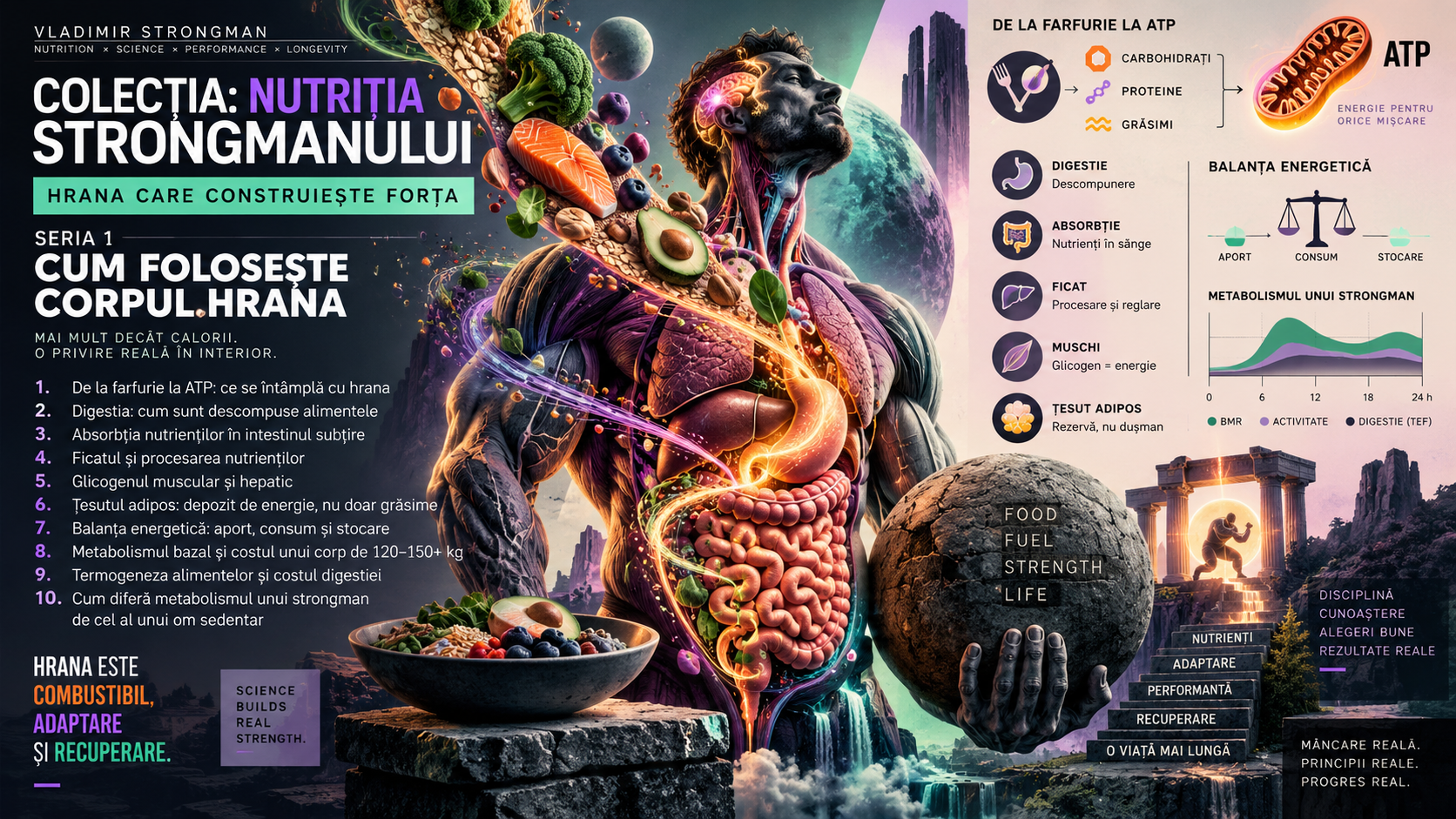
A strongman may eat a lot, but what enters the plate is not automatically what reaches muscle. Between the two stands a digestive system that must fragment, acidify, emulsify and chemically break food down until the resulting molecules are small enough to cross the intestinal wall.
Digestion combines mechanics, chemistry, nerves, hormones and microbes. Protein, carbohydrate and fat do not follow exactly the same route, and processing speed depends on meal composition, volume, fiber, fluids, stress, exercise and individual biology.
For a strength athlete, this physiology becomes highly practical. A diet can look perfect on paper and still fail if it creates bloating, reflux, nausea, excessive fullness or slow gastric emptying. This episode follows exactly how food is dismantled, step by step.
1. Digestion turns food into absorbable molecules
Foods contain structures too large to cross the intestinal epithelium directly. Proteins must be reduced to amino acids and small peptides, starch to monosaccharides, and triglycerides to fatty acids and monoglycerides. Digestion is the process that converts complex food structures into forms the body can absorb and use.
2. The cephalic phase begins before the first bite
Smell, sight, anticipated taste and even the routine of eating can activate the vagus nerve and increase salivation, gastric secretion and pancreatic preparation. The body starts preparing digestion before food reaches the stomach. Intense stress can alter this response, which helps explain why the same meal may feel different on a calm day and on competition day.
3. Teeth are the first digestive tools
Chewing cuts and crushes food, increasing the surface area available to enzymes. Large bites swallowed quickly do not receive the same mechanical processing as thoroughly chewed food. In athletes who need very high calorie intakes, eating too fast can promote swallowed air, discomfort and a feeling of gastric overload.
4. Saliva moistens, lubricates and begins chemistry
Saliva contains water, electrolytes, mucus and enzymes. It turns chewed food into a bolus that can be swallowed and begins starch digestion through salivary amylase. Lingual lipase also contributes, although fat digestion becomes much more important later. Saliva additionally protects the oral lining and supports oral health.
5. Salivary amylase attacks starch bonds
Starch consists of long chains of glucose. Salivary amylase starts cleaving specific bonds between those units, creating smaller molecules. Its activity is limited because gastric acidity progressively inactivates it, but it is still the first meaningful chemical step in digesting rice, bread, pasta, potatoes or oats.
6. Swallowing is a precisely coordinated reflex
During swallowing, the airway must be protected while the food bolus is directed into the esophagus. The process combines voluntary control with automatic reflexes. Once the oral phase ends, transport toward the stomach is driven mostly by coordinated peristaltic contractions.
7. The esophagus moves food through peristalsis
Waves of esophageal muscle contraction push the bolus toward the stomach. The lower esophageal sphincter relaxes to allow passage and should then close. When this barrier functions poorly, acidic gastric contents can move upward and cause reflux, a problem often worsened by very large meals and lying down soon after eating.
8. The stomach is a reservoir, mixer and chemical reactor
The stomach receives substantial amounts of food, stores them temporarily and mixes them through muscular contractions. At the same time it secretes acid, enzymes and protective mucus. The result is a semiliquid mixture called chyme, released gradually into the duodenum. The stomach therefore controls how quickly a meal reaches the small intestine.
9. Gastric acid changes the environment decisively
Parietal cells secrete hydrochloric acid, lowering gastric pH. Acid denatures proteins, activates pepsinogen into pepsin and contributes to defense against some ingested microbes. It does not burn food into energy; it creates chemical conditions that make later digestion possible.
10. Proteins are denatured before they are cut
Food proteins are amino-acid chains folded into complex three-dimensional shapes. The acidic environment disrupts forces that maintain those shapes and exposes the polypeptide chain. Denaturation does not destroy the amino acids; it makes the protein more accessible to proteolytic enzymes.
11. Pepsin begins cutting protein
Pepsin works in the acidic stomach and fragments proteins into shorter peptides. It does not complete digestion into individual amino acids. This stage is an initial processing step that prepares proteins for the much larger set of proteases released into the small intestine.
12. The stomach protects its own wall
Acid and pepsin could damage gastric tissue without protective mechanisms. Mucus, local bicarbonate, blood flow and epithelial integrity maintain the barrier. When that protection is compromised by certain medications, infections or other factors, gastritis and ulcers may develop.
13. Intrinsic factor prepares vitamin B12 absorption
Parietal cells also produce intrinsic factor, a protein required for efficient vitamin B12 absorption later in the ileum. This shows that stomach function extends beyond macronutrients. Gastric disorders can also affect micronutrients important for red blood cell formation and neurological function.
14. Fat usually slows gastric emptying
A substantial amount of fat entering the duodenum triggers neural and hormonal signals that slow gastric emptying. This is useful because the intestine receives nutrients at a manageable rate. Before an event, however, a very fatty meal may leave an athlete feeling full when mobility and comfort matter most.
15. Fiber changes volume and digestive speed
Soluble fibers can form gels and slow movement of some nutrients, while insoluble fiber increases stool bulk and may accelerate colonic transit. Effects depend on type and dose. A high-fiber diet can support health, but a large dose immediately before training may create fullness and discomfort.
16. Liquids and solids leave the stomach differently
Isotonic liquids or drinks with moderate energy density may leave the stomach relatively quickly, while solid particles must be reduced sufficiently before passing through the pylorus. This is one reason carbohydrate drinks can provide fuel more rapidly than a large solid meal between competition events.
17. The duodenum receives chyme, bile and pancreatic juice together
The first section of the small intestine is a major digestive junction. Acidic chyme arrives from the stomach while the pancreas delivers bicarbonate and enzymes and the biliary system delivers bile salts. Acidity is neutralized and digestion of carbohydrate, protein and fat becomes highly active.
18. Pancreatic bicarbonate neutralizes acid
Pancreatic enzymes do not work optimally in the strongly acidic conditions of the stomach. Bicarbonate raises the pH of chyme as it enters the duodenum, protecting the intestinal lining and creating conditions favorable to enzyme activity.
19. Secretin responds to duodenal acidity
When acidic chyme reaches the duodenum, intestinal cells release secretin. This hormone stimulates bicarbonate-rich pancreatic and biliary secretions and helps regulate the intestinal environment. The intestine is therefore actively sensing the meal and instructing digestive organs how to respond.
20. CCK coordinates fat and protein digestion
Cholecystokinin, or CCK, is released especially in response to fat and protein. It stimulates gallbladder contraction and pancreatic enzyme secretion and can slow gastric emptying. This helps match digestive processing speed to meal complexity.
21. The pancreas delivers a battery of enzymes
Pancreatic juice contains amylase for carbohydrate, lipase and related enzymes for fat, and protease precursors for protein. These enzymes are released in a controlled fashion. Proteases in particular are secreted first as inactive precursors to reduce the risk of the pancreas digesting itself.
22. Trypsin activates other proteases
Pancreatic trypsinogen is activated in the intestine to trypsin, which then activates other enzyme precursors such as chymotrypsinogen and procarboxypeptidases. The result is a powerful proteolytic cascade capable of reducing peptides to progressively smaller units.
23. Pancreatic proteases cut at different sites
Trypsin, chymotrypsin and elastase recognize different bonds and positions within protein chains. Carboxypeptidases remove amino acids from peptide ends. Their combined action is more efficient than a single enzyme and produces a mixture of amino acids and short peptides.
24. Brush-border enzymes finish protein digestion
Peptidases on the intestinal microvilli continue breaking down oligopeptides. Some peptides are absorbed as dipeptides or tripeptides and then hydrolyzed inside enterocytes. Through this combination, dietary protein reaches forms that can enter circulation.
25. Protein is not absorbed as ready-made muscle
A steak does not travel directly into the biceps, and whey protein does not enter muscle fibers intact. Proteins are dismantled, absorbed and added to an amino-acid pool. The body then uses that pool for muscle, enzymes, hormones, transport proteins and many other structures.
26. Pancreatic amylase continues starch digestion
In the intestine, pancreatic amylase performs much of the work begun by salivary amylase and breaks starch into maltose, maltotriose and dextrins. These fragments are still too large for complete absorption and must be processed by enzymes on the enterocyte surface.
27. Disaccharidases produce absorbable monosaccharides
Maltase, sucrase-isomaltase and lactase break sugars into glucose, fructose and galactose. These are absorbable forms. Lactase deficiency, for example, leaves more lactose in the lumen where it can draw water and be fermented by bacteria, producing gas, bloating and diarrhea.
28. Glucose and galactose use secondary active transport
The SGLT1 transporter uses the sodium gradient to move glucose and galactose into enterocytes. This mechanism also explains why glucose and sodium are so effective together in oral rehydration solutions. Carbohydrate and electrolyte absorption are linked by physiology, not just by sports tradition.
29. Fructose uses mainly GLUT5
Fructose enters enterocytes through a different transporter, GLUT5, and absorption capacity varies among individuals. Large amounts of fructose alone can cause symptoms in people with limited absorption. Combining glucose and fructose can increase total carbohydrate absorption in some sports contexts.
30. Absorbed carbohydrate exits toward blood through GLUT2
After entering the enterocyte, glucose, galactose and fructose are transported toward portal blood, largely through GLUT2. They then reach the liver. Before glucose from rice ever reaches muscle, it has therefore moved through a clear sequence of enzymes, transporters and vessels.
31. Fat requires a different digestive strategy
Fat does not mix well with the watery environment of the digestive tract. It therefore cannot be treated exactly like sugars or amino acids. The body must first disperse it into small droplets and then use specialized molecules to keep it accessible to enzymes.
32. Bile emulsifies fat
Bile salts are amphipathic, meaning they can interact with both fat and water. They disperse and stabilize small lipid droplets, increasing the surface area lipase can attack. Bile is not an enzyme, but without it normal fat digestion and absorption would be much harder.
33. Pancreatic lipase breaks triglycerides
Triglycerides consist of glycerol linked to three fatty acids. Pancreatic lipase, assisted by colipase, cleaves mainly two of these bonds and produces free fatty acids and monoglycerides. These products can then be incorporated into micelles.
34. Micelles carry lipid products through water
Micelles are tiny structures formed with bile salts that carry fatty acids, monoglycerides, cholesterol and fat-soluble vitamins. They bring these lipids close to the enterocyte membrane where they can be absorbed.
35. Inside enterocytes, fats are rebuilt
After absorption, long-chain fatty acids and monoglycerides are reassembled into triglycerides. Digestion is therefore not only destruction. The body dismantles molecules to move them across the intestinal barrier and then rebuilds them into forms suitable for transport.
36. Chylomicrons transport dietary lipids
Reassembled triglycerides are packaged with cholesterol, phospholipids and proteins into chylomicrons. These particles are too large to enter ordinary blood capillaries in the villi directly, so they first enter lymphatic vessels and later reach systemic circulation.
37. Shorter fatty acids can use more direct routes
Not all fats are transported identically. Short-chain and some medium-chain fatty acids are more water-soluble and can reach portal blood more directly. Chemical structure therefore influences the digestive and metabolic route.
38. Fat-soluble vitamins depend on fat digestion
Vitamins A, D, E and K are absorbed along with lipids and depend on bile, micelles and pancreatic function. Disorders that impair fat digestion can therefore produce not only fatty stools but deficiencies in fat-soluble vitamins.
39. Villi multiply intestinal surface area
Folds, villi and microvilli turn the small intestine into an enormous absorptive surface. Without this architecture, nutrient absorption per unit time would be far lower. The microscopic structure of the intestine is one of the main reasons human digestion is so efficient.
40. Enterocytes actively select what passes
The intestinal barrier is not an inert sieve. Enterocytes use transporters, channels, pumps and endocytic mechanisms to control absorption. The integrity of cell junctions and the condition of the mucosa influence how well the system functions.
41. The jejunum absorbs a large share of nutrients
Although absorption occurs throughout the small intestine, the jejunum is especially important for carbohydrates, amino acids, lipids and many micronutrients. The ileum then handles components such as vitamin B12 bound to intrinsic factor and recycles bile salts.
42. Bile salts are recycled
Most bile salts are reabsorbed in the ileum and transported back to the liver through enterohepatic circulation. The body reuses them repeatedly, reducing the need to synthesize large amounts from scratch after every meal.
43. The colon recovers water and electrolytes
Material remaining after the small intestine reaches the colon. Water and electrolytes are recovered there while contents become progressively concentrated. Transit that is too rapid can contribute to diarrhea, while very slow transit can promote constipation.
44. The microbiota receives what human enzymes did not digest
Fermentable fibers, resistant starch and other substrates reach colonic bacteria. These microbes metabolize them and produce gases, short-chain fatty acids and many other metabolites. The amount and type of substrate influence both symptoms and the intestinal ecosystem.
45. Fermentation produces short-chain fatty acids
Acetate, propionate and butyrate are major products of bacterial fermentation. Butyrate is an important fuel for colon cells, while the others can enter circulation and participate in metabolism. The microbiota therefore converts some fibers we cannot digest into molecules the body can use.
46. Gas is a normal consequence of fermentation
Hydrogen, carbon dioxide and methane can be produced in the colon. Some gas is normal. Problems arise when fermentable substrate is very high, transit is altered or visceral sensitivity is increased. For a strongman, a very fermentable meal before training can become a purely practical problem.
47. FODMAPs can trigger symptoms in some people
Certain fermentable carbohydrates are incompletely absorbed and can draw water into the intestine while feeding fermentation. In sensitive people this may increase bloating, pain and accelerated transit. It does not mean these foods are universally bad; tolerance is individual.
48. Lactose, gluten and symptoms should not be confused
Lactose intolerance, celiac disease, wheat allergy and gastrointestinal sensitivity have different mechanisms. Symptoms such as bloating or diarrhea do not identify the cause by themselves. Broad food elimination without evaluation can unnecessarily reduce dietary variety and nutrient intake.
49. Protein digestibility differs between foods
Protein sources differ in structure, food matrix, processing and the presence of antinutritional factors. Animal proteins and isolated supplements generally have high digestibility, while some plant sources may be somewhat less digestible. Cooking and processing can substantially change enzyme access.
50. Cooking can improve digestibility
Heat can denature proteins, gelatinize starch and soften plant structures, making some foods easier to digest. Excessive preparation can degrade certain vitamins or reduce palatability. For athletes, cooking method is also a digestive-tolerance tool, not just a matter of taste.
51. Meal size changes the digestive experience
A 700-calorie meal and a 2,000-calorie meal do not challenge the digestive system equally. Gastric volume, energy density, fat, fiber and time before the next meal all shape comfort. Very large athletes often need to distribute energy intelligently so eating does not become a constant battle.
52. Energy density can help athletes with very high calorie needs
When calorie requirements are very high, extremely bulky low-calorie foods can create fullness before energy needs are met. More energy-dense choices, calorie-containing liquids and moderately fibrous meals can make intake easier without turning every meal into a mountain of food.
53. Liquid meals behave differently
Shakes and carbohydrate drinks may be easier to consume and can leave the stomach faster than comparable solid meals depending on concentration. They can help when appetite is low or competition gaps are short, but they do not need to replace solid food entirely.
54. Intense exercise can slow digestion
During intense exercise, blood flow is redistributed toward working muscle, the heart and skin, while gastrointestinal activity may decrease. Catecholamines and competition stress alter motility and secretion. Food that is comfortable at rest can therefore become problematic when eaten too close to maximal effort.
55. Dehydration worsens gastrointestinal tolerance
Reduced plasma volume and heat stress can decrease intestinal perfusion and increase nausea, cramping and discomfort. Hydration is not only a muscle and cardiovascular issue; it also supports digestive function around exercise.
56. Stress can speed up or slow down transit
The brain-gut axis allows psychological stress to change motility, secretion and visceral sensitivity. Some athletes develop diarrhea before competition, while others experience constipation or loss of appetite. These are genuine physiological responses, not merely imagined symptoms.
57. Sleep influences digestion indirectly but importantly
Poor sleep alters appetite, stress responses, insulin sensitivity and food choices. It may promote late meals, reflux and poorer gastrointestinal tolerance. In athletes who eat large amounts, meal timing and sleep quality can become part of the same problem.
58. Digestive-enzyme supplements are not mandatory for a healthy gut
A healthy pancreas and intestine normally produce enough enzymes for ordinary digestion. Enzyme supplements have specific clinical uses and may help selected intolerances, but every athlete does not need them. Persistent symptoms deserve investigation rather than automatically being covered with capsules.
59. Eating a lot does not automatically mean absorbing a lot
Amount consumed and amount absorbed are different concepts. Most healthy people absorb macronutrients efficiently, but digestive disease, surgery, pancreatic insufficiency or intestinal inflammation can impair absorption. Unexplained weight loss, fatty stools or persistent diarrhea are not just athletic inconveniences.
60. Conclusion: digestion is the first filter of performance
Before protein can repair muscle, carbohydrate can restore glycogen or fat can enter metabolism, food must be broken down and absorbed. Teeth, stomach, pancreas, bile, intestine and microbiota form one continuous processing line. For strongman, performance also begins with a digestive system capable of handling large food volumes consistently.
The first key idea is that digestion combines mechanical and chemical processes. Chewing and mixing physically fragment food, while acids and enzymes break molecular bonds.
The second is that each macronutrient follows its own logic: carbohydrates become monosaccharides, proteins become amino acids and small peptides, and fats require bile, lipases, micelles and chylomicrons.
The third is that the digestive system is actively regulated by hormones and nerves. Gastrin, secretin, CCK and the vagus nerve adapt secretion and motility to meal contents.
The fourth is that digestive tolerance matters in practice. Meal size, fiber, fat, hydration, stress and proximity to training can radically change how the same food feels.
Finally, strength nutrition is not only about macros. A useful diet is one the body can digest and absorb repeatedly without the gastrointestinal tract becoming the weak link in the program.
Sources and recommended reading
1. Hall JE. Guyton and Hall Textbook of Medical Physiology. Sections on gastrointestinal physiology, secretion and absorption.
2. Boron WF, Boulpaep EL. Medical Physiology. Chapters on gastrointestinal motility, secretion and transport.
3. Nelson DL, Cox MM. Lehninger Principles of Biochemistry. Digestion and metabolism of macronutrients.
4. Berg JM, Tymoczko JL, Gatto GJ, Stryer L. Biochemistry. Protein, carbohydrate and lipid structure and hydrolysis.
5. Jeukendrup A, Gleeson M. Sport Nutrition: An Introduction to Energy Production and Performance. Human Kinetics.
6. Thomas DT, Erdman KA, Burke LM. Nutrition and Athletic Performance. Academy of Nutrition and Dietetics, Dietitians of Canada and ACSM.
7. Gastroenterology literature on gastric emptying, pancreatic secretion, bile acids and intestinal absorption.
8. Sports-nutrition literature on multiple transportable carbohydrates and gastrointestinal tolerance during exercise.
9. Literature on the intestinal microbiota, fiber fermentation and short-chain fatty acids.
10. Clinical literature on lactose intolerance, carbohydrate malabsorption, celiac disease and malabsorption syndromes.
Editorial note: this article is educational. Persistent abdominal pain, chronic diarrhea, blood in the stool, unexplained weight loss, repeated vomiting or difficulty swallowing require medical assessment and should not be managed only through empirical dietary changes.
More From The Journal

Training
The Science of Strongman Training - Episode X: Competition Programming
How to build a complete Strongman competition preparation block: calendar, events, volume, intensity, specificity, simulations, autoregulation, tapering and fatigue management.

Training
The Science of Strongman Training - Episode IX: Peaking
Peaking in Strongman: how to turn months of training into maximal competition performance by reducing fatigue, preserving adaptations and managing specificity.