
Nutrition
Series: Strongman Nutrition: Food That Builds Strength - Episode 1: From Plate to ATP: What Happens to Food in the Body
September 9, 2026
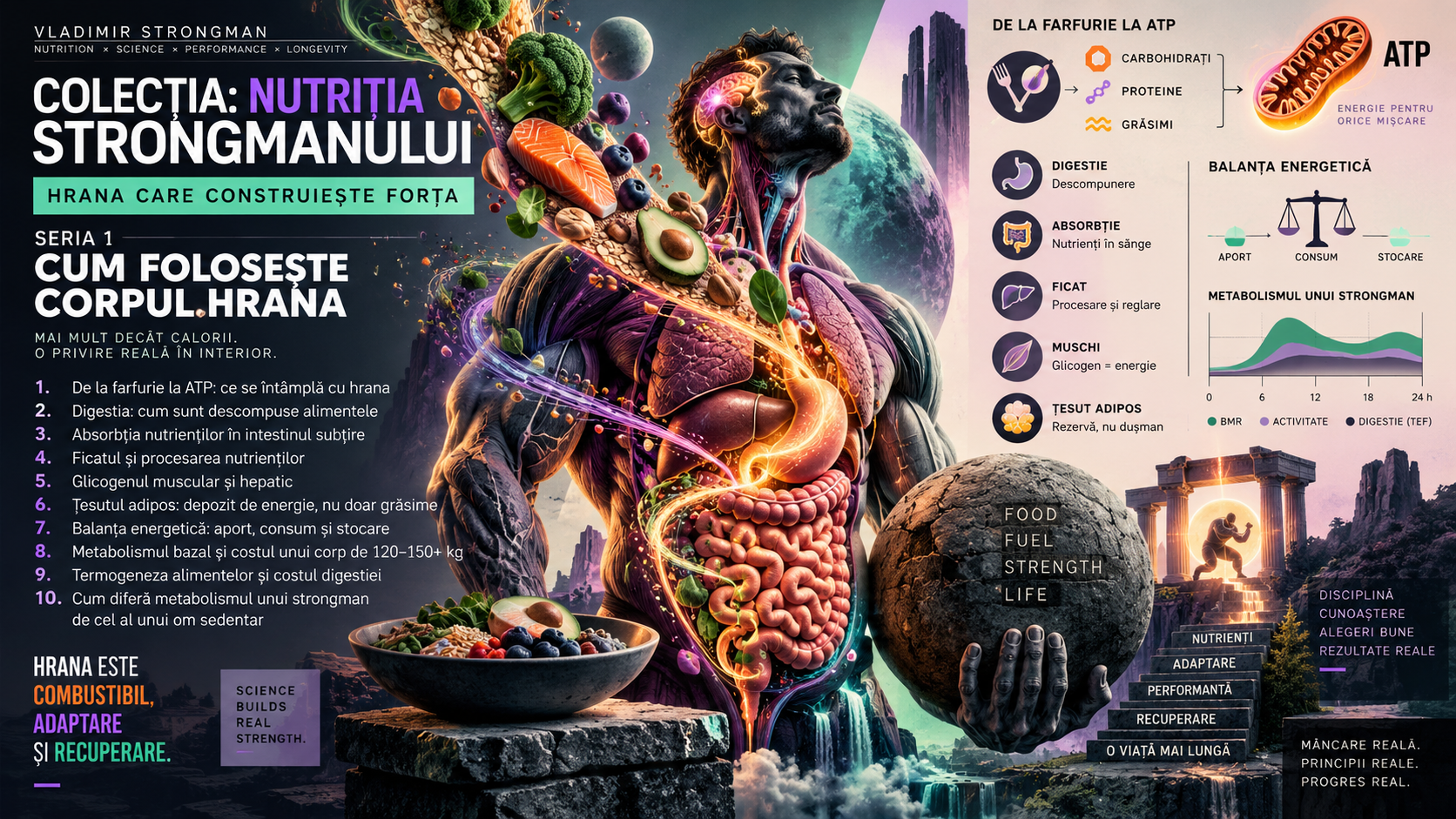
Strength does not begin when the hand touches the bar, log, or frame. Many hours earlier, the body had to turn an ordinary-looking meal into glucose, fatty acids, and amino acids, absorb them, distribute them, store them, and finally use them to regenerate the molecule without which no muscle contraction can continue: ATP.
Food does not enter muscle as ready-packaged “energy.” It is broken down mechanically and chemically, passes through the intestine, liver, and circulation, then reaches cells where nutrients enter different metabolic pathways. Some supply energy very quickly, others support longer-duration work, and others provide the raw material for repairing and building tissues.
This first episode follows the entire journey from plate to ATP, with special attention to what matters in strongman: maximal efforts lasting a few seconds, heavy sets, medleys, recovery between events, and the ability of a very large body to convert large amounts of food into performance without digestion becoming an event of its own.
1. Food does not turn directly into strength
A kilogram of rice, meat, or potatoes does not produce force simply by being present in the stomach. The body must extract usable molecules, transport them, and feed them into biochemical reactions. Mechanical force appears only at the far end of the chain, when chemical energy stored in ATP allows contractile proteins inside muscle to generate tension.
2. Digestion begins before food reaches the stomach
The sight, smell, and anticipation of a meal can trigger neural and hormonal responses that prepare the digestive tract. Salivary and gastric secretions increase, while the pancreas and intestine enter a state of readiness. This cephalic phase shows that digestion is not a simple chemical tube but a coordinated process involving the nervous system and hormones.
3. Chewing increases the working surface
Teeth fragment food into smaller particles, increasing the surface area available to digestive enzymes. Thorough chewing does not meaningfully “burn” extra calories, but it can make later processing more efficient and reduce the mechanical burden on the stomach. For a strongman eating very large portions, this seemingly minor detail can matter for gastrointestinal comfort.
4. Saliva begins starch digestion
Salivary amylase starts breaking down starch while food is still in the mouth. The process continues briefly after swallowing until the acidic environment of the stomach reduces enzyme activity. Most carbohydrate absorption does not occur here, but this is the first chemical step by which a starch-rich food begins to be converted into simpler units.
5. The esophagus transports rather than extracts energy
After swallowing, peristaltic contractions move the food bolus toward the stomach. The esophagus is primarily a transport organ, not a major site of digestion or energy absorption. This stage looks unspectacular, but its neural coordination is essential for safely moving large volumes of food and fluid toward the stomach.
6. The stomach turns a meal into a controlled mixture
The stomach temporarily stores food, mixes it through muscular contractions, and converts it into a semi-liquid mixture called chyme. Serious protein digestion begins here, while the rate at which contents are released into the intestine is carefully regulated. A very large meal rich in fat and fiber may remain in the stomach much longer than a mostly liquid, easily digested carbohydrate meal.
7. Gastric acid prepares proteins for digestion
Hydrochloric acid in the stomach denatures many proteins, unfolding their three-dimensional structure and making peptide bonds more accessible to enzymes. Pepsin then begins cutting them into smaller peptides. Gastric acid does not “melt” food into calories; it creates chemical conditions that make efficient processing possible in later stages.
8. Gastric emptying sets the pace
How quickly nutrients reach the intestine depends greatly on gastric emptying. Meal volume, energy density, fat, fiber, solution concentration, and exercise intensity can all alter this rate. That is why a meal that looks “perfect on paper” can be a poor pre-competition choice if it is still sitting heavily in the stomach when the first event begins.
9. The small intestine is the center of absorption
The duodenum, jejunum, and ileum provide an enormous absorptive surface through folds, villi, and microvilli. Most digestive processes are completed here, and most glucose, amino acids, fatty acids, vitamins, and minerals enter the body here. Metabolically, the small intestine is the true transition point between “food” and “available nutrients.”
10. The pancreas supplies the decisive enzymes
The pancreas releases amylases for carbohydrates, proteases for proteins, and lipase for fats into the intestine, along with bicarbonate that neutralizes the acidity of gastric chyme. Without these secretions, macronutrient breakdown would be severely limited. The digestive pancreas is one of the invisible factories behind every meal used for performance.
11. Bile makes fats accessible
Bile produced by the liver and stored in the gallbladder emulsifies fats, breaking large fat droplets into structures that lipase can attack more efficiently. Bile salts then help form micelles that carry products of fat digestion toward the intestinal surface. Without this step, efficient absorption of fats and fat-soluble vitamins would be compromised.
12. Enterocytes are the gateway into the body
The cells lining the intestine are not passive filters. They use specific transporters, concentration gradients, and energy-dependent processes to take up nutrients. Some molecules then pass directly into portal blood, while others are repackaged before leaving the intestine. Absorption is therefore an active and selective stage, not food simply “leaking” into the bloodstream.
13. Carbohydrates end up as monosaccharides
Starches and disaccharides must be reduced mainly to glucose, galactose, and fructose before they can be absorbed. Intestinal transporters move these monosaccharides through enterocytes and into circulation. Whether the original source was rice, bread, oats, or fruit, cellular metabolism eventually works with a relatively small set of simple molecules.
14. Glucose enters the portal circulation
Glucose absorbed from the intestine first reaches the liver through the portal vein. There it can be oxidized, stored as glycogen, or released into the general circulation depending on demand and hormonal signals. The liver acts as a regulator between what enters from a meal and what the rest of the body actually receives.
15. The liver is the first major distribution center
The liver processes not only glucose but also fructose, amino acids, lactate, and many compounds absorbed from the intestine. It can synthesize glycogen, glucose, lipids, and plasma proteins and regulate which fuels are sent onward. For an athlete, the liver is closer to a metabolic logistics center than to a simple “filter.”
16. Insulin coordinates the post-meal state
Rising blood glucose and the presence of certain amino acids stimulate insulin secretion. Insulin promotes glucose uptake in selected tissues, glycogen synthesis, lipid synthesis, and an anti-catabolic environment while reducing the mobilization of some stored fuels. It is not a “fat-gain switch” but an essential hormone coordinating the body's transition into nutrient use and storage.
17. Liver glycogen helps maintain blood glucose
The liver stores glucose as glycogen and can later release glucose to support blood sugar between meals and during exercise. This reserve serves the whole body. It differs from muscle glycogen, which is largely reserved for the muscle fibers in which it is stored.
18. Muscle glycogen is local fuel
Muscle stores substantial amounts of glycogen and breaks it down rapidly as intensity rises. Because muscle cannot efficiently export glucose derived from its own glycogen to the rest of the body, this reserve behaves almost like a local fuel tank. During repeated events and high-volume training, glycogen availability can directly influence the ability to maintain power.
19. Fructose follows a different metabolic route
Fructose is absorbed in the intestine, but a large proportion is processed by the liver before reaching the general circulation. It can contribute to liver glycogen restoration and be converted into other metabolic intermediates. In sports settings, combinations of glucose and fructose can use different intestinal transporters, potentially improving tolerance of high carbohydrate intakes during prolonged exercise.
20. Fiber is not “useless calories”
Fiber is not completely digested by human enzymes, but it influences satiety, bowel function, glycemic response, and intestinal health. Some types are fermented by the colonic microbiota. For a strongman the issue is balance: enough fiber for health, but not necessarily enormous amounts immediately before training or competition when intestinal bulk can become uncomfortable.
21. The microbiota recovers energy from fiber
Colon bacteria can ferment certain fibers and resistant starch, producing short-chain fatty acids such as acetate, propionate, and butyrate. These can be used by colon cells or enter systemic metabolism. Their energy contribution is modest compared with the major macronutrients, but their effects on intestinal barrier function and metabolic signaling are relevant.
22. Proteins are broken into peptides and amino acids
Protein digestion begins in the stomach and continues intensely in the intestine through pancreatic proteases and brush-border enzymes. The result is a mixture of amino acids, dipeptides, and tripeptides that can be absorbed. At the cellular level, the body does not recognize “chicken breast” or “whey” but streams of amino acids entering the same metabolic system.
23. Amino acids enter a common pool
After absorption, amino acids enter a metabolic pool used to synthesize muscle proteins, enzymes, hormones, neurotransmitters, and many other molecules. This pool is supplied by both dietary protein and normal breakdown of body proteins. Muscle is always undergoing construction and demolition rather than existing in a fixed state.
24. Leucine signals, but it does not build muscle by itself
Leucine is an essential amino acid important in activating mechanisms that stimulate protein synthesis, including signaling through mTORC1. But the signal cannot build a complete protein if the other essential amino acids are missing. An effective protein-containing meal provides both the “start signal” and the raw material required for assembly.
25. Protein synthesis is only half the equation
Muscle mass changes according to the balance between protein synthesis and protein breakdown. Resistance training increases muscle sensitivity to amino acids, while dietary protein supports synthesis. Over time, hypertrophy emerges when periods of positive protein balance sufficiently outweigh periods of negative balance.
26. The body has no dedicated protein storage tank
Carbohydrates can be stored as glycogen and fats as triglycerides, but the body does not maintain a comparable large “amino acid reservoir.” Excess amino acids must be metabolized, and their nitrogen is eliminated mainly as urea. This is one reason distributing protein across the day makes physiological sense even though total daily intake remains the primary factor.
27. Fats are packaged differently from carbohydrates
Products of fat digestion enter enterocytes, where they are rebuilt into triglycerides and packaged into particles called chylomicrons. Unlike glucose and amino acids, which rapidly enter portal blood, most dietary lipids first enter the lymphatic system. The route reflects the major differences between transporting water-soluble nutrients and transporting lipids.
28. Chylomicrons leave through the lymph
Chylomicrons travel through lymphatic vessels and later enter the bloodstream, where lipoprotein lipase releases fatty acids to muscle and adipose tissue. Their remnants are then taken up by the liver. This circuit is slower than the appearance of glucose in blood and helps explain why a very high-fat meal is not ideal fuel for an explosive event starting in an hour.
29. Adipose tissue is an energy reserve, not an enemy
Triglycerides stored in adipose tissue represent the body's largest energy reserve. Between meals and at lower intensities, mobilized fatty acids can contribute substantially to ATP production. For performance, the issue is not the mere existence of body fat but the relationship between its amount, active mass, metabolic health, and the specific demands of the sport.
30. ATP is the immediate energy currency
Adenosine triphosphate, ATP, is the molecule from which cellular machinery directly extracts energy for contraction, active transport, and synthesis. When ATP loses a phosphate group and becomes ADP, the released energy can be coupled to mechanical work in muscle. Carbohydrates and fats do not pull the bar from the floor directly; they are used to regenerate the ATP that powers the contractile cycle.
31. ATP stores are extremely small
Muscle stores only enough free ATP for a few seconds of intense activity. Without continuous regeneration, maximal contraction would stop almost immediately. Performance therefore depends not on a huge stored ATP reservoir but on how rapidly several energy systems can resynthesize ATP from ADP.
32. Phosphocreatine reloads ATP in the first seconds
The phosphagen system uses phosphocreatine to rapidly donate a phosphate group to ADP, regenerating ATP through the creatine kinase reaction. It is an extremely fast source with limited capacity. A maximal deadlift, log lift, or the first steps under a very heavy yoke depend strongly on this pathway.
33. Glycolysis produces ATP quickly
Glycolysis breaks down glucose or glycogen to pyruvate and produces ATP without oxygen being directly required in its reactions. The yield per molecule is lower than with aerobic oxidation, but the rate can be high. As an event extends from a few seconds toward tens of seconds, glycolytic contribution becomes increasingly important.
34. Pyruvate is a metabolic crossroads
Pyruvate produced by glycolysis can enter mitochondria and be converted to acetyl-CoA or can be converted to lactate depending on energy flux and cellular conditions. There is no simple border between “aerobic” and “anaerobic.” In active muscle, pathways operate simultaneously while their relative contributions continually change.
35. Lactate is fuel and a messenger, not waste
Lactate can be transported to other muscle fibers, the heart, or the liver and reused as fuel or as a precursor for glucose. Its production also helps maintain glycolytic flux by regenerating NAD+. The burning sensation and fatigue cannot be explained simply by “lactic acid buildup”; exercise physiology is much more complex.
36. Mitochondria produce aerobic energy at large scale
Mitochondria convert energy from carbohydrates, fats, and sometimes amino acids into large amounts of ATP through oxidative metabolism. The process is slower than the phosphagen system but has far greater capacity. Even in a strength sport, mitochondria are essential for recovery between sets, between events, and between heavy training days.
37. Acetyl-CoA is a common gateway
Carbohydrates through pyruvate and fats through beta-oxidation converge largely on acetyl-CoA. This molecule enters the citric acid cycle and connects several fuel sources within a common metabolic architecture. The body does not have completely separate “carb” and “fat” engines; the pathways constantly intersect and exchange intermediates.
38. The citric acid cycle extracts electrons
In the citric acid cycle, acetyl-CoA is progressively oxidized and energy is captured in electron carriers such as NADH and FADH2. The cycle makes relatively little ATP directly, but it prepares fuel for the high-yield stage: the electron transport chain. It is a central step between nutrients and aerobic ATP production.
39. The respiratory chain turns electrons into a gradient
Electrons carried by NADH and FADH2 pass through protein complexes in the inner mitochondrial membrane. Their energy is used to pump protons and create an electrochemical gradient. ATP synthase allows protons to flow back and uses the gradient's energy to convert ADP and inorganic phosphate into ATP.
40. Oxygen closes the chain
At the end of the respiratory chain, oxygen accepts electrons and participates in forming water. Without sufficient oxygen, oxidative flux cannot continue at the same rate. So although a maximal lift is not directly “powered” by the breath taken in that second, cardiovascular capacity and oxygen delivery matter greatly for energy restoration between attempts.
41. Beta-oxidation cuts fatty acids into energy units
Fatty acids are transported into mitochondria and broken down through beta-oxidation into acetyl-CoA units while also generating NADH and FADH2. Total ATP yield is high, but the process is slower and depends on aerobic metabolism. Fat is excellent background energy, not the primary source for the first two seconds of a maximal deadlift.
42. Amino acids can be burned, but that is not their primary role
After the nitrogen group is removed, the carbon skeletons of amino acids can enter glycolysis, the citric acid cycle, or other energy pathways. In a well-fueled sports diet, however, protein is more valuable as structural and functional material than as the main source of ATP. Carbohydrates and fats should cover most energy needs.
43. Gluconeogenesis protects glucose availability
The liver, and to a lesser extent the kidneys, can produce glucose from lactate, glycerol, and selected amino acids. The process becomes important between meals, during fasting, and in prolonged exercise, helping maintain glucose for tissues that depend on it. Gluconeogenesis does not make dietary carbohydrate useless; it shows that the body has backup systems for protecting blood glucose.
44. Metabolism changes priorities after and between meals
In the post-meal state, higher insulin favors nutrient use and storage. Between meals, falling insulin and a relative increase in glucagon facilitate mobilization of liver glycogen and fat stores. Healthy metabolism is flexible, moving between storage and mobilization instead of remaining locked in a single state.
45. A strongman event never uses only one energy system
The phosphagen system, glycolysis, and aerobic metabolism are active at the same time. What changes is their relative contribution. A three-second lift places enormous emphasis on ATP and phosphocreatine, a one-minute medley demands much more glycolysis, and recovery between events relies heavily on aerobic metabolism.
46. A maximal single demands a phosphagen burst
In a maximal deadlift, squat, or log press, the actual effort is short and the rate of energy production must be enormous. Stored ATP and phosphocreatine dominate the opening phase of the movement. That does not mean competition-day nutrition can ignore carbohydrates, because phosphocreatine restoration and repeated attempts depend on the wider metabolic context.
47. A long medley shifts pressure toward glycolysis
When an athlete carries farmers, sandbags, a frame, and then loads implements for 40-90 seconds, phosphocreatine can no longer cover demand by itself. Glycolytic flux rises sharply, lactate accumulates, and glycogen use increases. In these events carbohydrate availability matters much more than during an isolated single.
48. The aerobic system restores phosphocreatine between efforts
After a maximal burst, phosphocreatine must be rebuilt. This process depends largely on oxidative metabolism and requires time. A strongman with a better aerobic base does not become a marathon runner, but can recover more efficiently between sets, attempts, and events, preserving more quality for the next effort.
49. Carbohydrates support repeated high intensity
Muscle glycogen is an important fuel for high-volume training and events long enough to strongly engage glycolysis. Adequate carbohydrate intake helps restore glycogen between sessions and competition days. The optimal amount depends on training volume, body mass, goals, and gastrointestinal tolerance rather than on one universal number.
50. Protein builds the adaptation, not the repetition itself
Dietary protein supports repair, remodeling, and tissue growth after training. It is not the preferred fuel for explosive contractions when total energy and carbohydrate availability are adequate. In strongman, its major role is to help the body rebuild after enormous mechanical stress rather than to replace glycogen during a medley.
51. Dietary fat supports the metabolic background
Fats provide dense energy, essential fatty acids, membrane components, and support absorption of fat-soluble vitamins. They contribute substantially to resting energy use and lower-intensity activity. In a strongman diet, cutting them excessively can be as counterproductive as consuming so much that meals become difficult to digest.
52. Water is the medium in which the whole story happens
Metabolic reactions occur in an aqueous environment, blood transports nutrients in plasma, and sweating regulates temperature. Dehydration reduces plasma volume, can increase cardiovascular strain, and may impair both performance and digestion. Water contains no calories, but without it nutrients cannot be transported and used normally.
53. Sodium and potassium make electrical signaling possible
Muscle contraction begins with electrical signals built on differences in ion concentrations, especially sodium and potassium, across cell membranes. The sodium-potassium pump itself uses ATP to maintain these gradients. Electrolytes are therefore not merely “sweat salts” but fundamental components of nerve and muscle excitability.
54. Magnesium works right beside ATP
In many reactions, biologically active ATP is complexed with magnesium. The mineral participates in hundreds of enzymatic reactions, including those involved in energy metabolism, protein synthesis, and neuromuscular function. This does not mean high-dose magnesium automatically increases strength; it means adequate magnesium status is necessary for normal system function.
55. Iron helps oxygen reach the right place
Iron is essential for hemoglobin, myoglobin, and several enzymes involved in oxidative metabolism. Deficiency can reduce oxygen transport and utilization and impair recovery and exercise capacity. Supplementing iron without a demonstrated deficiency is not a performance strategy and can be harmful, so iron status should be interpreted through laboratory data and clinical context.
56. Vitamins are cofactors, not “energy”
B vitamins and other micronutrients participate in reactions that extract energy from macronutrients, but they do not provide calories themselves. If a deficiency exists, correcting it can restore normal function. If status is already adequate, megadoses do not turn mitochondria into a supercharged engine.
57. Dietary and supplemental creatine increase phosphocreatine stores
Creatine comes from both internal synthesis and food, especially meat and fish. Creatine monohydrate supplementation can increase muscle creatine and phosphocreatine stores, supporting rapid ATP resynthesis and performance in short, repeated, high-intensity efforts. It is one of the most direct bridges between nutrition and the bioenergetics of strength sport.
58. Meal timing changes comfort and fuel availability
Daily energy and nutrient totals are fundamental, but meal timing can alter immediate performance. A very large, fatty meal close to effort may delay gastric emptying, while easily digested carbohydrates and fluids may be more practical before or between events. Timing is less magic and more management of fuel and the stomach.
59. In a large strongman, digestion becomes a logistical problem too
An athlete weighing 120-160 kg may require an impressive energy intake for maintenance and training. The issue is not only how many calories fit into a plan but how many can be eaten, digested, and tolerated without reflux, bloating, poor sleep, or loss of appetite. Energy density, meal frequency, and food selection become programming tools as real as sets and repetitions.
60. Conclusion: strength is the far end of a long chain
Between the plate and a maximal lift lie digestion, absorption, transport, storage, hormonal signaling, cellular metabolism, and ATP resynthesis. No food directly produces a personal record, but without an adequate flow of energy and nutrients, the mechanisms that make one possible remain underfueled. Strongman nutrition begins with understanding this chain rather than searching for a “magic” food.
The first key idea is that the body does not use whole foods at the cellular level but molecules produced by digestion. Carbohydrates become mainly monosaccharides, proteins become amino acids and peptides, and fats become fatty acids and monoglycerides that are then absorbed and redistributed.
The second key idea is that ATP is the immediate link between metabolism and force. Its stores are small, so the phosphagen system, glycolysis, and oxidative metabolism must continually rebuild it, each with its own speed and capacity.
The third key idea is that strongman events do not belong to one energy system. A maximal single, a 20-second farmers walk, a 70-second medley, and the rest period between events emphasize different proportions of the same bioenergetic machinery.
The fourth key idea is that macronutrients have overlapping but non-identical roles. Carbohydrates support repeated intensity and glycogen restoration, proteins provide material for remodeling, and fats offer dense energy while supporting many structural and metabolic functions.
Finally, effective strongman nutrition is not simply “more food.” It means enough fuel, digestion the athlete can tolerate, adequate hydration and micronutrients, and timing good enough that chemical energy is available when it has to be converted into mechanical work.
Sources and recommended reading
1. Hall JE. Guyton and Hall Textbook of Medical Physiology. Chapters on digestion, absorption, metabolism, endocrinology, and exercise physiology.
2. Nelson DL, Cox MM. Lehninger Principles of Biochemistry. Carbohydrate, lipid, and amino-acid metabolism and oxidative phosphorylation.
3. Berg JM, Tymoczko JL, Gatto GJ, Stryer L. Biochemistry. Bioenergetics, glycolysis, the citric acid cycle, and the respiratory chain.
4. Jeukendrup A, Gleeson M. Sport Nutrition: An Introduction to Energy Production and Performance. Human Kinetics.
5. Thomas DT, Erdman KA, Burke LM. Nutrition and Athletic Performance. Position paper of the Academy of Nutrition and Dietetics, Dietitians of Canada, and the American College of Sports Medicine.
6. Burke LM and colleagues. Consensus literature on carbohydrate availability, muscle glycogen, and fueling for athletic performance.
7. Jäger R and colleagues. International Society of Sports Nutrition Position Stand: protein and exercise. Journal of the International Society of Sports Nutrition.
8. Kreider RB and colleagues. International Society of Sports Nutrition Position Stand: safety and efficacy of creatine supplementation in exercise, sport, and medicine.
9. Hargreaves M, Spriet LL. Skeletal muscle energy metabolism during exercise. Exercise physiology literature on substrate use and ATP resynthesis.
10. Gastrointestinal physiology and sports nutrition literature on gastric emptying, carbohydrate absorption, hydration, and gastrointestinal tolerance during exercise.
Editorial note: this article is educational and explains general physiology of digestion and metabolism. Energy needs, macronutrient distribution, and strategies around training or competition should be individualized according to body mass, training load, goals, gastrointestinal tolerance, and any relevant medical conditions.
More From The Journal

Training
The Science of Strongman Training - Episode X: Competition Programming
How to build a complete Strongman competition preparation block: calendar, events, volume, intensity, specificity, simulations, autoregulation, tapering and fatigue management.

Training
The Science of Strongman Training - Episode IX: Peaking
Peaking in Strongman: how to turn months of training into maximal competition performance by reducing fatigue, preserving adaptations and managing specificity.