
Pharmacology
Molecule by Molecule: Effects on Muscle Growth and Strength - Episode 8: Testosterone and Strength Gain
September 7, 2026
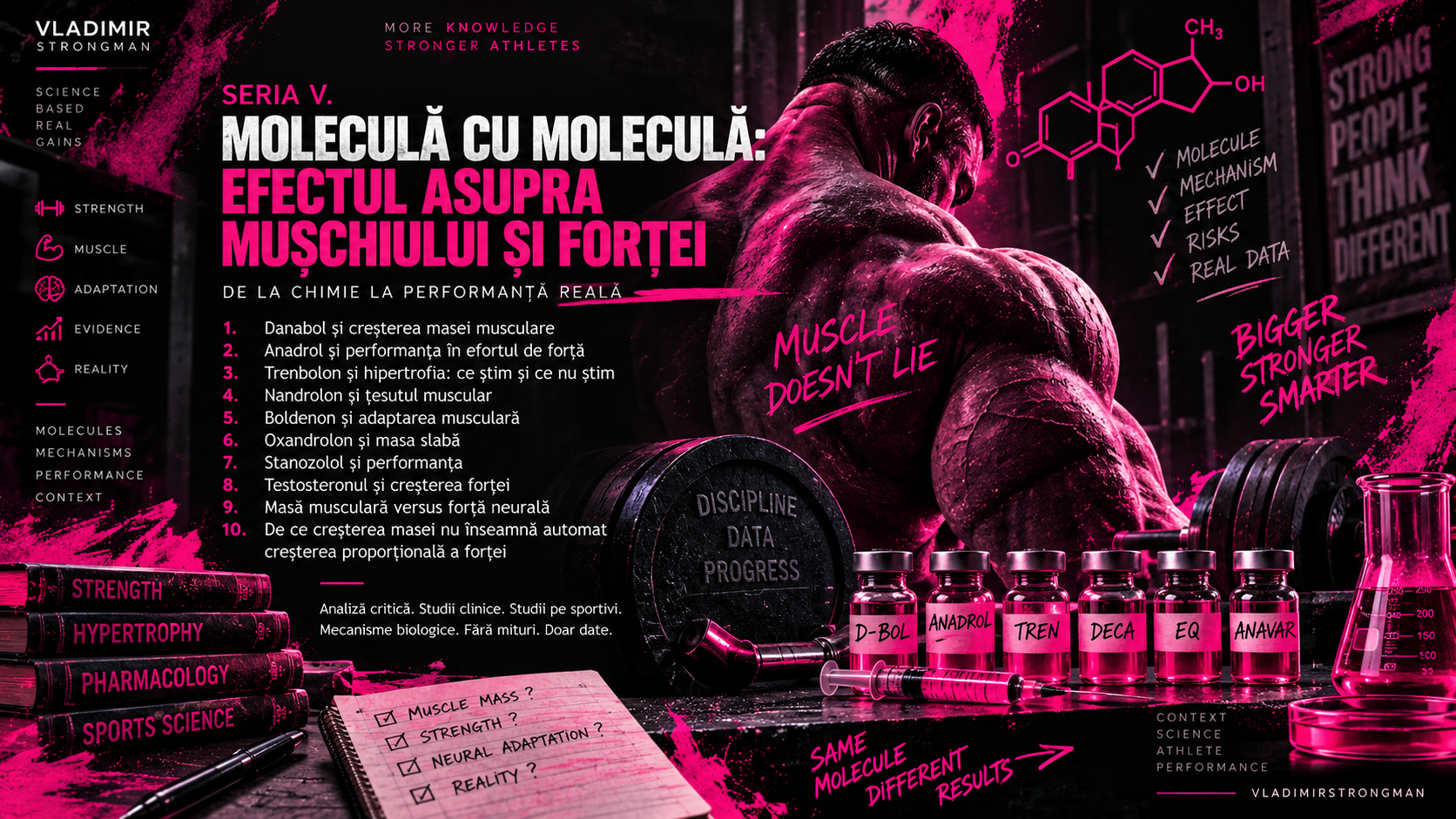
Testosterone is the reference molecule when we talk about androgens and strength. In this series, we look at it not as a word that has become synonymous with performance, but as a molecule: where it binds, what it changes in muscle tissue, and how it can turn training adaptation into a greater capacity to produce force.
1. What is testosterone?
Testosterone is the principal androgen produced physiologically in males and is also present, at lower concentrations, in females. It is a steroid hormone that circulates in blood, enters tissues and can activate the androgen receptor. This signaling produces effects in muscle, the nervous system, erythropoiesis, metabolism and other tissues.
2. Why is testosterone the reference point?
Many anabolic molecules were developed from the testosterone structure. Comparing them with testosterone therefore helps explain androgen-receptor signaling, metabolism, aromatization and effects on muscle mass and strength.
3. The androgen receptor is the starting point
Testosterone binds to the androgen receptor and can alter expression of genes in androgen-responsive tissues. In muscle, this signaling supports an environment that favors maintenance and accumulation of contractile proteins. The receptor is not a direct counter of kilograms lifted, but the beginning of a biological cascade.
4. DHT adds a second pathway
In some tissues, testosterone can be converted by 5-alpha-reductase to dihydrotestosterone, or DHT. DHT binds the androgen receptor with high affinity and contributes to androgenic effects in tissues where this pathway is active. In muscle, the story is different from tissues with greater 5-alpha-reductase activity.
5. Aromatization changes the picture
Testosterone can be aromatized to estradiol. Its effects are therefore not exclusively androgenic. Estradiol has important physiological roles, including in bone and other tissues. In a setting of high androgen exposure, changes in this balance can contribute to fluid retention, breast tenderness and other endocrine effects.
6. How can muscle mass increase?
An androgenic environment can favor muscle protein balance and accumulation of contractile components. When protein synthesis and maintenance exceed loss over time, muscle mass can increase. Training remains the central mechanical stimulus, while nutrition and recovery provide the resources required.
7. Why can strength increase?
Strength is influenced by contractile mass, motor-unit recruitment, coordination, technique and training specificity. Increasing muscle mass can increase force-producing potential, and an androgenic environment can support training adaptation. The final outcome is more complex than the simple equation testosterone equals strength.
8. What have controlled studies shown?
Randomized testosterone studies show that when androgen exposure rises sufficiently, lean mass and strength can increase. In a classic study in healthy men, supraphysiological testosterone exposure increased muscle size and strength, with larger effects when testosterone was combined with resistance training. These findings demonstrate a biological effect, but they should not be turned into a sports-use recipe.
9. Lean mass is not the same as contractile muscle
Lean mass includes water, glycogen, organs and other tissues, not only muscle fibers. A rise in fat-free mass therefore should not automatically be interpreted as an equivalent increase in contractile tissue.
10. Testosterone and water retention
Aromatization to estradiol and other physiological changes can influence fluid balance. Rapid weight gain can therefore include both new tissue and shifts in water and glycogen. The scale is useful, but it does not tell the whole story.
11. Absolute strength versus relative strength
In Strongman, absolute strength is critical, and body mass can influence leverage and stability in some events. In other sports, strength relative to body weight can matter more. The same increase in muscle can therefore be highly useful in one context and much less useful in another.
12. Recovery is not a superfood for the nervous system
A favorable anabolic environment can support muscular adaptation and training tolerance. It does not make central fatigue disappear. Sleep, stress, autonomic regulation and total training load remain major determinants of performance.
13. Testosterone and the nervous system
Androgens also affect the central nervous system. Changes in androgen signaling can influence mood, perceived energy and motivation, but these effects vary and cannot be turned into a simple rule about performance. Athletic strength remains a combination of muscle biology and neuromotor control.
14. Effects on erythropoiesis
Testosterone stimulates erythropoiesis and can increase hemoglobin and hematocrit. This can alter oxygen transport, but it is not automatically a net cardiovascular advantage. Excessive increases in hematocrit can become a medical problem.
15. Lipid profile
Androgen exposure can alter the lipid profile, including lowering HDL and changing other risk markers. An athlete can therefore see a clear increase in strength while cardiovascular markers move in an unfavorable direction.
16. The hormonal axis can be suppressed
When testosterone is administered exogenously, negative feedback can reduce LH and FSH and therefore lower endogenous testosterone and sperm production. An anabolic effect on muscle can coexist with suppression of normal endocrine function.
17. Why exposure matters pharmacologically, without turning it into a recipe
The biological response depends on exposure, receptor sensitivity, metabolism and duration. Effects do not increase indefinitely, and physiological costs do not remain constant. Pharmacology describes exposure-response relationships; it is not a justification for non-medical use.
18. Testosterone and Strongman
For Strongman, increases in contractile mass and absolute strength can have direct competitive value. But the platform shows only what gets lifted, not what changes in the liver, lipids, blood pressure, hematocrit or hormonal axis.
19. What should not be confused
Testosterone, strength, muscle mass and performance are not synonyms. Higher androgen exposure can change the biological environment and favor certain adaptations, but sporting performance depends on multiple systems working together.
20. What does a serious evaluation look like?
A serious evaluation considers body composition and performance together with systemic indicators: blood pressure, complete blood count and hematocrit, lipid profile, liver function, endocrine function and clinical symptoms. With androgens, the sporting result is only one part of the equation.
21. Episode 8 conclusion
Testosterone is the reference point that makes much of anabolic pharmacology understandable. Androgen-receptor activation, metabolism to DHT and aromatization to estradiol can contribute to changes in muscle mass and strength. Controlled studies show that androgen exposure can increase lean mass and strength, but effects depend on context and come with systemic costs. In sport, the molecule can change what muscle can do, but it does not rewrite the rules followed by the rest of the body.
Safety note
This article is educational. It does not provide doses, cycles, combinations or instructions for non-medical use of testosterone or other anabolic steroids. In organized sport, testosterone is regulated as a prohibited substance according to the applicable competition and anti-doping rules.
More From The Journal

Training
The Science of Strongman Training - Episode X: Competition Programming
How to build a complete Strongman competition preparation block: calendar, events, volume, intensity, specificity, simulations, autoregulation, tapering and fatigue management.

Training
The Science of Strongman Training - Episode IX: Peaking
Peaking in Strongman: how to turn months of training into maximal competition performance by reducing fatigue, preserving adaptations and managing specificity.