
Pharmacology
Molecule by Molecule: Effects on Muscle Growth and Strength - Episode 5: Boldenone and Muscle Adaptation
September 7, 2026
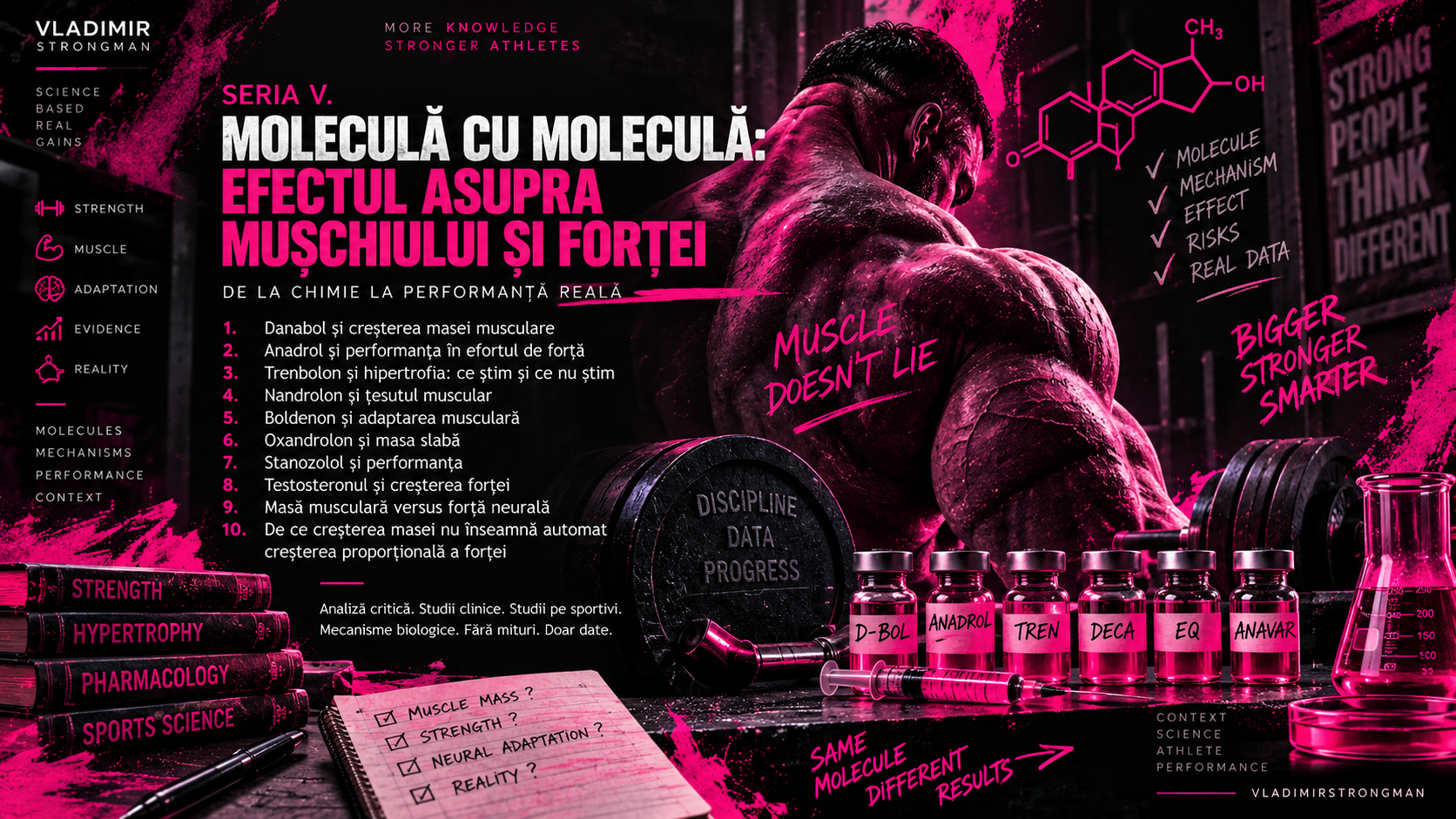
Boldenone is one of the molecules that strength culture often describes in simple terms: mass, appetite, recovery. Pharmacology is more nuanced. In this episode we move from the molecule’s reputation down to muscle tissue and ask what muscular adaptation actually means under the influence of an anabolic androgen.
1. What is boldenone?
Boldenone is a synthetic anabolic-androgenic steroid structurally derived from testosterone. In sport it is known mainly through the esterified form boldenone undecylenate. The ester changes release kinetics from the depot, while the active molecule produces androgenic signaling.
2. What does muscle adaptation mean?
Muscle adaptation is the sum of changes produced by training over time: growth and remodeling of contractile proteins, metabolic changes, alterations in fiber structure and nervous-system adaptations. An androgen can change the environment in which this adaptation occurs, but it cannot separate muscle from training, nutrition and recovery.
3. The androgen receptor is the starting point
Boldenone binds to the androgen receptor and can alter expression of genes in androgen-responsive tissues. This signaling can influence synthesis and maintenance of muscle proteins. The receptor is not a hypertrophy button, however: the outcome depends on tissue, exposure, metabolism and physiological context.
4. Muscle mass is the result of a repeated process
A single training session does not instantly build muscle. Mechanical stimulus is repeated, and the body responds through repair and remodeling. When the balance of accumulating proteins and other structural components remains favorable over time, muscle mass can increase. An anabolic environment can support that process.
5. Boldenone and lean mass
Boldenone’s anabolic activity can favor accumulation of lean mass. Lean mass, however, is not synonymous with pure muscle fiber. Water, glycogen and other fat-free components contribute to measurements. To understand muscular adaptation, body composition has to be considered separately from simple scale weight.
6. Why does its testosterone-derived structure matter?
Structural changes compared with testosterone modify the molecule’s pharmacology. Boldenone retains androgenic activity but has a different aromatization profile and its own metabolic behavior. It is therefore not correct to assume that two molecules from the same family produce exactly the same adaptation.
7. Aromatization should not be ignored
Boldenone can aromatize to estradiol, but to a lesser extent than testosterone. This means estrogen can still be part of its physiological picture, including effects on fluid balance and other endocrine processes. “Less aromatization” does not mean “zero estrogen” or “zero adverse effects.”
8. Protein synthesis is not the only piece
Muscle adaptation also involves protein turnover, tissue remodeling, use of energy substrates and the response to repeated training stimulus. Therefore, an increase in protein synthesis observed in one context cannot automatically be converted into a specific amount of new muscle.
9. Repeated effort changes the problem
For a strength athlete, adaptation does not mean only larger muscle. It also means the ability to repeat hard efforts, recover between sessions and maintain technique. Any effect on mass and recovery can indirectly influence performance, but final performance is the product of multiple systems.
10. Why the reputation for “clean mass” is misleading
In gym culture, boldenone is sometimes described as a compound that produces mostly “clean” mass. That is not a pharmacological term. Appearance depends on fat, water, glycogen, muscle mass and tissue distribution. A photograph cannot separate those components.
11. Muscle adaptation is not tendon adaptation
Increasing muscle mass and force-producing capacity can also increase loading transmitted to tendons and joints. It does not automatically follow that connective tissues adapt at the same speed. A rapid rise in performance can therefore create a gap between muscular capacity and the tolerance of other tissues.
12. Hematocrit is part of the story
Boldenone has androgenic activity and can stimulate erythropoiesis, raising hemoglobin and hematocrit in some people. For an athlete, this should not be interpreted simply as a performance advantage. Excessive increases in red-cell mass can become a medical problem, especially when combined with other cardiovascular risk factors.
13. Lipids and adaptation
A muscle that adapts favorably tells us nothing about the lipid profile. Anabolic-androgenic steroids can lower HDL and alter other markers associated with atherogenic risk. Muscular development and cardiovascular health therefore need to be measured separately.
14. The hormonal axis can be suppressed
As an exogenous androgen, boldenone can reduce hypothalamic and pituitary signals that stimulate the body’s own testosterone production through negative feedback. Lower LH and FSH can impair testicular function and fertility. Muscular adaptation can be favored while endocrine function is suppressed.
15. “Appetite” and muscle growth
Boldenone is associated in sporting culture with increased appetite. Even when appetite rises in some people, that is an indirect behavioral and metabolic effect, not a direct mechanism of hypertrophy. Muscle grows through stimulus, resources and adaptation, not simply because a drug makes someone hungry.
16. Why individual differences matter so much
Genetics, training history, body composition, diet, sleep, hormone levels and general health all change the response to androgens. The same compound does not produce one standardized adaptation in every person.
17. What can we say about hypertrophy without exaggeration?
We can say that boldenone has anabolic activity and that stronger androgenic signaling can support accumulation of lean mass and muscular adaptation in certain contexts. We cannot turn the molecule’s sporting reputation into a universal number for muscle gain or a guarantee that the result will be predominantly contractile tissue.
18. Boldenone and Strongman
In Strongman, body mass and absolute strength have direct competitive value, and muscular adaptation can influence multiple events. But muscle does not function in isolation: sleep, blood pressure, hematocrit, lipids and the hormonal axis can influence an athlete’s ability to keep training over the long term.
19. Adaptation versus physiological cost
This is where pharmacology becomes interesting. A molecule can facilitate a particular muscular adaptation while simultaneously increasing costs in other systems. A good training result is not a laboratory analysis and cannot replace assessment of the organism as a whole.
20. What does a serious evaluation look like?
A serious evaluation separates muscular effects from systemic effects: body composition, performance, blood pressure, complete blood count and hematocrit, lipid profile, liver function, endocrine function and clinical symptoms. The more spectacular a compound’s reputation becomes, the more important it is to measure rather than simply tell stories.
21. Episode 5 conclusion
Boldenone is a good example of the difference between an anabolic molecule and the mythology built around it. Androgen-receptor signaling can support an environment favorable to lean-mass accumulation and muscular adaptation, but the final result depends on training, nutrition, recovery, metabolism and individual biology. At the same time, hematocrit, lipids, blood pressure and the hormonal axis belong to the same equation. Muscle adapts, but the organism always pays the bill in its own currencies.
Safety note
This article is educational. It does not provide doses, cycles, combinations or instructions for non-medical use of boldenone or other anabolic steroids. In organized sport, boldenone is a prohibited substance under applicable anti-doping rules.
More From The Journal

Training
The Science of Strongman Training - Episode X: Competition Programming
How to build a complete Strongman competition preparation block: calendar, events, volume, intensity, specificity, simulations, autoregulation, tapering and fatigue management.

Training
The Science of Strongman Training - Episode IX: Peaking
Peaking in Strongman: how to turn months of training into maximal competition performance by reducing fatigue, preserving adaptations and managing specificity.