
Pharmacology
Molecule by Molecule: Effects on Muscle Growth and Strength - Episode 2: Anadrol and Strength Performance
September 7, 2026
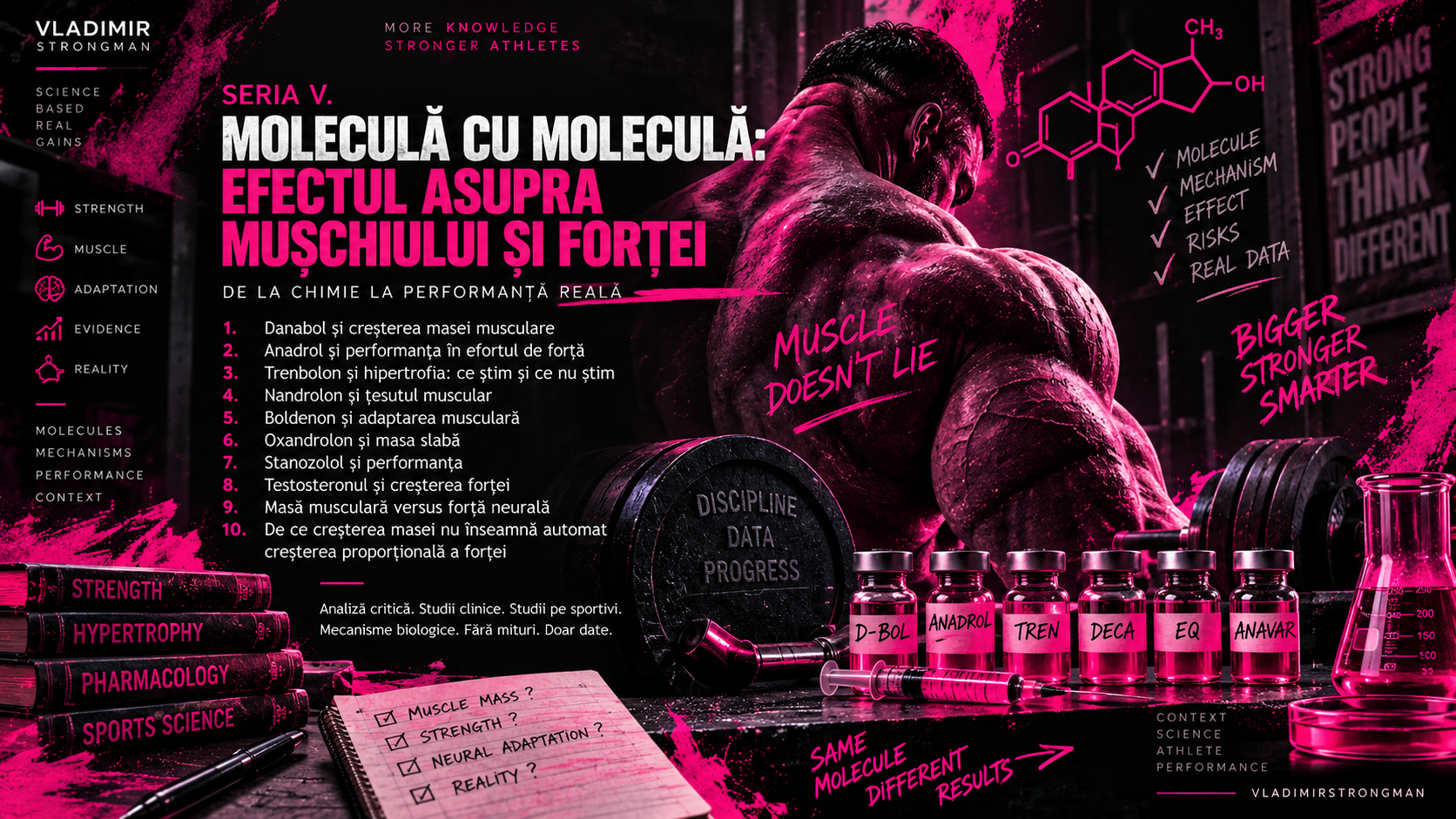
Anadrol is the name under which oxymetholone became famous in strength culture. But a serious analysis should not begin with the reputation of a «powerful» steroid. It should begin with the question: what does this molecule do in the body, and why can it change both lean mass and performance in strength exercise?
1. What is Anadrol?
Oxymetholone is a synthetic anabolic-androgenic steroid administered orally. It has been used medically in settings where increasing red-cell mass and lean tissue could be useful. In sport, however, the name Anadrol is associated mainly with rapid weight gain and a reputation for supporting strength.
2. What does the literature tell us about mass and strength?
Clinical studies have shown that oxymetholone can increase lean mass and muscle strength. In a randomized study in older men, 12 weeks of oxymetholone increased lean body mass and some strength measures compared with placebo. Other clinical data showed increases in fat-free mass and handgrip strength in patients receiving hemodialysis. These findings demonstrate an anabolic effect, but medical trials should not be turned into a performance-use guide. (PubMed: PMID 12388137; PMID 23124786)
3. Strength does not rise through a single mechanism
When an athlete becomes stronger, several factors can contribute: increased muscle mass, neural adaptations, training tolerance, recovery and changes in movement mechanics as body mass changes. Oxymetholone therefore should not be imagined as a «strength switch». The molecule changes the biological environment, and the body turns that change into a complex performance outcome.
4. Body mass can rise quickly
Anadrol’s reputation for «mass» partly comes from the fact that body weight can rise over a relatively short period. But scale weight is not the same thing as new muscle fiber. Some of the change may be true lean tissue, while some may reflect water, glycogen and other shifts in body compartments.
5. Water also changes the perception of strength
When the musculature looks fuller and body weight rises, the experience of training can also change. In some exercises, additional body mass can affect stability and leverage. This may contribute to performance without every kilogram on the scale representing newly built contractile tissue.
6. The androgen receptor remains central
As an anabolic-androgenic steroid, oxymetholone acts through androgen signaling. Activation of the androgen receptor can alter gene expression in target tissues and favor an anabolic environment. Importantly, the receptor is not a «strength meter». It controls biological processes that can contribute, through multiple steps, to muscular and functional changes.
7. Protein synthesis and contractile tissue
Increasing muscle mass requires a more favorable protein balance over time. When synthesis and accumulation of contractile proteins exceed breakdown, muscle tissue can expand. Oxymetholone can contribute to this anabolic environment, but the result still depends on training, nutrition and recovery.
8. Why can it sometimes feel «explosive»?
A rapid perceived response should not be confused with an extraordinary rate of manufacturing new muscle fibers. Changes in water and glycogen can happen faster than structural remodeling of muscle. Performance can also improve through the combination of lean mass, training tolerance and neuromuscular changes.
9. Oxymetholone and the ability to sustain effort
In strength sports, performance is not only the result of a single repetition. It also depends on how well an athlete can repeat quality efforts, recover and maintain force production from set to set. Effects on lean mass and physiological status can influence that capacity, but there is no reason to turn every increase in training tolerance into a direct and exclusive effect of the molecule.
10. Oxymetholone is not simply a «mass steroid»
That label is too simplistic. Oxymetholone has systemic effects, not just muscular ones. It can affect hepatic metabolism, lipid profile, red-cell production, fluid balance and endocrine regulation. That is why performance has to be analyzed together with physiological cost.
11. The liver is a critical point
Oxymetholone is a 17α-alkylated oral steroid, and this structural modification enables oral administration but is associated with a more problematic hepatic profile than androgens that do not require this strategy. Clinical studies of oxymetholone have reported increased liver enzymes and cases of liver injury. In the randomized study of older men, ALT rose significantly in the higher-treatment group. Other studies also observed liver-enzyme elevations and treatment-associated hepatic toxicity. (PubMed: PMID 12388137; PMID 23124786; PMID 12815555)
12. Lipid profile can worsen
Another important issue is lipids. In the randomized study in older men, HDL cholesterol fell in the oxymetholone groups. For a strength athlete, a short-term increase in performance does not cancel the consequences of a more atherogenic lipid profile.
13. Hemoglobin and hematocrit can rise
Androgens can stimulate erythropoiesis, and oxymetholone has been used medically in hematologic settings for that reason. Increasing red-cell mass can alter oxygen transport, but for an athlete it does not automatically mean net cardiovascular performance improvement. Excessively high hematocrit can itself become a medical problem.
14. Fluid retention and blood pressure
Oxymetholone is also associated with fluid retention and edema in clinical settings. For an athlete, added body weight may look useful, but fluid retention can influence blood pressure and cardiovascular stress. Therefore, «heavier» and «stronger» are not biological synonyms.
15. The endocrine axis is still part of the equation
An exogenous androgen can reduce hypothalamic-pituitary signals that support the body’s own testosterone production. Lower LH and FSH can suppress testicular function, with possible consequences for fertility and sexual function. The severity and duration vary between individuals.
16. Why «strength» does not automatically mean «complete performance»
A strongman may become stronger in one movement and still not be better at every event. Real performance includes technique, speed, coordination, repeated-effort capacity, resilience and recovery. A molecule that increases mass and some measures of strength does not guarantee the same advantage across every component of performance.
17. What do studies say about the relationship between androgens and strength?
At the level of anabolic steroids as a class, controlled literature shows strength increases in some studies, but effect size varies considerably and many studies are short or methodologically limited. A meta-analysis of randomized trials in healthy adults who exercise found a modest increase in strength and a more consistent increase in lean mass in androgen-treated groups versus placebo. These data support a biological effect, not a promise about any individual athlete’s result. (PubMed: PMID 29994823)
18. Anadrol and Strongman
Strongman is probably one of the contexts where increased body mass and absolute strength have the most visible competitive value. That helps explain Anadrol’s persistent reputation. But this is also a setting in which risk can be underestimated, because the competitive target favors what is visible on the platform: kilograms lifted, not the biological markers changing in the background.
19. The myth «Anadrol = raw strength»
The formula is too simple. Strength resulting from an androgenic drug is the product of several mechanisms: lean mass, anabolic status, training adaptation, neuromuscular changes and, sometimes, changes in body weight and leverage. Assigning the entire result to a single property called «strength» is not pharmacology, it is a slogan.
20. What should be monitored when evaluating the molecule?
A serious pharmacological analysis looks at effects on lean mass and strength, blood pressure, blood count and hematocrit, lipid profile, liver enzymes and markers, endocrine function and clinical symptoms. The more dramatic the anabolic effect, the more important it becomes not to ignore the organs and systems paying the bill.
21. Episode 2 conclusion
Anadrol, or oxymetholone, is an excellent example of the series’ central idea: the molecule can change lean mass and strength, but performance does not arise from one mechanism and does not come without costs. Clinical data show increases in mass and some strength measures, while the same literature contains important signals for liver health and lipid profile. In strength sports, the perceived advantage may be large, but biology remains much broader than the barbell.
Safety note
This article is educational. It does not provide doses, cycles, combinations or instructions for non-medical use of oxymetholone or other anabolic steroids. In organized sport, oxymetholone is included among prohibited substances under applicable anti-doping rules.
More From The Journal

Training
The Science of Strongman Training - Episode X: Competition Programming
How to build a complete Strongman competition preparation block: calendar, events, volume, intensity, specificity, simulations, autoregulation, tapering and fatigue management.

Training
The Science of Strongman Training - Episode IX: Peaking
Peaking in Strongman: how to turn months of training into maximal competition performance by reducing fatigue, preserving adaptations and managing specificity.