
Physiology
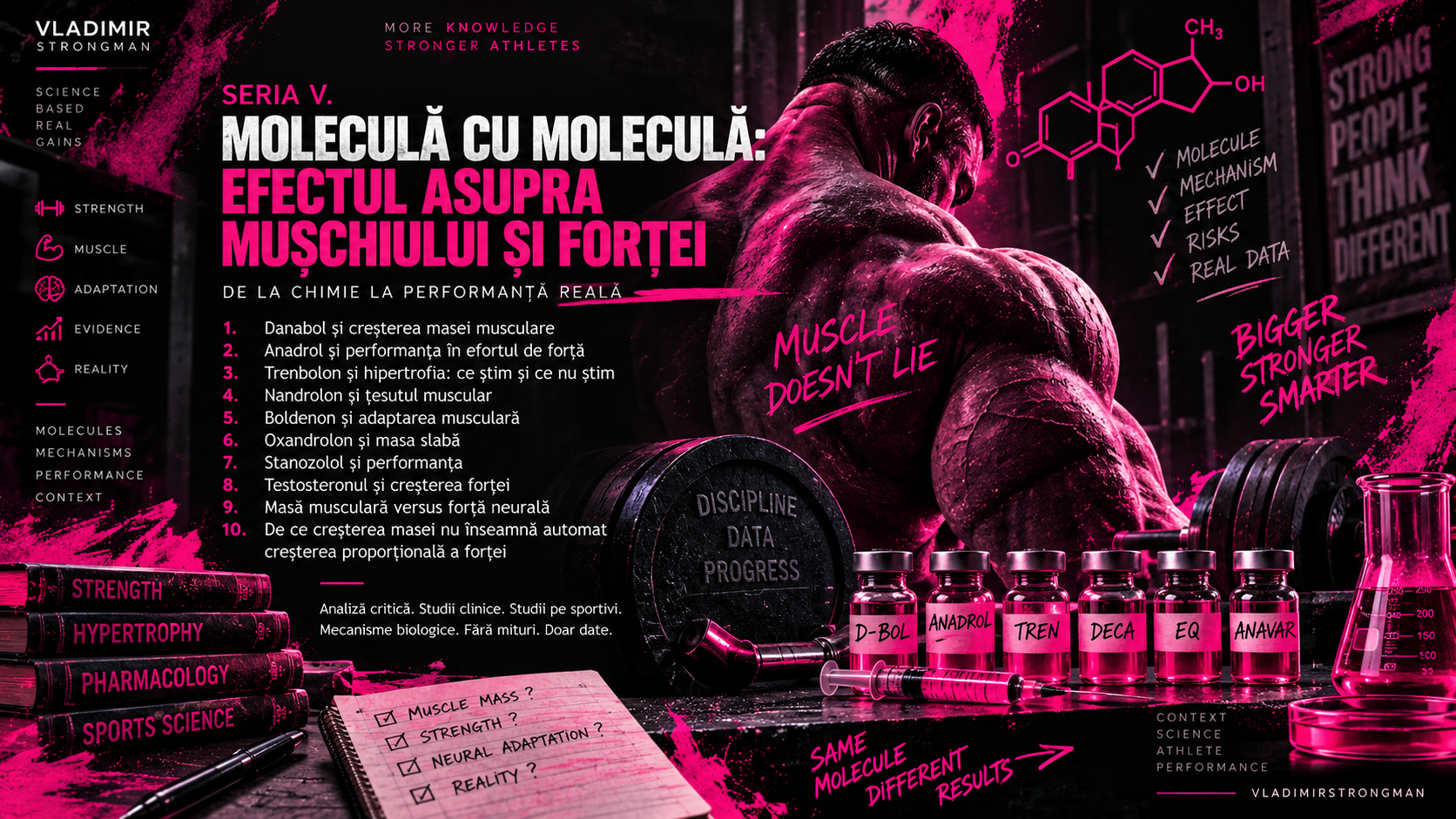
Molecule by Molecule: Effects on Muscle Growth and Strength - Episode 10: Why More Muscle Does Not Necessarily Mean Proportionally More Strength
September 8, 2026
At first glance, the equation seems simple: more muscle should mean proportionally more strength. In reality, the relationship is more complicated. Muscle mass creates the potential to produce force, but final performance also depends on muscle architecture, the nervous system, technique, leverage, coordination and training specificity.
1. Bigger muscle means greater potential, not automatically proportionally greater performance
An increase in muscle cross-sectional area can increase a muscle’s capacity to produce tension. But a muscle does not work alone. Measured strength in a movement is the result of interaction between contractile tissue and the systems that activate and position it.
2. Strength is not only a problem of volume
Two people can have similar circumferences and still have very different strength levels. The difference may come from motor-unit recruitment, firing frequency, intermuscular coordination, technique and experience. Muscle volume matters, but it is not the only variable.
3. Muscle architecture changes the mass-strength relationship
Muscle can also be described by its architecture: fascicle length, pennation angle and fiber organization. Two muscles with similar volume are not necessarily functionally identical. Architecture influences how much force can be produced and at which muscle lengths or contraction velocities.
4. Physiological cross-sectional area matters more than simple circumference
When analyzing force, the quantity and organization of contractile tissue matter more than a superficial circumference measurement. Part of an increase in size may come from water, glycogen or other components of fat-free mass.
5. The nervous system turns potential into usable force
For a maximal effort, the nervous system must activate available motor units rapidly and efficiently. Recruitment, firing rate and intermuscular coordination can change expressed strength dramatically without a major change in muscle size.
6. That is why beginners can become much stronger before they become much bigger
Early in strength training, neural and technical adaptations happen quickly. The athlete learns the movement, coordinates body segments more effectively and can use existing muscle more efficiently. A record can rise before visible hypertrophy becomes dramatic.
7. At advanced levels, muscle mass becomes increasingly important
As technique and neural adaptation approach a high level, contractile mass becomes a more important determinant of the strength ceiling. Even then, the relationship does not become perfectly linear. A gain in mass can have different effects depending on the exercise and the athlete.
8. Training specificity can break the proportion
An athlete can gain muscle through a hypertrophy-oriented program without immediately increasing the maximum in a highly technical lift. Strength is specific to movement. To express strength in that movement, the ability to produce force in that exact pattern must also be trained.
9. Technique can add kilograms without adding muscle
A more efficient position, bar path or coordination can reduce wasted effort and allow a larger proportion of existing capacity to be expressed. Therefore, an increase in a personal record does not automatically demonstrate an equivalent increase in muscle mass.
10. Leverage and body weight can change the outcome
Increasing body mass changes body geometry. In some events this can improve stability or mechanical position; in others it can limit mobility. Strength measured on the platform is always force produced within a particular mechanical system.
11. Muscle mass can increase, but its distribution matters
A gain in mass in certain muscle groups can have a large effect on some movements and almost none on others. Performance is determined by the muscles that actually contribute to the sporting action, not simply by total body mass.
12. Force depends on joint angle and muscle length
The capacity to produce force varies with muscle length and joint angle. A larger muscle does not produce the same force in every position. That is why different tests and events can show different relationships between muscle mass and strength.
13. Absolute and relative strength tell different stories
If an athlete gains 10% in mass and 10% in strength, the strength-to-body-weight ratio may remain almost unchanged. In other cases, mass may increase faster than strength, or strength may increase faster than mass. Evaluation should therefore specify whether absolute or relative strength is being discussed.
14. Where do anabolic androgens enter the equation?
Anabolic androgens can favor gains in lean mass and muscular adaptation. But the fact that mass increases does not mean every kilogram added becomes the same amount of strength expressed in a lift. The final effect is mediated by the neuromuscular system and training.
15. Rapid weight gain can have a different composition than it appears
Water and glycogen can rapidly change body weight and muscle appearance. If we look only at the scale, we can overestimate the relationship between a change in mass and a change in contractile tissue. Body composition therefore has to be interpreted carefully.
16. Recovery is not measured only by how much you lift
An athlete can become stronger in a lift and still have a poor recovery profile. Sleep, central fatigue, stress, tendons and the cardiovascular system affect the ability to reproduce performance. Today’s strength does not describe the state of the whole organism by itself.
17. Why one kilogram of muscle does not have a fixed value in kilograms on the bar
Because muscle functions within a mechanical and neural system. One kilogram of new tissue can contribute very differently depending on where it is located, its architecture, the exercise being tested and how effectively the nervous system controls it.
18. The Strongman example
In Strongman, muscle mass can have major competitive value, but transfer to performance differs from event to event. Deadlift, log press, carries and events with unusual objects require different combinations of mass, neural strength, coordination, technique and stability.
19. How should progress be analyzed?
Look at several variables at once: body composition, muscle mass, absolute strength, relative strength, movement velocity, technique and event-specific performance. The better these components are separated, the better the source of progress can be understood.
20. The big confusion: correlation versus proportionality
Muscle mass and strength are correlated, but correlation does not mean that every percentage increase in mass produces the same percentage increase in strength. Two variables can have a strong association without having a linear relationship.
21. Episode 10 conclusion
Increasing muscle mass creates more potential for force production, but it does not come with an automatic proportional conversion into performance. Muscle architecture, motor-unit recruitment, coordination, technique, leverage and training specificity determine how much of that potential actually reaches the platform. Mass is the raw material; strength is the product of a system that must know how to use it.
Safety note
This article is educational. It does not provide doses, cycles, combinations or instructions for non-medical use of anabolic steroids.
More From The Journal

Training
The Science of Strongman Training - Episode X: Competition Programming
How to build a complete Strongman competition preparation block: calendar, events, volume, intensity, specificity, simulations, autoregulation, tapering and fatigue management.

Training
The Science of Strongman Training - Episode IX: Peaking
Peaking in Strongman: how to turn months of training into maximal competition performance by reducing fatigue, preserving adaptations and managing specificity.