
Nutrition
Series: Micronutrients: The Small Things That Keep the Engine Alive - Episode 5: Sodium and Performance in Strength Athletes
September 10, 2026

Sodium is one of the most controversial micronutrients in nutrition. In public health, it is discussed mainly in relation to blood pressure, cardiovascular disease and excessive salt intake. In sport, it appears in a different setting: heavy sweating, plasma volume, electrolyte drinks, cramps, dehydration and the ability to maintain performance. Both perspectives are valid, but both can become misleading when removed from context.
For a strength athlete, especially one with a large body mass who trains in heat, sweats heavily or competes in several events during the same day, sodium has obvious practical relevance. It contributes to extracellular fluid volume, intestinal absorption of water and glucose, nerve impulse propagation and normal muscle fiber function.
That does not mean more sodium automatically produces more strength. It means that intake which is too low relative to losses can become limiting, while chronically excessive intake can have unwanted consequences, especially in people susceptible to hypertension. This episode focuses on that balance: what sodium does, what happens when it is lost in sweat, how it affects hydration and when it becomes relevant to strength performance.
1. Sodium is the major cation of extracellular fluid
Most exchangeable sodium in the body is located in the extracellular space, including plasma and interstitial fluid. This distribution makes it central to extracellular osmolality and the movement of water between body compartments.
Water largely follows osmotic particles. For this reason, major changes in sodium content or concentration can alter fluid distribution. In practice, plasma sodium concentration is tightly regulated by thirst, the kidneys and hormones such as vasopressin and aldosterone.
2. Salt and sodium are not the same thing
Table salt is sodium chloride. Only part of its mass is sodium. Therefore, the amount of “salt” and the amount of “sodium” listed in recommendations or labels are not identical values. This distinction matters when comparing public-health guidance, foods and electrolyte products.
3. Nerve impulses depend on the sodium gradient
A muscle does not contract spontaneously. Contraction begins with an electrical signal. When a neuron or muscle fiber depolarizes, sodium channels allow rapid sodium influx, contributing to propagation of the action potential.
In strength sports, rapid motor-unit recruitment is essential. Sodium does not directly increase contractile force in the way larger muscle cross-sectional area or better technique can, but it is part of the electrical infrastructure without which neural signaling cannot function normally.
4. The sodium-potassium pump maintains the cell's electrical battery
Na+/K+-ATPase uses ATP to move sodium out of the cell and potassium into it. This mechanism maintains the concentration difference between compartments and allows nerves and muscles to remain excitable.
During repeated effort, these ionic fluxes become intense. Restoring gradients after electrical activity has a real energetic cost. Sodium physiology is therefore connected to neuromuscular fatigue, although it cannot be reduced to the simplistic claim that more salt equals more power.
5. Sodium helps maintain plasma volume
Plasma volume is the liquid component of blood. During exercise, especially in heat, water is lost through sweat and circulating volume may fall. Adequate fluid and sodium intake can improve fluid retention and help support circulation.
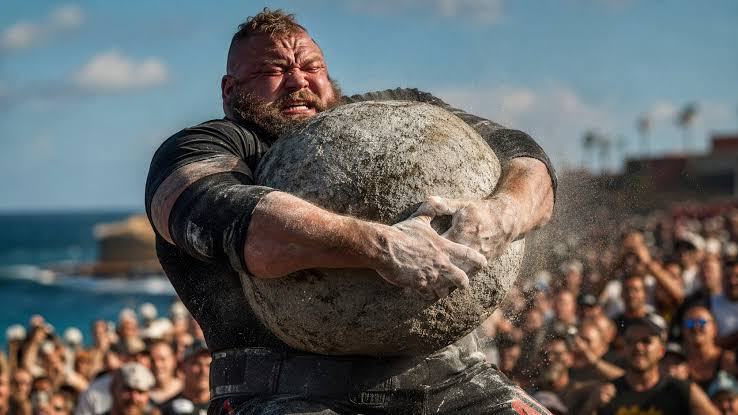
For strongman athletes, this may matter between events. A competition can combine maximal efforts, loaded carries, repetition events and long periods in the sun. If the athlete loses large amounts of water and salt, recovery between events may deteriorate.
6. Sweat means loss of more than water
Sweat contains water and electrolytes, especially sodium and chloride. Sweat sodium concentration differs substantially among athletes and can vary with heat acclimation, genetics, diet and sweating rate.
Two athletes of the same body mass performing the same session may lose very different amounts of sodium. Universal rules stating that every athlete needs the same amount of salt are therefore too simplistic.
7. The more you sweat, the more context matters
A 45-minute strength session in a cool gym is not the same as a six-hour outdoor strongman competition in hot weather. Cumulative water and sodium losses can become substantial in the latter, particularly in large athletes who generate considerable metabolic heat.
8. Sodium and intestinal water absorption
In the intestine, sodium and glucose can be transported together through specialized cotransporters, and water follows osmotically. This principle underlies oral rehydration solutions and helps explain why, in some circumstances, a drink containing water, sodium and carbohydrate can be absorbed and retained more effectively than plain water.
9. Plain water does not always solve the problem
When sweat losses are high and sodium intake is very low, consuming very large volumes of plain water can further dilute plasma sodium. In extreme cases, exercise-associated hyponatremia can occur, a potentially serious condition.
Hyponatremia is not simply another word for “not eating enough salt.” It usually reflects an inappropriate relationship between fluid intake, losses and the body's ability to excrete water. Hydration should not be treated as a contest to see who can drink the greatest number of liters.
10. Dehydration can reduce repeated performance
Meaningful fluid loss can increase cardiovascular strain, reduce heat tolerance and alter perceived exertion. The effect may be less obvious in a single maximal lift than in endurance exercise, but in a multi-event competition the cumulative impact can become relevant.
11. Sodium can support rehydration between events
After a heavy event, the goal is not merely to put water into the stomach but to replace lost fluid and retain it. Sodium in drinks or foods promotes fluid retention and reduces the likelihood that the entire volume is rapidly excreted in urine.
12. Sodium before exercise: useful in context, not a mandatory ritual
Adequate sodium intake before long, hot or high-sweat exercise may support better hydration status. This does not justify taking large doses before every training session. Strategy should match habitual diet, temperature, duration and individual losses.
13. Sodium during exercise matters more as sessions become longer
During a short strength session, habitual food intake is often enough to cover sodium needs. As duration, temperature and sweat rate increase, electrolyte intake during exercise becomes more justifiable.
14. Post-exercise food can matter as much as a sports drink
Post-exercise rehydration does not necessarily require specialized products. A normal meal containing sodium, together with sufficient fluid, can restore fluid and electrolyte balance effectively. Sports drinks are tools, not mandatory recovery equipment.
15. Muscle cramps cannot be explained by sodium alone
The idea that every cramp results from salt deficiency is too simple. Exercise-associated muscle cramps likely involve multiple mechanisms, including neuromuscular fatigue and altered reflex control. Large fluid and electrolyte losses may contribute in some settings but do not explain every case.
16. A salty sweater may have different needs
Some athletes notice white salt marks on clothing or skin after training and may have higher sweat sodium concentrations. Visual signs are not an exact measurement, however. A more useful approach is to consistently observe body-mass changes, fluid intake, environmental conditions and individual tolerance.
17. Pre- and post-exercise weighing can provide useful information
The difference in body mass before and after a session, adjusted for fluids consumed and urine produced, can approximate sweat rate. It does not directly reveal sodium loss but helps estimate the amount of fluid that must be replaced.
18. The kidneys are the main long-term regulators
The kidneys can conserve or excrete sodium according to intake, circulating volume and hormonal signals. Under ordinary conditions, this regulation is remarkably effective. Sodium requirements therefore cannot be inferred from a single meal or from how salty a food tastes.
19. Aldosterone helps conserve sodium
When circulating volume falls or the renin-angiotensin-aldosterone system is activated, aldosterone increases renal sodium reabsorption. Water tends to follow sodium, helping defend extracellular volume.
20. Heat acclimation changes sweat composition
As the body adapts to heat, sweating can begin earlier and become more effective for cooling. At the same time, aldosterone promotes greater sodium reabsorption in sweat glands, making sweat relatively less salty.
21. Strongman has a distinctive heat-stress profile
Large body mass, thick equipment, belts, deadlift suits, knee sleeves and outdoor events can reduce heat dissipation. Athletes may also spend hours warming up, waiting and competing. Water and sodium losses can accumulate even when individual events last only seconds.
22. Loaded carries increase cardiovascular cost
Yoke walks, farmers walks, frame carries and medleys combine very high muscular tension with locomotion. Heart rate and ventilation rise rapidly. Maintaining circulating volume becomes more relevant than during a single powerlifting repetition performed in a controlled environment.
23. Repetition events turn strength into a capacity problem
A log press for repetitions, deadlift for repetitions or sandbag medley does not test maximal strength alone. The athlete must repeatedly generate force while fatigue accumulates rapidly. Hydration and electrolyte status do not create new strength, but they may influence how well function is preserved across the set and the entire day.
24. Carbohydrate and sodium can work together during long competition days
During multi-event days, easily digested carbohydrate may help restore energy between events. Combined with fluid and an appropriate amount of sodium, it can support both energy intake and rehydration. The key is suitable concentration and gastrointestinal tolerance.
25. Too much sodium is not consequence-free
Chronically high sodium intake can contribute to increased blood pressure in salt-sensitive individuals. Responses vary, and risk also depends on age, kidney function, body mass, potassium intake, cardiovascular status and other factors.
Sweating heavily does not make every sodium intake harmless. Sports nutrition should solve real performance problems without ignoring long-term health.
26. Blood pressure matters in strength sports
Maximal efforts produce very large acute rises in blood pressure. These are temporary parts of the exercise response, but an athlete who already has resting hypertension starts from a different risk profile. Sodium intake should therefore be considered together with blood pressure, not in isolation.
27. Potassium changes the equation too
A diet rich in fruits, vegetables, potatoes, legumes and other potassium sources is associated with a more favorable cardiovascular profile. Sodium is more meaningfully discussed within the overall dietary pattern than as an isolated mineral.
28. Body mass can change rapidly with sodium and carbohydrate intake
Changes in sodium, carbohydrate and water intake can temporarily alter body mass through extracellular fluid and glycogen-associated water. A rapid gain of one or two kilograms does not automatically mean fat gain, just as a rapid loss does not necessarily mean true fat loss.
29. A better muscle pump is not the same as better performance
Higher carbohydrate, water and sodium intake can change muscular fullness and fluid distribution. These changes may feel like a better pump, but the subjective sensation should not be confused with a guaranteed increase in maximal strength.
30. Public-health recommendations and sports needs are not identical
Public-health recommendations are designed for entire populations in which hypertension and excessive salt intake are common. An athlete losing large amounts of sodium in sweat may have different needs on particular days. This does not invalidate general guidance; it shows why sports nutrition requires context.
31. There is no perfect universal dose
Practical requirements depend on habitual diet, sweat rate, sweat sodium concentration, environmental temperature, exercise duration, acclimation, medication and health status. A fixed formula may be a starting point but cannot replace individual observation and context.
32. Electrolyte supplements are tools, not magic
Electrolyte tablets, powders and drinks can be useful when losses are meaningful and food is impractical. They do not compensate for poor sleep, inadequate energy intake, insufficient carbohydrate, weak conditioning or a poor competition strategy.
33. More is not automatically better
A product with a very high sodium concentration is not automatically superior. Large doses may taste unpleasant, increase thirst or cause gastrointestinal discomfort and may be inappropriate for people with certain medical conditions. The effective strategy is the one that solves the requirement without creating new problems.
34. Warning signs should not be treated with random salt intake
Confusion, severe headache, vomiting, impaired coordination, marked weakness or altered consciousness during or after exercise can signal a serious hydration, heat or electrolyte problem. These situations require medical assessment, not experimentation with salt and water.
35. What a strength athlete should monitor in practice
Rather than obsessing over a universal number, athletes can monitor a few practical variables: body-mass change during long sessions, fluid intake, baseline dietary salt, response to heat, resting blood pressure and whether performance repeatedly deteriorates under high-sweat conditions.
36. Competition-day strategy should be tested beforehand
Competition day is not the right moment to try a highly concentrated drink, unusually large amounts of salt or unfamiliar volumes of water for the first time. Gastrointestinal tolerance and individual response should be tested in training and simulations.
37. Sodium does not replace carbohydrate, but it can complete the strategy
During a long competition, the problem may be both energetic and fluid-electrolyte related. If an athlete consumes only water and salt but fails to obtain enough carbohydrate and energy, performance can still decline. Competition nutrition works as a system, not through one miracle ingredient.
38. For most people, food remains the main source
Bread, cheese, processed meats, sauces, restaurant meals and processed foods can provide substantial sodium. A strength athlete eating a large amount of food may already consume a high sodium intake without supplements. It is therefore useful to understand baseline diet before adding electrolyte products.
39. Cardiovascular health still matters when you are an athlete
Strength training offers important benefits but does not provide immunity from hypertension, kidney disease or cardiovascular risk. Athletes with elevated blood pressure, persistent edema, kidney disease or medications affecting sodium balance require individualized medical guidance.
40. Conclusion: sodium is a regulator, not a strength supplement
Sodium participates in functions without which performance cannot exist: action potentials, extracellular volume, intestinal water absorption, fluid retention and circulatory control. Under high-sweat conditions, sodium intake can become an important part of hydration strategy.
But sodium is not a universal accelerator. A well-hydrated athlete with sufficient dietary intake and low losses does not automatically become stronger by adding salt. Its value appears when intake matches the real context and actual losses.
Selected bibliography
American College of Sports Medicine. Exercise and Fluid Replacement. Medicine & Science in Sports & Exercise. Sawka MN et al. American College of Sports Medicine position stand: Exercise and fluid replacement. Casa DJ et al. National Athletic Trainers' Association position statement: Fluid replacement for athletes. Hew-Butler T et al. Statement of the Third International Exercise-Associated Hyponatremia Consensus Development Conference. World Health Organization. Guideline: Sodium intake for adults and children. Institute of Medicine. Dietary Reference Intakes for Water, Potassium, Sodium, Chloride, and Sulfate. Maughan RJ, Shirreffs SM. Dehydration and rehydration in competitive sport. Baker LB. Sweating rate and sweat sodium concentration in athletes.
More From The Journal

Training
The Science of Strongman Training - Episode X: Competition Programming
How to build a complete Strongman competition preparation block: calendar, events, volume, intensity, specificity, simulations, autoregulation, tapering and fatigue management.
Training
The Science of Strongman Training - Episode IX: Peaking
Peaking in Strongman: how to turn months of training into maximal competition performance by reducing fatigue, preserving adaptations and managing specificity.