
Nutrition
Series: Micronutrients: The Small Things That Keep the Engine Alive - Episode 3: Calcium and Bone Health
September 10, 2026
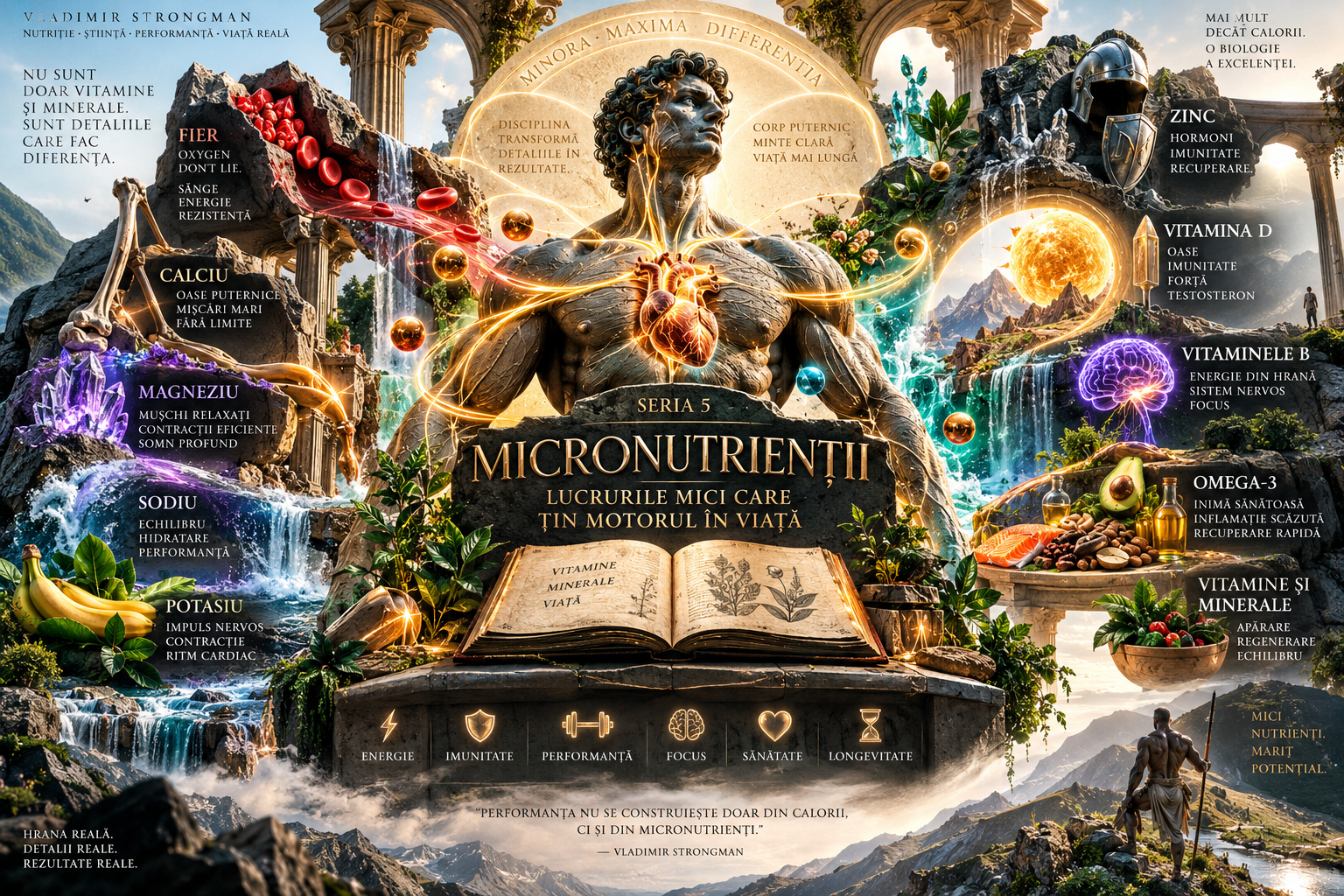
Calcium is almost automatically associated with bones, but that picture is incomplete. In the body, the same ion that helps mineralize the skeleton also participates in muscle contraction, nerve signaling, blood clotting and hormonal regulation. For a strength athlete, calcium sits at the crossroads between structure and function: it contributes to what must resist load and to what must move.
The skeleton is not inert armor. Bone is living tissue that is continuously remodeled through the activity of osteoclasts, which resorb bone, and osteoblasts, which build new bone. At the same time, blood calcium concentration is kept within a very narrow range because even modest disturbances can affect neuromuscular and cardiac function.
This episode follows calcium from the plate to bone and muscle fiber. We will examine absorption, vitamin D, parathyroid hormone, bone remodeling, resistance training, food sources, supplementation and the practical meaning of adequate calcium intake for a strength athlete.
1. Calcium is both a structural mineral and a biological messenger
Roughly 99% of body calcium is stored in bones and teeth, largely as hydroxyapatite crystals. The remaining fraction is tiny in quantity but enormous in physiological importance. Ionized calcium in extracellular fluid and inside cells acts as a signal that can trigger muscle contraction, hormone secretion and neurotransmitter release.
This distribution creates an important paradox: the body can defend blood calcium even when dietary intake is inadequate by using bone as a mineral reservoir. A normal serum calcium value therefore does not automatically prove that intake is optimal or that the skeleton is not slowly losing mineral.
2. Bone is living tissue, not biological concrete
Bone contains an organic matrix dominated by type I collagen, onto which a calcium- and phosphate-rich mineral phase is deposited. Collagen contributes flexibility and tensile strength, while mineral increases stiffness and resistance to compression. Bone quality depends on both components, not simply on how much calcium it contains.
3. Bone remodeling is a permanent construction site
Throughout life, microscopic areas of old bone are removed and replaced with new tissue. Osteoclasts resorb mineralized bone, while osteoblasts synthesize new matrix and help mineralize it. The balance between these processes changes with age, hormones, nutrition, activity level and mechanical loading.
4. Strength training sends a mechanical signal to bone
Bone responds to mechanical loading. Muscle pull, compression and repeated loading create tiny strains that bone cells can detect. When the stimulus is sufficient and recovery is adequate, the skeleton can adapt its structure to tolerate future demands more effectively.
For strongman athletes this is particularly relevant. Yoke walks, farmers carries, deadlifts, squats, log presses and heavy loading events generate large forces through the hips, spine, shoulder girdle and limbs. These forces can promote beneficial adaptation, but only when the tissue has enough energy, protein, minerals and time to remodel.
5. Calcium is absorbed in the intestine, but not everything you eat reaches the bloodstream
Dietary calcium is absorbed mainly in the small intestine through active and passive mechanisms. The fraction absorbed varies with need, age, vitamin D status, the amount consumed in one sitting and the food matrix. The number on a nutrition label is therefore not identical to the amount the body ultimately uses.
6. Vitamin D improves the efficiency of calcium absorption
The active form of vitamin D, calcitriol, increases the expression of proteins involved in intestinal calcium transport. When vitamin D status is inadequate, the body may absorb less calcium from the same amount of food. Bone health therefore cannot be reduced to a single nutrient.
7. Parathyroid hormone protects blood calcium
When ionized blood calcium falls, the parathyroid glands release parathyroid hormone, or PTH. PTH promotes renal calcium conservation, stimulates calcitriol production and can indirectly increase calcium mobilization from bone. The body's immediate priority is internal stability, not preserving every gram of mineral in the skeleton.
8. Calcium initiates muscle contraction
In skeletal muscle, an electrical impulse triggers calcium release from the sarcoplasmic reticulum. Calcium binds to troponin and permits actin and myosin to interact. Without this signal, the contractile machinery cannot work normally. After contraction, calcium is pumped back into storage and the fiber relaxes.
This does not mean that taking a large calcium dose before training automatically creates a stronger contraction. Extracellular calcium is tightly regulated, and performance does not rise simply because intake exceeds requirement. The main benefit is avoiding deficiency and preserving normal physiology.
9. Calcium also participates in nerve transmission
At nerve terminals, calcium entry into the cell helps trigger neurotransmitter release. Through this mechanism, calcium participates in communication between neurons and between nerve and muscle. It is simultaneously construction material and molecular signal.
10. Severe deficiency can affect nerves and muscles
True hypocalcemia can increase neuromuscular excitability and may cause tingling, spasms, cramps or, in severe cases, cardiac and neurological disturbances. However, low blood calcium is not the same thing as a short period of modest dietary intake. Serum calcium is actively defended, sometimes at the expense of skeletal mineral.
11. Bone mineral density does not tell the whole story
DXA scans estimate bone mineral density and are clinically valuable, but bone strength also depends on geometry, microarchitecture, collagen quality, remodeling rate and loading history. A denser bone is not automatically invulnerable, and fracture prevention requires more than maximizing one number.
12. High body mass does not guarantee perfect bones
High body mass and heavy resistance training can increase mechanical loading of the skeleton, but they do not erase the influence of nutrition, hormones, sleep, smoking, alcohol, inflammation, low energy availability or certain medications. In strength sports, bone is heavily challenged and should be treated as adaptable tissue, not as an unbreakable component.
13. Food sources matter more than supplement obsession
Dairy foods are among the most concentrated and well-absorbed sources of calcium. Other useful options include fortified plant beverages, tofu prepared with calcium salts, sardines or other small fish eaten with bones, certain green vegetables and some mineral waters. Calcium content and bioavailability differ substantially between foods.
14. Oxalates and phytates can reduce absorption
Some plant foods contain compounds that bind calcium and reduce its absorption. Spinach, for example, is rich in oxalate, so its calcium is less available than calcium from foods such as kale, broccoli or fortified products. Looking only at total calcium content can therefore be misleading.
15. How much calcium is needed
For most adults, standard dietary recommendations are around 1,000 mg of calcium per day, with variation by age, sex and guideline. An athlete does not automatically need enormous doses simply because the weights are heavy. The goal is consistent adequacy, not pushing intake to extremes.
16. Spreading intake may be more efficient than one very large dose
Fractional calcium absorption tends to decline when a very large amount is consumed at once. In practice, obtaining calcium across several meals and foods is often more natural than relying on one massive dose at a single time of day.
17. Calcium carbonate and calcium citrate are not identical
Calcium carbonate contains a high proportion of elemental calcium and is generally absorbed better with food because it depends more on gastric acidity. Calcium citrate contains less elemental calcium by weight but may be easier to absorb when stomach acidity is reduced. Supplement choice should follow context, not marketing.
18. More calcium does not automatically mean better bones
Once requirements are met, aggressive supplementation does not turn bone into an indestructible material. Excess intake can produce unwanted effects, including gastrointestinal symptoms and, in some contexts, may contribute to kidney stone risk or mineral imbalances. High doses deserve the same caution as any other intervention.
19. Protein and calcium are not enemies
The claim that high-protein diets inevitably “pull” calcium from bone is overly simplistic. Protein is required for the bone matrix and for the muscle that mechanically loads the skeleton. With adequate calcium intake and an otherwise balanced diet, the higher protein intakes used by athletes should not automatically be treated as harmful to bone.
20. Energy availability and hormones are part of the equation
An athlete can consume enough calcium and still develop bone problems if energy availability is chronically too low or hormonal disturbances occur. Bone formation costs energy. When the body perceives severe and persistent energy shortage, reproductive and remodeling processes may change, making bone one of the quiet casualties of an aggressive diet.
21. Strongman creates a distinctive pattern of skeletal loading
In strongman, the skeleton must handle enormous axial loads, impact, acceleration, braking and force transfer in positions that are not always perfectly symmetrical. A several-hundred-kilogram yoke, an Atlas stone lifted from the ground or a heavy farmers carry challenges more than muscle. Bone, tendon, joint and spine all operate in the same mechanical network.
22. Calcium cannot repair a poorly designed training program
Adequate calcium cannot compensate for abrupt increases in volume, poor technique, accumulated fatigue or returning too quickly after injury. Nutrition provides materials and a suitable environment for adaptation, but the mechanical signal still has to be dosed intelligently. Bone needs stimulus, but it also needs time to respond.
23. Laboratory values need context
Total blood calcium is influenced by plasma proteins, especially albumin. In some situations, ionized calcium provides a more direct measure of the biologically active fraction. When clinically indicated, calcium may be interpreted together with albumin, PTH, vitamin D, phosphate, magnesium, kidney function and other findings.
24. The kidneys are major controllers of calcium balance
The kidneys filter and reabsorb calcium and participate in vitamin D activation. Kidney disease can profoundly disturb the balance among calcium, phosphate, PTH and bone. General supplement advice should therefore not be applied blindly to people with kidney disease or a history of stones.
25. Conclusion: bone is a long-term account
Calcium is essential for bone health, but it never works alone. Vitamin D, protein, energy availability, hormones, kidney function and mechanical loading jointly determine what happens to the skeleton. For strength athletes, the sensible strategy is not to chase the highest dose but to maintain adequate intake, eat a varied diet and give tissues time to adapt to training.
Bones are not built in a week and they are not lost in a day. They reflect a balance repeated thousands of times between stimulus, building material and recovery. In strength sport, where external loads can look almost unreasonable for the human body, this quiet structural foundation is what makes performance possible.
Selected references
National Institutes of Health, Office of Dietary Supplements. Calcium Fact Sheet for Health Professionals.
Institute of Medicine. Dietary Reference Intakes for Calcium and Vitamin D. National Academies Press.
Weaver CM et al. The National Osteoporosis Foundation’s position statement on peak bone mass development and lifestyle factors. Osteoporosis International.
International Olympic Committee. Consensus statements on Relative Energy Deficiency in Sport and athlete health.
American College of Sports Medicine. Position stands and reviews concerning nutrition, bone health and resistance exercise.
More From The Journal

Training
The Science of Strongman Training - Episode X: Competition Programming
How to build a complete Strongman competition preparation block: calendar, events, volume, intensity, specificity, simulations, autoregulation, tapering and fatigue management.

Training
The Science of Strongman Training - Episode IX: Peaking
Peaking in Strongman: how to turn months of training into maximal competition performance by reducing fatigue, preserving adaptations and managing specificity.