
Physiology
The Strongman Metabolism: Episode 8 - Proteins: Synthesis, Breakdown and Turnover
September 7, 2026
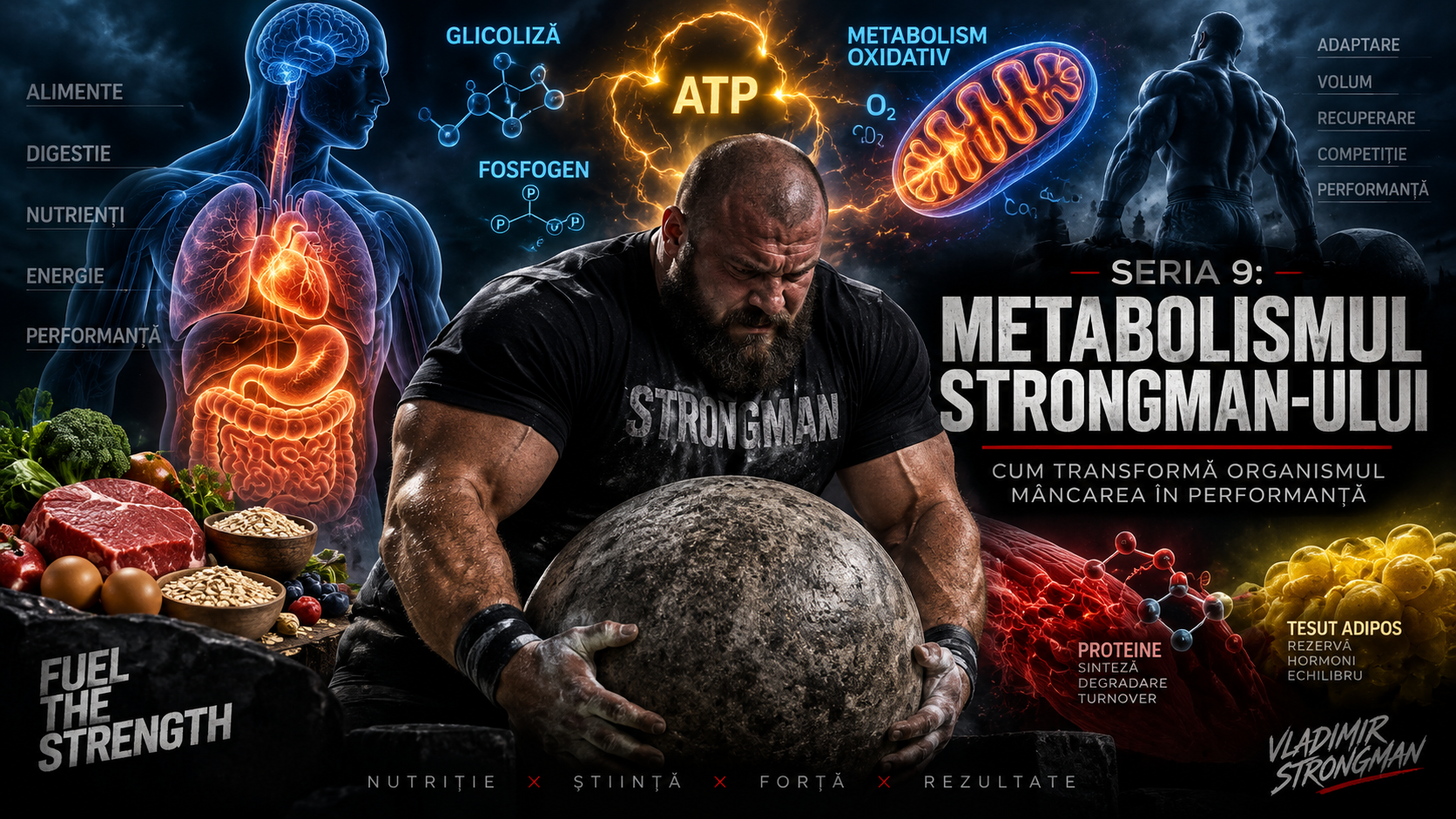
Introduction: protein is a process, not just raw material
When an athlete says that protein is needed to build muscle, the statement is correct but incomplete. Inside the body, proteins are constantly moving through cycles of synthesis, modification, use, repair and breakdown. Some exist only briefly, while others remain for years. Muscle mass is the result of the balance among these processes.
For a strongman, this idea is essential. There is no moment when the body simply switches muscle construction on and then lets it run independently. After each training session, meal, sleep period and competition, the body continuously decides which proteins must be produced, which should be retained and which need to be removed. Proteins are therefore living infrastructure.
What is a protein?
Proteins are molecules made from chains of amino acids. The order of amino acids and the three-dimensional structure of each protein determine its function. The body contains thousands of different proteins: enzymes, receptors, channels, transporters, structural proteins, antibodies and contractile proteins.
In muscle, actin and myosin are the best-known examples. But contraction also depends on troponin, tropomyosin, titin, nebulin, energy enzymes, sarcoplasmic-reticulum proteins and many components involved in signaling and tissue repair.
Amino acids: reusable building blocks
The body uses about twenty amino acids to make proteins, and they come from food or from its own metabolism. An amino acid is not destined for only one protein. After digestion and absorption, it enters the metabolic amino-acid pool and can be used in several directions.
This amino-acid pool is dynamic. Sometimes amino acids enter from the intestine after a meal. At other times they come from the breakdown of body proteins. Depending on demand, they can be incorporated into new proteins, used to make other molecules or oxidized for energy.
Dietary protein does not go directly to muscle
One persistent misconception is that protein eaten at a meal simply “goes to the muscles” and automatically becomes muscle fiber. Digestion breaks proteins into peptides and amino acids, which are absorbed by the intestine. From there, the body decides where they are used.
The liver, gut, immune system, skeletal muscle and many other tissues use amino acids. Some are retained locally, some circulate, and the pattern changes with feeding, exercise and recovery.
Muscle protein synthesis
Muscle protein synthesis is the process by which the cell assembles amino acids into new proteins. It is influenced by mechanical, hormonal and nutritional signals. Resistance training is a strong stimulus, and amino-acid availability contributes to the synthesis response.
For a strongman, mechanical loading matters enormously. Heavy loads, muscle tension and sufficient training volume activate cellular signals that can temporarily increase protein-synthesis processes.
mTOR: one of the major control nodes
The mTORC1 pathway is one of the major regulatory systems for protein synthesis and cell growth. It integrates signals related to amino acids, energy, insulin and mechanical tension. Leucine is one of the amino acids that can contribute to activation of this system when overall amino-acid availability is adequate.
The key point is not to turn mTOR into a magic switch. Activating a signaling pathway does not automatically guarantee disproportionate muscle growth. Adaptation is the result of repeated stimulus, nutrition, recovery and time.
Protein breakdown: why the body must destroy in order to rebuild
Protein breakdown is just as normal as protein synthesis. Damaged or unnecessary proteins must be removed, and the resulting amino acids can be reused. Without breakdown, the cell could not replace aging components or remodel structures according to changing needs.
The best-known systems include the ubiquitin-proteasome system and autophagy, including macroautophagy. These mechanisms support protein-quality control and recycling of cellular components.
The proteasome and ubiquitin
Proteins marked for breakdown can be tagged with ubiquitin. The proteasome recognizes these targets and fragments them. This is not a “bad” process that simply destroys muscle. It is one of the tools cells use to maintain internal order and quality.
When a contractile protein is damaged, its breakdown can be part of normal remodeling. The problem occurs when net breakdown repeatedly exceeds synthesis, as can happen during severe energy restriction, illness or prolonged inactivity.
Autophagy: recycling cellular components
Autophagy describes processes through which cellular components are isolated and directed toward degradation and recycling. In muscle, autophagy helps maintain the quality of organelles and proteins.
Sport and nutrition should not be described in black and white. Autophagy is necessary for cellular health, while protein synthesis is necessary for adaptation. The body uses both, at different levels, depending on context.
Protein turnover: a construction site that never closes
Protein turnover is the continuous flow of synthesis and breakdown. A protein appears, functions for a period and is eventually replaced. Some proteins change quickly, while others are much more stable. Turnover allows tissues to adapt continuously.
In muscle, turnover is not only about growth. It allows repair of damage, replacement of oxidized proteins, adaptation of energy enzymes and remodeling of the contractile structure.
Protein balance: the simple equation behind muscle mass
Muscle protein balance can be simplified as the difference between muscle protein synthesis and breakdown. When synthesis exceeds breakdown for long enough, there is potential for accumulation of muscle tissue. When breakdown exceeds synthesis, muscle mass tends to decrease.
This is a useful model, but it does not describe every detail of human metabolism. There are many protein compartments and continuous whole-body turnover. Muscle can be in positive balance during one interval and negative during another.
Why training increases turnover
Resistance training creates a mechanical signal that changes synthesis and breakdown fluxes. After a hard session, muscle protein synthesis can rise, while the tissue enters a period of remodeling and adaptation.
The more relevant the stimulus and the better the recovery, the more likely the overall flux is to support adaptation. But more training does not automatically mean more synthesis. Excess work can increase recovery costs and reduce the quality of the next stimulus.
Leucine and the stimulation threshold
Leucine plays an important role in nutritional signaling to protein-synthesis mechanisms. A meal supplying enough essential amino acids can create a synthesis stimulus, especially when total protein intake is adequate.
However, “more leucine” does not mean “more muscle” without limit. The signal can be amplified over a certain range, after which the response is limited by the rest of the amino acids, energy availability, mechanical stimulus and tissue biology.
Complete proteins and amino-acid profile
The quality of a protein source depends on amino-acid profile, digestibility and the amount consumed. Animal proteins and well-combined plant sources can provide all essential amino acids needed for protein synthesis.
For a strongman, dietary variety can make it easier to reach protein needs. Meat, fish, eggs, dairy, legumes and plant-based foods can each play different roles in a well-designed diet.
Why energy matters for protein
The body does not treat protein separately from energy balance. During energy restriction, available resources can be redirected toward essential functions, and muscle gain becomes more difficult. Adequate energy and protein create a more favorable environment for adaptation.
A strongman trying to add muscle while training very hard cannot ignore total energy intake. Protein is critical, but it cannot fully replace carbohydrates, fats, sleep and recovery.
Protein and carbohydrates work together
Carbohydrates support glycogen and high-intensity work, and their availability can affect training capacity. Protein provides amino acids for turnover and adaptation. A performance diet uses them together rather than setting them against each other.
For strongman events with longer duration or repeated efforts, insufficient carbohydrate intake can reduce work volume even when protein intake is perfect. Without a high-quality training stimulus, the potential of protein remains underused.
Protein during a calorie deficit
When an athlete is losing weight, preserving lean mass becomes a priority. Adequate protein, resistance training and a reasonable deficit can reduce the risk of muscle loss.
As the deficit becomes more aggressive, the risk of losing lean mass and performance rises. Adipose tissue provides stored energy, but it cannot supply every resource needed to synthesize and maintain contractile proteins.
Protein during a calorie surplus
During a gaining phase, an energy surplus can support growth and recovery, but it does not mean that every additional calorie or gram of protein becomes muscle. Muscle protein synthesis is limited by stimulus and by the biological capacity of the tissue.
An excessive surplus mainly increases the likelihood of fat accumulation. For a strongman, the goal is a rate of gain that supports performance without turning every gaining phase into a marathon of adipose tissue.
How often should protein be consumed?
Distributing protein across the day can be useful for repeatedly providing amino acids and synthesis stimuli. There is no single mandatory frequency for everyone, but dividing intake across several meals is a practical strategy.
On training days, meals can be organized around the session for digestive comfort and sufficient intake. On competition days, priorities shift toward tolerance, carbohydrate and hydration between events rather than enforcing a rigid hourly protein ritual.
Protein before sleep
Sleep is a long period without food, and a protein-containing meal before bed can provide amino acids during the night. Slower-digesting proteins, such as some dairy proteins, are often used for this purpose.
But the effect of one meal should not be taken out of context. Total daily protein intake, training quality and sleep duration matter far more than searching for a “magic 11 p.m. meal.”
Protein after training and the anabolic window
Training increases tissue responsiveness to nutritional signals, and consuming protein after exercise can support the synthesis response. There is not, however, a tiny few-minute window in which everything is lost if you do not eat immediately.
For strongman, a normal meal in the hours around training is usually more realistic than obsessing over second-by-second timing. The diet must support the full day and the next session.
Turnover differs between tissues
Not all proteins have the same lifespan. Proteins in the liver and gut can turn over rapidly, while some structural proteins are much more stable. The body adjusts turnover speed according to function and need.
This difference shows why protein metabolism is bigger than the story of “eat protein, build muscle.” Muscle is only one destination for amino acids.
Enzymatic proteins and energy
Many of the reactions discussed in earlier episodes depend on protein enzymes. Glycolysis, the Krebs cycle, the respiratory chain, fat oxidation and tissue repair all rely on specialized proteins.
That is why inadequate intake or disturbed turnover does not affect only visible muscle. It can also alter the metabolic infrastructure inside the cell, influencing over time the ability to produce and use energy.
Structural proteins and tendons
Collagen is a major structural protein in tendons, ligaments, skin and other connective tissues. Its turnover is slower than that of many metabolic proteins. Adaptation of connective tissue happens over time and is influenced by mechanical loading, nutrition and age.
This is highly relevant to strongman: muscle can respond relatively quickly to training, while tendons and other connective tissues adapt more slowly. Strength should not be built faster than the tissues transmitting that strength can tolerate.
What happens during fasting
During fasting, insulin is lower, fat mobilization increases and substrate use shifts. Protein turnover continues. The body does not “turn off” protein synthesis, but it changes the priority of different processes.
During prolonged fasting, glucose conservation and the use of alternative fuels become more important, and amino-acid metabolism changes. For a performance athlete, this does not make fasting automatically good or bad. It has to be evaluated against training demands and energy requirements.
Sleep and turnover
Sleep is an important period for recovery and hormonal regulation. Sleep deprivation can affect protein synthesis, insulin sensitivity and training quality, especially when it is repeated.
For strongman, sleep is one of the cheapest and most powerful recovery interventions. It does not require a sophisticated supplement, only consistency, a good sleep environment and programming that allows enough time in bed.
Stress and cortisol
Cortisol is a normal stress-response hormone and contributes to substrate mobilization. The problem arises when total physiological stress is too high or recovery is too poor for prolonged periods.
A strongman can experience mechanical, psychological, thermal and metabolic stress at the same time. Cortisol should not be demonized; the important point is understanding how chronically activated stress systems can make a favorable anabolic balance harder to maintain.
Protein and hydration
Adequate hydration supports circulation and physiological processes required for digestion, transport and metabolism. There is no magic “anabolic” amount of water, but severe dehydration can impair performance and complicate digestion and recovery.
In competition, sweating, heat and food intake change the requirements. Protein should be viewed within a larger plan that also includes fluids, electrolytes and carbohydrate.
Protein as an energy source
Amino acids can be oxidized and used for energy, but the body does not store them in a dedicated reservoir comparable to glycogen or triglycerides. When amino acids are used for energy, their nitrogen must be handled and excreted.
For a strongman, this means protein should not be treated as the primary fuel for explosive events. Carbohydrate and the phosphagen system are better suited to the speed requirements of maximal effort, while protein is primarily structural and functional.
What happens when protein intake is too low
Chronically inadequate intake can limit amino-acid availability for synthesis and recovery. In a sport with high training volume and intensity, this can become a limiting factor for maintaining lean mass.
The body prioritizes essential functions, but there is no infinite amino-acid supply. When protein and energy remain too low, adaptation to training can be compromised.
What happens when protein intake is very high
Very high protein intake does not automatically turn the surplus into muscle. Once needs for synthesis and other functions are covered, amino acids can be oxidized or processed through other pathways.
For a healthy athlete, the useful question is less “what is the largest amount possible?” and more “what intake supports mass, recovery, digestion, hydration and total energy needs without unnecessary cost?”
Protein and muscle mass across age
Responses to protein and training can change with age. As people get older, anabolic resistance can develop, and training plus nutrition may need a more deliberate strategy to maintain muscle mass.
This is one reason a long-term strongman program should consider protein in relation to age, recovery and training history rather than as one fixed recipe for every athlete.
Turnover after injury
After injury or immobilization, muscle protein metabolism can change. Loss of mechanical loading reduces the growth stimulus, and muscle loss can occur even when dietary intake is not dramatically different.
Return to training must progressively rebuild both the synthesis stimulus and structural tolerance. Protein helps, but it cannot replace appropriate loading and a rehabilitation plan.
Protein on rest days
Turnover does not disappear on rest days. Tissues continue to repair and remodel, and protein synthesis remains necessary. Therefore, drastically reducing protein on non-training days does not have a strong physiological rationale.
Carbohydrate intake can be adjusted according to energy expenditure and goals, but protein should be viewed as support for the whole recovery process, not only the hours when weights are being lifted.
What this means for a strongman training day
A good day starts with adequate energy intake and protein distributed across several meals. Before training, the goal is to arrive with available energy and a comfortable stomach. After training, the combination of protein and carbohydrate supports restoration and prepares the next session.
During high-volume phases, consistency across days matters more than one “perfect” meal. Muscle is not built from one isolated shake. It is built from hundreds of repeated cycles of stimulus, nutrition and recovery.
What this means for competition day
In competition, digestion and tolerance become priorities. With multiple events, huge meals are usually not desirable. You need tested foods, enough fluid, accessible carbohydrate and a protein amount that contributes to the daily target without unnecessarily burdening the stomach.
Protein is not the component that needs obsessive attention between every event. Over a few competition hours, the priority is maintaining available energy, hydration and overall recovery.
Protein supplements: tool, not magic
Whey, casein and other protein supplements can be useful when it is difficult to reach protein needs through food. Their main advantage is convenience, not a secret ability to build muscle independently of training.
For a strongman traveling or spending many hours between sessions, a shake can be practical. But a diet based almost entirely on powders loses food variety and can become unnecessarily complicated.
Protein and the liver: amino-acid breakdown
The liver processes a large share of absorbed amino acids and handles the nitrogen generated by their breakdown. The urea cycle converts ammonia into a form that can be eliminated by the kidneys.
This is part of normal amino-acid metabolism. Protein is not simply “burned” without consequence; its breakdown produces products that must be processed and integrated into the broader metabolic network.
Connection with the liver and adipose-tissue episodes
In the liver episode, we followed how amino acids and other fuels are processed and redistributed. In the adipose-tissue episode, we saw how the body stores energy and communicates through hormones. Protein links those chapters to contractile tissue and cellular turnover.
The liver manages flows, adipose tissue manages stores and signals, and skeletal muscle converts these resources into function. Protein is the material from which many components that make the system possible are built and repaired.
Common protein mistakes
The first mistake is believing that more protein can compensate for poor training. The second is treating a shake as a permanent substitute for food. The third is ignoring total energy and carbohydrate intake. The fourth is confusing a temporary rise in protein synthesis with net muscle growth.
The fifth mistake is treating protein breakdown as an enemy. Breakdown is necessary. The goal is control of balance and quality, not elimination of breakdown.
Practical model: how to think about turnover
Imagine muscle as a city under constant renovation. Some buildings are new, some are repaired, and some pieces of infrastructure are replaced. Dietary protein supplies materials, training is the signal that tells the city what needs upgrading, and turnover is the crew that removes and rebuilds.
If you have materials without a plan, you do not get a better building. If you have a plan without materials, the work stops. If you work without rest, the crew becomes exhausted. For a strongman, performance emerges when stimulus, amino acids, energy and recovery all point in the same direction.
Conclusion
Proteins are fundamental to the body not because they automatically “become muscle,” but because they participate in nearly every structure and biological process relevant to performance. Synthesis produces new proteins, breakdown removes and recycles components, and turnover keeps tissue functional and adaptable.
For strongman, the central lesson is that muscle mass is the result of a balance over time. Training provides the mechanical signal, protein provides amino acids, energy allows the processes to be sustained, and sleep and recovery provide the time needed for remodeling. None of these elements can be reduced to one supplement or one meal.
Quick glossary
Amino acid: a basic unit used to build proteins. Protein synthesis: formation of new proteins. Protein breakdown: decomposition of proteins into smaller components. Protein turnover: the continuous cycle of synthesis and breakdown. Protein balance: the relationship between synthesis and breakdown in a tissue. mTORC1: signaling complex integrating nutrients, energy and growth stimuli. Proteasome: cellular complex that degrades tagged proteins. Autophagy: processes that degrade and recycle cellular components.
Editorial note: this material is educational and does not replace medical evaluation, laboratory testing or advice from a qualified professional.
More From The Journal

Training
The Science of Strongman Training - Episode X: Competition Programming
How to build a complete Strongman competition preparation block: calendar, events, volume, intensity, specificity, simulations, autoregulation, tapering and fatigue management.

Training
The Science of Strongman Training - Episode IX: Peaking
Peaking in Strongman: how to turn months of training into maximal competition performance by reducing fatigue, preserving adaptations and managing specificity.