
Nutrition
The Strongman Metabolism: Episode 2 - ATP and the Phosphagen System
September 7, 2026
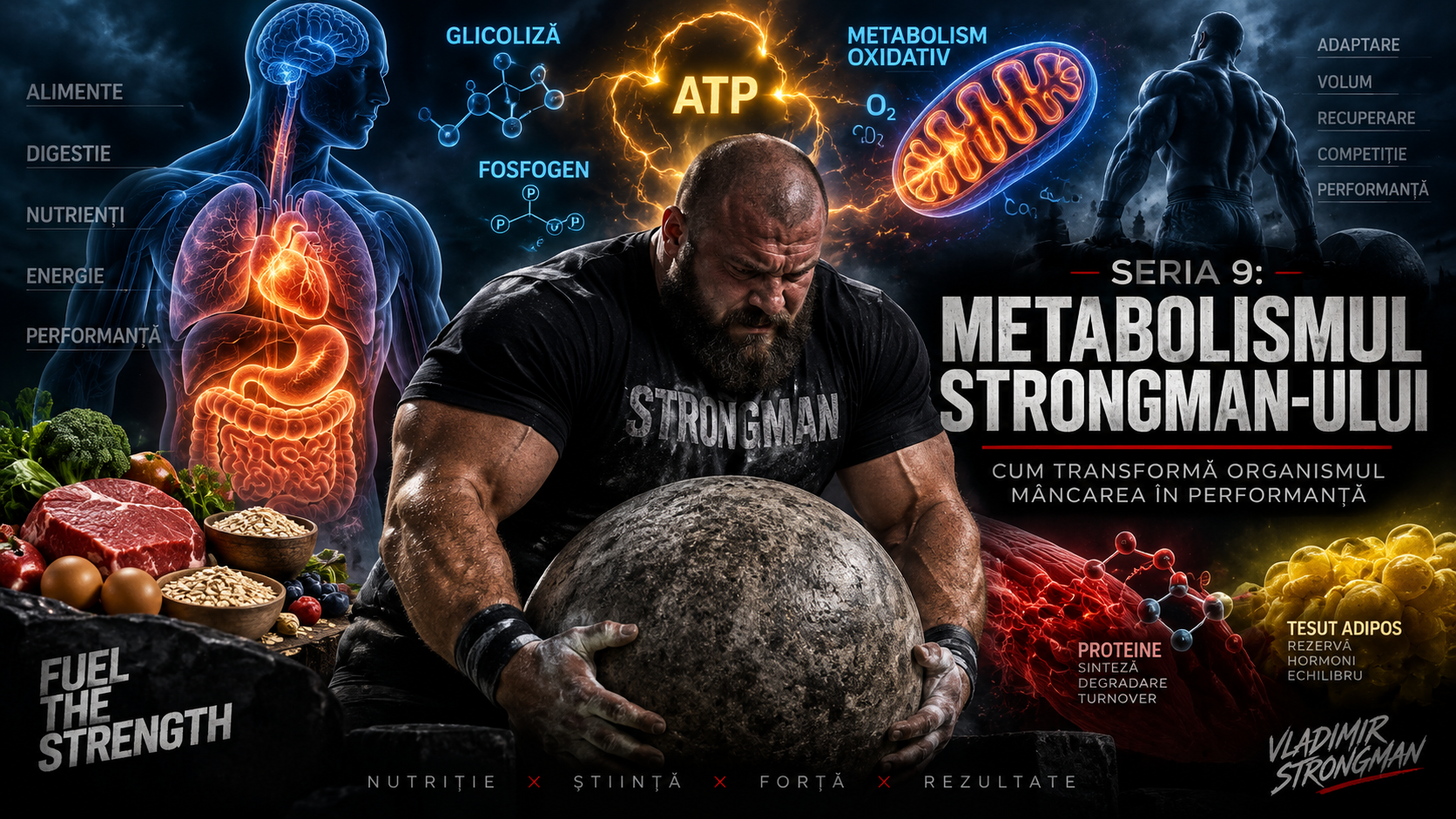
The Strongman Metabolism: Episode 2 - ATP and the Phosphagen System
In the first episode we followed food from the plate into metabolism. In this second episode we reach one of the most important links in the entire chain: ATP. If food is the raw material, ATP is the chemical energy molecule that a muscle fiber can use immediately to produce contraction. When a strongman attempts to move an enormous load during the first seconds of an event, the phosphagen system is one of the body's fastest energetic weapons.
There is an essential distinction here. Muscle does not transform a meal of rice, meat or bread directly into kilograms lifted in real time. Food energy is processed and stored in several forms, and ATP is the immediately usable currency. Because direct ATP stores are small, the body must continuously regenerate it. During maximal effort, the speed of that regeneration becomes critical.
1. ATP: the energy currency of contraction
ATP stands for adenosine triphosphate and is present in every cell. For muscle, its importance is fundamental: the energy released when ATP is hydrolyzed can be coupled to the processes required for contraction. In muscle fibers, the actin-myosin cross-bridge cycle, ion pumps and other processes involved in neuromuscular function depend on continuous ATP availability.
The problem is quantity. Existing ATP stores in muscle are small compared with the rate at which ATP can be consumed during maximal effort. If the body relied only on ATP already present inside the fiber, the ability to sustain contraction would be extremely brief. Performance therefore depends not only on ATP already present, but on the capacity to regenerate it.
2. Why ATP cannot be stored in enormous quantities
ATP is a reactive molecule and is not a practical solution for storing huge amounts of energy. The body uses other energy reserves: glycogen, triglycerides and the creatine-phosphocreatine system. These reserves can feed ATP production and regeneration when immediate energy is being consumed.
Think of ATP as money in your wallet, while the larger energy reserves are money available in accounts and savings. The wallet is what you can spend instantly. Accounts can refill the wallet, but the transfer speed differs. The phosphagen system is one of the fastest ways the body can refill that energetic wallet.
3. What is the phosphagen system?
The phosphagen system, also called the ATP-PCr system, is a rapid energy-supply mechanism in which phosphocreatine donates a phosphate group to ADP to form ATP again. The reaction is catalyzed by creatine kinase. Because the reaction is extremely rapid and does not depend directly on immediate oxygen delivery, it is well suited to the beginning of intense effort.
This does not mean the phosphagen system works alone. Glycolysis and oxidative metabolism are active in parallel. What changes is the relative contribution of each pathway. During the first seconds of a maximal action, phosphocreatine can provide a very large share of rapid ATP regeneration.
4. ATP, ADP and phosphate: the basic circuit
ATP contains three phosphate groups. When energy is used, ATP can lose one phosphate and become ADP, adenosine diphosphate. AMP, adenosine monophosphate, can also appear under certain conditions. To keep contraction going, ADP must be converted back into ATP.
In the phosphagen system, phosphocreatine is the rapid phosphate donor. Creatine kinase catalyzes the transfer, allowing ATP to be regenerated quickly. It is an elegant biological solution: rather than waiting for a longer sequence of metabolic reactions, the muscle uses a molecule that is already prepared for immediate ATP regeneration.
5. Creatine: the reservoir of rapid phosphate
Creatine is a naturally occurring molecule with a substantial concentration in muscle tissue. Some exists in free form and some as phosphocreatine. Through this creatine-phosphocreatine pair, muscle has a system for buffering and rapidly transferring phosphate groups.
During intense effort, phosphocreatine is consumed to help maintain ATP. After exercise, the reaction can shift in the opposite direction, helping restore phosphocreatine reserves using energy produced through oxidative metabolism. This is why recovery between efforts and oxygen availability are directly connected to phosphagen performance.
6. Where does the body's creatine come from?
The body synthesizes creatine, and some is obtained from food, especially animal products. Creatine is then transported to tissues and stored primarily in muscle. Total creatine stores and the proportion present as phosphocreatine vary between individuals and can be influenced by diet, muscle mass and creatine intake.
Creatine monohydrate supplementation has become one of the most studied nutritional strategies in sport. Its effect should not be imagined as an instant energy surge. The more accurate idea is simple: increased creatine availability can increase the total intramuscular creatine pool and may support a greater amount of high-intensity work in certain contexts.
7. Why does this matter so much for strongman?
Strongman combines movements in which rapid force production is crucial with events that can last longer and require repeated effort. Starting a yoke, lifting a heavy stone, a maximal deadlift, a heavy log press or the first seconds of a farmer's walk all demand very rapid energy production.
In these situations, the phosphagen system is highly valuable because it can supply ATP rapidly without waiting for the entire digestive stream to become immediate energy. Nutrients from previous meals have built and support the reserves, but the contraction is paid for by ATP that is already available and regenerated locally.
8. What happens during the first seconds of a lift?
Picture the bar, implement or object before the start. The moment the athlete produces a maximal contraction, ATP use rises extremely fast. Existing ATP is hydrolyzed, and the resulting ADP must be recycled. Phosphocreatine rapidly begins transferring phosphate groups to ADP.
This mechanism allows ATP availability to remain high when demand suddenly explodes. But the phosphocreatine pool is limited. As the effort continues, its relative contribution declines and other metabolic pathways become increasingly important.
9. Why is a maximal repetition not just 'strength'?
A maximal attempt looks from the outside like a purely mechanical act: muscle pushes, pulls and moves a load. Internally, however, the nervous system must recruit motor units, while muscle fibers consume ATP for every stage of contraction. The force can be enormous, but the rate of energy demand is enormous as well.
That is why two people with the same body mass can perform very differently. The difference is not just how much muscle they have, but also muscle architecture, technique, coordination, neuromuscular recruitment and the metabolic ability to support force production.
10. Regeneration speed matters as much as the reserve
Having phosphocreatine available matters. Being able to restore it rapidly matters just as much when intense efforts are repeated. After a hard contraction, phosphocreatine restoration begins immediately and is supported primarily by oxidative metabolism.
This helps explain why aerobic conditioning can relate to performance in strength sports. A strongman is not doing cardio to become a marathon runner. He can build a better ability to recover between hard efforts, sets or events.
11. Why does the rest period between repetitions change performance?
If you perform one maximal attempt after a very long rest, the demand on the system differs from doing several heavy attempts with short rests. In the second situation, phosphocreatine stores are not yet fully restored, while glycolytic and oxidative contributions increase.
In training, the rest period therefore becomes a metabolic variable. In competition the rule is the same, but the stakes are higher. An athlete can be extremely strong in the first event and look like a completely different athlete by the fourth if recovery between efforts is poor.
12. The phosphagen system does not mean 'anaerobic = no oxygen' in an absolute sense
The word anaerobic can create a misleading picture, as if oxygen completely disappeared from the organism. In reality, the body does not switch off oxidative metabolism when a sprint or heavy lift begins. All energy systems operate simultaneously. What changes is their relative contribution and the rate at which they can supply ATP.
In a very short event, the phosphagen contribution is larger. In a longer repeated event, glycolysis and oxidation become more important. Biology does not draw thick lines between systems; it creates continuous overlap.
13. What role does glycolysis play when phosphagen contribution starts to fall?
Glycolysis can generate ATP relatively quickly from glucose or glycogen. As exercise continues, its contribution becomes increasingly important. In a strongman event in which the athlete must continue moving or repeating a task, glycolysis can become a major contributor.
This creates an important advantage from good glycogen availability. If the phosphagen system is the sprint out of the blocks, glycolysis can be the engine that maintains the pace when the event lasts beyond the first seconds.
14. Phosphocreatine and the sensation of explosiveness
Athletes often describe the beginning of very intense effort with words such as 'explosion', 'pop' or 'instant speed'. The term is subjective, but there is a physiological basis: the phosphagen system can supply ATP at a very high rate. It is designed for situations in which the time available for energy production is extremely short.
The sensation of explosiveness, however, is not produced by creatine alone. Force and speed depend on the nervous system, muscle fiber properties, technique, tendon stiffness, joint positions and athlete experience. Rapid energy is necessary, but it is not sufficient for elite performance.
15. What happens inside the muscle fiber?
During contraction, myosin heads use ATP to cycle through the mechanochemical interaction with actin. At the same time, ATP is required by the pumps that maintain ion distribution, including processes that allow muscle relaxation after activation.
So ATP does not simply 'pay for the lift' in a simplistic sense. It supports the microscopic infrastructure of contraction and relaxation. The higher the intensity and frequency of activation, the more urgent ATP regeneration becomes.
16. Creatine supplementation: what can it and cannot do?
Creatine monohydrate is among the most researched supplements for high-intensity performance. With appropriate use, it can increase intramuscular creatine and phosphocreatine content and can support the ability to repeat short, intense efforts.
But creatine cannot replace training, technique, sleep or nutrition. It does not turn an untrained person into a strongman and it does not create ATP from nothing. It is a metabolic tool that can improve one component of the energy system.
17. Why can body weight increase after creatine?
Weight gain after starting creatine is commonly related to increased water associated with muscle tissue and should not automatically be interpreted as fat gain. In a sport where body mass matters, this change can be practically relevant, but individual responses differ.
It is also important not to confuse intracellular water with pathological fluid retention. In the context of creatine, increased muscle water is part of the response to a larger total creatine pool in the tissue.
18. What does phosphocreatine recovery mean?
After exercise, creatine and phosphocreatine need to be restored toward baseline. The energy required is supplied primarily by oxidative metabolism. This is where oxygen availability, circulation and the ability to repeat effort become connected.
Recovery is not instantaneous. Its dynamics depend on exercise intensity, training status, muscle mass and metabolic state. Practically, longer rest periods allow greater phosphagen recovery before another attempt.
19. The phosphagen system in classic strongman events
A maximal deadlift is an obvious example. The athlete needs an extremely rapid energy burst to initiate and accelerate the movement. In a heavy log press, the beginning of the repetition and stabilization of the implement also demand very rapid energy production. In an atlas stone, the initial phases of lifting and extension are highly demanding.
In carrying events, the situation changes with duration. The first seconds have an important phosphagen component, but glycolytic and oxidative metabolism contribute more and more as the event continues. If another task follows the carry, the ability to recover between phases can become decisive.
20. Why can an athlete be very strong but 'die' after a few repetitions?
Maximal strength and repeat-effort capacity are not the same physiological quality. An athlete can produce enormous force in one contraction while having a more modest capacity to sustain repeated actions. This is where glycogen availability, metabolic tolerance, circulation, oxidative capacity and between-effort recovery enter the picture.
In strongman, the champion is not necessarily the person with the biggest single lift. It is the athlete who can turn strength into points across the entire competition day. The phosphagen system is the first link in that equation, not the whole equation.
21. How does training influence the phosphagen system?
Strength and power training can improve the ability to produce and recycle ATP during intense effort. Adaptations can occur at the neuromuscular, enzymatic and structural levels, while programming appropriate intervals and rest periods can train the specific energetic quality being targeted.
Training the phosphagen system does not mean turning every session into a sequence of maximal attempts. Total volume, recovery and fatigue management are essential. Too much intensity without recovery can reduce stimulus quality and increase injury risk.
22. Breathing during a heavy lift
During a maximal lift, the athlete may use breathing and bracing strategies that increase trunk stiffness and help transmit force. These mechanisms should not be confused with a complete shutdown of oxidative metabolism. Even in a very short action, oxygen, circulation and metabolism continue to support the body.
After the repetition, breathing can rise to support gas exchange and recovery processes. That is why feeling out of breath after a short, brutally heavy set does not mean the event was purely aerobic. It means the whole organism is paying the cost of the effort and its recovery.
23. Lactic acid? No. Lactate is something else
An old myth says that lactate is directly responsible for all soreness and that 'lactic acid' builds up and remains in muscle. Real physiology is more nuanced. Lactate is an important metabolic product and can be reused as fuel by other tissues or by the same muscle, depending on context.
The burning sensation and loss of force during intense effort arise from multiple overlapping processes. It is not accurate to reduce everything to a single molecule or describe lactate as waste that must be removed by a miracle solution.
24. Why is the phosphagen system fast but not infinite?
The system's main advantage is speed. Its main limitation is capacity. Phosphocreatine stores cannot sustain an enormous rate of ATP regeneration indefinitely. As they are depleted, the body increasingly shifts the workload toward glycolysis and oxidative metabolism.
This shift helps explain the difference between a very short maximal effort and a longer strongman event. There is no exact moment when the phosphagen system 'turns off'. Its contribution gradually falls while other pathways contribute more.
25. ATP between events: the invisible part of competition
A strongman competition is not made of five isolated seconds. Between events, the athlete has to restore reserves and prepare for the next effort. This is where oxidative metabolism becomes essential again, because phosphocreatine restoration and whole-body energy recovery continue during the rest period.
That is why nutrition, hydration, sleep in the preceding days, conditioning and management of rest periods are not separate from ATP. They influence the environment from which ATP and phosphocreatine can be restored.
26. What does this mean for training?
If the goal is maximal strength, sets should allow high force output and high-quality technique. If the goal is repeat effort, rest intervals, volume and metabolic stress must be structured differently. If the goal is a carrying event, programming must reflect its actual duration and sequence of demands.
From this perspective, the energy system is not a lesson separate from strength programming. It explains why the same exercise with the same load can produce different adaptations when you change set duration, repetitions, rest interval and order within the session.
27. What does this mean for nutrition?
For the phosphagen system to work, the body needs an adequate creatine and phosphocreatine pool, and for that pool to be restored between efforts it needs energy, oxygen and time. Nutrition should not be seen as a way to 'load ATP' directly, but as a strategy to maintain the substrates and reserves metabolism needs.
This is where creatine connects naturally to the rest of nutrition. Creatine can support the phosphagen system, while carbohydrates, protein, fats, fluids and micronutrients support the whole organism. A strongman is not creatine with legs. He is a complex metabolic system.
28. The mistake: looking for one fuel for every event
One of the most persistent myths is that a single fuel explains all performance. In reality, energy systems overlap. ATP is the immediate currency, phosphocreatine enables rapid ATP regeneration, carbohydrates feed glycolysis and oxidation, and fat provides a major reserve for longer-duration energy production.
In strongman, performance comes from orchestrating these systems. An event begins with a demand for speed, continues with a demand for sustainability and ends with a demand for recovery. Metabolism must change gear without losing control.
29. Conclusion: the first seconds can decide everything
ATP is the immediately usable energy molecule. Phosphocreatine is one of the fastest reserves that can regenerate ATP. Creatine belongs to this infrastructure, and creatine kinase enables rapid transfer between phosphorylated creatine and ADP. For strongman, this system is essential because many actions begin with an explosive demand for force in which every second matters.
But the bigger lesson is that the phosphagen system does not exist in isolation. It depends on oxidative metabolism for recovery, glycolysis for continued effort and nutrition for maintaining reserves. Elite performance does not come from one mechanism. It comes from the way mechanisms connect.
What comes next in the series
The next episode will go into glycolysis and carbohydrate metabolism: how muscle glycogen supports repeated efforts, why some strongman events 'burn' more than others, how lactate is produced, and why carbohydrate availability can dramatically change the ability to sustain volume and repeated hard work.
More From The Journal

Training
The Science of Strongman Training - Episode X: Competition Programming
How to build a complete Strongman competition preparation block: calendar, events, volume, intensity, specificity, simulations, autoregulation, tapering and fatigue management.

Training
The Science of Strongman Training - Episode IX: Peaking
Peaking in Strongman: how to turn months of training into maximal competition performance by reducing fatigue, preserving adaptations and managing specificity.