
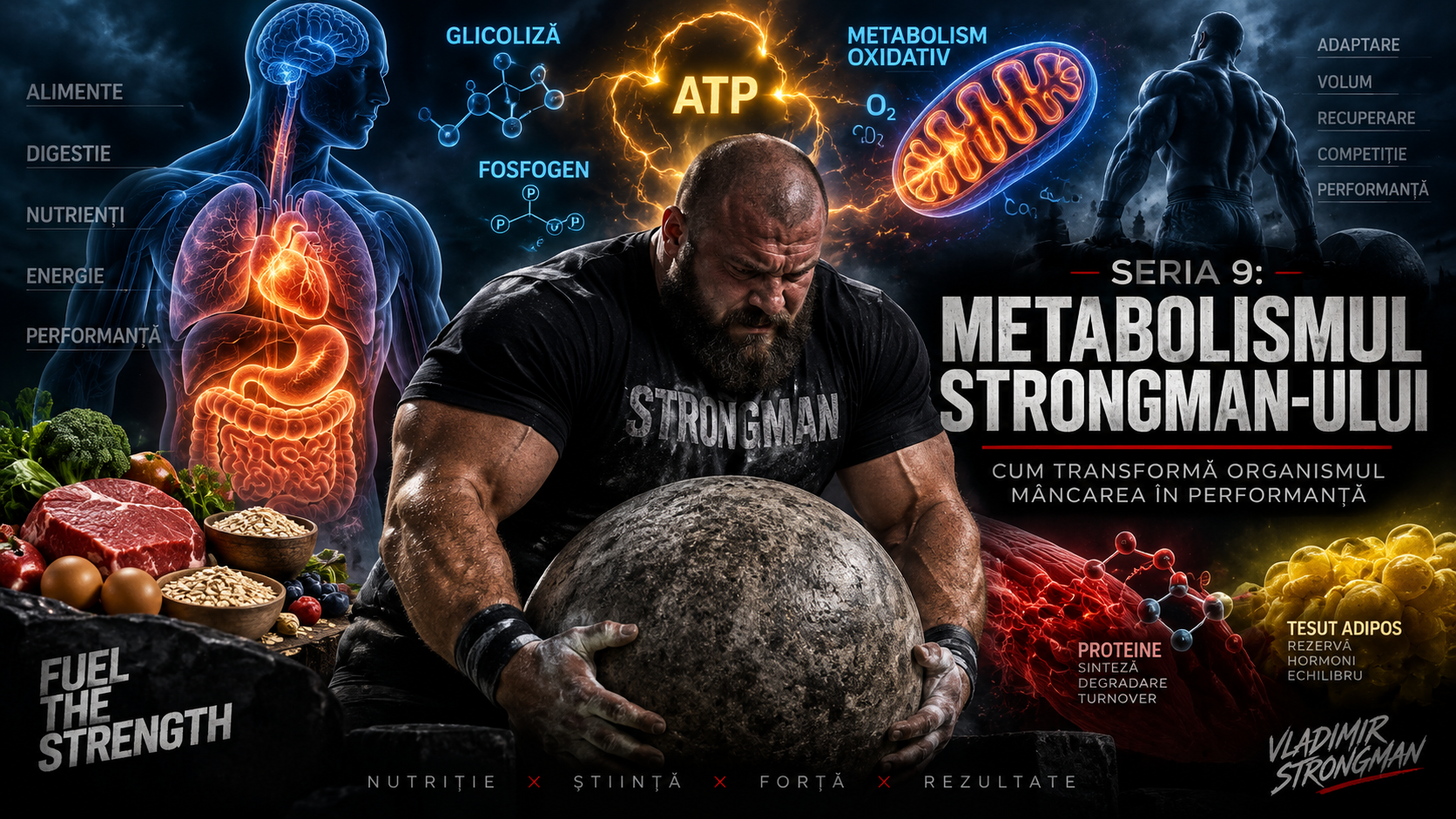
THE STRONGMAN METABOLISM: How Food Becomes Performance
For a strongman, the food on the plate is only the beginning of a much longer metabolic story. Rice, potatoes, meat, fruit, dairy, fats and fluids do not enter the muscle and instantly become another successful repetition. The body must digest them, absorb them, transport them, transform them chemically and decide where to use or store each component. All of this happens while the nervous system, heart, liver, kidneys and skeletal muscle are working continuously.
The moment an athlete begins to lift, the body does not ask how impressive lunch looked. The real questions are how much immediately available chemical energy exists, how quickly it can be supplied, which fuel pathway fits the intensity and duration of the effort, and how effectively the body can balance energy production with energy use. This is where performance metabolism begins.
1. What does metabolism actually mean?
Metabolism is the network of chemical reactions through which the body processes nutrients, produces and uses energy, builds new molecules and maintains the functions required for life. It is better understood as a network than as a single process. Some metabolic pathways break molecules down and release energy. These are catabolic processes. Others use energy and raw materials to build glycogen, proteins, lipids or cellular structures. These are anabolic processes.
For an athlete, metabolism becomes particularly interesting when these reactions are connected to real demands. A strongman does not perform only one kind of work. One event may be a maximal-strength effort lasting a few seconds, while another may be a heavy carry that stresses the energy systems for much longer. Some events involve brief explosive acceleration, others require sustained contraction and posture, and others require repeated efforts under fatigue. That is why a strongman needs a flexible metabolic system capable of shifting between energy sources.
2. The first stop: digestion
Before a nutrient can be used by cells, it has to be released from the food matrix. Complex carbohydrates are broken down into smaller units, proteins into amino acids and peptides, and triglycerides into fatty acids and other products of lipid digestion. Digestion starts in the mouth and continues through the stomach and small intestine, where digestive enzymes, bile and the enormous surface area of the intestine enable nutrient breakdown and absorption.
This matters in strongman because two meals containing the same total energy do not necessarily create the same metabolic timeline. Food composition, fiber, carbohydrate type, fat content, food texture and the combination of macronutrients can influence gastric emptying and the speed at which nutrients become available. Around training or competition, that difference can have real practical consequences.
3. Absorption: when food becomes circulating material
After digestion, nutrients cross the intestinal epithelium and enter circulation. Glucose and amino acids are transported primarily through the portal circulation to the liver, while dietary fat initially follows a different route through the lymphatic system, traveling in chylomicrons before entering the bloodstream.
The liver therefore acts as one of the body's major metabolic sorting stations. It can store glucose as glycogen, release glucose into the circulation, transform metabolic substrates, and participate in amino-acid and lipid processing. Muscle has its own glycogen stores, and this distinction is crucial: muscle glycogen is primarily a local energy reserve for the muscle rather than a general glucose reservoir for the whole body.
4. Glucose: from meal to glycogen and ATP
Carbohydrates are especially relevant to strongman because glucose can be used rapidly in energy metabolism. After absorption, glucose can be oxidized to support ATP production, stored as glycogen or, depending on metabolic state, participate in other synthetic and conversion pathways.
Muscle glycogen is stored carbohydrate inside muscle fibers. When exercise begins, enzymes can mobilize glycogen and feed it into glycolysis, generating intermediates that support ATP production. During high-intensity efforts of short to moderate duration, this ability to mobilize carbohydrate rapidly can become critical. Well-fueled muscle glycogen does not guarantee a record, but inadequate carbohydrate availability can restrict the ability to sustain volume, repetitions and repeated high-intensity work.
5. ATP: the currency that pays for muscle contraction
Muscle does not directly consume rice, sugar or fat. It consumes ATP. ATP, or adenosine triphosphate, is the immediately usable energy molecule for many cellular processes, including the actin-myosin cross-bridge cycle that underlies muscle contraction. The problem is that intramuscular ATP stores are small. The body therefore has to resynthesize ATP almost continuously during exercise.
This brings us to the three major pathways that resynthesize ATP: the phosphagen system, glycolysis and oxidative metabolism. They do not switch on one at a time like three separate buttons. All are active simultaneously, but their relative contribution changes with exercise intensity and duration. During a very short explosive effort, phosphagen pathways contribute heavily. As the effort continues or is repeated, glycolysis and oxidative metabolism carry an increasing share of the workload.
6. The phosphagen system: energy for the first seconds
Phosphocreatine provides an extremely rapid way to resynthesize ATP. The reaction is catalyzed by creatine kinase, which transfers a phosphate group from phosphocreatine to ADP, forming ATP. This system is well suited to very intense, short-duration efforts, exactly the context in which a strongman may attempt a single heavy lift, a powerful acceleration or the opening seconds of an event involving a massive implement.
Dietary and supplemental creatine can contribute to maintaining the body's creatine and phosphocreatine pool, but that should not be confused with the idea that a supplement creates energy from nothing. It influences the availability of a substrate used by the phosphagen system. Actual force production remains dependent on muscle mass, coordination, neuromuscular recruitment, technique, fatigue and many other factors.
7. Glycolysis: when carbohydrate is converted rapidly into energy
Glycolysis is the sequence of reactions through which glucose or glycogen is converted into pyruvate. The process can generate ATP rapidly. When pyruvate production and energy demand temporarily exceed mitochondrial oxidative capacity, some pyruvate is converted to lactate. Lactate is not useless waste. It can be transported, oxidized by other tissues or recycled as a metabolic substrate through inter-organ exchange pathways.
For strongman, this is especially relevant during events that last long enough for glycolysis to contribute substantially but remain too intense to be supported primarily by oxidative metabolism. Repeated lifts, carries, pushes, pulls and combinations of movements can create exactly this metabolic mix. The feeling of burning and loss of speed cannot be explained by a single metabolite, but the accumulation of metabolic products and changes in the muscle environment contribute to fatigue and reduced force production.
8. The mitochondria: the power plant that matters especially during longer work and recovery
Oxidative metabolism uses oxygen and occurs largely in mitochondria. Carbohydrates, fatty acids and, under certain conditions, carbon skeletons derived from amino acids can feed this network to produce ATP. Oxidative pathways are slower than the phosphagen system but have a much greater capacity to sustain energy production over time.
In strongman, oxidative metabolism does not become irrelevant simply because an event looks like a fight lasting a few tens of seconds. It contributes to recovery between sets and events, restoration of phosphocreatine, lactate metabolism and all the energy processes that continue after the repetition ends. The more hard efforts a competition or training session contains, the more important recovery between them becomes.
9. Why fat is not one-speed fuel
Fatty acids can provide large amounts of energy, but their mobilization and oxidation are generally slower than rapid carbohydrate metabolism. For that reason, fat is better suited to supporting long-duration energy needs and overall energy balance than to powering a single explosive maximal action by itself.
However, fats should not automatically be pushed to the minimum in a strongman diet. Dietary fat is an energy source, part of cellular membranes, involved in absorption of fat-soluble vitamins and relevant to multiple synthetic processes. The goal is an intake that fits total energy needs, digestive tolerance, meal timing and individual priorities.
10. Protein: not the main fuel, but the material for building and repair
When discussing strength-sport nutrition, protein is almost automatically associated with muscle. Its role is broader. Amino acids are used to synthesize muscle proteins and many other proteins, including enzymes, transporters and cellular structures. The body can also use amino acids as an energy substrate under certain conditions, but that is not the primary reason a strongman needs adequate protein intake.
For training adaptation, total protein matters, but so do protein distribution across meals, source quality, overall energy intake and the training stimulus itself. When energy availability is too low, the body must prioritize basic physiological needs, and providing a huge protein dose does not automatically make new tissue construction more efficient.
11. Insulin is not the athlete's enemy
After a meal, blood glucose and certain amino acids change, and the pancreas releases insulin. Insulin promotes glucose uptake by certain tissues, glycogen synthesis and several anabolic processes. In strength sports, the popular idea that any rise in insulin is inherently bad is a crude oversimplification. Metabolic context, total energy intake, diet composition and exercise timing matter far more than demonizing a single hormone.
After training, glycogen restoration and nutrient availability are useful processes. Before exercise, adequate carbohydrate intake can support energy availability. Insulin is one component of that system, not its imaginary opponent.
12. The liver: a metabolic command center
The liver maintains an important share of the body's metabolic balance. It stores glycogen, can produce glucose through gluconeogenesis, metabolizes many substances and participates in lipid and amino-acid processing. During exercise, the liver helps maintain blood glucose so tissues that rely heavily on glucose can continue to function.
This is one of the key differences between liver glycogen and muscle glycogen. Muscle primarily uses its own glycogen for its own work. The liver has a larger role in regulating circulating glucose. When glycogen availability is low, maintaining blood glucose and supporting prolonged work can become more difficult, particularly when training volume is high and dietary intake is inadequate.
13. Why can a strongman eat huge amounts and still fail to progress?
Calories are not performance. They are chemical energy. To become progress, that energy has to enter a system in which training, recovery, sleep and adaptation can use it. A caloric surplus can support body-mass gain and anabolic processes, but more food does not automatically mean more strength.
If the surplus is excessive, a significant share of the extra energy can be stored as adipose tissue. For some strongmen, gaining body mass can be strategically useful. For others, excessive mass can impair mobility, cardiovascular tolerance, heat tolerance, digestion or movement speed. Metabolism does not obey the ideology that more is always better; it responds to need, availability and context.
14. Energy from food is not identical to energy available to muscle
The energy value listed for food is an estimate, but the body does not transfer that energy completely and instantly to muscle fibers. Some energy is spent digesting and absorbing food, some supports basic physiological function, some may be stored, and the remainder feeds the metabolic pathways required for current activity and adaptation.
This helps explain individual differences between athletes. Two people can appear to eat the same amounts and still show different responses because of body size, body composition, spontaneous activity, digestion, dietary history, training status and metabolic adaptation.
15. The thermic effect of food: energy spent processing energy
Digestion and nutrient processing also have an energetic cost. This is called the thermic effect of food. Protein generally has a higher thermic effect than carbohydrate and fat because its processing involves more biochemical transformation. For a strongman, the thermic effect is not a fat-loss trick, but it is part of the total energy equation.
16. Why the same diet can work differently in the offseason and in competition
In the offseason, the goal may be adding muscle and building work capacity. Near competition, priorities can shift toward digestibility, gastrointestinal comfort, glycogen restoration, hydration, body-weight control and the ability to maintain performance between events. The same meal that works perfectly on a recovery evening may be uncomfortable two hours before a heavy event.
This is where metabolism meets strategy. There is no single strongman diet. There are, however, stable principles: enough energy, adequate protein, carbohydrates matched to training volume and intensity, dietary fat at an individually appropriate level, hydration and sufficient micronutrients.
17. Hydration: chemical reactions need the right environment
Water is not fuel, but normal metabolism cannot function without it. Plasma volume, temperature regulation, nutrient transport, waste removal and neuromuscular function all depend on adequate hydration. During hard exercise and in hot environments, water and electrolyte losses can impair performance before an athlete feels that the energy tank is empty.
Sodium and other electrolytes matter in the context of sweat loss and fluid balance. But the strategy should not become a contest to consume huge amounts of water or salt without context. Requirements vary with sweat rate, environmental temperature, exercise duration, diet and individual characteristics.
18. When digestion becomes the limit instead of energy
One of the defining practical challenges of strongman is that energy needs can become very high. The stomach, however, has limits. An athlete may require many calories but cannot increase food volume indefinitely. Energy density, food selection, meal frequency and gastrointestinal tolerance therefore become strategic variables.
A very high-volume diet can cause bloating, reflux, nausea or discomfort. In competition, these symptoms can reduce performance even when the written calorie target is perfect. Strongman nutrition is therefore partly a problem of digestive logistics.
19. What happens after the meal?
The period after eating is characterized by a metabolic state in which the body uses absorbed nutrients and restores reserves. Glucose can support immediate oxidation or be stored as glycogen. Amino acids can be incorporated into proteins. Lipids can be oxidized or stored. Insulin, glucagon and other hormonal signals coordinate these flows.
This is why the popular idea of a tiny "anabolic window" needs perspective. Nutrition around training matters, but adaptation is not decided by a few dozen minutes. Total energy and macronutrient intake over days and weeks are major determinants. For a strongman, consistency beats obsession with the perfect minute for a post-workout shake.
20. What happens during maximal effort?
When the load becomes maximal, energetic and neural demand rises abruptly. ATP is consumed rapidly, and the phosphagen system accelerates its resynthesis. Glycolysis contributes according to the duration and intensity of the action, while oxidative metabolism is already active and becomes increasingly important as time passes and between efforts.
During a lift lasting only a few seconds, an athlete does not literally burn lunch. The body uses energy molecules already available or stored and rapidly mobilizes substrates. The pre-training meal contributes to the metabolic context and reserve status, not as a direct conversion of food into kilograms lifted in real time.
21. After the event: metabolism enters reconstruction mode
After exercise, the body must restore ATP and phosphocreatine, replenish glycogen, repair affected structures and normalize temperature, fluid balance and the hormonal environment. Nutrition can support these processes, especially when sessions are close together or when several events occur within a competition.
Carbohydrates can support glycogen restoration, protein supplies amino acids for repair and adaptation, and fluids and electrolytes help restore fluid balance. There is no need for elaborate rituals for biology to work. The basic materials simply need to be available in sufficient amounts, repeatedly.
22. How metabolism turns nutrition into adaptation
Long-term performance does not appear simply because ATP was produced. Training creates a signal, and the body responds with adaptation. Muscle proteins are remodeled, enzymes adapt, energy stores can change, and the cardiovascular and neuromuscular systems adjust. Nutrition provides a substantial share of the raw materials required for that reconstruction.
This is why diet and training cannot be completely separated. An excellent training stimulus combined with inadequate recovery and insufficient energy availability can produce less progress than the athlete's potential would allow. Conversely, a strong diet cannot turn poor programming into championship-level preparation.
23. The strongman needs metabolic flexibility
Relevant metabolic fitness for strongman is not simply the ability to burn many calories. It is the ability to use different substrates effectively and shift between energy systems without major losses in performance. An athlete needs to produce energy quickly, sustain work for longer periods, recover and repeat the process.
That is why a strongman's physical preparation involves more than maximal-strength attempts. Conditioning work and aerobic development can indirectly affect performance through recovery, tolerance to volume and the ability to repeat high-intensity efforts.
24. What does all of this mean for the plate?
The first principle is adequate energy for the objective. Gaining muscle, maintaining body weight, reducing fat mass and supporting competition have different requirements. The second is adequate protein to support protein turnover and adaptation. The third is not to treat carbohydrates as an enemy: for many strongman events, glycogen availability and the ability to mobilize carbohydrate rapidly are highly relevant. The fourth is to choose fat intake and food sources that provide energy while remaining compatible with digestive tolerance. The fifth is to treat hydration and micronutrients as part of the system rather than accessories.
25. Conclusion: the plate is only the first link
In strongman, food becomes performance only after passing through an entire biological infrastructure. Digestion breaks it down. The intestine absorbs it. The liver and blood distribute it. Muscle turns it into ATP or stores it. Mitochondria process substrates. Glycogen supports hard work. Phosphocreatine buys the first seconds. Protein supplies material for reconstruction. Water and electrolytes maintain the environment in which all these reactions can occur.
Once you understand this chain, nutrition becomes easier to see without myths. There is no magic food that enters the stomach and exits as a record. There is a metabolic system in which energy, nutrients, hormones, the nervous system, muscle and recovery work together. For a strongman, the goal is not simply to eat a lot. It is to turn what you eat intelligently into the capacity to produce force, repeat hard efforts and recover well enough for the next fight with the weight.
What comes next in the series
Future episodes will go deeper into each component: glycogen and carbohydrate metabolism in strongman, protein and muscle protein synthesis, dietary fat and hormones, insulin and energy management, metabolism during events, hydration and electrolytes, digestion at very high calorie intakes, and how the body adjusts metabolism during mass-gain phases, dieting and competition preparation.
More From The Journal

Training
The Science of Strongman Training - Episode X: Competition Programming
How to build a complete Strongman competition preparation block: calendar, events, volume, intensity, specificity, simulations, autoregulation, tapering and fatigue management.

Training
The Science of Strongman Training - Episode IX: Peaking
Peaking in Strongman: how to turn months of training into maximal competition performance by reducing fatigue, preserving adaptations and managing specificity.