
Nutrition
Series: Food Around Training - Episode 5: Fat Before Exercise: When It Helps and When It Gets in the Way
September 11, 2026
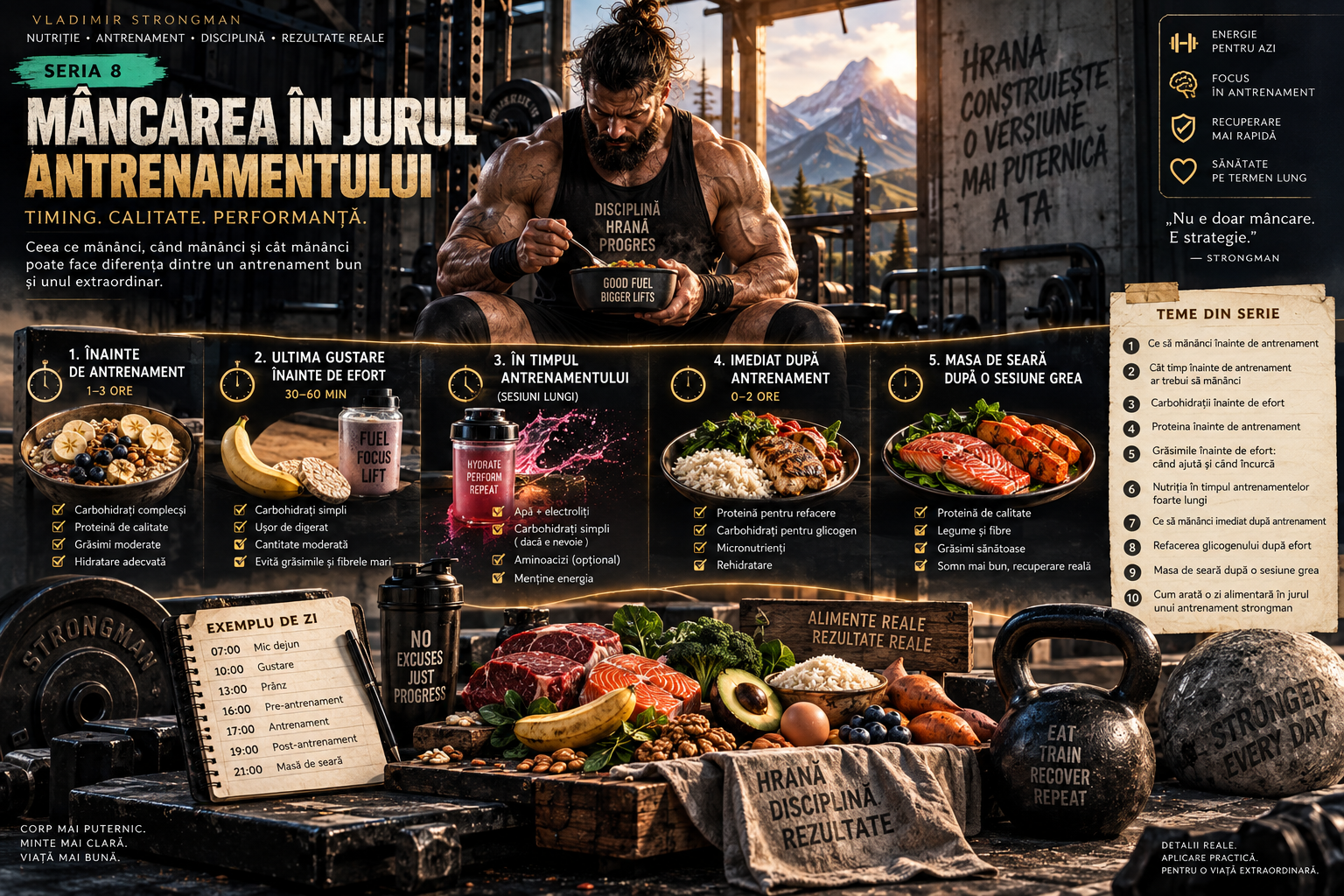
Dietary fat is essential in a good diet, but that does not mean a very high-fat meal is automatically a good choice immediately before training.
For strength athletes, fat plays an important role in daily energy intake, cellular health and absorption of fat-soluble vitamins, but its acute effect before exercise differs from carbohydrate.
The useful question is not whether fat is good or bad, but how much you eat, what kind of meal you build and how much time remains before training.
1. Fat is not the main fuel for a heavy set
A heavy set of squats, deadlifts or log press relies mainly on the phosphagen system and glycolysis, not rapid fat oxidation.
Fat contributes more to resting energy and lower-intensity work, but it does not suddenly become the dominant fuel just because you ate a fatty meal before the gym.
2. Why fat is still important
Dietary fat provides essential fatty acids, contributes to cell-membrane structure and helps absorb vitamins A, D, E and K.
For these functions, the diet across days and weeks matters more than a large dose of fat immediately before the first set.
3. The main pre-workout issue: gastric emptying
Fat can slow gastric emptying, which means a meal may stay in the stomach longer and the sensation of fullness may persist.
The effect depends on the amount, total meal volume and what else the meal contains, especially fiber, dense protein foods and highly processed foods.
4. Three to four hours before training
If training is three to four hours away, a moderate amount of fat in a complete meal is usually well tolerated.
Rice with meat, potatoes with eggs, pasta with a protein source or yogurt with cereal can all contain some fat without that fat automatically becoming a problem.
5. One to two hours before
As training gets closer, reducing both fat and total meal volume becomes more useful.
Leaner protein sources, easy-to-digest carbohydrate and smaller portions tend to be more predictable than a heavy high-fat meal.
6. Less than one hour before
With less than 60 minutes before exercise, large amounts of fat rarely provide a practical advantage for a strength session.
If you need extra energy, fruit, some bread, a carbohydrate drink or another light snack is usually more appropriate than a fatty food.
7. Portion size changes the response
Ten grams of fat in a meal do not have the same digestive impact as 40-60 grams consumed with a large portion of solid food.
The problem often comes from the combination of a lot of fat, high food volume, fiber and proximity to the training session.
8. Energy density can be an advantage
For a very heavy athlete who needs many calories, fat can increase energy intake without adding the same food volume as an equivalent amount of carbohydrate.
That advantage is more useful at meals farther from training than in the final hour before a session with aggressive bracing.
9. During a calorie surplus
During mass-gain phases, oils, nuts, nut butters, eggs and higher-fat dairy can help reach daily calorie targets.
It is usually more effective to distribute those calories across the day than to turn the pre-workout meal into a calorie bomb that occupies the stomach.
10. During a calorie deficit
In a calorie deficit, fat can support satiety and make meals more satisfying, but it is very energy dense.
When calories are limited, many athletes prefer a pre-workout meal richer in carbohydrate and protein while placing more of their fat elsewhere in the day.
11. Saturated versus unsaturated fat before the gym
For immediate pre-workout comfort, total fat and overall meal composition are often more important than a simple saturated-versus-unsaturated classification.
For long-term health, the quality of fat sources still matters and should be judged in the context of the entire diet.
12. Nuts and seeds
Nuts and seeds provide fat, protein, fiber and micronutrients in a relatively small volume, making them useful in high-calorie diets.
Close to training, the combination of high fat and fiber may be harder to tolerate for athletes who bloat easily.
13. Peanut butter and other nut butters
A small amount of peanut butter in a meal several hours before training can be perfectly tolerable and adds energy in a small volume.
Several large spoonfuls close to training can quickly turn a simple snack into a very energy-dense and slow-digesting meal.
14. Eggs before training
Whole eggs combine protein and fat and can work very well in a pre-workout meal when enough time is available for digestion.
If training begins soon, a smaller serving or combining egg whites with fewer yolks can reduce fat without removing protein.
15. Fatty meat versus lean cuts
A fatty steak and a lean cut can both provide protein, but they differ in energy density and digestive speed.
Closer to exercise, leaner cuts tend to be easier to integrate, especially before squats, deadlifts or strongman events.
16. Dairy and fat content
Yogurt, milk and cheese vary widely in fat content, and lower-fat versions are often easier to tolerate close to training.
Lactose tolerance and portion size matter just as much as fat percentage, so individual response remains important.
17. Fried food and fast food
Fast-food meals often combine a lot of fat with large portions, salt, sauces and dense foods, making them harder to tolerate before training.
The issue is not that one meal automatically ruins performance, but that digestion becomes less predictable exactly when you want to focus on execution.
18. MCTs are not magical fuel
Medium-chain triglycerides are absorbed differently from many other fats, but that does not make them equivalent to carbohydrate for intense strength work.
In larger amounts they can cause gastrointestinal discomfort, so introducing them immediately before a hard session is not a risk-free digestive strategy.
19. If you follow a low-carbohydrate diet
Adaptation to a low-carbohydrate diet can alter substrate use, but it does not mean you need a very high-fat meal immediately before every training session.
High-intensity work still relies strongly on phosphagen and glycolytic energy systems regardless of dietary preference.
20. Morning training
If you train shortly after waking, there is no need to force down a very fatty breakfast just to obtain supposedly long-lasting energy.
A smaller snack with easy-to-digest carbohydrate and protein may be much more comfortable when the session starts within 30-60 minutes.
21. Evening training
For evening training, fat can be distributed through breakfast and lunch while the meal closest to the gym remains lighter.
A very high-fat meal late in the day may create both training discomfort and, in some people, more reflux or poorer sleep after the session.
22. Strongman amplifies the full-stomach problem
A tight belt, aggressive bracing, loaded movement and rapid changes in body position can make a very fatty meal impossible to ignore.
Yoke, farmers, sandbag, log press and deadlift are examples where abdominal comfort may matter more than the theoretical advantage of a few hundred extra calories.
23. On competition day
On competition day, use foods you have already tested and keep larger, higher-fat meals far enough away from the events.
A huge greasy meal before the first event may deliver more reflux and stomach heaviness than useful energy.
24. If you have reflux
High-fat meals can worsen reflux in some people, especially when they are quickly followed by exercise and high abdominal pressure.
In that case, leaving a longer interval between eating and training and lowering fat in the meal closest to exercise can be practical strategies.
25. How much fat is too much?
There is no universal gram threshold that turns a good meal into a bad one because tolerance depends on the person, food choices, portion size and time before exercise.
Practical signs are more useful: if you experience fullness, reflux, nausea, sleepiness or uncomfortable pressure under the belt, the amount or timing needs adjustment.
26. The practical formula
Keep fat as a normal part of the diet and use it for energy density and satiety when needed, but the closer and more demanding the session is for the abdomen, the lower-fat, smaller and easier-to-digest the pre-workout meal should become.
More From The Journal

Training
The Science of Strongman Training - Episode X: Competition Programming
How to build a complete Strongman competition preparation block: calendar, events, volume, intensity, specificity, simulations, autoregulation, tapering and fatigue management.

Training
The Science of Strongman Training - Episode IX: Peaking
Peaking in Strongman: how to turn months of training into maximal competition performance by reducing fatigue, preserving adaptations and managing specificity.