
Nutrition
Series: Food Around Training - Episode 3: Carbohydrates Before Exercise
September 11, 2026
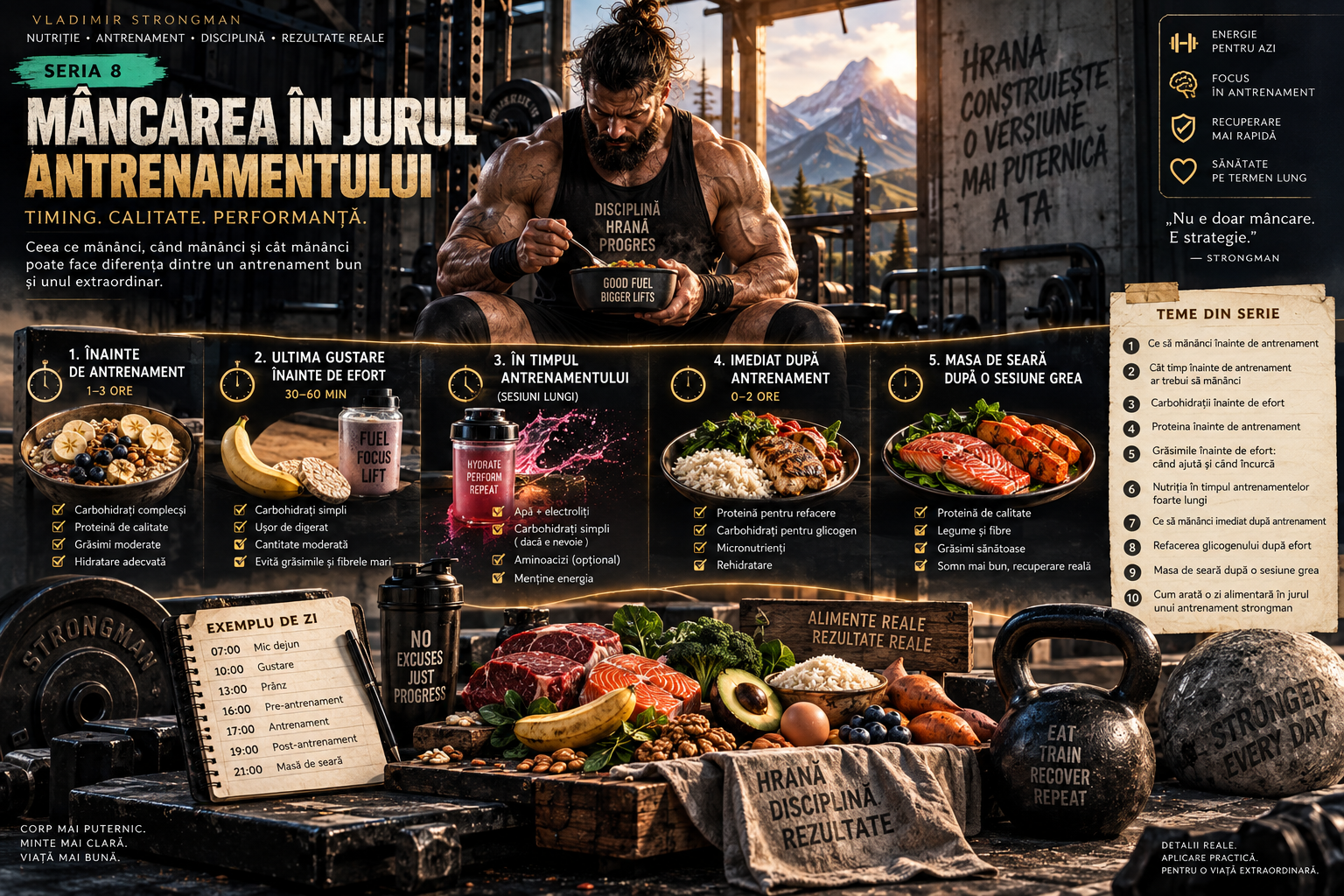
Pre-exercise carbohydrate should be understood as part of fueling the whole session, not as a last-minute trick.
In strength sports, carbohydrate needs depend on session duration, set count, training density and the meals eaten beforehand.
A heavy single and a three-hour session with yoke, farmers and medleys do not require the same fueling strategy.
1. Why carbohydrates matter
Carbohydrates support muscle and liver glycogen and can provide available glucose during exercise.
As repetitions, sets and repeated efforts increase, glycogen becomes more important for maintaining work quality.
2. Maximal strength does not rely only on glucose
A maximal effort lasting only a few seconds relies mainly on the phosphagen system rather than carbohydrate as the dominant immediate fuel.
But training also includes warm-ups, work sets, accessories and sometimes repeated events, where glycolytic contribution rises.
3. Muscle glycogen
Muscle stores carbohydrate as glycogen and uses it locally to support repeated contractions.
A meal eaten two hours before training does not instantly fill every store because glycogen status reflects nutrition over a longer period.
4. The pre-workout meal cannot repair the whole day
If carbohydrate intake has been very low all day, one banana before warming up does not instantly rebuild the energy context.
Pre-workout carbohydrate works best as part of a coherent daily intake.
5. When carbohydrates become more important
Their importance rises during long sessions with many sets, short rests, moderate repetitions or several strongman events.
Log press followed by yoke, farmers and sandbags demands a different energy strategy from a few heavy singles with long rests.
6. How long before training
A larger carbohydrate-rich meal often fits two to four hours before exercise, while a simple snack can be eaten closer to training.
The shorter the interval, the smaller the portion should become and the easier the source should be to digest.
7. How much carbohydrate
For many strength sessions, roughly 0.5-1.5 g/kg in the hours beforehand can be a useful starting point, adjusted to context.
For very heavy athletes, mechanically multiplying every recommendation by total body mass makes little sense when it creates portions that cannot be tolerated.
8. Rice before training
White rice is popular because it provides plenty of starch, little fat and relatively little fiber in an easy-to-control portion.
It is not magical, but it is predictable, and digestive predictability matters enormously before training.
9. Potatoes and pasta
Potatoes and pasta can work just as well, but food volume, satiety and accompanying sauces can change tolerance substantially.
Plain pasta and pasta covered in a heavy, fatty sauce are two very different digestive experiences even though both contain carbohydrate.
10. Bread and cereals
Bread and cereals can provide easily portioned carbohydrate, especially when training is relatively close.
If you bloat easily, products very high in bran or seeds may be less comfortable than refined options.
11. Fruit
Bananas, grapes, oranges and other fruits can provide carbohydrate, water and micronutrients in a practical form.
Fructose does not make fruit unsuitable before exercise; the amount and individual tolerance matter.
12. Juices and carbohydrate drinks
Carbohydrate-containing fluids can be useful when time is short, appetite is low or a solid meal would create too much gastric volume.
During very long sessions, they can also be used while training to spread intake across time.
13. Simple carbohydrates are not automatically bad
Sugar, honey, jam or carbohydrate drinks can have a practical role close to training because they are easy to digest.
The problem begins when these foods dominate the daily diet and replace sources rich in fiber, vitamins and minerals.
14. Glycemic index does not decide everything
The glycemic index describes a response under standardized conditions, but mixed meals, portion size and timing change the real response.
For athletes, digestibility and stable energy are often more important than labeling a carbohydrate as fast or slow.
15. Insulin and the myth of the mandatory spike
You do not need a massive insulin spike before training in order to produce strength.
The practical goal is enough fuel and well-tolerated blood glucose, not turning the meal into an endocrine experiment.
16. Responses differ between people
Some athletes tolerate fast carbohydrate extremely well before exercise, while others feel better with a mixed meal eaten earlier.
If you experience sleepiness, rapid hunger or discomfort, adjust the source, portion or timing before blaming carbohydrate as a whole.
17. Strongman and carbohydrates
Strongman combines maximal strength with movement, grip work, medleys and repeated efforts, which makes carbohydrate more relevant.
Yoke, farmers, sandbags and prowler work in the same day demand a more serious fueling strategy than a short three-exercise session.
18. Bracing changes food choice
Even when carbohydrate is useful, a gigantic portion immediately before belt work and repeated Valsalva maneuvers can become counterproductive.
A larger meal earlier and a small top-up before the session can preserve energy without sacrificing abdominal comfort.
19. Morning training
If you train immediately after waking, you do not have to force a large amount of solid carbohydrate.
A small snack or carbohydrate drink may be enough when the previous evening meal was adequate and the session is not very long.
20. Evening training
For evening sessions, carbohydrate eaten at breakfast and lunch already contributes to the energy context of training.
The pre-workout meal completes this context rather than creating it from zero.
21. Calorie deficit
During a calorie deficit, placing a larger share of daily carbohydrate around training can help preserve performance and training volume.
This is a distribution strategy, not proof that carbohydrate eaten at other times does not matter.
22. Calorie surplus
During a surplus, carbohydrate is usually abundant and excessive food volume before exercise may become the bigger problem.
You do not need to force the largest meal of the day before squats simply because you are trying to gain weight.
23. If your stomach is sensitive
If reflux, bloating or cramps occur, try smaller portions, less fiber and carbohydrate sources you already know you tolerate.
A simple log of meals, time to training and symptoms can quickly reveal which combinations work best.
24. Carbohydrate before or during the session?
For a short session, pre-workout fueling may be enough. For two to three hours of training or many events, intra-workout carbohydrate can become useful.
Spreading intake across time can reduce the need for a huge meal before the first exercise.
25. The practical formula
Two to three hours before training, choose a meal built around a carbohydrate source you digest well; with less than an hour remaining, reduce the portion and simplify the source.
Consider daily intake, session duration, body mass, digestive tolerance and calorie goals together.
Pre-workout carbohydrate is useful when it improves the session, not when it becomes a rigid rule that forces you to eat against your stomach.
The effective strategy is simple: enough carbohydrate across the day, an appropriate dose before exercise and, when needed, additional fueling during long sessions.
More From The Journal

Training
The Science of Strongman Training - Episode X: Competition Programming
How to build a complete Strongman competition preparation block: calendar, events, volume, intensity, specificity, simulations, autoregulation, tapering and fatigue management.

Training
The Science of Strongman Training - Episode IX: Peaking
Peaking in Strongman: how to turn months of training into maximal competition performance by reducing fatigue, preserving adaptations and managing specificity.