
Nutrition
Series: Food Around Training - Episode 10: What a Full Day of Eating Around a Strongman Workout Looks Like
September 11, 2026
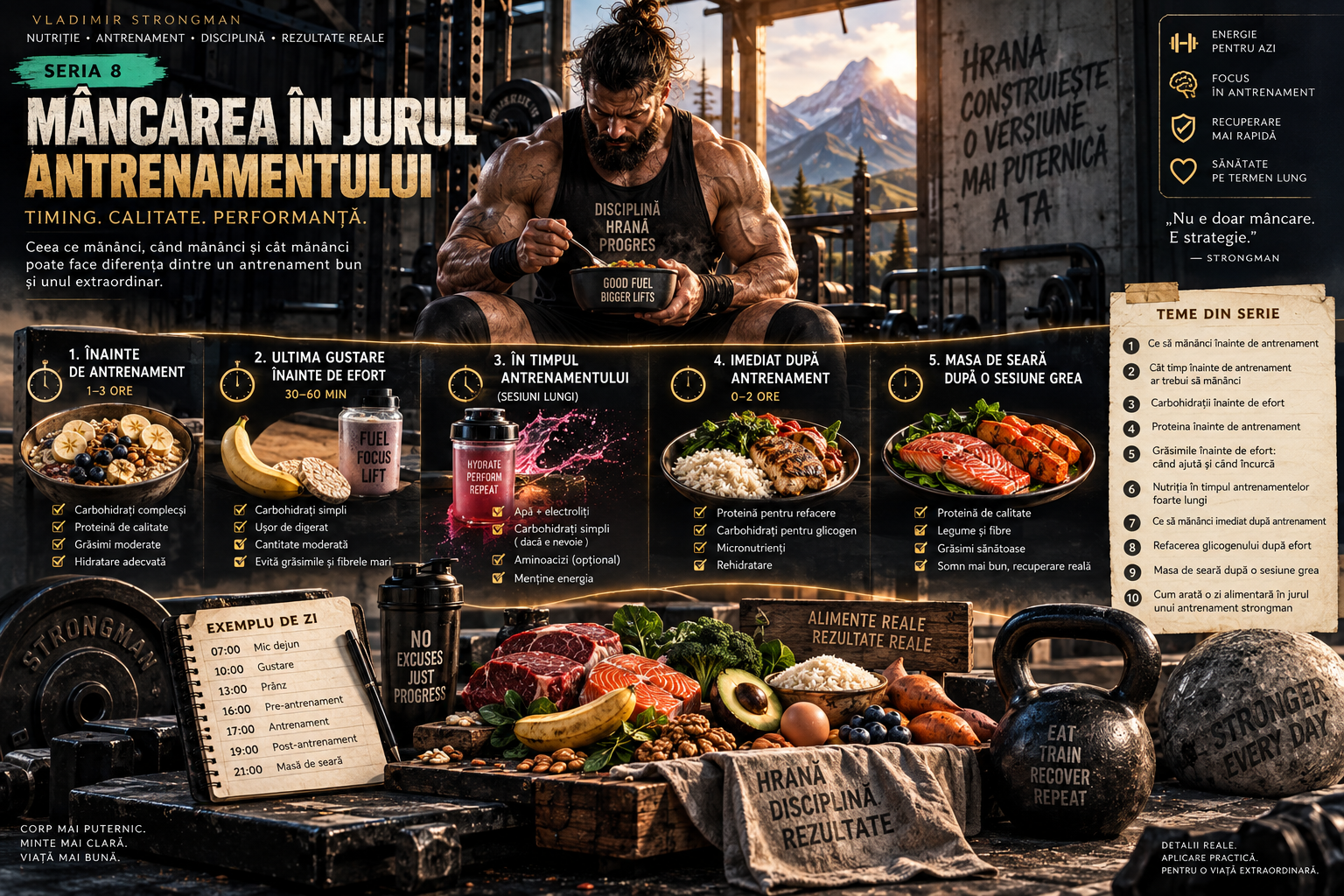
What does a practical day of eating around a strongman workout look like? There is no single correct menu, but there are repeatable principles: enough energy, intelligently distributed protein, carbohydrate concentrated around training, fluids and sodium matched to sweat loss, and meals that do not turn digestion into another event.
Strongman combines maximal strength, repetitions, loaded carries, short high-intensity efforts and sessions that can last well beyond two hours. For that reason, nutrition on a hard training day looks less like a rigid meal plan and more like a fueling system that keeps the engine running without flooding it.
The model below assumes an evening training session and is an adaptable example, not a prescription. Amounts should be adjusted to body size, lean mass, calorie goal, gastrointestinal tolerance, temperature, sweat rate and the athlete's experience [1][2][3].
1. A good day starts with the session goal
Before choosing rice, meat or a shake, you need to know what is coming: one hour of log press does not require the same fueling as three hours of yoke, farmers, sandbag and medleys.
Volume and duration increase glycogen use. Recent systematic evidence shows that resistance exercise significantly reduces muscle glycogen, with greater depletion as set number and session duration increase [4][5].
2. Daily energy is the foundation
An athlete can organize meals around training perfectly and still recover poorly if total daily energy intake is too low. Energy availability influences recovery, endocrine function, sleep and the ability to sustain large training volumes.
In a surplus, meals can be more energy dense; in a deficit, protein and carbohydrate around important sessions deserve priority. Nutrient timing cannot rescue a chronically underfueled day [1][2].
3. Protein is built across the whole day
For most active people, ISSN places useful daily protein intake around 1.4-2.0 g/kg/day, with servings of roughly 20-40 g or about 0.25 g/kg per meal to stimulate muscle protein synthesis [3].
In very heavy athletes, these figures should not be multiplied blindly by total body mass. Lean mass, total intake, digestive tolerance and distribution across 4-6 feedings are more useful than one gigantic protein serving at dinner.
4. Carbohydrate should be periodized to the work
Carbohydrate does not have the same importance every day. A rest day, a heavy-singles day and a three-hour event session can require very different strategies.
Resistance-training literature does not show that more carbohydrate automatically improves every workout, but high-volume sessions, repeated sessions and training after glycogen depletion are the situations where benefit becomes more likely [4][17].
5. Fat matters, but it does not drive the workout
Dietary fat provides energy, essential fatty acids and helps absorb fat-soluble vitamins. It should not be removed from an athlete's day simply because the session is hard.
However, very high-fat meals close to exercise can slow gastric emptying and increase fullness. Therefore, more of the day's fat can sit farther from training, while immediate pre- and post-workout meals can remain easier to digest [1].
6. Hydration starts in the morning
It is inefficient to arrive dehydrated and try to fix everything in the first 20 minutes of training. Hydration for an evening session begins in the morning through regular fluid and food intake.
Needs vary enormously between athletes, temperatures and environments. Guidelines recommend individualizing intake according to sweat rate and body-mass change rather than copying one universal number of liters [6][7][14].
7. Breakfast should not be a test of willpower
For evening training, breakfast does not need to be enormous. It should contribute to daily energy and protein without creating so much fullness that later meals become difficult.
A simple model can combine eggs or dairy, oats or bread, fruit and a moderate fat source. The goal is to begin the day fueled, not to consume half the day's calories before nine o'clock.
8. Breakfast example
A practical example could be oats with milk or yogurt, banana and a little honey, together with eggs; alternatively bread, an omelet, yogurt and fruit. Portions are adjusted to individual needs.
There is no mandatory metabolic advantage to one exact combination. The meal needs to be tolerated, provide protein and carbohydrate, and leave room for later fueling.
9. Lunch builds the base for the evening session
Lunch is often the meal that lets the athlete enter the afternoon with good energy availability without being forced to cram an enormous meal immediately before training.
Rice, potatoes, pasta or bread can provide carbohydrate; lean meat, fish or dairy can provide protein; vegetables and a moderate amount of fat complete the meal.
10. Lunch example
A serving of rice or potatoes with lean meat, cooked vegetables and a little olive oil is boring precisely because it works. For an athlete with high energy needs, the carbohydrate portion can be generous.
If lunch is 5-6 hours before training, it does not need to be extremely low in fiber or fat. Digestive restrictions become more relevant as the session approaches.
11. Main pre-workout meal: 2-4 hours before
For a hard session, a complete meal two to four hours before training is often the most predictable solution. It provides time for digestion and allows a meaningful carbohydrate intake.
Sports-nutrition positions place pre-exercise intake in the context of session duration and intensity; very large per-kilogram recommendations should be adapted for large athletes and gastrointestinal tolerance [1][2].
12. What the pre-workout meal can look like
White rice with chicken or turkey, potatoes with lean fish, pasta with lean meat or cereal with dairy can work. The closer the meal sits to training, the more sensible it is to reduce fat, fiber and heavy sauces.
Protein does not need to be enormous. A serving large enough to count as one of the day's protein feedings, combined with carbohydrate and fluids, is usually more practical than a plate that remains in the stomach during the first yoke run.
13. The 60-90 minute snack
If the main meal was earlier, a small snack can bridge the gap to training. Its role is to top up energy, not to repeat another complete meal.
Banana, white bread with jam, rice cakes, low-fat yogurt, simple cereal or a carbohydrate drink are adaptable examples. The correct choice is the one the stomach tolerates under a lifting belt.
14. Caffeine: performance versus sleep
Caffeine can improve alertness and performance, but evening training creates a timing problem. A dose that helps the first event can still be circulating when you are trying to sleep.
A systematic review in athletes indicates that evening caffeine, especially above roughly 2 mg/kg, can reduce sleep duration and efficiency [18]. For late sessions, dose and timing should be weighed rather than copied automatically from a morning routine.
15. Fluids and sodium before the session
The final hours before training are the time to check whether you have been drinking adequately across the day. Very concentrated urine, persistent thirst and unintended body-mass reduction can suggest that you are entering the session with a deficit.
Sodium in normal meals supports fluid retention. Athletes who sweat heavily, train in heat or leave heavy salt marks on clothing may need a more deliberate strategy [6][14].
16. When water is enough during training
A short session started well fed and well hydrated does not automatically require intra-workout carbohydrate. Sometimes water and normal rest periods are enough.
The benefit of carbohydrate in resistance training appears more likely with high volume, fasting or glycogen depletion and sessions with many sets. Turning every hour in the gym into a sugar infusion is not supported by the evidence [4].
17. When intra-workout carbohydrate becomes useful
For long, dense sessions, roughly 30-60 g carbohydrate per hour is a commonly used sports-nutrition reference, particularly when exercise extends beyond about an hour [2].
In strongman, this can matter during a two- to three-hour session of carries, loading and medleys, where maintaining blood glucose and carbohydrate availability can become more relevant than during a heavy-singles day.
18. The intra-workout drink
A diluted carbohydrate-electrolyte drink can provide fuel and fluid simultaneously. Its advantage is that it can be sipped gradually without the bulk and chewing of solid food.
Concentration must remain tolerable. Very concentrated drinks consumed quickly can increase gastrointestinal discomfort, especially in heat or when events involve running and high abdominal pressure.
19. Sodium during a long session
Sodium should not be prescribed identically to everyone. Sweat sodium concentration and sweat rate vary widely, and recent modeling shows that requirements can differ dramatically between athletes [14].
In practice, duration, temperature, fluid intake and individual losses matter more than chasing one universal number. Overdrinking plain water can be as illogical as ignoring fluids completely [6][14].
20. Solid food during training
In a very long session, some athletes tolerate small amounts of solid food such as bananas, white bread, simple biscuits, rice cakes or low-fat bars.
There is no prize for eating solid food if a drink works better. The goal is to maintain energy without nausea, reflux or the feeling that the sandbag is also sitting inside the stomach.
21. Strongman's special feature: alternating energy systems
A strongman session can alternate a heavy log press with a 20-meter yoke, then farmers, sled work and a medley. This combination repeatedly shifts energetic demand and creates more metabolic fatigue than the short duration of each event might suggest.
Fueling therefore needs to support the whole session, not just the main set. Recovery between events and the ability to repeat effort become as important as peak strength.
22. Immediately after training: context first
If you finish at 20:30 and will eat a full dinner at 21:00, a separate shake is not mandatory. If the trip home is long, appetite is low or the next session is very close, a liquid option becomes practical.
The anabolic window is not a trapdoor that closes after 30 minutes. Still, rapid feeding has value when recovery must be accelerated or when many hours have passed since the previous meal [2][3].
23. Post-workout protein
High-quality protein after exercise supplies amino acids needed for muscle remodeling. For most athletes, roughly 20-40 g is a useful reference, while large athletes may use somewhat larger servings as part of a complete meal [3].
More important than the difference between 35 and 45 g is consuming enough protein across the entire day and distributing feedings reasonably, roughly every 3-4 hours [3].
24. Post-workout carbohydrate
After a high-volume session, carbohydrate supports glycogen restoration. If the next hard effort is only a few hours away, recommendations become aggressive, reaching roughly 1.2 g/kg/hour during very rapid recovery [2][12].
If the next session is the following day, there is no need to turn the first 30 minutes into a race. A carbohydrate-rich dinner and adequate daily intake can restore stores across the night and following day.
25. Rehydration after exercise
If the session produced large sweat losses, recovery does not end with the final repetition. Water, sodium and food work together to restore fluid balance.
When rapid rehydration is required, consuming more fluid than the measured deficit and including sodium can improve retention. When there is no urgency, normal eating and drinking can restore balance gradually [7][13].
26. Dinner is a recovery meal, not a magic ritual
For evening training, dinner can bring together protein, carbohydrate, fluids and some micronutrients missing from the day. It does not need to resemble a bodybuilder meal from an advertisement.
A simple model is a substantial carbohydrate source, high-quality protein, cooked or well-tolerated vegetables and enough fluid. Fat can be present, but a huge amount immediately before bed can make digestion harder.
27. Dinner example
Rice with lean beef, potatoes with fish, pasta with lean meat or a large bowl of rice, eggs and yogurt can work. The choice depends on what you can actually eat after an exhausting session.
If appetite is low, part of the energy can come from liquids: milk, drinkable yogurt or a shake with fruit and ground cereal. Liquid does not mean inferior; sometimes it simply means possible.
28. Pre-sleep protein
Protein consumed before sleep is digested and absorbed overnight and can increase overnight muscle protein synthesis. Studies have frequently used roughly 30-40 g of casein or other protein sources [8][9][10].
However, this is an additional tool. If dinner was protein rich and daily intake is adequate, a pre-bed shake is not mandatory, and acute studies do not show that it guarantees better performance the following day [11].
29. Late training and sleep
A good nutrition day can be undone by poor sleep. Late sessions, caffeine, gigantic meals and reflux can keep an athlete awake long after the muscles have finished working.
The evening strategy must pursue two goals at once: nutritional recovery and the ability to fall asleep. Sometimes splitting dinner into two smaller feedings works better than a feast at 23:00 [18].
30. A calorie-surplus day
During a gaining phase, energy density becomes useful. Oils, dairy, nut butters, bread, cereal and caloric drinks can increase intake without forcing the athlete to eat mountains of bulky food.
However, extra energy can be placed mostly away from the immediate pre-workout period. A high-calorie meal is useful only if it can be digested and repeated consistently.
31. A calorie-deficit day
In a deficit, not every meal can be large. To protect performance, many athletes benefit from moving a larger share of daily carbohydrate toward the hours before and after training.
Protein remains a priority, while bulky micronutrient-rich foods can sit farther from the session. Close to training, digestibility and energy availability carry more weight [3].
32. The 130-150 kg athlete: the scaling problem
A very heavy athlete can generate unrealistic numbers by mechanically applying every per-kilogram recommendation. For example, 4 g carbohydrate/kg in a single meal becomes enormous at 150 kg.
In practice, recommendations must be adjusted according to lean mass, experience, energy expenditure, goal and tolerance. Scientific ranges are starting points, not mathematical orders to execute without context.
33. Training day versus competition day
Training allows experimentation with fiber, quantities and new foods. Competition rewards predictability: familiar foods, tested portions and fluids you already know you tolerate.
A competition can last many hours and include unpredictable gaps between events. Therefore, competition nutrition looks more like fragmented fueling than three traditional meals.
34. Train the gut as well
Gastrointestinal tolerance can improve through practice. If you plan to consume 40-60 g carbohydrate per hour in a hard session, testing that strategy for the first time on competition day is poor planning.
Repeating the same drink, concentration and portions during training lets you observe reflux, bloating or bathroom urgency and adjust before the stakes increase.
35. Fiber and micronutrients need their place
A performance diet should not become a collection of white rice and protein powder. Fruit, vegetables, whole grains, legumes and other nutrient-dense foods remain important for overall health.
The key is distribution: meals farther from training can carry more fiber and variety, while meals close to yoke or deadlift can be simplified for digestive comfort.
36. What is worth avoiding around the session
The worst food is not universal; it is the food you cannot tolerate when you need to perform. For many athletes, very fatty meals, fried food, gigantic salads, alcohol and unfamiliar foods are poor candidates before a hard session.
The issue is not moral and these foods are not inherently forbidden. The issue is predictability: around training, the stomach should be an ally, not a hostile referee.
37. Example timeline for an 18:00 workout
08:00 breakfast; 12:30 lunch; 15:00-15:30 main pre-workout meal; 17:00-17:15 optional snack; 18:00-20:30 training with fluids and, if volume justifies it, carbohydrate; 20:30-21:00 initial recovery; 21:00-21:30 dinner.
If protein or calorie needs have not been met, an easy-to-digest pre-sleep snack can be added around 23:00. The clock shifts with training time; the principles stay the same.
38. Practical formula for a strongman day
Build the day in this order: adequate total energy; distributed protein; carbohydrate matched to volume; hydration started early; digestible pre-workout meal; intra-workout fueling only when the session justifies it; a dinner that restores rather than paralyzes digestion; protected sleep.
A good day is not measured by how spectacular the meals look. It is measured by arriving fueled for the first event, remaining functional for the last, being able to eat after training and waking the next day ready to continue the process.
References / principal sources
[1] Thomas DT, Erdman KA, Burke LM. Nutrition and Athletic Performance. Med Sci Sports Exerc. 2016;48(3):543-568. PMID: 26891166. [2] Kerksick CM et al. International Society of Sports Nutrition position stand: nutrient timing. JISSN. 2017;14:33. PMID: 28919842. [3] Jäger R et al. ISSN Position Stand: protein and exercise. JISSN. 2017;14:20. PMID: 28642676. [4] Henselmans M et al. The Effect of Carbohydrate Intake on Strength and Resistance Training Performance: A Systematic Review. Nutrients. 2022. PMID: 35215506. [5] Acute effects of resistance exercise on skeletal muscle glycogen depletion: systematic review and meta-analysis. PMID: 41420384. [6] Sawka MN et al. ACSM Position Stand: Exercise and Fluid Replacement. Med Sci Sports Exerc. 2007. PMID: 17277604. [7] Fluid and electrolyte needs for training, competition, and recovery. PMID: 22150427. [8] Snijders T et al. Protein ingestion before sleep improves postexercise overnight recovery. Med Sci Sports Exerc. 2012. PMID: 22330017.
[9] Trommelen J, van Loon LJC. The Impact of Pre-sleep Protein Ingestion on the Skeletal Muscle Adaptive Response to Exercise in Humans: An Update. Front Nutr. 2019. PMID: 30895177. [10] Pre-sleep protein and muscle-related outcomes: systematic review. PMID: 32811763. [11] Ormsbee MJ et al. Pre-sleep protein supplementation after evening resistance exercise does not improve next-day performance or recovery. JISSN. 2022. PMID: 35599912. [12] Recovery nutrition: timing and composition after exercise. PMID: 18607220. [13] Post-Exercise Rehydration in Athletes: Effects of Sodium and Carbohydrate. Nutrients. 2023. PMID: 38004153. [14] McCubbin AJ. Modelling sodium requirements of athletes across exercise scenarios. Eur J Sport Sci. 2022. PMID: 35616504. [15] Carbohydrate intake and resistance-based exercise: are current recommendations reflective of actual need? PMID: 27993175. [16] The Impact of Dietary Factors on the Sleep of Athletically Trained Populations: A Systematic Review. Nutrients. 2022. PMID: 36014779. [17] Presleep Whey but Not Casein Protein Ingestion Improves Sleep Quality After Resistance Exercise. Int J Sport Nutr Exerc Metab. 2026. PMID: 42413910.
More From The Journal

Training
The Science of Strongman Training - Episode X: Competition Programming
How to build a complete Strongman competition preparation block: calendar, events, volume, intensity, specificity, simulations, autoregulation, tapering and fatigue management.

Training
The Science of Strongman Training - Episode IX: Peaking
Peaking in Strongman: how to turn months of training into maximal competition performance by reducing fatigue, preserving adaptations and managing specificity.