
Nutrition
Series: Food Around Training - Episode 1: What to Eat Before a Strength Workout
September 11, 2026
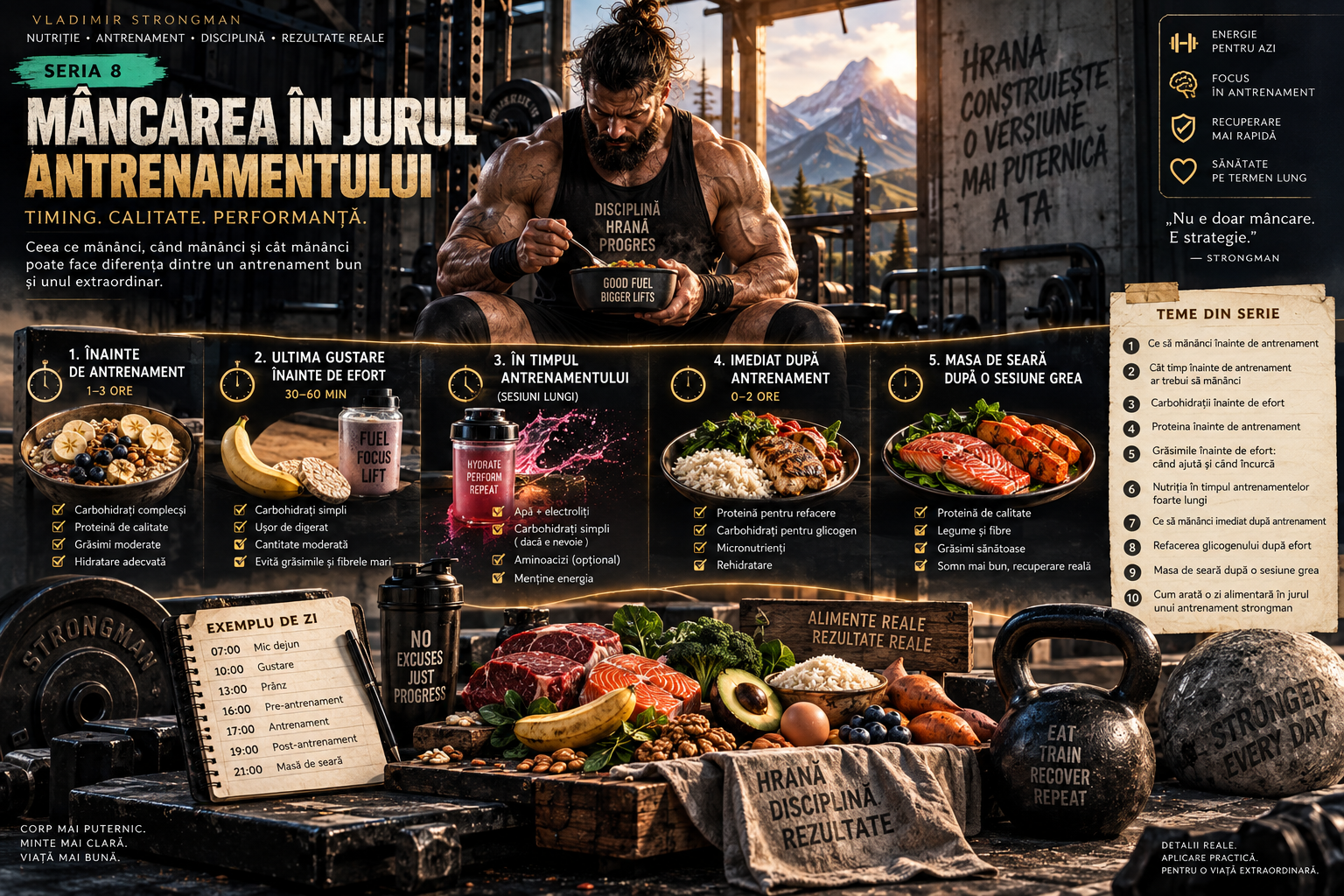
What you eat before strength training does not need to be a magical formula. It needs to provide usable energy, amino acids, fluid and digestive comfort when the session begins.
For a powerlifter, strongman athlete or anyone handling heavy weights, the pre-workout meal should support force production, concentration, repeated sets and tolerance of hard bracing.
There is no single correct menu for everyone. Training time, body mass, session volume, previous meals, calorie goals and digestive tolerance all change the answer.
1. The goal of the pre-workout meal
The meal before training has four simple jobs: limit hunger, provide available carbohydrate, supply enough protein and avoid sitting heavily in the stomach.
A meal that looks perfect on paper but causes nausea, reflux or a painfully full abdomen under a lifting belt is a poor choice for strength training.
2. Timing matters
The larger the meal and the more fat or fiber it contains, the more time it generally needs before training. In practice, complete meals often fit best roughly two to four hours before the session.
As training gets closer, the portion should usually become smaller, simpler and easier to digest.
3. Three to four hours before
This is the window in which a normal meal usually works well: a substantial carbohydrate source, a serving of protein, some fat and a moderate amount of vegetables or other fiber-containing foods.
Rice with lean meat, potatoes with fish or meat, pasta with a protein source, or cereal with dairy can all work well if they are foods you already tolerate.
4. Around two hours before
Two hours before training, the meal can still be solid, but it is useful to keep it less bulky and avoid excessive fat, very heavy sauces and huge fiber loads.
For many athletes, rice or bread with lean protein, yogurt with cereal, or a banana with dairy is more predictable than a very large mixed meal.
5. Sixty to ninety minutes before
When time is short, digestibility becomes more important than the idea of a perfect meal. Easily tolerated carbohydrate and a modest amount of protein are usually enough.
A banana, white bread, rice cakes, low-fat yogurt, a protein shake or a small bowl of cereal can be practical options depending on tolerance.
6. Thirty to forty-five minutes before
In this window you are no longer trying to build a complete meal. You are mainly correcting hunger, hydration or the absence of a quick carbohydrate source.
Fruit, a carbohydrate drink, some diluted juice or a small amount of easy-to-digest food may be more appropriate than meat, high-fat foods or large solid meals.
7. Carbohydrate is the main session fuel
Strength training relies heavily on phosphagen and glycolytic energy systems, while muscle glycogen becomes increasingly important as training volume, set count and session duration rise.
You do not need a dramatic insulin spike. You need enough carbohydrate across the day and, when useful, a pre-workout portion that supports available energy.
8. You do not start from zero at every workout
The pre-workout meal cannot fully compensate for an entire day of under-eating. Glycogen stores and energy availability are also shaped by meals consumed many hours earlier.
If breakfast and lunch were adequate, an evening session may need only a modest top-up. If you arrive after many hours without food, pre-workout needs become more important.
9. How much carbohydrate?
For many strength sessions, a moderate amount is enough. A practical range can be roughly 0.5-1.5 g/kg in the hours before training, adjusted for volume, duration and previous meals.
Very heavy athletes do not need to multiply every recommendation mechanically by total body mass. Digestive tolerance, lean mass, calorie goals and total daily intake matter more than a rigid number.
10. Choose predictable carbohydrate sources
Before training, simple and familiar foods are often more useful than elaborate combinations. Rice, potatoes, bread, cereals, fruit and pasta can all be excellent options.
The glycemic index does not need to become an obsession. Timing, portion size, digestibility and the context of the whole day matter more than labeling a food fast or slow.
11. Protein before training
Pre-workout protein provides circulating amino acids during and after exercise and helps you reach daily protein intake without concentrating everything in the post-workout period.
For many athletes, roughly 20-50 g of high-quality protein in a meal one to three hours before training is sufficient. Very large athletes do not automatically need enormous protein servings at every meal.
12. Protein sources that work well
Lean meat, fish, eggs if tolerated, yogurt, milk, lower-fat cheeses and whey protein are common pre-workout options.
The best choice is the one that supplies enough protein without adding so much volume or fat that digestion becomes slow precisely when you want to move well.
13. Fat: useful, but dose it wisely
Dietary fat is essential, but a very high-fat meal immediately before training can slow gastric emptying and increase the feeling of fullness.
If training is three to four hours away, some fat is usually fine. As the window becomes shorter, reducing fried foods, heavy sauces and large amounts of fat becomes more sensible.
14. Fiber: do not eliminate it, but dose it
Fiber is important for digestive health, but a large amount right before exercise can increase gastric bulk, fermentation and the urge to use the bathroom.
Vegetables, oats and whole grains can stay in the diet, but the immediate pre-workout meal is not the best time to test a huge serving of bran, legumes or raw salad.
15. Hydration begins before the gym
Poor hydration can impair exercise capacity, increase perceived effort and make long sessions harder to tolerate. It is inefficient to arrive dehydrated and try to repair everything after the first set.
Drink fluids regularly in the hours before training and use urine color, thirst, environmental heat and your typical sweat rate as practical clues rather than perfect formulas.
16. Sodium is not automatically the enemy
Athletes who sweat heavily lose sodium, and a normally salted pre-workout meal can help support fluid and electrolyte intake.
Needs differ greatly between individuals. You do not need an aggressive salt protocol for every session, but complete sodium avoidance also makes little sense for a heavy sweater without a medical reason to restrict it.
17. Meal volume and bracing
In strongman and powerlifting, the abdomen must tolerate high pressure under the belt. A very full stomach can make bracing uncomfortable and can worsen reflux during squats, deadlifts, log press or yoke.
Sometimes the problem is not the food itself but the amount. The same intake split into two smaller portions can be much easier to tolerate than one enormous plate.
18. Strongman also demands energy for volume
A strongman session can include pressing, loaded carries, medleys, yoke, farmers and conditioning, creating greater glycogen demand than a session with only a few low-repetition sets and long rest periods.
The longer and denser the session becomes, the more important pre-workout carbohydrate and sometimes intra-workout carbohydrate can become.
19. Early-morning training
If you train soon after waking, you do not have to force down a huge meal. Many athletes feel better with a small snack, fluids and a complete breakfast after training.
A banana, some bread with honey, yogurt, a shake or a carbohydrate drink can be enough for a shorter session, especially if the previous evening meal was adequate.
20. Evening training
For an evening session, performance depends heavily on what you ate all day. Breakfast and lunch build the context, while the pre-workout meal simply finishes the job.
If you reach the gym extremely hungry after a busy day, the problem is not only the 6 p.m. snack. Too much of the day's intake was probably left for the final hours.
21. When you are in a calorie surplus
During mass-gain phases, it is tempting to turn the pre-workout meal into an opportunity to force in many calories. That can backfire if food volume restricts breathing and movement.
It is usually more effective to distribute the surplus across several meals and keep the pre-workout window relatively predictable with foods you digest easily.
22. When you are in a calorie deficit
In a calorie deficit, the pre-workout meal can become one of the most important meals of the day because it helps preserve training quality when total energy is lower.
Many athletes prefer to place a larger share of their daily carbohydrate around training, without this meaning the rest of the day must be completely carbohydrate-free.
23. If your stomach is sensitive
People with reflux, bloating or sensitive bowel habits need more individualization. Very large, fatty, spicy or high-fiber meals may be harder to tolerate before exertion.
Keep a simple record of foods, time to training and symptoms. A few weeks of observation often provide more useful information than changing the menu randomly every day.
24. Coffee and caffeine
Coffee can be part of a pre-workout routine, but its performance effect comes mainly from caffeine rather than from a special property of coffee as a food.
If you use caffeine, consider tolerance, sleep, training time and digestive response. More does not automatically mean more strength, and late doses can impair recovery through poor sleep.
25. What to avoid before a heavy session
Avoid experiments: completely new foods, unusually large portions, excessive fat, huge fiber loads or combinations that you already know cause reflux or cramping.
The pre-workout meal does not need to impress anyone. Repeatability, good digestion and the ability to get under the weight without discomfort are more valuable criteria.
26. The practical formula
Two to three hours before training, build the meal around a carbohydrate source you tolerate, a sufficient protein serving, fluids and moderate fat and fiber; when time is shorter, reduce the portion and simplify the foods. The best pre-workout meal is the one you can repeat, that keeps energy stable and that disappears from your attention when the first set begins.
More From The Journal

Training
The Science of Strongman Training - Episode X: Competition Programming
How to build a complete Strongman competition preparation block: calendar, events, volume, intensity, specificity, simulations, autoregulation, tapering and fatigue management.

Training
The Science of Strongman Training - Episode IX: Peaking
Peaking in Strongman: how to turn months of training into maximal competition performance by reducing fatigue, preserving adaptations and managing specificity.