
Training
Major Strongman Strategy and Tactics - Episode IX: The Final Event and Standings Management
September 2, 2026
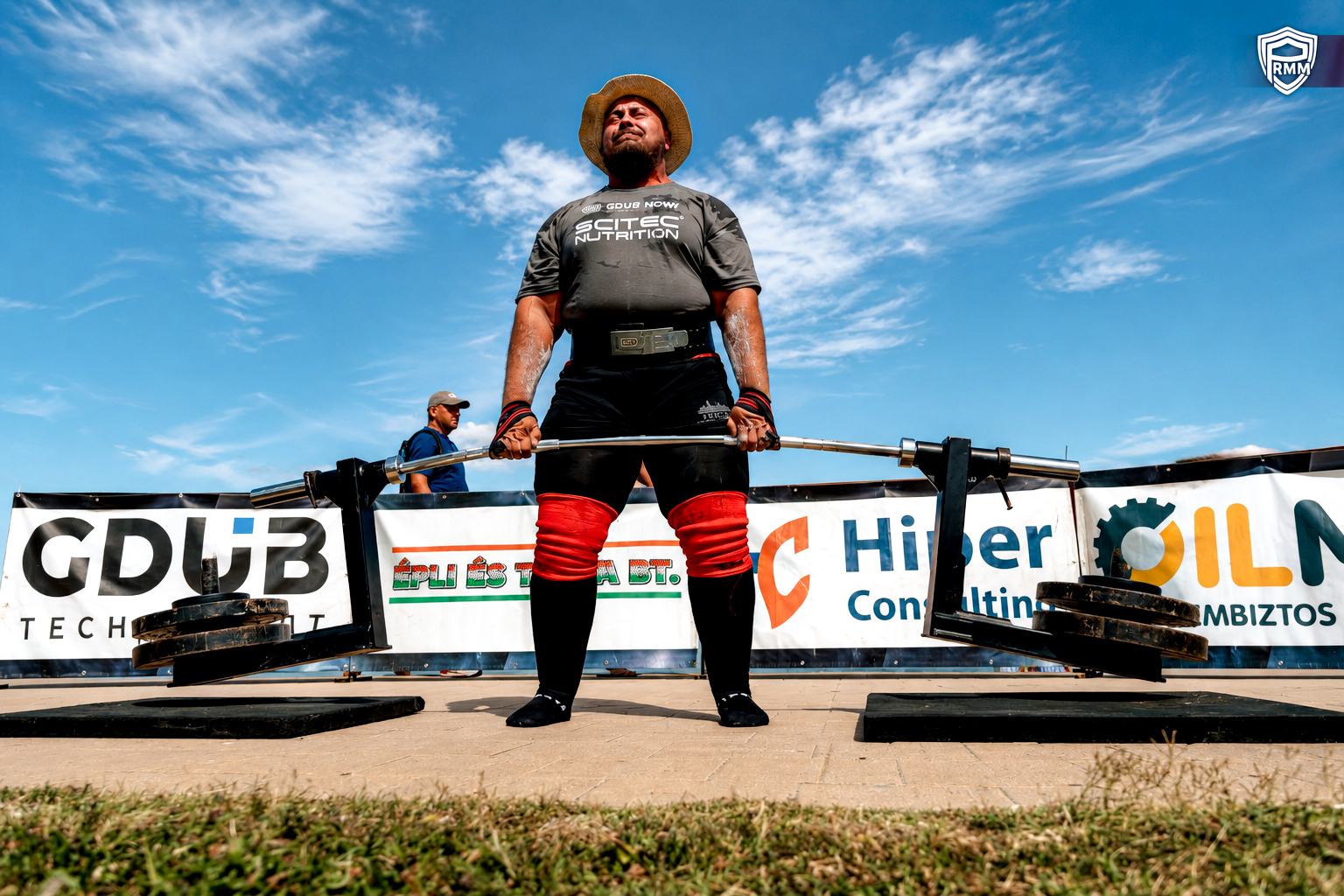
Major Strongman Strategy and Tactics - Episode IX: The Final Event and Standings Management
The final event of a Strongman contest is not simply another event. It is the moment when all previous decisions become a final position, and every repetition, second, meter or load must be interpreted through the standings. At that point, the athlete is no longer competing only for performance. He is competing for the consequence of performance on the final result.
Managing the final event is therefore a decision-making problem under pressure. Pacing research shows that athletes continuously regulate effort according to internal state and the competitive environment, while opponent behavior can alter energy investment. In Strongman, this principle becomes concrete when standings and point gaps are known before the final event.
1. The final event cannot be judged separately from the standings
In earlier events you can focus on a raw result: weight, distance, time or repetitions. In the final event you must track two results simultaneously: the event result and the contest result. A better performance is not automatically a better decision if it does not change the final position or if it introduces disproportionate risk.
The first question before the final event is therefore not “How much can I do?” but “What do I need to do for my objective?”
2. The standings become the dashboard
Before the start you should know at least four things: current position, gap to the direct opponent, number of points available in the final event and which outcomes actually change the standings. Without these data, the decision is incomplete.
Turn the standings from a list of positions into a map of scenarios. If you lead, ask how low you can finish without losing the win. If you are the pursuer, ask what result is needed to close the gap. If you are fighting for the podium, identify the exact threshold that moves you into the next position.
3. The point gap matters more than the position
Position tells you where you are. The point gap tells you how vulnerable that position is. A leader with a large advantage may only need a safe performance. A leader with a minimal advantage may be forced to attack. Third place one point behind second is completely different from third place ten points behind second.
Standings management therefore begins with calculating the gap, not reacting emotionally to the position.
4. Calculate the minimum required threshold
The minimum threshold is the result that allows you to achieve your objective without taking more risk than necessary. For a leader it may be fifth place. For a pursuer it may require a win. For an athlete chasing the podium it may simply require finishing ahead of one direct opponent.
This is one of the most important concepts of the final event: you do not always need maximum performance. You need sufficient performance for the desired outcome.
5. The leader and the pursuer do not have the same problem
The leader has to protect. The pursuer has to recover. This completely changes the risk-benefit relationship.
If the leader has a sufficiently large advantage, unnecessary attacking can turn a likely win into a vulnerable result. If the pursuer is behind by a gap that cannot be recovered through conservative performance, conservation may be equivalent to accepting defeat. For the pursuer, calculated risk can become necessary.
6. The final event increases the value of information
Before the final event you already have information accumulated across the contest: actual opponent level, your grip condition, fatigue, technical quality, recovery capacity and how others have responded to pressure. This information must be integrated into the final decision.
A plan made before the contest should not be treated as a contract. It is a hypothesis. After eight events, the hypothesis must be recalibrated using real data.
7. When the direct opponent goes before you
If the direct opponent competes before you, his performance can reduce uncertainty. But you should not automatically copy what he does. The question is: “What result do I still need after his performance?”
If he performs below your estimate, a conservation opportunity may appear. If he performs above it, the threshold must be recalculated. Research on direct competition shows that the competitive environment changes pacing decisions, but the response depends on the competitive situation and the athlete's internal state.
8. When the direct opponent goes after you
This is more difficult because you must choose without knowing his final result. Probability becomes important. If you are leading and need only a moderate performance to remain ahead in most realistic scenarios, there is little reason to assume the worst case and attack without limit.
If you are the pursuer, however, and the leader needs only a modest result to remain ahead, you may need to accept a higher level of risk. The key is to attack the part of the performance distribution that can actually change the standings.
9. The final event and the all-or-nothing trap
The final event can create a dangerous temptation: the idea that you must give everything because “nothing comes after this.” Physically, there may be no later event. Strategically, however, the outcome of this event matters enormously.
An all-out attack makes sense when only an extreme result can change your position and the probability of success justifies the risk. It makes little sense when a safe result is already enough for the objective.
10. Do not confuse the final event with the final maximal effort
This distinction is essential. The final event may require maximum strategic effort without requiring maximum physical effort. Sometimes the best execution is controlled, technically clean and free of unnecessary extra attempts.
Pacing is described in sports literature as continuous decision-making about resource investment. In competition, position and opponent behavior can alter that investment. This is directly relevant to final-event Strongman strategy.
11. Energy management all the way to the final event
The final event actually begins much earlier. If earlier events were attacked unnecessarily for wins that did not change the standings, you arrive at the final event with less capacity to execute the strategy you need. Final-event management is therefore also the result of whole-contest management.
Immediate preparation should follow what you know works for you. Strongman-specific research shows that athletes use competition warm-ups and cognitive preparation strategies, with these routines commonly practiced during training.
12. The final event can be a defensive event
If you are leading with an advantage, the final event may become an event for defending the standings. This does not mean fear or lack of ambition. It means the objective has changed from accumulating points to preserving a sufficient position.
Defensive strategy can mean selecting a secure load, avoiding an unnecessary extra attempt or maintaining a pace that minimizes the chance of technical error.
13. The final event can also be an attacking event
For a pursuer, the final event may be the last opportunity. If the gap is large and cannot be closed through an average performance, the athlete must identify the point at which additional risk becomes justified.
The attack should be built on probability, not desperation. If you need a result that you can produce in roughly one out of two realistic scenarios, that may be a calculable risk. If you need a performance you have almost never produced, recognize that the strategy is a last-chance scenario rather than a normal-probability strategy.
14. Scenario A, leader with a comfortable advantage
Suppose the leader has 58 points and second place has 52. The final event offers a maximum of 10 points. If fourth place is enough to preserve the lead in realistic scenarios, the leader has little reason to chase the event win. The strategy becomes securing the final result.
In this case, an additional heavy attempt made only to win the event may have little competitive value and unnecessary risk.
15. Scenario B, leader with a minimal advantage
If the leader has only a one-point advantage, the situation changes dramatically. A poor result may allow the direct opponent to overtake. Excessive conservation can therefore be as dangerous as unnecessary attacking.
The optimal strategy may become a safe performance followed by a conditional decision. If intermediate outcomes are favorable, stay in the safe zone. If the opponent produces a result that changes the threshold, adjust.
16. Scenario C, the pursuer needs the win
If the pursuer is five points behind the leader and only a win in the final event can close the gap, the objective is clear. A good performance is no longer enough. The athlete must maximize the probability of a result that produces sufficient points.
In this situation, accepting greater risk can be rational. But the risk should be directed toward the action that actually changes the standings, not toward a personal record with little value in the scoring equation.
17. Scenario D, the podium battle
A podium battle can be more complicated than a fight for first because several opponents may matter simultaneously. If second, third and fourth are close, multiple possible outcomes must be monitored.
A useful approach is to build three thresholds: the result that protects your current position, the result that moves you up one place and the maximum realistic result. Each threshold should be linked to probability and cost.
18. The final event and psychological pressure
Pressure changes when every outcome can close or reopen the standings. The natural tendency is to overestimate the consequences of an error and increase intensity to eliminate uncertainty. Competitive research shows that the competitive environment modifies pacing and decision-making, meaning pressure should be included in the plan rather than allowed to control it.
19. The rule: do not change what does not need changing
If the final event is one you have executed dozens of times in training, this is not the moment to reinvent technique. If your warm-up works, do not turn it into an extra workout. If you have an efficient pace, do not change it simply because the opponent is faster.
At the end of a contest, consistency becomes a weapon. You do not need a new version of yourself. You need the version of yourself that executes what the situation requires.
20. Final model: Secure, Attack, Recalculate
Secure: identify the result that protects your objective. Attack: identify the point at which additional risk can create a real change in the standings. Recalculate: after every relevant piece of information, check the gap and required threshold again.
This model is simple but powerful because it prevents two opposite errors: unnecessary conservation and unnecessary attacking.
21. The Failure Point of the final event
The Failure Point appears when the strategic objective is replaced by an emotional objective. For the leader it may be “I have to win the final event.” For the pursuer it may be “I have to do something crazy.” For a podium athlete it may be “I cannot finish lower.”
In reality, the final event should be treated like every other decision: what do I gain, what do I lose, what is the probability, what does it cost and which result actually changes the standings?
22. Conclusion: the final event is not about how much you can still do, but how much you need to do
A Strongman contest can be decided in the final event, but final-event strategy is built from everything that happened before it. The standings are the central information. The point gap is the problem. Opponents are the variables. Physical capacity is the resource. Decision-making is the tool that turns all of these into an outcome.
The leader must know when enough is enough. The pursuer must know when risk becomes necessary. The athlete between two positions must know exactly which threshold changes the result. In every case, the final event should not be driven by the instinct to do more, but by the clarity to do exactly what the contest requires.
True tactical performance is not finishing the contest with the biggest possible execution. It is finishing with the best possible result for the situation you are in.
Selected references
1. Konings MJ, Hettinga FJ. Pacing Decision Making in Sport and the Effects of Interpersonal Competition: A Critical Review. Sports Med. 2018;48(8):1829-1843. DOI: 10.1007/s40279-018-0937-x.
2. Smits BLM, Pepping GJ, Hettinga FJ. Pacing and decision making in sport and exercise: the roles of perception and action in the regulation of exercise intensity. Sports Med. 2014;44(6):763-775. DOI: 10.1007/s40279-014-0163-0.
3. Konings MJ, Hettinga FJ. The Impact of Different Competitive Environments on Pacing and Performance. Int J Sports Physiol Perform. 2018;13(6):701-708. DOI: 10.1123/ijspp.2017-0407.
4. Winwood PW, Pritchard HJ, Wilson D, Dudson M, Keogh JWL. The Competition-Day Preparation Strategies of Strongman Athletes. J Strength Cond Res. 2019;33(9):2308-2320. DOI: 10.1519/JSC.0000000000003267.
More From The Journal

Training
The Science of Strongman Training - Episode X: Competition Programming
How to build a complete Strongman competition preparation block: calendar, events, volume, intensity, specificity, simulations, autoregulation, tapering and fatigue management.
Training
The Science of Strongman Training - Episode IX: Peaking
Peaking in Strongman: how to turn months of training into maximal competition performance by reducing fatigue, preserving adaptations and managing specificity.