
Physiology
The Strongman Laboratory: What We Can Learn About an Athlete from Inside the Body - Episode 9: Inflammation and Recovery Markers
September 7, 2026
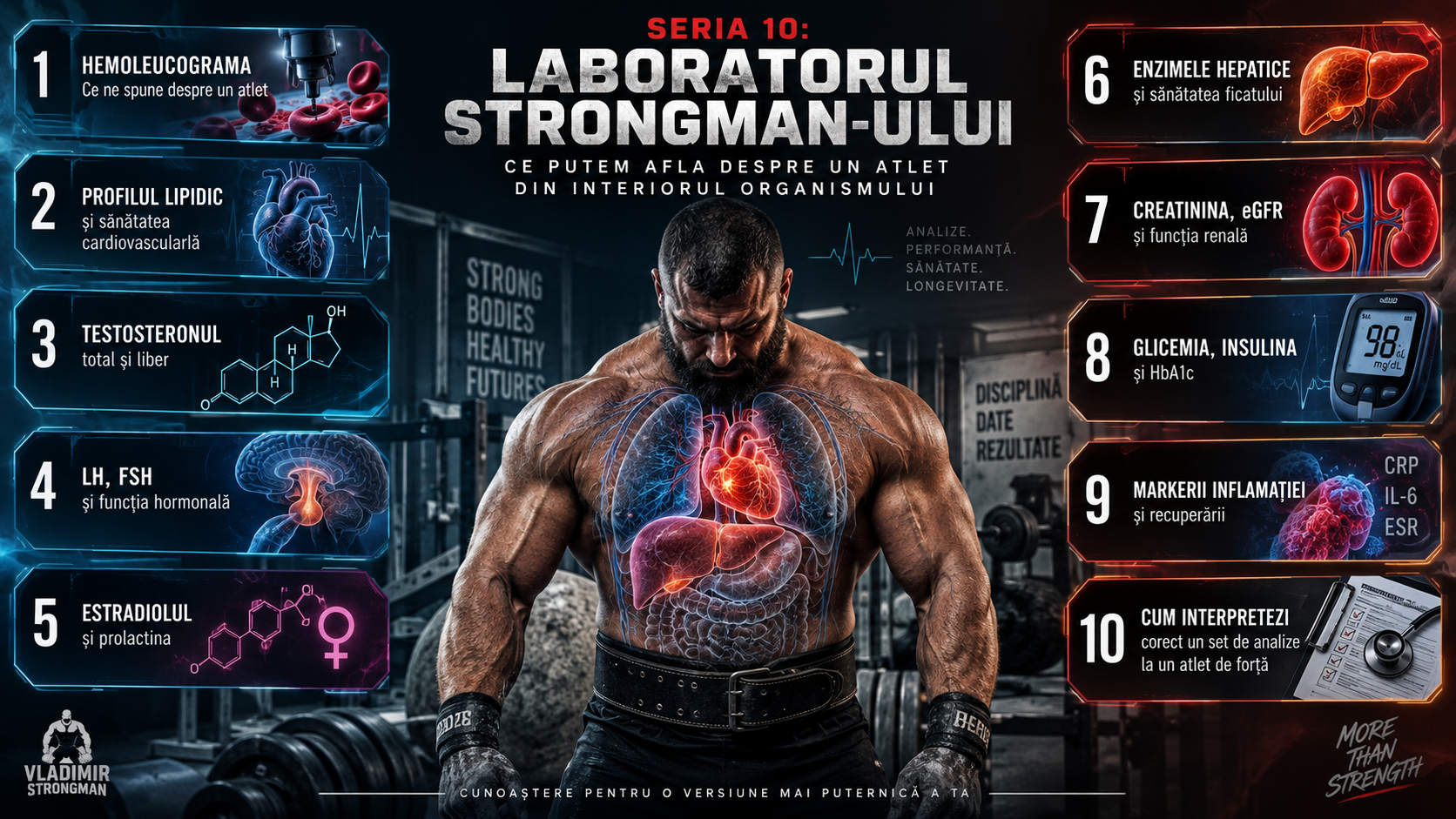
1. Inflammation is not synonymous with disease
In sports physiology, inflammation has two faces. It can be part of a normal response to mechanical, metabolic, or infectious stress, but it can also signal a problem that deserves evaluation. For a strongman, that distinction is essential because hard training creates genuine tissue stress, and blood markers may reflect part of repair and adaptation. Inflammatory biomarkers should not be reduced to a simple rule where lower is always better. Recent work on exercise biomarkers emphasizes that interpretation depends on exercise intensity, sampling time, individual baseline, and physiologic context.
2. What an inflammatory response actually means
The inflammatory response is a network of signals and cells that detects tissue stress and coordinates repair and adaptation. During and after exercise, muscle is not simply torn apart and mechanically repaired. There are local signals, permeability changes, immune-cell mobilization, and release of mediators such as interleukins. Part of this response is necessary for adaptation. The right question is not whether inflammation exists, but whether the response is disproportionate, persistent, or occurring in a context that can no longer be reasonably explained by training.
3. CRP: one of the best-known markers
C-reactive protein, CRP, is an acute-phase protein produced mainly by the liver in response to inflammatory signals. In medicine it helps assess the presence and trajectory of inflammation, but it does not identify the cause by itself. CRP can rise with infection, injury, and other inflammatory processes. In sport, sampling time is important because exercise can temporarily alter inflammatory biomarkers.
4. CRP does not directly measure how recovered you are
One of the most common mistakes is using CRP as a universal recovery meter. Normal CRP does not prove that the neuromuscular system is fully recovered, while mildly elevated CRP does not prove that the athlete is unrecovered. Recovery includes muscle function, fatigue perception, sleep, performance, energy availability, and general condition. Biomarkers complement the picture rather than replacing it.
5. hs-CRP and CRP: same family, different questions
CRP and hs-CRP refer to the same protein, but sensitivity and common applications differ. hs-CRP is often used in cardiovascular risk assessment at low inflammation levels, whereas standard CRP is more commonly used for more evident inflammatory responses. Athletes should not compare results from different methods without checking method and context.
6. ESR: a slower, indirect marker
Erythrocyte sedimentation rate, ESR, is an indirect inflammation marker. It is influenced by inflammation but also by hematologic factors, plasma proteins, and other conditions. It generally changes more slowly than CRP. This makes it less suited to very rapid post-exercise monitoring and means it should be interpreted alongside the broader clinical picture.
7. Why CRP and ESR can disagree
CRP can be relatively normal while ESR is elevated, or the reverse. That does not automatically mean one test is wrong. The two tests respond differently to inflammatory processes and are influenced by different variables. When they disagree, return to the clinical question and the rest of the data.
8. Fibrinogen: more than coagulation
Fibrinogen is a key coagulation protein and can also increase as an acute-phase reactant. It can add context to an inflammatory profile, but it is not specific to one cause. Its meaning belongs with the clinical picture and the other findings.
9. White blood cells: a dynamic population
Total white blood cells and the differential provide information about immune-cell populations. Intensive exercise can produce transient changes in white-cell counts, including an increase immediately after exercise. This should not automatically be labeled infection. Exercise studies show that leukocyte and cytokine responses depend on intensity and sampling time.
10. Neutrophils
Neutrophils can rise as part of the physiologic stress response to exercise, but they can also increase in infection and other inflammatory processes. An isolated neutrophilia after hard training is not the same as persistent neutrophilia accompanied by fever, respiratory symptoms, or other abnormalities. Clinical context determines how much weight the result deserves.
11. Lymphocytes
Lymphocytes also change with exercise, stress, and immune status. A mildly low or high count should be interpreted with the complete differential and the athlete's context. Ratios between leukocyte populations can be informative in research, but no such metric is sufficient to diagnose so-called immune fatigue.
12. The neutrophil-to-lymphocyte ratio
The neutrophil-to-lymphocyte ratio, NLR, has been studied as an integrative marker of stress and inflammation. Exercise research suggests it can reflect mobilization of different leukocyte populations, but there is no universal cutoff that tells a strongman whether he is recovered or unrecovered. Such biomarkers appear more useful when combined with functional measures.
13. IL-6: an important exercise cytokine
Interleukin-6, IL-6, is produced in part by skeletal muscle during exercise and participates in communication between metabolism and the immune system. It can rise after exercise, with the response depending on dose, duration, intensity, and tissues involved. An acute post-exercise rise is not automatically pathologic.
14. IL-6 is not the bad molecule
Cytokines have context-dependent roles. During exercise, IL-6 can participate in substrate mobilization and coordination of the post-exercise response. In other settings, persistently elevated levels may be part of an unfavorable inflammatory or metabolic environment. Duration and context matter more than the simple existence of the molecule.
15. CK: the marker strongmen often see
Creatine kinase, CK, enters the circulation when muscle is stressed or injured. In strength sports it can rise after very demanding training, especially after novel exercises, substantial eccentric loading, or high volume. CK is useful, but it should be interpreted against what the athlete actually did in the preceding days.
16. High CK does not automatically mean rhabdomyolysis
CK can rise after intense exercise without a medical emergency. Rhabdomyolysis is a clinical context in which muscle breakdown is more substantial and may occur with severe pain, weakness, swelling, or dark urine. A very high value accompanied by compatible symptoms requires prompt medical assessment. There is no safe interpretation based on the CK number alone.
17. LDH: another non-specific marker
Lactate dehydrogenase, LDH, is found in many tissues. It can rise with tissue injury, including after exercise, but it cannot identify the source by itself. In a strongman, LDH should be correlated with CK, AST, ALT, and training history. A non-specific marker becomes useful when it fits a coherent pattern.
18. Myoglobin
Myoglobin can rise when muscle proteins enter the blood, including after significant muscle injury. It is cleared by the kidneys and can be relevant in selected acute situations, but it is not a routine recovery marker. When severe muscle injury is suspected, the clinician decides what combination of testing is appropriate.
19. Muscle inflammation and systemic inflammation are not the same thing
A predominantly muscular inflammatory response can occur after exercise without severe systemic inflammation. Exercise studies show that circulating biomarkers can have different trajectories and do not perfectly represent every tissue compartment. This is why the simplistic conclusion that a rise in CRP means the whole body is inflamed is unreliable.
20. DOMS and blood tests
Delayed-onset muscle soreness, DOMS, is a functional and sensory experience. CK, CRP, IL-6, and other biomarkers can have different trajectories from perceived soreness. A meta-analysis of post-exercise recovery techniques showed that reductions in inflammatory or muscle-damage markers are not identical to improvement across every component of recovery.
21. Why sampling time changes everything
The same test can look different at 30 minutes, 12 hours, 24 hours, or 72 hours after hard training. Studies with repeated post-exercise sampling show distinct time courses for CK, IL-6, CRP, leukocytes, and functional markers. For monitoring, collection time and the interval since the last hard session should be recorded.
22. Eccentric loading can produce a larger signal
Eccentric loading, unfamiliar exercises, and high mechanical stress can produce larger muscle-damage responses and changes in some inflammatory markers. That does not automatically mean the session was too much. Adaptation emerges from the interaction between stimulus and response. The problem is chronic mismatch between training load and recovery.
23. Repeated exercise changes the response
An adapted athlete can respond differently to a familiar session than to a novel stimulus. In trained athletes, muscle-damage and inflammatory markers still varied after exercise, while DOMS was more attenuated with repeated exposure. Training history matters, but it does not eliminate the biological response.
More From The Journal

Training
The Science of Strongman Training - Episode X: Competition Programming
How to build a complete Strongman competition preparation block: calendar, events, volume, intensity, specificity, simulations, autoregulation, tapering and fatigue management.
Training
The Science of Strongman Training - Episode IX: Peaking
Peaking in Strongman: how to turn months of training into maximal competition performance by reducing fatigue, preserving adaptations and managing specificity.